

Lift sling rigging company produce Fireproof Endless Type Round Sling,Fireproof Eye Round Sling,Fire Retardant/Fire Resistant Round Sling,Fireproof sling,Fireproof and Wear-resistant Lifting Sling,Fireproof Type Textile Sling.
Fireproof Endless Type Round Sling
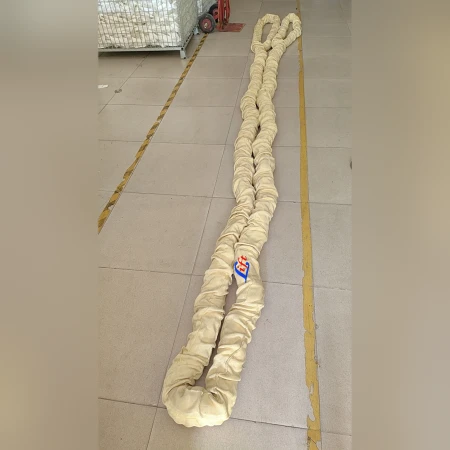
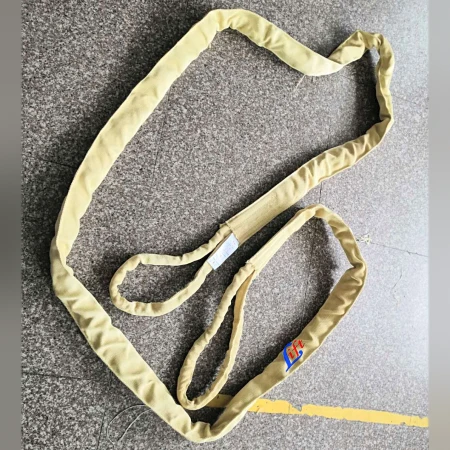
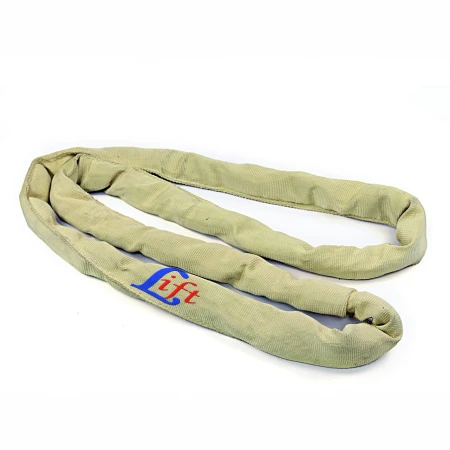
A fireproof endless type round sling is a closed loop of high-tenacity filament inside a flame-retardant woven sleeve, built so that it resists ignition, stops burning when the flame or spark source is removed, and does not drip molten polymer onto the load or the floor. The endless form matters in hot work: there is no eye, no thimble and no stitching in the load path, so the whole circumference can be turned to face the hazard and the bearing point can be moved instead of retired. The RK01 series on this page runs from 1 t ki 20 t in eleven steps, 1.5 m ki 80 m, in FR polyester or para-aramid.
1. He aha “fireproof” means on a sling, me te mea kaore e mahia
Three different claims get sold as fireproof, and only the first two are properties of the sling. The third is a property of the test.
It does not sustain combustion. Once the ignition source leaves, the material stops burning. That is what a limiting oxygen index above 28 buys you: the fibre needs more oxygen than the air around it contains to keep a flame going. Ordinary polyester sits near 20-21 and will keep burning in air.
It does not melt and drip. Polyester softens and melts around 250-260 °C; aramid has no melting point and chars instead. A burning drip is worse than a flame in a workshop, because it lands on whatever is underneath and it takes the sling’s strength with it.
It is not a fire barrier. No textile sling is rated like a fire door. “Fireproof” here means it will survive the sparks, slag and spatter of hot work and can be pulled out of a brief flame, not that it can be left in a fire, used as a heat shield, or immersed in molten metal. Those are different products and different tests.
2. Hangahanga: where the fire protection sits
The load path is a parallel bundle of filament running the full circumference inside a woven tube. The sleeve carries no load. Ka mau te abrasion, the sparks, the slag and the sunlight — and on a fireproof build it is also where most of the flame protection is put, because the sleeve is the part that meets the hazard and the part that can be replaced.
That gives three practical builds:
| Hanga | Core | ringaringa | Te wahi e pai ai |
|---|---|---|---|
| FR polyester throughout | Ko te polyester tino kaha te mura o te mura | FR polyester, paparanga kotahi, takirua ranei | Sparks, kotiiri fehokotaki'anga, slag and brief flame at normal workshop temperature. The economical answer, and the one most hot-work shops actually need. |
| FR sleeve over standard core | Standard high-tenacity polyester | FR polyester or aramid | The same hazards, with the protection concentrated where the sparks land. Costs less than an FR core and is replaced as a sleeve when it is burnt through. |
| Aramid core and sleeve | Para-aramid (Kevlar-akomanga) | Raranga aramid, aramid plus glass on the hot side | Where the sling also touches the hot workpiece: foundry moulds, hot rolls, dies and castings. Karekau he ira whakarewa, and the fibre keeps its strength at temperatures that destroy polyester. |
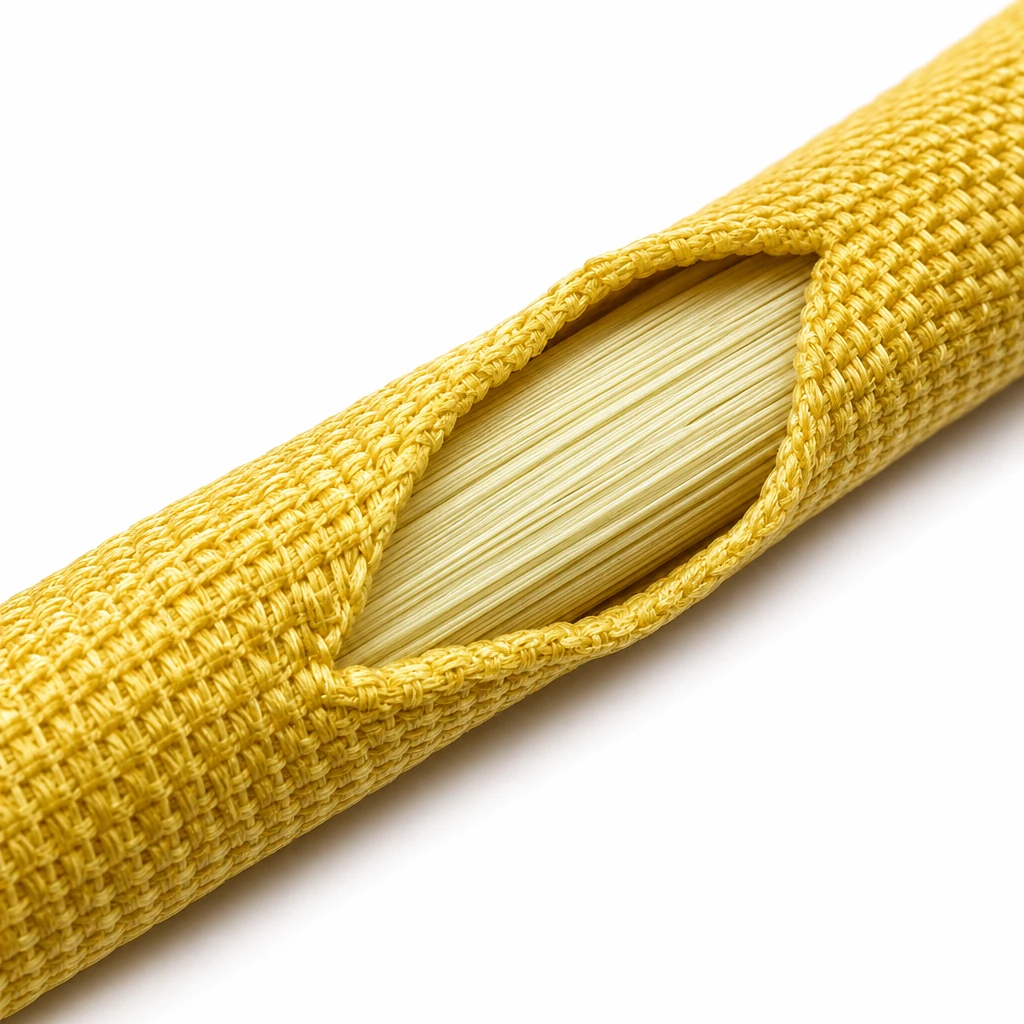
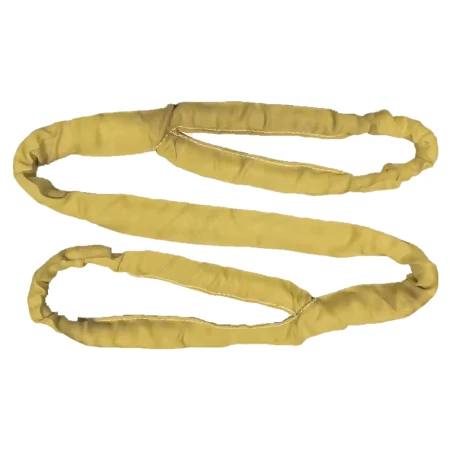
Two details decide how a fireproof sling behaves in service, and neither is visible in a photograph. The first is sleeve fit: a sleeve that can slide lets you move the burnt patch away from the bearing line and keep working, while a tight sleeve concentrates every spark in the same place. The second is where the sleeve is doubled. On the RK01 sizes above 10 t the sleeve is normally doubled over the length that will bear on the load, because that is where contact pressure and heat arrive together.
3. Fire performance: the figures to ask for
Fire performance on a textile sling is a set of measured behaviours, not a single badge. These are the four that decide whether a build is worth the premium, with the test each one comes from and what it means on the shop floor.
| Taonga | Whakamatau | FR polyester build | Para-aramid build | He aha te tikanga |
|---|---|---|---|---|
| Te whakawhāiti i te taupū hāora (LOI) | ISO 4589-2 | 28 and above | Approx. 29, untreated | Kei raro mo 26 the material keeps burning in air. 28 and above is the working threshold for self-extinguishing. |
| Ignition and flame spread | ISO 6941 / EN ISO 15025 | Self-extinguishing after removal of the flame | Te tinei i a koe ano; chars rather than burns | The sling stops contributing once the spark shower stops, instead of carrying a flame along the body. |
| Afterflame time | ISO 6941 | Tikanga 2 s or less | Tikanga 2 s or less | How long the material keeps burning after the igniter is withdrawn. Short afterflame is what keeps a small burn from becoming a burnt-through sleeve. |
| Behaviour at temperature | — | Softens near 250-260 °C; FR treatment delays ignition, it does not raise the melting point | Karekau he ira whakarewa; chars and decomposes near 500 °C | This is the row that separates fireproof from heat resistant. An FR polyester sling self-extinguishes and is still limited to about 90 °C in contact. |
| Burning drip | Ataata, per ISO 6941 | No burning drip in the FR build | None — the fibre does not melt | A drip takes the flame to the floor and to whatever is underneath, and it is the failure mode that ends a sling’s life in one event. |
Read the LOI row together with the temperature row, because they answer different questions and buyers routinely buy one while needing the other. An FR polyester sling with an LOI of 30 will shrug off a welding spark and then lose strength against a 120 °C billet, and an aramid sling that survives the billet will still be damaged by a sustained flame at the same spot. Neither is “more fireproof” than the other; they fail at different things.
4. Tawhā Hangarau: the RK01 series
The dimensional series below is the working table for this product. It gives, for each article number, the vertical working load limit, the approximate body thickness and width, the length range and the unit weight — which is the figure that decides whether the sling can be carried up a ladder and how much a 20 m body weighs on the hook.
| Art.No. | WLL (kg) | Approx. matotoru (mm) | Approx. whanui (mm) | Min length (m) | Max length (m) | Taumaha (kg/m) |
|---|---|---|---|---|---|---|
| RK01-01 | 1,000 | 4 | 30 | 1.5 | 80 | 0.28 |
| RK01-02 | 2,000 | 5 | 40 | 1.5 | 80 | 0.42 |
| RK01-03 | 3,000 | 6 | 50 | 1.5 | 80 | 0.50 |
| RK01-04 | 4,000 | 7 | 60 | 1.5 | 80 | 0.56 |
| RK01-05 | 5,000 | 8 | 70 | 1.5 | 80 | 0.60 |
| RK01-06 | 6,000 | 9 | 75 | 2.0 | 80 | 0.70 |
| RK01-08 | 8,000 | 11 | 80 | 2.0 | 80 | 0.80 |
| RK01-10 | 10,000 | 13 | 90 | 2.0 | 80 | 1.50 |
| RK01-12 | 12,000 | 14 | 100 | 3.0 | 80 | 2.24 |
| RK01-15 | 15,000 | 16 | 110 | 3.0 | 80 | 2.66 |
| RK01-20 | 20,000 | 18 | 125 | 3.0 | 80 | 3.64 |
Dimensions from the RK01 specification sheet, reproduced unchanged. Weight is quoted per metre of body, na a 5 t kotaha i 6 m effective length is about 7.2 kg before packing. Capacities above 20 t are built to order on the same construction; te kotaha porotaka mutunga kore para-aramid range runs to 100 t.
| Hua | Fireproof endless type round sling, also supplied as fireproof round sling, flame retardant round sling and fire resistant lifting sling |
|---|---|
| Hangahanga | Ko te uho kakawaua whakarara tonu i roto i te karekau ngongo raranga, closed into an endless loop — no eyes, kahore he taputapu, karekau he tuitui i te ara uta |
| Core options | Ko te polyester tino kaha te mura o te mura (paerewa); para-aramid (Kevlar-akomanga) for hot contact |
| Sleeve options | FR polyester, paparanga kotahi, takirua ranei; woven aramid; aramid with a glass outer layer for the hottest bearing points |
| Te rohe kawenga mahi | 1 t ki 20 t in the RK01 series (1,000-20,000 kg); 100 t ki te ota |
| Te take haumaru | 7:1 hei mahi paerewa. The RK01 sheet carries a 6:1 notation in its weight column, so state the factor your market requires on the order and the sling is built and marked to that figure |
| Te roa whai hua | 1.5 m ki 80 m per the series; roa i runga i te tono, quoted individually |
| Flame performance | LOI 28 and above, te tinei i a koe ano, no burning drip (FR build); aramid chars without melting |
| Te pāmahana ratonga | FR polyester approximately -40 °C ki +90 °C; para-aramid build approximately 200-300 °C i te atanga sling/load, teitei ake nga haerenga poto |
| Tae | Natural khaki or golden as standard; capacity colour code on request where the sleeve is not the FR build |
| Te tohu | Tuia te tapanga me te rohe kawenga mahi, roa whai hua, batch and standard; karekau taia tohu tohu hei whiriwhiri |
| Paerewa | IN 1492-2 construction practice for the polyester build; aramid sits outside the fibre list of that standard and is rated as a manufacturer specification |
| Whakamatau | Kua utaina he tohu i mua i te tuku, with the test record matched to the serial on the label |
| Te takai | Porohia ki roto i te putea poly, kātene tapaina; pallet, pouaka ranei i runga i te tono |
| MOQ me te OEM | MOQ iti mo te ota whakamatautau; OEM i runga i te roa, sleeve colour and build, printing, tahora tapanga me te takai |
| Waehere HS | 630790 — lifting slings of textile materials |
5. Capacity depends on the hitch, not on the sleeve
The figure on the label is the vertical rating of a single leg. Every other arrangement multiplies it, and on a fireproof sling the multiplication is what decides whether you can pick the load with the size you have or need the next one up.
| Whakaritenga | Tauwehe | 5 t kotaha | 10 t kotaha | 20 t kotaha |
|---|---|---|---|---|
| Kotahi waewae, poutū | 1.0 | 5.0 t | 10.0 t | 20.0 t |
| Kotahi waewae, kowaowaotia | 0.8 | 4.0 t | 8.0 t | 16.0 t |
| kete, 0-7° | 2.0 | 10.0 t | 20.0 t | 40.0 t |
| kete, 7-45° | 1.4 | 7.0 t | 14.0 t | 28.0 t |
| kete, 45-60° | 1.0 | 5.0 t | 10.0 t | 20.0 t |
| E rua nga waewae, 0-45° from vertical | 1.4 | 7.0 t | 14.0 t | 28.0 t |
| E wha nga waewae, 0-45° from vertical | 2.1 | 10.5 t | 21.0 t | 42.0 t |
Two points catch most orders. A choker costs a fifth of the capacity, and a choker is exactly what you are forced into when the load has no lifting point and the sling has to grip it. And four legs are calculated on three, because a real load never sits perfectly symmetrical — the factor is 2.1 engari 2.8. Read both before choosing the size, not after the sling arrives. Where the headroom is short and the legs would open past 45°, a kurupae hiki keeps the legs vertical and recovers the capacity the angle has just spent.
6. Te roa: the figure that is a factor of two out
Ko te kotaha mutunga kore he mutunga, no reira ka taea te whakahua i tona roa e rua nga huarahi, and quoting the wrong one is the most expensive mistake on this product because the sling has to be remade rather than adjusted.
| I whakahuahia hei | What you receive | Example | Whakamahia mo |
|---|---|---|---|
| Te roa o te mahi whai hua | Half the circumference — hook down to the load and back up | 1.5 m EWL = 3 m kopikopiko | Hikinga poutū me te kowaowao, where the height under the hook is known |
| Porowhita | Ko te roa o te koropiko katoa | 6 m circumference = 3 m EWL | Whakarewa kete, where the girth of the load sets the length |
We quote and print the effective length as standard, so the label and the quotation always agree. For a basket, measure the girth of the load, add the headroom to the hook and quote that as the effective length — the body then takes the long way round, and the legs stay at the angle the capacity table assumes.
7. Endless type against eye type
Both are sold as fireproof round slings, and the difference is only in the terminations — but the terminations are what decide how the sling wears in hot work.
| Taonga | Endless type | Momo kanohi |
|---|---|---|
| Whakamutua | None — a closed loop with no stitching in the load path | Two fixed eyes, either spliced or sewn |
| Te roa | Set by the loop circumference | Set by the distance between the eyes |
| Wear distribution | Can be turned end for end and the bearing point moved along the loop | Wear concentrates at the eyes and at the fixed bearing points |
| Reeving | The whole loop can be passed round the load and through itself | Must be hooked, so the hook has to reach the eye |
| Hot-work repair | A scorched patch can be moved off the bearing line and the sling kept in service | A scorched eye is a retirement, because the eye is the termination |
| Te mea pai mo | Koowaotia hiki hiki, ahua tuke nei, tinana roa, hot work where the contact point moves | Repeated lifts from a fixed hook height, where a defined length saves rigging time |
If the lift repeats from the same hook to the same pick-up points, the eye type is quicker to rig; kite te kotaha porotaka me nga kanohi awhe. If the hazard moves, or the sling has to be re-reeved between lifts, the endless type is the one that survives the week.
8. Where a fireproof endless sling is specified
| Te kawenga | What the sling is up against |
|---|---|
| Welding and fabrication bays | Spatter, grinding sparks and hot offcuts landing on the body while it is rigged and waiting. FR polyester is the usual answer. |
| Steel mills and rolling mills | Radiant heat from billets and coils, plus scale and slag on the floor. Aramid core where the body also touches the workpiece. |
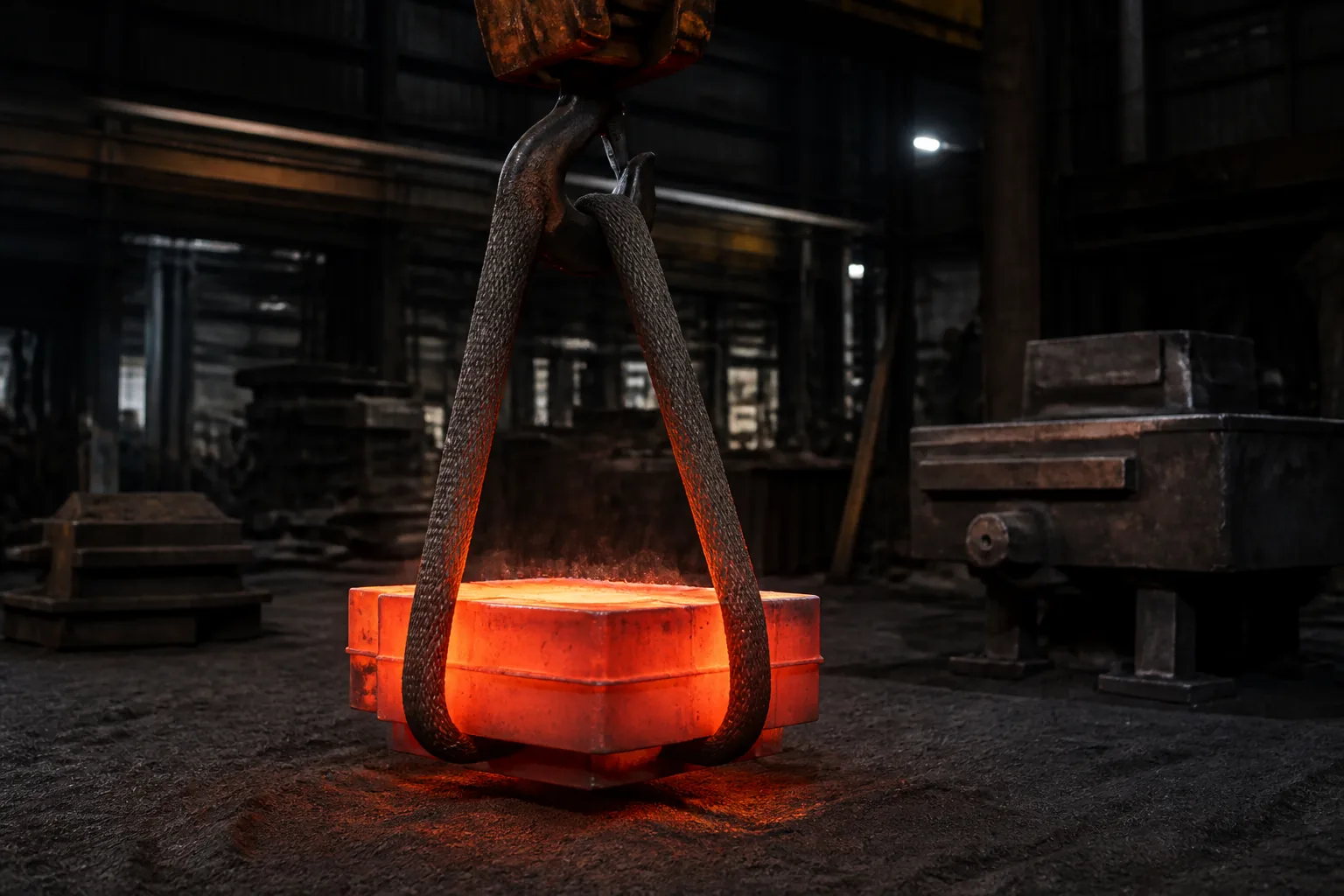
| Nga kaihanga me te whakarewanga mate | Moulds and dies moved while still hot, with a flame path from the pour. Aramid build, doubled sleeve on the bearing length. |
| Galvanising and coating lines | Hot dip work where the sling is close to the bath and the load comes out at temperature. |
| Mahi karaihe me nga umu | Radiant heat and a load that must not be marked; the sleeve insulates the workpiece as well as the core. |
| Shipyards and heavy plant maintenance | Hot work permits in force while the lift is rigged, so the sling has to tolerate spatter it was not bought for. |
9. Te tirotiro, and what ends a fireproof sling’s life
Ko te ringaringa he waahanga mahi, and on a fireproof sling it is the part that is expected to be damaged. The point of the construction is that you see the damage on the outside before the core is affected.
- Look for scorching and glazing first. He kanapa, stiff or brown patch is heat that has already been absorbed. It is telling you how much of the sleeve’s margin has been used.
- Check for a burnt-through patch. A hole that exposes the core is a retirement, not a repair — even if the core looks intact.
- Slide the sleeve back where it will move. On an endless sling you can inspect a working length of core directly; a dull or brownish core has been overheated and no sleeve replacement recovers it.
- Tirohia te roa o te kawe, not the visible side. Sparks land where the sling wraps, which is usually the side facing away from you.
- Pānuihia te tapanga. If the working load limit, te roa, te puranga ranei kaore e taea te panui, the sling cannot be verified and comes out of service.
- Kaua rawa e toia he kotaha kua utaina. Friction builds heat from the outside in, te wahi kaore koe e kite i te tiimata.
10. What to send for a quotation
| Nga korero | Why it changes the price |
|---|---|
| Utaina mo ia waewae, and the hitch | Sets the RK01 size; the mode factor decides whether the next size up is needed |
| Te roa whai hua, and the convention | Effective length or circumference — a factor of two apart |
| Te mōrearea, not the ambient temperature | Sparks and spatter need FR polyester; contact with a hot workpiece needs aramid |
| Contact or radiant heat, and dwell time | Decides the sleeve build and whether the sleeve is doubled on the bearing length |
| Surface condition | Sheared edges and burrs cut a sleeve as readily as they cut a hand; edge protectors may be needed |
| Te tohu me te tiwhikete | Label language, standard marking, batch traceability and test record with the consignment |
11. Pātai auau
Is a fireproof round sling the same as a heat-resistant round sling?
Kao. Heat resistance is about how much temperature the fibre keeps its strength at. Fire resistance is about ignition, flame spread and dripping. An FR polyester sling self-extinguishes in a spark shower and is still limited to about 90 °C in contact; an aramid sling survives the contact and chars rather than melts. Ko te kotaha a tawhio pāmahana teitei page covers the temperature side; this page is about the flame side.
What does the endless type change in practice?
There are no eyes and no stitching in the load path, so the loop can be re-reeved, turned end for end and the bearing point moved. In hot work that is the difference between retiring a sling because one patch is scorched and moving that patch off the bearing line. The cost is that length is ordered as a circumference and there are no eyes to hold a hook in position.
What LOI should I specify?
28 and above for a flame-retardant build. Ordinary polyester is around 20-21 and keeps burning in air; 28 and above is where the material stops supporting combustion once the igniter is removed. Untreated para-aramid sits at about 29 without any finish, which is one reason it needs no FR treatment.
Can it lift molten metal?
Kao. It resists sparks, para, spatter and brief flame, but it is not rated for immersion in molten metal or for holding a load that is still liquid. Splash should be brushed off, the sleeve inspected, and the sling returned to service only if the weave is intact.
FR polyester or para-aramid?
FR polyester when the hazard is sparks and spatter at normal workshop temperature — it is cheaper and it self-extinguishes. Para-aramid when the sling also touches the hot workpiece, because it has no melting point and holds strength at temperatures that destroy polyester. Ko te kotaha porotaka aramid range covers the standard-duty sizes.
He aha te roa ka ota ahau?
The effective working length: hono iho ki te uta ka hoki ki runga, which is half the loop circumference. A 1.5 m effective length is a 3 m kopikopiko. State the convention on the order, because a circumference quoted as an effective length is a factor of two out and cannot be corrected afterwards.
How much does it lift in a choke or a basket?
The label gives the vertical figure. A choke takes it to 0.8 wā, a basket at 0-7° raises it to 2.0 wā, at 7-45° to 1.4 wā, and at 45-60° to 1.0 wā. Two legs at 0-45° give 1.4 times and four legs give 2.1 wā, calculated on three legs.
Is it certified, and to which standard?
The polyester build follows EN 1492-2 construction practice with a sewn label and a proof-load record matched to the serial. A para-aramid build sits outside the fibre list of that standard, so the rating is a manufacturer specification. Tell us the marking or certificate your market requires and we will confirm exactly what can be provided for the construction you buy.
12. Why buy fireproof round slings from Lift
We have been making slings, webbing and rope in Taizhou, Jiangsu mai 1985, with the core, the sleeve and the stitching under one roof — which is what makes a build-to-order fireproof sling a production order rather than a special project. Nga mahi, the test laboratory and the export paperwork are described on the about us wharangi.
- The build is chosen, not guessed. Tell us what the sparks land on and whether the body touches the hot workpiece, and the core and sleeve are paired to that hazard rather than to a catalogue line.
- Karekau maru. A burnt sleeve is a consumable. Replacement sleeves are supplied separately so a scorched cover does not take a serviceable sling out of the rack.
- Tested and marked per sling. Kua utaina he tohu i mua i te tuku, with the record matched to the serial on the label; a self-testing laboratory with a 1,000 t tensile machine behind the range, me CE, DNV and PICC certification — see tiwhikete.
- One supplier for the hot job. Fireproof round slings, aramid webbing slings, high temperature webbing slings, kotaha tukutuku a taputapu hiki from the same works, so the whole lift is specified against one set of figures.
13. Tonoa he korero
Send the load per leg and the hitch, te roa whai hua, what the sling will touch and for how long, and the marking your market requires. Ka whakapumautia e matou te hanga, the factor and the length the same working day, me te whakahua i te wheketere-tonu me te tuhi, a proof-load record and a sample sling. Full contact details are on the wharangi whakapā.
Lift Sling Rigging Co., Ltd — Lifute Industrial Park, Taizhou, Jiangsu, Haina
Waea: +86 523 8693 5818 | WhatsApp: +86 180 6600 2268
Related reading: kotaha porotaka mutunga kore for the general-purpose form, eye-eye round sling for the fixed-length alternative, kotaha porotaka katoa for the full range, a Kotaha porotaka Dyneema where weight, not heat, is the constraint.