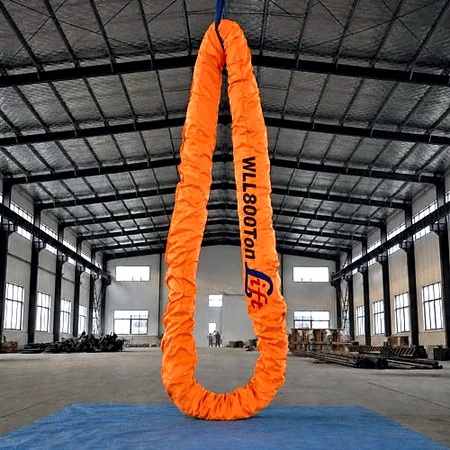
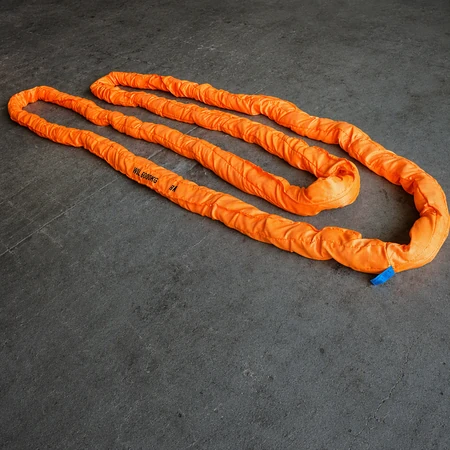
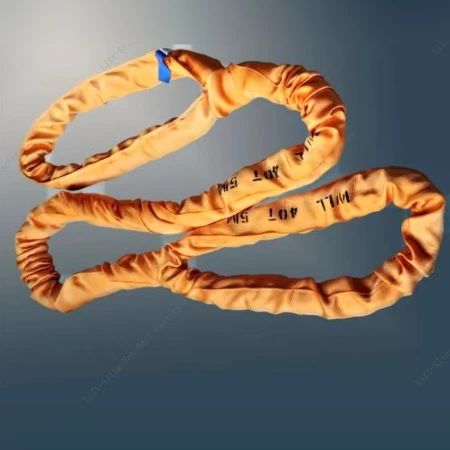
Lift sling rigging company produce 50T Heavy Duty Polyester Lifting Sling Endless Round Sling,50t Polyester Lifting Round Sling,50 Tone Round Sling.
50T Heavy Duty Polyester Lifting Sling Endless Round Sling
50,000 kg ia waewae me 350,000 kg before it breaks, in a body with no metal, no ends and no stitching in the load path.
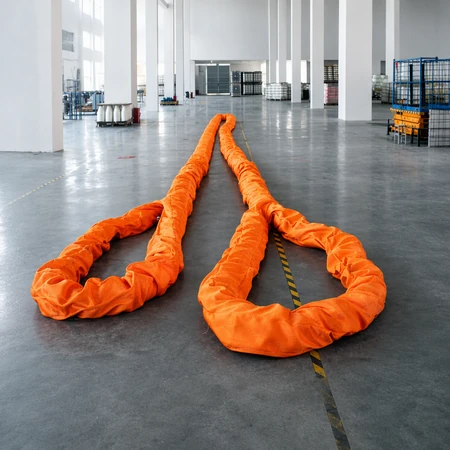
Ka hangaia e matou mai i 1 m ki 30 m te roa whai hua, single or double sleeve, in polyester as standard, with the working load limit and the length printed on the sleeve and a sewn label carrying the serial. Every sling is proof loaded before dispatch and the test record is matched to that serial, so the certificate in the folder belongs to the sling in the crate. The build follows EN 1492-2 and ASME B30.9 practice.
Part of the kotaha porotaka awhe. The tier below is the 40 tana kotaha porotaka; the tier above is the 60 tana kotaha porotaka. For the whole heavy series see heavy duty round slings.
He aha te 50 t figure actually buys you
The number on the sleeve is the working load limit of kotahi waewae, iri poutū. It is what the sling is proof loaded and certified against, and it is where a lifting plan starts — but it is not what the sling will pick up in the arrangement you are actually using. Two adjustments turn the single-leg figure into a set figure, and both of them move it.
- The mode. A choke costs 20 %; a basket at a shallow angle nearly doubles the figure; the same sling in a basket at 45–60° is back to its vertical rating.
- The leg angle. The wider the legs spread from the hook, the more tension each one sees for the same load. A multi-leg set is also calculated on fewer legs than it has — four legs are taken as three, because a real load never sits perfectly symmetrically.
| Whirihoranga | Tauwehe | Te kaha |
|---|---|---|
| Kotahi te kotaha, poutū | × 1.0 | 50 t |
| Kotahi te kotaha, kowaowaotia | × 0.8 | 40 t |
| Kotahi te kotaha, basket at 0–7° | × 2.0 | 100 t on the sling |
| Kotahi te kotaha, basket at 7–45° | × 1.4 | 70 t on the sling |
| Kotahi te kotaha, basket at 45–60° | × 1.0 | 50 t |
| E rua nga kotaha, 0–45° mai i te poutū | × 1.4 | 70 t huinga |
| E wha nga kotaha, 0–45° mai i te poutū | × 2.1 | 105 t huinga |
Pānuihia te ripanga mai i te kawenga whakamuri. A 50 t uta i runga i nga waewae e rua e hiahia ana 50 t kotaha i te 0–45° (70 t huinga) a 60 t slings once the legs pass 45°. Rua 30 e kore e mahia e nga kotaha 60 t, and two 40 t kotaha kawe 56 t — which is why the tier is chosen from the arrangement rather than from the tonnage on the drawing.
Kei hea 50 t sits against the tiers either side
At this size the sling is rarely the weak link: te matau, the shackle, the beam and the lifting point each carry their own rating, and the lift is limited by the lowest one. What the tier table settles is whether you buy 50 t slings or a pair of smaller ones.
| kotaha | Poutū, kotahi waewae | Two legs at 0–45° | Chosen when |
|---|---|---|---|
| 30 t | 30 t | 42 t | Up to about 40 t i runga i nga waewae e rua, me te tawhē |
| 40 t | 40 t | 56 t | 45–55 t on two legs at a moderate angle |
| 50 t | 50 t | 70 t | 55–65 t on two legs, or unknown weights |
| 60 t | 60 t | 84 t | Legs opening past 45° on a 50–60 t load |
He kotahi 50 t sling also makes sense where the hook is unknown or a fleet sling has to cover several jobs: the extra tonne of rating costs less than a second body, a second label and a second inspection.
The core carries the load, the sleeve decides the life
Ko te kotaha porotaka e rua nga mea kei te kotahi, and the outer one is what retires it. The core is a parallel bundle of high-tenacity polyester filament, te waxed ka whakatakotoria kahore he miro; every filament shares the load, which is how a body this slim rates at 50 t. The sleeve is a woven tubular jacket that protects the core from abrasion, from the load and from daylight, and it is what the person making the lift reads.
The sleeve is the inspection window
Because the core cannot be seen, the sleeve is judged instead: tapahi, mahanga, whakarara, poke matū, and the loop ends where the core turns. A sleeve cut through so that the core is visible retires the sling even if the core itself looks sound — a sling that cannot be judged cannot be used.
Ko te mahi taumaha he hanga, ehara i te whakatauranga
The phrase describes the sleeve and the standard of make. A 50 t kotaha ko 50 t ahakoa te karekau; a second layer buys wear life rather than capacity. Where the load is abrasive, the yard is rough or the sling is a rental item, specify the kotaha porotaka ringa rua — on a clean indoor lift it is money spent on nothing.
Me whai waahi te tinana maro
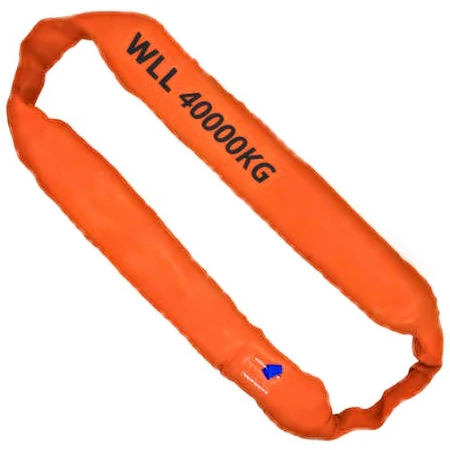
A 50 t tinana e kore e piko a tawhio noa te radius piri te ara a 10 t tetahi. Hei tikanga mahi, a very short body has no slack to seat in the hook and starts to fight the rigging; the minimum length at this rating is confirmed on the drawing issued with the quotation. I te nuinga o te wa ka whakautuhia te ahuahanga kiki me te tinana roa, a kurupae hiki kia tata atu nga waewae ki te poutū, a kotaha porotaka me nga kanohi hanga ki te roa ine.
Tawhā Hangarau
| Tawhā | Whakatakotoranga |
|---|---|
| Hua | 50 t heavy duty polyester lifting sling, kotaha porotaka mutunga kore, 50,000 kg kotaha hiki porotaka |
| Hangahanga | Ko te uho kakawaua whakarara tonu i roto i te ringaringa tubular raranga, katia ki roto i te kohanga mutunga kore; kahore he konganuku i te ara kawenga |
| Core | polyester tino kaha (PES) karau maha, takoto whakarara, te waxed |
| ringaringa | He taumaha te raranga polyester tino kaha, paparanga kotahi hei paerewa; ringaringa rua ki te ota |
| Te rohe kawenga mahi | 50,000 kg (50 t), waewae kotahi, poutū |
| Te kawenga pakaru | 350,000 kg i a 7:1 take |
| Te take haumaru | 7:1 hei paerewa; Ko etahi atu mea i hangaia ki te ota i nga waahi e hiahiatia ana e te maakete |
| Te whakaroa i te WLL | Approximately 2–3 % |
| Te pāmahana ratonga | −40 °C ki +100 °C |
| Te roa whai hua | 1–30 m made to order; te roa iti ka pa ki tenei kaha |
| Tae | Karaka hei paerewa; etahi atu tae ringaringa hei ota |
| Te tohu | WLL me te roa i taia ki te ringaringa; tapanga tuia ki te WLL, roa, rangatū, paerewa me te ra |
| Paerewa | IN 1492-2 me te mahi hangahanga ASME B30.9 |
| Whakamatau | Kua utaina he tohu i mua i te tuku; te rekoata whakamatautau i rite ki te tau rangatū |
| Te takai | Porohia ki roto i te putea poly, kātene tapaina; pallet, pouaka ranei i runga i te tono |
| MOQ & OEM | MOQ iti mo te ota whakamatautau; OEM i runga i te roa, tae ringaringa, muka matua, tahora tapanga me te takai |
Te roa: roa whai hua, porowhita ranei
Ko te kotaha mutunga kore he mutunga, so its length can be quoted two ways and the two are a factor of two apart. Koinei te hapa ota tino noa i runga i te kotaha porotaka, a i 50 t he utu nui te whakatika i muri i te huihuinga.
| I whakahuahia hei | Ka whiwhi koe | Whakamahia mo |
|---|---|---|
| Te roa o te mahi whai hua | Ko te haurua o te porowhita — hono iho ki te uta ka hoki whakamuri | Hikinga poutū me te kowaowao, e mohiotia ana te teitei iri |
| Porowhita | Ko te roa o te koropiko katoa | Whakarewa kete, kei hea te porowhita o te kawenga e akiaki ana i te roa |
A 4 m te roa whai hua he an 8 m kopikopiko. On our slings the figure printed on the sleeve is the effective length, no reira ka whakaae tonu te ta me te whakahua. Mo te hiki kete, tangohia te whitiki o te pikaunga, add the headroom to the hook and quote that: a sling that only just reaches forces the legs wide, he rite tonu ki te hoko i te kotaha iti.
Te tohu, serial and proof-load traceability
Kei runga 10 t the colour code stops identifying the sling, na i 50 t the print and the label are the only things a rigger can read. Both are part of the specification, not decoration.
- The working load limit and the effective length are printed on the sleeve in characters sized to be read at arm’s length in a yard.
- A sewn label carries the WLL, roa, rangatū, standard and date of manufacture; the serial is what links the physical sling to its paperwork.
- Every sling is proof loaded before dispatch and the test record is matched to that serial.
- A fibre certificate and batch figures are available on request; if your market needs a specific standard marking, say so before the order rather than after.
Kei hea a 50 t sling earns its place
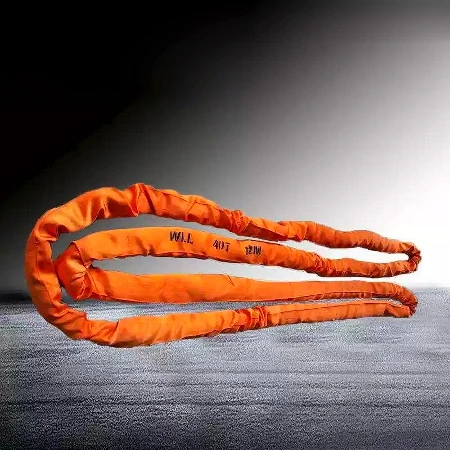
At this capacity the sling is chosen for what it does kaore do to the load — a wire rope grommet carries the same figure. Ko te rereketanga ko te whakapiri.
- Nga porowhita o mua me nga waahanga piriti. Kotahi te kotaha i ia pito, te taumata hikina; ka tiakina e te ringaringa te mata kua hangai me te chamfer.
- Steel coils and plate packs. Kete i raro i te kete, sleeve against the plate edge — the round body follows the coil rather than bearing on a line.
- Kaihurihuri, generators and machine beds. Trunnions and lifting holes are small and the surfaces are machined or painted; nothing metal touches the load.
- Moulds, dies and skids. Lifting holes are drilled rather than designed for a fitting, so a soft loop threaded through the hole is the whole method.
- Poraka kaipuke me te kōwae. E wha nga tohu me te kurupae ki runga, ko te koki kotaha te taurangi e whakatau ana i te huinga.
Te tirotiro, tiaki me te whakatā
Tirohia i mua i nga whakamahinga katoa, me okawa i te wa e hiahiatia ana e to tikanga. The check is nearly all on the outside, because that is all there is to see.
- Sleeve along its full length: tapahi, mahanga, whakarara, melts, poke matū.
- Loop ends, where the core turns inside the sleeve, and the stitching at the join.
- Tapanga me te tuhi: ki te kore e taea te panui te WLL, te roa ranei, e kore e taea te manatoko te kotaha.
- Grit inside the sleeve — it abrades the core from within long after the yard has been swept.
- Retire on any cut through to the core, whakamahana wera, he uho kua maro, kua pupuke ranei, chemical attack or a missing label.
- Roopuhia ka takai i te papa, mai i te awatea me te matara atu i te wera, nga whakarewa me te maatai a te weld; kaua rawa e penapena he kotaha makuku ki roto i te putea kati, and never drag one under load.
He maha nga patai
Can one 50 t sling lift 100 t i roto i te kete?
I te taha kotaha, āe— 100 t i te 0–7°. I roto i te mahi te matau, hono matua, kurupae ranei i runga ake me tohu mo 100 t, a i tenei rahi karekau te warou. No reira te kete i 50 Ko t he whakatau hopu tuatahi me te whakatau kaha tuarua.
Kia rua 50 t slings hiki 100 t?
Not at an angle. Two legs at 0–45° from vertical carry 70 t, a 50 t once the legs open past 45°. A genuine 100 t uta i runga i nga waewae e rua e hiahia ana 75 t kotaha, which is why we ask for the arrangement before the price.
Polyester or UHMWPE at this capacity?
Polyester is the general-purpose core: totoro iti, ora abrasion pai, −40 ki +100 °C, lowest cost at this rating. A UHMWPE matua is worth it where the sling’s own weight is the problem — long bodies, whiriwhiri teitei, he kotaha ranei me mau ki runga i te arawhata.
What about hot loads?
A standard polyester core is rated to +100 °C. Above that the fibre degrades, and the answer is an aramid core or a high temperature round sling rather than a thicker standard sleeve.
What length do I order — 4 m ranei 8 m?
Korerohia ko tehea huihuinga e kii ana koe. A 4 m te roa whai hua he an 8 m kopikopiko. For a vertical or choked lift the effective length is the distance from hook to load; mo te kete, tāpirihia te porowhita o te kawenga ki te rūma upoko ka whakahua i tērā.
He aha nga tuhinga ka tae mai me te kotaha?
A sewn label carrying the WLL, te roa me te raupapa; he rekoata kawenga-tohu e rite ana ki taua rangatū; he tiwhikete muka me nga tatauranga puranga i runga i te tono. Korerohia mai ki a maatau i mua i te ota mena ka hiahia to maakete ki tetahi tohu paerewa motuhake.
Can the sleeve be replaced or repaired?
Kao. A sling is proof loaded as a complete article, and re-sleeving or re-stitching voids that record. A damaged sleeve retires the sling; the answer is a new body, or a double sleeve next time.
Tono a 50 t porohita kotaha quotation
Send the lift, get a drawing and a price
Utaina mo ia waewae, the arrangement and the angle from vertical;
Distance between pick-up points and the headroom to the hook;
Te roa whai hua, te porowhita ranei, te taiao, and any sleeve or marking requirement.
Lift Sling Rigging Co., Ltd · Lifute Industrial Park, Taizhou, Jiangsu, Haina · Waehere HS 630790 · Tel +86 523 8693 5818 · WhatsApp +86 180 6600 2268
Hua e pa ana
- Kotaha porotaka katoa, 1–1000 t — the full range this sling belongs to;
- WLL 40T polyester round slings — the tier below, same build;
- WLL 30T polyester kotaha porotaka — for 40 t loads on two legs;
- 60 tana kotaha porotaka — the tier above;
- Heavy duty round sling range — 50 t me runga ake, heavier sleeves;
- Kotaha porotaka me nga kanohi — a measured length and two pick-up points;
- Kotaha tukutuku papatahi — the same rating in a thinner profile;
- Te hiki kurupae — to keep multi-leg sets closer to vertical.