

Lift sling rigging company manufacture Aramid braided rope,Aramid Fiber Rope,Braided Aramid Cord,Aramid Fibre Braided Ropes 400 °C.
Aramid taura whiri
Para-aramid 12-strand braid for heat, stretch and strength — 4 mm ki 24 mm, hanga ki te ota
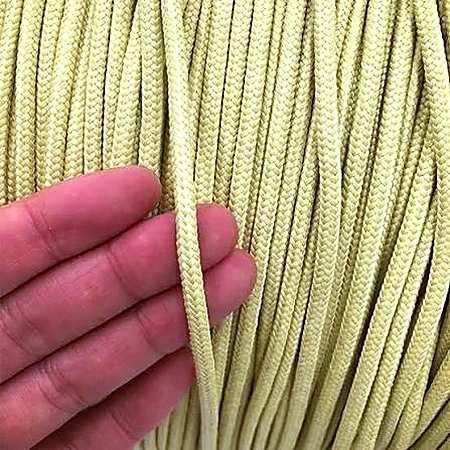
To tatou taura whiri aramid is a 12-strand single braid made from 100 % para-aramid filament. It is the rope to specify when the duty combines heat with strength: it has no melting point, it keeps working above 150 °C, and it holds far more of its strength at high temperature than nylon or polyester. Because it barely stretches under load, the load stays where it was set — which is why braided aramid cord is used for furnace and ladle work, heat-shield rigging, guy lines and high-temperature pulling, as well as for industrial lifting where a taura nylon would be too elastic. Standard braids run from 4 mm ki 24 mm, me nga kanohi hono, thimbles, hooks or buckles fitted at the ends.
- Works hot — kore ira whakarewa; strength falls to zero only near 455 °C, and long-term service is above 150 °C
- Totoro iti — a 70–100 GPa modulus keeps a suspended load steady instead of letting it settle or swing
- Strong for its weight — specific strength 5–6 times that of steel wire at roughly one fifth of the weight
- Tapahi me te abrasion ātete — a dense 12-strand braid with a hard-wearing surface
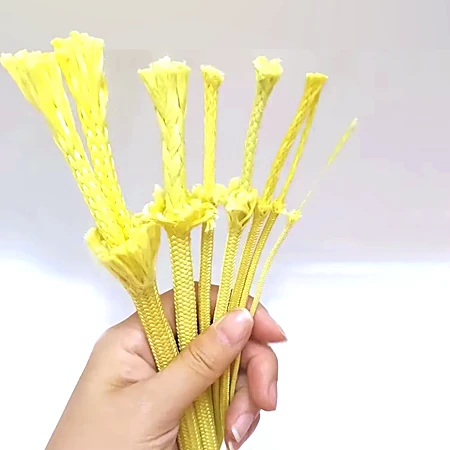
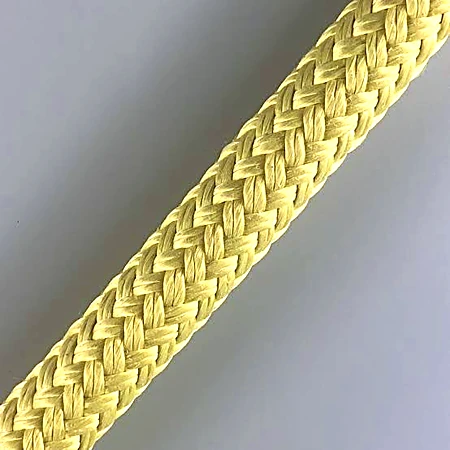
Key Features of Our Aramid Braided Rope
Heat Resistance Where Nylon and Polyester Fail
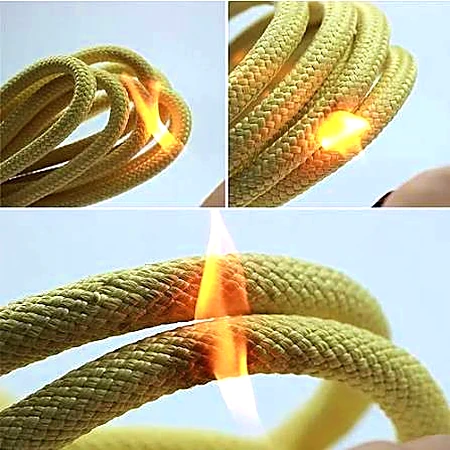
Para-aramid does not melt and does not drip. It can be used continuously above 150 °C, retains about 75 % of its tenacity after 100 hours at 200 °C, and reaches zero strength only at about 455 °C. That is the reason this rope is specified for areas where ordinary synthetic rope would soften, glaze or fail — see also our taura here herenga wera nui.
Whakaroa iti, So the Load Stays Put
A 70–100 GPa tensile modulus means the rope gives very little under load. Where a nylon rope absorbs shock by stretching, an aramid braided rope is chosen for the opposite reason: a suspended load keeps its height, a tensioned line stays tensioned, and there is no stored energy to release when the load is set down.
12-Strand Single Braid
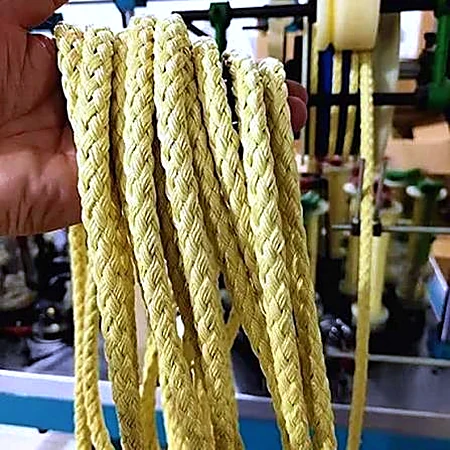
Twelve strands are braided without a core, so the rope is torque-free, round and even, and takes a splice that keeps most of the rope’s strength. The braid angle and density are controlled per batch, which is what fixes the finished diameter and the way the rope behaves in a hand, on a capstan or over a sheave.
Spliced Ends, Kaore i herea
A knot gives away a large part of the rope’s strength and becomes the weakest point. We finish aramid rope with hand-spliced eyes, kanohi thimble, matau, swivels or buckles, and whip or heat-seal the free ends so the braid cannot unravel.
Whakatakotoranga Hangarau
| Tūemi | Awhe Whakatakotoranga |
|---|---|
| ingoa hua | Aramid taura whiri / aramid fibre braided rope / braided aramid cord / Kevlar braided rope |
| Rauemi | 100 % para-aramid (aromatic polyamide) karau maha, natural yellow |
| Hangahanga | 12-whenu kotahi whiri (huri noa); 8-whenu, 16-strand and double braid on request |
| Paerewa diameter | 4 · 6 · 8 · 10 · 12 · 14 · 16 · 18 · 20 · 24 mm (custom range 3–32 mm) |
| Nga roa paerewa | 100 m · 200 m · 500 m coil, 1000 m spool; any cut length to order |
| Tae | Natural yellow · black · custom colours |
| paninga / mutu | Kore i pania, or PU-coated for extra abrasion resistance and a locked braid |
| Te pāmahana mahi | Continuous service above 150 °C; strength falls to zero at about 455 °C; kahore he ira whakarewa |
| Te whakaroa | Low — chosen where a suspended load must not settle or swing |
| Tiaki UV | Protective jacket or cover recommended for permanent outdoor exposure |
| Whakamutua te whakaoti | Hand-spliced eye · thimble eye · hook · swivel · buckle; whipped or heat-sealed ends |
| Te takai | Porohia me te tapanga, spool or carton; e waatea ana te tapanga ritenga me te tohupaepae |
| MOQ & OEM | MOQ iti mo nga ota whakamatautau; full OEM — diameter, tae, roa, splicing, moko kua taia, packaging |
Awhe whakaritenga paerewa - etahi atu diameters, braid constructions and lengths are produced to order.
Diamita me te Kaha Whati
Diameter follows from the load and from what the hardware will accept. Heavier diameters carry more, stand up to abrasion for longer and are easier to grip; lighter diameters are quicker to handle and cheaper to ship.
| Diamita | Approx. taumaha (g/m) | Te kaha pakaru angamaheni | Reference working load at 5:1 |
|---|---|---|---|
| 4 mm | ≈ 11 | ≈ 15 kN (1.5 t) | ≈ 3.0 kN |
| 6 mm | ≈ 24 | ≈ 34 kN (3.5 t) | ≈ 6.8 kN |
| 8 mm | ≈ 43 | ≈ 60 kN (6.1 t) | ≈ 12.0 kN |
| 10 mm | ≈ 68 | ≈ 94 kN (9.6 t) | ≈ 18.8 kN |
| 12 mm | ≈ 97 | ≈ 135 kN (13.8 t) | ≈ 27.0 kN |
| 14 mm | ≈ 132 | ≈ 185 kN (18.9 t) | ≈ 37.0 kN |
| 16 mm | ≈ 173 | ≈ 240 kN (24.5 t) | ≈ 48.0 kN |
| 18 mm | ≈ 219 | ≈ 305 kN (31.1 t) | ≈ 61.0 kN |
| 20 mm | ≈ 270 | ≈ 377 kN (38.4 t) | ≈ 75.4 kN |
| 24 mm | ≈ 389 | ≈ 540 kN (55.0 t) | ≈ 108.0 kN |
Typical reference values for standard 12-strand aramid braid. Breaking strength and working load are confirmed by the test certificate issued for your batch — always work from that figure, not from this table.
Material Properties of Para-Aramid
| Taonga | Typical value |
|---|---|
| Density | 1.43 – 1.47 g/cm³ (para-aramid filament, grade dependent) |
| Specific strength | 5 – 6 × that of steel wire, at roughly one fifth of the weight |
| Tensile modulus | 70 – 100 GPa at room temperature |
| Glass transition temperature | 320 – 380 °C |
| Strength retention | Mō 75 % after 100 hours at 200 °C |
| Zero-strength temperature | Mō 455 °C |
| Te rewa | None — the fibre decomposes rather than melting (from about 500 °C) |
| Te whakawhāiti i te taupū hāora | 25 – 29 (flame retardant, te tinei i a koe ano) |
| Moisture regain | 4.0 – 7.0 %, grade dependent (Kevlar 29 ≈ 7.0 %, Kevlar 49 ≈ 4.0 %) |
| Te ātete matū | Good against most organic solvents; degraded by strong acids and alkalis, especially hot and concentrated |
Typical published values for para-aramid filament; confirm against the yarn datasheet used for your order.
Te wera, Chemical and UV Behaviour
- Te wera — kore ira whakarewa; the fibre decomposes from about 500 °C and reaches zero strength near 455 °C. Continuous service is above 150 °C.
- Chemicals — resistant to most organic solvents, but degraded by strong acids and alkalis, especially when hot and concentrated.
- UV — for permanent outdoor exposure, ask about a protective jacket or covered construction rather than leaving the braid bare.
Nga tono
- Furnace, ladle and foundry rigging where radiant heat is present
- Heat shields, insulation blankets and refractory handling
- Guy lines, static lines and high-temperature pulling
- Industrial lifting and tensioning where the load must not settle
- Utility and winch duty, including the heavier forms of utility winch line
- Cut-resistant cordage for slings and lanyards, alongside toia taura a taura piki
Whakaritea me te Ratonga OEM
- Diamita — 4–24 mm standard, 3–32 mm on request
- Hangahanga — 12-strand single braid, 8- whenu ranei, 16-strand and double braid
- Ka mutu — spliced eye, kanohi thimble, matau, swivel, kopere, or plain cut ends
- Te roa — any cut length; 100 m, 200 m me 500 m nga roera, 1000 m nga poroporo
- Finishing — PU coating, tae, mid-rope marking, tapanga tā, tākai hokohoko
- Tuemi hoa — kotaha tukutuku, kotaha porotaka a te here haumaru supplied as matched sets
Mana Kounga
Each batch is checked on diameter, kiato rārangi, braid density and end finish, me te tauira mo te pakaru kaha. We have manufactured rope and webbing for industrial, safety and sports customers for close to three decades. I runga i te tono ka tukuna e matou te tiwhikete miro, the batch test report and a sample length for you to handle and test before volume production begins.
Pātai Auau
What temperature can aramid braided rope take?
There is no melting point. Long-term service is above 150 °C, it keeps roughly 75 % of its tenacity after 100 hours at 200 °C, and its strength approaches zero at about 455 °C. Tell us the working temperature and for how long, and we will confirm the construction and whether a heat-resistant cover is needed.
Aramid braided rope or nylon rope — which one do I need?
Choose aramid for heat and low stretch; choose nylon where shock absorption and elasticity matter more than stability. If both heat and shock are present, tell us the duty rather than a fibre, and we will recommend the construction that suits it.
Can the ends be spliced?
Ae. A 12-strand single braid takes a hand-spliced eye that keeps most of the rope’s strength, and thimbles, matau, swivels and buckles can be fitted to the eye. A finished end shortens the usable length, so allow for it when you order.
Do you supply kevlar braided cord in small quantities?
Ae. We keep the minimum order low for trial orders and will send a sample length to handle and test before volume production. Tukuna te diameter, te roa, the working temperature and the end finish you need.
Request a Quote for Aramid Braided Rope
Tukuna mai te diameter, te roa, the working temperature and how the rope is loaded, plus any marking or certification your market requires. Ka hoki mai to taatau roopu me te korero, a sample length and a factory-direct price.
Whakapā: Lift Sling Rigging Co., Ltd — waea me WeChat 18066002268, imeera 702461526@qq.com, Lifute Industrial Park, Taizhou City, Porowini o Jiangsu, Haina. Waehere HS 630790.