

Lift sling rigging company produce Recycled-Fiber Car Lashing Belts,Vehicle Lashing Belt,Polyester Woven Lashing Belt,Fiber cargo lashing belt,Cargo Lashing Strap,Rachet Lashing Belt,Truck Cargo Lashing Webbing Belt,Car Lashing Straps,Car Ratchet Straps,Konteinerio tvirtinimo dirželis.
Car Lashing Belt — Recycled-Fiber Vehicle Lashing Belts
A car lashing belt is a polyester webbing strap with a ratchet tensioner in its run and a hook, ring or over-wheel strap at each end, used to hold a vehicle on a trailer, a car-carrier deck, a flatbed or a recovery truck. This range is woven from recycled high-tenacity polyester — post-consumer PET bottle flake spun into lashing yarn — in widths from 25 mm iki 100 mm, with a lashing capacity (LC) iš 400 daN to 10,000 daN per assembly.
Two things separate a car lashing belt from a general cargo strap, and both are about the load rather than the strap. A car is a finished object: its paint, its alloy wheel faces and its plastic trim belong to somebody, so the belt has to hold a tonne and a half of steel without leaving a mark on it. And a car is lashed at four small points — a wheel, a slot in the unibody, a lashing ring on the deck — so the hardware at each end decides whether the lashing works, not the width of the band.
The recycled fiber changes neither of those duties. Same woven band, same sewn label, same LC, same inspection rules, same retirement criteria. What it changes is where the yarn came from and what paperwork stands behind the claim.
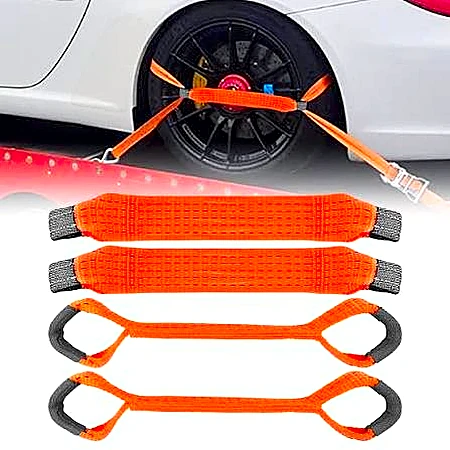
What a Car Lashing Belt Is — and What It Is Not
Three duties get confused in this product, and the confusion is what turns a cheap strap into an insurance claim. A car lashing belt belongs to exactly one of them.
| Pareiga | Įvertinta | What is printed | Hardware you would expect | Must never be used for |
|---|---|---|---|---|
| Lifting the vehicle | WLL, darbinės apkrovos riba | WLL per hitch, saugos faktorius (7:1 on flat webbing) | Sustiprintos akys, jokių kabliukų | Restraining a load in transit |
| Restraining the vehicle | LC, rišimo pajėgumas, plus STF | LC, STF, ilgio, plotis, gamintojas | Ratchet buckle, J kabliukas, plokščias kabliukas, wheel strap | Kėlimas, or towing a casualty |
| Towing or recovery | Tow rating, shock-rated | Tow rating, elastic elongation, gamintojas | Reinforced eyes or shackle ends | Any steady restraint duty |
A lashing is loaded continuously and unattended, at whatever the ratchet put into it, for the whole journey. A sling is loaded briefly, matomai, with somebody watching. That difference is why the two articles are marked in different units and why a belt bought for restraint should never be pressed into a lift — if the job is lifting a body shell or a chassis, the article you want is a juostos diržas, rated per hitch with its mode factors on the label.
Names vary by market: the same assembly is catalogued as a car lashing strap, a vehicle lashing belt, a car-carrier tie-down strap or a wheel strap set. Those are four labels for one product family, differing in the end fitting rather than in the band, so a buyer comparing quotations should compare the LC, the STF and the hardware — not the title of the page.
Why Recycled Fiber — and What It Does Not Change
The band in this range is woven from rPET: post-consumer bottle flake, washed, re-polycondensed and spun into high-tenacity lashing yarn. Nothing about the weaving, the stitching or the hardware changes. The reason buyers ask for it is rarely the strap itself and almost always the tender behind it — automotive logistics contracts increasingly carry a recycled-content KPI, and a carrier that can hand over a GRS transaction certificate for the webbing in its wheel straps has an answer that a virgin-polyester competitor does not.
Three honest limits belong in the same paragraph as the benefit. Pirma, mechanically recycled yarn usually starts a little lower in tenacity than virgin lashing yarn, so we specify the yarn by minimum tenacity and break-test every woven lot rather than trusting the feedstock. Antra, recycled chips vary in colour, so a natural-finish rPET band can shift batch to batch and a colour-matched programme needs dye lots agreed up front. Trečia, a lashing belt is a composite of steel and webbing and is normally ne recyclable at end of life — the recycled content is in the yarn, and any supplier claiming the finished belt is recyclable is overstating it.
| Turtas | Recycled rPET band | Virgin polyester band | What it means on the deck |
|---|---|---|---|
| Base polymer | Post-consumer PET, mechanically recycled | Virgin PET | Identical chemistry; different feedstock |
| Yarn tenacity | Specified by minimum, lot-tested | Typically higher at the top of the range | Compensated by weave density and band weight |
| LC of the finished assembly | Same as virgin at the same build | Reference | The label states what the belt reaches, not what the yarn could reach |
| Low elongation at LC | Taip, denser weave | Taip | A stretching band lets the car walk, then shocks the system |
| Colour consistency | Batch variation on natural finish | Stabilus | Fix dye lots for a colour-matched fleet programme |
| UV and heat | Same as polyester: apie 100 °C working limit | Same | Neither belongs against a hot exhaust or a baking deck |
| End-of-life | Composite, not recyclable as an assembly | Composite, not recyclable as an assembly | Retire on condition, not on a recyclability claim |
| Dokumentacija | GRS certificate and transaction certificate on request | None required | This is the part procurement actually buys |
Car Lashing Belt — Technical Parameters
The table below is the standard build for this range. Plotis, LC, ilgio, end fittings and marking are fixed on the order, because the LC applies to the finished assembly — the band, the stitching and the hardware together — and not to the webbing on the roll.
| Parametras | Specifikacija |
|---|---|
| Produktas | Car lashing belt / vehicle lashing belt / car carrier tie-down strap |
| Diržas | High-tenacity recycled polyester (rPET), twill weave, mažas pailgėjimas; 25 mm – 100 mm vardinis plotis |
| Recycled content | 30 % – 100 % post-consumer rPET by yarn weight; GRS 4.0 certified on request |
| Tvirtinimo pajėgumas (LC) | 400 Ir (0.4 t) į 10,000 Ir (10 t) už surinkimą |
| Minimali trūkimo jėga | 2 × LC, verified by batch pull test (IN 12195-2) |
| Standartinė įtempimo jėga (STF) | 150 – 500 Ir, depending on width and tensioner; printed with the LC |
| Standard hand force (SHF) | 50 daN at the ratchet handle; 25 daN at a cam buckle |
| Pailgėjimas | ≤ 7 % at LC on the low-elongation weave (typical 5 – 6 %) |
| Juostos storis | 1.2 mm (25 mm) į 2.4 mm (100 mm) |
| Width tolerance | ± 2 % |
| Ilgis | 1 m – 12 m, supjaustyti pagal užsakymą; 1.5 m / 2 m for wheel straps |
| Darbinė temperatūra | -40 °C iki +100 °C; polyester melts rather than deforms above that |
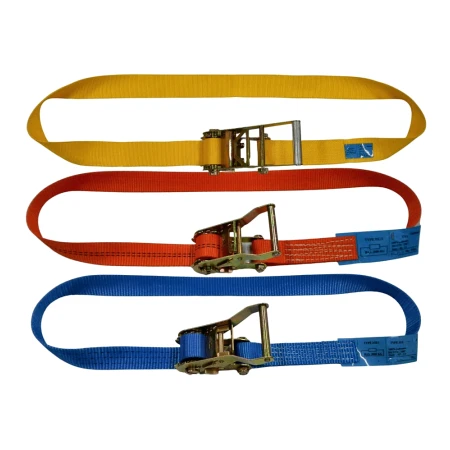
| Spalva | Oranžinė, raudona, mėlyna, geltona, juodas, žalias, pilka; dye lot fixed for fleet orders |
| Susiuvimas | Lock stitch, high-tenacity polyester thread, contrasting colour, box-X at every hook and buckle |
| Žymėjimas | Pasiūta etiketė: LC, STF, ilgio, plotis, gamintojas, partiją; IN 12195-2 paprašius |
| Pakavimas | Poly maišas ir antraštės kortelė, spalvos dėžutė, birių dėžių, OEM etiketė |
| Pareiga | Load restraint in tension only — never lifting, never towing |
| HS kodas | 630790 |
| Plotis | LC už surinkimą | Min. laužantis jėgą | Typical STF | Svoris | Vehicle it is normally bought for |
|---|---|---|---|---|---|
| 25 mm / 1″ | 400 Ir (0.4 t) | 800 Ir | 150 Ir | ~33 g/m | Motorcycles, ATV, quad, in-car and boot lashing |
| 35 mm / 1 3/8″ | 750 Ir (0.75 t) | 1,500 Ir | 250 Ir | ~52 g/m | Passenger cars, wheel straps, light vans |
| 50 mm / 2″ | 2,500 Ir (2.5 t) | 5,000 Ir | 350 Ir | ~88 g/m | Car carriers, flatbeds, SUV and pickup, light commercial |
| 75 mm / 3″ | 5,000 Ir (5 t) | 10,000 Ir | 500 Ir | ~140 g/m | Augalas, vans on beavertail decks, commercial vehicle haulage |
| 100 mm / 4″ | 10,000 Ir (10 t) | 20,000 Ir | 500 Ir | ~190 g/m | Heavy equipment, denio kroviniai, ro-ro securing |
Perskaitykite etiketę, not the table. The LC range is the manufacturing span for that width, not a menu to choose from within it: each assembly is made to one LC and marked with that figure. Send the vehicle, the anchor points and the deck surface, ir plotis, LC, length and marking come back together.
Lashing Capacity, STF and Breaking Strength
Three numbers on a car lashing belt are routinely read as one, and the gap between them is where overloads come from.
- LC — lashing capacity. The force the finished assembly is rated to hold in tension, in daN or tonnes. This is the figure European and most export markets quote, and it is the only one that describes what the belt may do in service.
- STF — standard tension force. The tension one person is expected to reach with the tensioner at the standard hand force: 50 daN at a ratchet handle, 25 daN at a cam buckle. It matters because a lashing does not hold a car by wrapping it — it holds it by pressing the tyres onto the deck, and the friction that results is proportional to that preload.
- Sulaužoma jėga. What the assembly takes before it fails, normally at least twice the LC. North American catalogues often print breaking strength and a working load limit derived from it, so a “10,000 lb” strap and a 2,500 daN belt can be the same article — or two very different ones if one figure is being read as the other.
The practical consequence: on a wet or polished aluminium deck, adding another turn on the handle buys much less than it appears to. Friction is the mechanism, so an anti-slip mat under the tyres does more for restraint than an extra 100 daN of preload, and it does it without crushing the sidewall.
Pasirinkite Modelį: Plotis, End and Length
Šioje eilėje pirkėjai nusprendžia tris dalykus: the width the vehicle needs, galą, kuris atitinka tvirtinimo tašką, ir jį pasiekiantį ilgį. Penki modeliai apima asortimentą.
| Modelis | Juostos plotis | LC | Įprasta pabaiga | Standartinis ilgis | Tipiškas pritaikymas |
|---|---|---|---|---|---|
| CLB-25 | 25 mm | 400 Ir | Cam buckle or ratchet, vinyl S-hook | 1.5 m / 2 m | Motorcycle, ATV, in-car cargo |
| CLB-35 | 35 mm | 750 Ir | Reketas, double-J or soft loop | 1.5 m / 6 m | Passenger car wheel strap, light van |
| CLB-50 | 50 mm | 2,500 Ir | Reketas, dvigubas J, flat hook or over-wheel strap | 6 m / 8 m | Car carrier deck, plokščias, SUV and pickup |
| CLB-75 | 75 mm | 5,000 Ir | Reketas, ilga svirtis, flat hook or ring | 8 m / 10 m | Augalas, beavertail, commercial vehicle |
| CLB-100 | 100 mm | 10,000 Ir | Reketas, ilga svirtis, ring or flat hook | Norėdami užsisakyti | Heavy equipment, ro-ro and deck cargo |
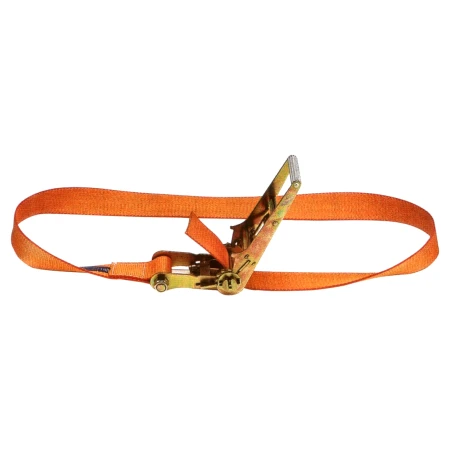
Attachment Parameters — Ratchet, Hooks and Wheel Fixings
The band is the cheap half of a car lashing belt. The end fittings are what the buyer actually chooses, because they decide whether the belt fits the vehicle in front of them. The table below is the standard hardware set; every item can be supplied on its own or built onto a belt to your length.
| Code | Attachment | Size range | Medžiaga / baigti | Rating | Fits band | Kur jis naudojamas |
|---|---|---|---|---|---|---|
| A1 | Ratchet buckle, trumpa svirtis | 25 / 35 / 50 mm | Forged carbon steel, zinc-plated Cr3 | 2 × LC of the band (800 – 6,000 Ir) | 25 – 50 mm | Standard car and van strap; 50 daN hand force |
| A2 | Ratchet buckle, ilga svirtis (begalinis) | 50 / 75 / 100 mm | Kaltas plienas, zinc-plated Cr3 | 2 × LC, 5,000 – 20,000 Ir | 50 – 100 mm | Car carrier and flatbed; longer handle, higher STF |
| A3 | Kumštelio sagtis | 25 / 35 mm | Aluminium alloy or steel | 800 – 1,500 Ir | 25 – 35 mm | Lengva apkrova, 25 daN hand force; quick release |
| B1 | Dvigubas J kabliukas | 35 / 50 / 75 / 100 mm | Kaltas plienas, zinc-plated, closed throat | 2 × LC | 35 – 100 mm | Deck lashing points, container fittings, D-žiedai |
| B2 | Plokščias kabliukas | 50 / 75 / 100 mm | Stamped or forged steel, zinc-plated | 2 × LC | 50 – 100 mm | Edge of a load bed or rail; marks the deck least |
| B3 | S formos kabliukas, vinyl sleeved | 25 / 35 mm | Steel with PVC sleeve | 800 – 1,500 Ir | 25 – 35 mm | Žiedai, skyles, small anchors; the sleeve protects paint |
| B4 | Swivel hook with safety latch | 35 / 50 mm | Kaltas plienas, zinc-plated, latch | 2 × LC | 35 – 50 mm | Where the anchor rotates; latch stops it walking out |
| B5 | Delta ring / D-ring | 50 / 75 mm | Kaltas plienas, zinc-plated | 2 × LC | 50 – 75 mm | Two belts to one point, or a shackle take-off |
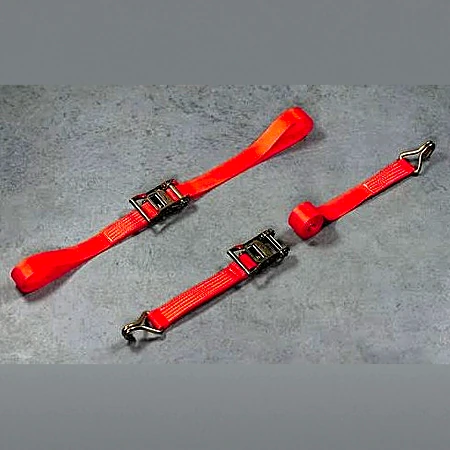
| C1 | Over-wheel strap (wheel strap) | 35 / 50 mm × 1.2 m / 1.5 m | Webbing with reinforced eye or D-ring both ends | 2 × LC of the band | 35 – 50 mm | Crosses the tyre tread; the car-carrier standard |
| C2 | Soft loop / axle strap | 35 / 50 mm × 0.6 m / 0.9 m | Webbing loop with wear sleeve | 2 × LC of the band | 35 – 50 mm | Round a rim, an axle or a wishbone without metal contact |
| C3 | Wheel choker with protective sleeve | 50 mm × 1.5 m | Diržas, PU-coated sleeve | 2 × LC of the band | 50 mm | Through the wheel, alloy-safe on the spoke face |
| C4 | E-track / airline track fitting | 50 mm (2″) | Plienas, zinc-plated, spring-loaded | ≥ 2,000 Ir | 50 mm | Track-equipped decks and van floors |
| C5 | Lashing ring, bolt-on | 50 mm ring bore | Kaltas plienas, zinc-plated | ≥ 2,500 Ir | — (deck side) | Retrofit anchor point on a flatbed or trailer |
| D1 | Edge sleeve / nešiojimo trinkelė | 0.5 m – 1 m | PU-coated webbing or split leather | — (protection) | Any width | Sharp deck edges, ramp lips, wheel arch trim |
| D2 | Neslystantis kilimėlis | Per deck bay | PVC foam or rubber granulate | — (friction) | — | Raises the friction the preload depends on |
Reketo įtampa
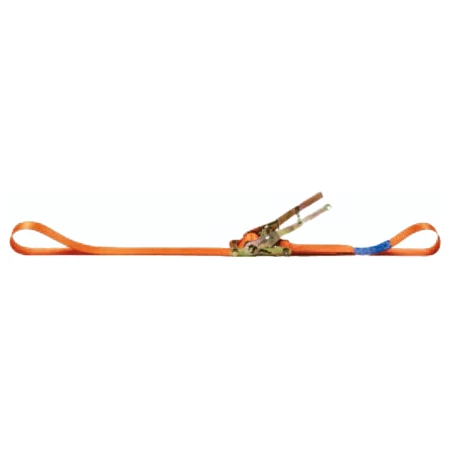
A short-lever ratchet is the standard car and van buckle: one hand on the lever, a pawl that holds what has been gained, and a drum that winds a few centimetres per stroke. Long-lever versions on 50 mm and above trade speed for tension, which is what a car-carrier deck wants because the operator is reaching under a low roofline. The buckle is a lever and a winch at once, and the number it produces is the STF on the label — not the LC. Parts that end a buckle’s life early are grit in the pawl, a bent lever and a drum that no longer turns freely.
Kabliukai, and why the anchor decides
Specify the anchor point rather than the hook, because a hook that sits half in its point is the commonest reason a car lashing comes loose — and it lets go under braking, which is the moment the lashing was bought for. A double-J hook with a closed throat for a deck lashing point or a container fitting; plokščias kablys krovinio lovos kraštui, because it marks the deck least and sits flat; a vinyl-sleeved S-hook for a ring or a hole on light duty, where the sleeve is doing as much work as the hook. Rings and shackles that take a belt end are on the kėlimo įrenginiai puslapį.
Wheel straps and soft loops
On a car carrier the belt should not touch the wheel face at all. An over-wheel strap crosses the tyre tread, which is the one part of a car built to be abraded, and the load is taken by a soft loop or a reinforced eye at the rim rather than by a metal hook dropped through the spokes. On an alloy wheel a bare hook marks the lacquer, and a mark under tension becomes a crack. Our wheel straps are supplied at 1.2 m ir 1.5 m in 35 mm ir 50 mm, with the loop stitched in the same recycled band as the belt so the assembly has one rating.
Track fittings and deck rings
Where the deck already has E-track or airline track, a 2″ spring fitting is faster than a hook and gives the operator a sliding anchor — worth having on a van floor or a multi-position car deck. Where there is no anchor at all, a bolt-on lashing ring turns a plain flatbed into a lashable one, and its own rating then becomes the weakest point, so specify it at or above the LC of the belts it will take.
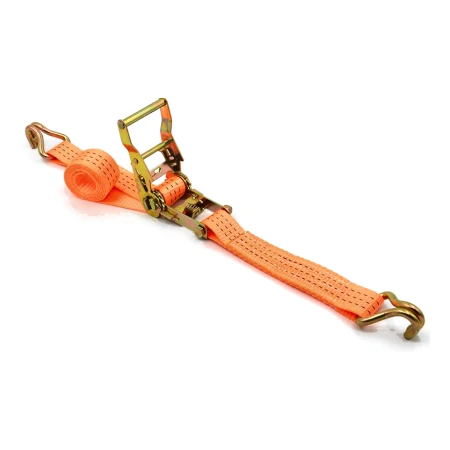
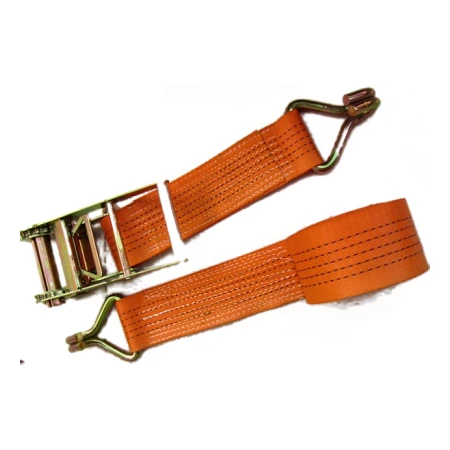
Five Ways to Lash a Car — and One That Must Not
| Method | What it grips | Belt and end | Saugokitės |
|---|---|---|---|
| Over-wheel, four corners | Tyre tread, with a soft loop at the rim | 35 – 50 mm, over-wheel strap plus ratchet | Strap must not cross a valve stem or bear on the alloy face |
| Through-wheel choker | Wheel and rim, band through the wheel | 50 mm choker with PU sleeve | Sleeve mandatory on alloy; never through a plastic wheel trim |
| Chassis slot lashing | Tie-down slot in the unibody or a dedicated ring | 50 mm, double-J or swivel hook with latch | Slot must be the manufacturer’s tie-down point, not a suspension part |
| Axle or wishbone loop | Axle beam, lower arm, recovery point | 35 – 50 mm soft loop plus ratchet | Keep clear of brake lines, ABS wiring and driveshafts |
| Body over the roof | — | Do not do this | Preload dents the roof panel and breaks glass; no belt is rated for it |
| Recovery or towing | — | Do not do this either | Snatch loads exceed any LC; use a purpose-made tow strap |
How Many Car Lashing Belts Does a Car Need?
The kerb weight is the start of the calculation, ne atsakymas. A vehicle is held against acceleration in three directions and the forward case is normally the worst: daugumos kelių rinkų dydis yra tvirtas, palyginti su lėtėjimu 0.8 g. Worked on a 1,500 kg car on a steel deck with rubber mats:
- Forward force to be held: 1,500 kg × 0.8 × 9.81 m/s² ≈ 11,770 N, or about 1,180 Ir.
- Friction already helping: a rubber mat on steel gives a coefficient of roughly 0.6, taip 0.6 × 1,500 × 9.81 ≈ 8,830 N, apie 880 Ir.
- Residual to be carried by the belts: grubiai 300 Ir — which four 35 mm belts at 750 daN each meet several times over.
That is why four belts is the normal answer for a passenger car and two 50 mm belts for a light commercial vehicle, and why the same car on a wet aluminium deck — friction coefficient nearer 0.2 — needs more restraint rather than more turns on the handle. The margin looks generous until the deck is wet, the ramp is steep or the tyres are new; the transport planner’s own calculation governs, and we will run it for a consignment on request.
Fitting a Car Lashing Belt in Five Steps
- Park and confirm the points. Chock or brake the vehicle, then identify the manufacturer’s tie-down points or the wheel you will lash. A suspension arm is not a tie-down point.
- Protect the contact. Soft loop or sleeve at every alloy face and every deck edge. A sleeve cannot be retro-fitted to a belt already woven, so it belongs in the order.
- Route the band. Over the tread, through the wheel, or to the slot — then check the run is straight to the anchor and clear of brake lines, fuel lines and trim.
- Įtampa STF, then stop. Take up the slack by hand, then use the ratchet to the standard tension force on the label. Past that point you are crushing the load and preloading the hooks, not adding restraint.
- Check and record. Re-check after the first 10–20 km, and at every stop on a long run. A belt that has gone slack is telling you the load moved.
Apžiūra, Priežiūra ir išėjimas į pensiją
Inspect before every trip and formally at the interval your system sets. A car lashing belt comes out of service for: pjūviai, snags or abrasion in the band, especially where it crossed an edge; sulaužytas, worn or pulled stitching at the hook and buckle ends; glazūruoti, stiff or discoloured fibre from heat or chemical contact; worn ratchet teeth, silpna spyruoklė, a bent lever or a drum that will not turn freely; a bent or opened hook; ir etiketė, kurios LC arba STF nebegalima nuskaityti. Without a legible LC the belt cannot be matched to a load, so it is out of service even if the band looks sound.
Laikyti suvyniotą, švarus ir sausas, nuo grindų ir nuo saulės spindulių, and wash with water and mild detergent — never solvent, which attacks the finish on the hardware and can degrade the fibre. A belt left coiled on an open deck for a season is not the belt that was delivered.
Recycled or Virgin — How to Specify Either
If the recycled claim is going into a tender, specify it the way an auditor will read it: the percentage of post-consumer rPET by yarn weight, the certification scheme and version (GRS 4.0), whether the transaction certificate is supplied per lot, and whether the colour is a natural finish or a dyed lot. If the claim is not required, specify virgin polyester and the same LC — the build, the hardware and the marking are otherwise identical, so the two versions of the same car lashing strap can sit on the same order without a second approval cycle.
Either way, ask for the batch pull-test record. It is the one document that ties the LC on the label to the band in the carton, and it is the document a serious buyer keeps.
Frequently Asked Questions About Car Lashing Belts
What is a car lashing belt?
A polyester webbing strap with a ratchet tensioner in its run and a hook, ring or over-wheel strap at each end, used to hold a vehicle on a trailer, a car-carrier deck or a flatbed. It is rated in lashing capacity because it restrains a load rather than lifting it. The industrial trade calls the same article a krovinio tvirtinimas; a builder’s merchant calls it a tie-down strap.
What does LC 2,500 daN mean?
2,500 deca-newtons, or about 2.5 tonnes of restraint in the tensioned band — the load the assembly is rated to hold. It is not a lifting capacity and it is not the breaking strength: pagal EN 12195-2 the webbing must reach at least twice the LC, so the webbing must break above 5,000 Ir.
Can I lift a car with a car lashing belt?
Nr. A lashing is rated for continuous tension in transit, marked in LC and STF. Lifting needs a poliesterio juostos diržas with a working load limit marked per hitch and a 7:1 saugos faktorius. The two articles come off the same loom and are not interchangeable.
Is recycled fiber weaker than virgin polyester?
Mechanically recycled rPET yarn usually starts slightly lower in tenacity, so we specify it by minimum tenacity and break-test every woven lot. The belt is then labelled with the LC it actually reaches — the same LC the same build reaches in virgin polyester. Recycled content is a feedstock decision, not a derating.
How many belts do I need for one car?
Four for a passenger car on a carrier deck, du 50 mm belts for a light commercial vehicle. The count comes from the residual force after friction — see the worked example above — not from the kerb weight, and a wet deck or a steep ramp needs more.
Over-wheel strap or a hook through the rim?
Over-wheel with a soft loop for alloy wheels, so no metal touches the rim face; a sleeved choker through the wheel for steel wheels. A bare hook through an alloy rim marks the lacquer, and a mark under tension becomes a crack.
Kokio ilgio turėčiau užsisakyti?
Measure from the deck anchor, over or through the wheel, and back to the second anchor, then add 300–500 mm of tail to grip. 6 m is the common car-carrier length; 1.5 m ir 2 m are the common wheel-strap lengths.
Can you supply GRS-certified belts with my own label?
Taip. We weave from GRS-certified rPET yarn on request, print your brand, part number, LC and STF on the sewn label, supply the transaction certificate for the yarn lot, and pack to your artwork — poly bag and header card, spalvos dėžutė, or bulk carton.
Susiję produktai
- Raketiniai surišimo dirželiai — the general cargo version of this belt, 25– 100 mm, rated in LC.
- Krovinių tvirtinimas — how the number of straps for a consignment is worked out.
- Poliesterio juostos diržas — the lifting article, with WLL and mode factors.
- Baltas plokščias diržas — the same band undyed, for lifting finished surfaces.
- 3 tonų plokščios juostos diržas — the most-bought lifting size.
- Kėlimo įrenginiai — hooks, shackles and rings at the belt end.
- Krovinių kėlimo tinklas — when the load is loose rather than a vehicle.
- Apvalūs stropai — soft lifting slings for chassis and body shells.
Request a Quotation for Car Lashing Belts
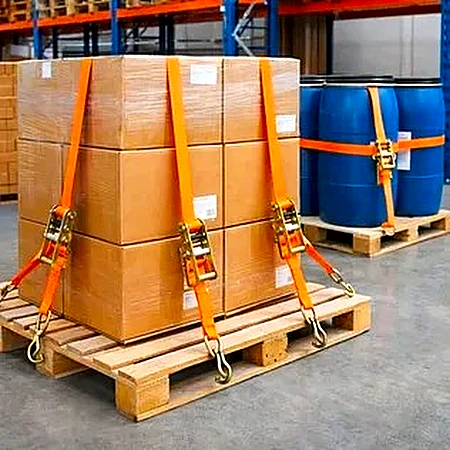
Send the vehicle, its mass, the anchor points and their spacing, the deck surface, the width and LC you need, and whether the recycled content has to be certified. Patvirtiname LC, the STF, the end fittings, the length and the marking before anything is cut — 25 mm iki 100 mm, iki 10 t LC, su jūsų nuoroda etiketėje.
Send your car lashing belt specification for a quotation
Telefonas / WeChat: +86 180 6600 2268 | paštas: lift98@jslift.com
Adresas: Lifutės pramonės parkas, Taidžou miestas, Dziangsu provincija, Kinija | HS kodas: 630790