

Lift sling rigging company produce 2000KG Single Use Lifting Slings,2000kg Lifting Slings,2Ton Single-use flat sling,2000kg Flat Webbing Slings,2000kg Single Use Slings,2Tonne one way lifting sling.
2000KG Single Use Lifting Slings
- 2,000 kgWLL, vertical hitch
- 1,600 kgWLL, choker hitch
- 4,000 kgWLL, basket hitch
- 60 / 30 mmJuostos plotis, vienišas / dvigubas sluoksnis
Single use describes the journey and the purchase, not a lower grade of band. The width, the factor and the marking are specified exactly as they are for a sling that will work for years, because the one lift still has to be a rated lift. If you need the same band rated for repeat service, į begalinio tipo juostos diržas covers that case; this page is about the one-way build.
The 2000 kg line at a glance
Both constructions carry the same rating. What changes is the shape of the band, and that is the decision most buyers actually make.
| Parametras | Vieno sluoksnio | Dvigubas sluoksnis |
|---|---|---|
| Darbinės apkrovos riba, vertikaliai | 2,000 kg | 2,000 kg |
| Darbinės apkrovos riba, choker | 1,600 kg | 1,600 kg |
| Darbinės apkrovos riba, krepšelis | 4,000 kg | 4,000 kg |
| Juostos plotis | 60 mm | 30 mm |
| Juostos storis | 7.5 mm | 15 mm |
| Minimalus ilgis | 1.2 m | 1.5 m |
| Weight of band | 0.45 kg/m | 0.50 kg/m |
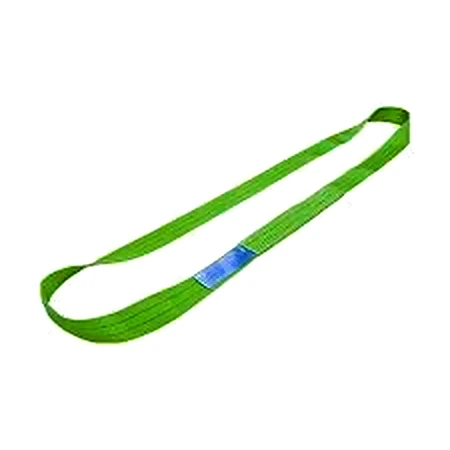
| Spalvos kodas (IN 1492-1) | Žalia | Žalia |
| Dizaino veiksnys | 7:1 | 7:1 |
60 mm single ply or 30 mm double ply
The rating is identical, so choose on handling and on the surface being lifted.
Vieno sluoksnio, 60 mm pločio
- Load spread over a wider face — the better default for finished surfaces, painted steel and dressed timber.
- Thin enough to lie flat under a pack and to be inspected by feel along its length.
- Shows abrasion earlier, which is an advantage on a one-trip sling: damage appears where you can see it.
Dvigubas sluoksnis, 30 mm pločio
- Two layers of the same webbing, so twice the thickness in half the width — it threads through tight eye bolts and shackle bows that a 60 mm band will not enter.
- More abrasion reserve where the band crosses a sharp arris.
- Stiffer to handle and slightly heavier per metre.
If the lift is a bundle of steel bars, choose single ply. If it is a machined shaft through a narrow eye, choose double ply. Both are 2 t; neither is the “stipresnis” one.
Ilgis, weight and packing
Band weight follows directly from the metre rate, which matters when you are air-freighting a few hundred slings or checking a carton against a customs declaration.
| Ilgis | Vieno sluoksnio | Dvigubas sluoksnis |
|---|---|---|
| 1.2 m | 0.54 kg | — |
| 1.5 m | 0.68 kg | 0.75 kg |
| 2 m | 0.90 kg | 1.00 kg |
| 3 m | 1.35 kg | 1.50 kg |
| 4 m | 1.80 kg | 2.00 kg |
| 6 m | 2.70 kg | 3.00 kg |
| 8 m | 3.60 kg | 4.00 kg |
| 10 m | 4.50 kg | 5.00 kg |
Each sling is folded, bagged and carton-boxed; larger orders are palletised. Dėl a 2000 kg band the packed weight runs about 15–20 % above the figures above once bags, labels and cartons are counted — use the carton weight on the packing list for freight, not the band weight.
Reading the colour, and the number beside it
IN 1492-1 assigns a colour to each working load limit so a supervisor can spot a wrong sling from a distance. Green means two tonnes in that code. The colour is a check, not the authority: the label states WLL, ilgio, batch and standard, and the lift plan is built from the label.
| WLL | Spalva (IN 1492-1) | Juostos plotis | Minimalus ilgis |
|---|---|---|---|
| 1,000 kg | Violetinė | 30 mm | 1.1 m |
| 2,000 kg | Žalia | 60 mm | 1.2 m |
| 3,000 kg | Geltona | 90 mm | 1.3 m |
| 4,000 kg | Pilka | 120 mm | 1.4 m |
| 5,000 kg | Raudona | 150 mm | 2.0 m |
| 6,000 kg | Ruda | 180 mm | 2.0 m |
| 8,000 kg | Mėlyna | 240 mm | 2.0 m |
| 10,000 kg | Oranžinė | 300 mm | 3.0 m |
| 12,000 kg | No standard colour | 300 mm | 3.0 m |
Aukščiau 12 t the range continues in double ply to 24 t, where the colour code no longer applies and the label carries the rating alone. The full spread of formats is listed under vienkartiniai stropai.
Ką 2 t rating becomes in each hitch
The number on the label is a vertical rating. Two other hitches are in common use and both change the figure before any dynamic effect is considered.
| Prikabinti | WLL | When it applies |
|---|---|---|
| Vertikalus | 2,000 kg | Viena koja, hook to load, no wrap-around |
| Chokeris | 1,600 kg | Band passed round the load and through its own eye |
| Krepšelis, kojos vertikalios | 4,000 kg | Juosta po apkrova, both eyes to the hook |
| Krepšelis, 45° leg angle | 2,800 kg | Two legs opening as the load spreads |
| Krepšelis, 90° leg angle | 2,000 kg | Wide load, legs almost horizontal |
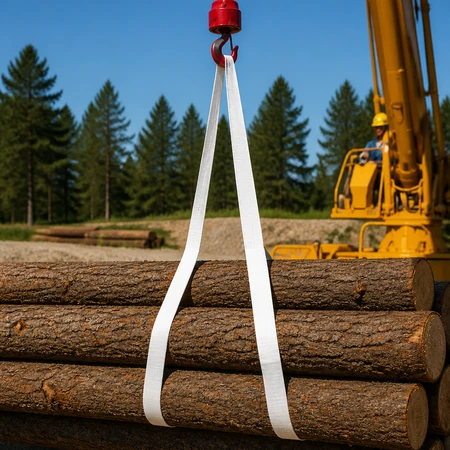
A choker costs you a fifth of the rating, štai kodėl a 2 t sling is often bought where the arithmetic says 1.6 t. Decide the hitch before you decide the tonnage.
Akys, sleeves and the places a band dies
The eyes are where a one-trip sling usually fails, so they are worth specifying rather than accepting.
- Plokščia akis, pasiūtas. The standard finish: the band is folded back and stitched, giving a soft eye that conforms to a hook.
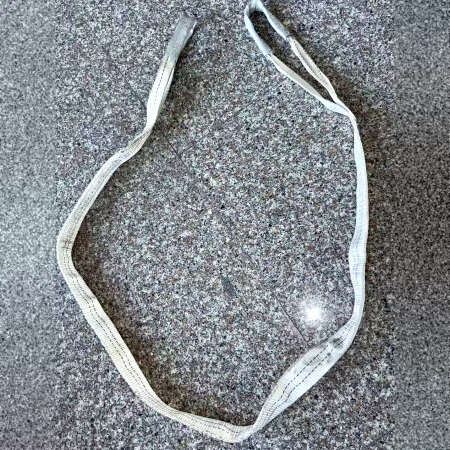
- Sustiprinta akis. An extra wrap of webbing or a red sleeve over the eye, as on the white sling below, takes the abrasion that a steel hook or a shackle pin would otherwise take from the band.
- Wear sleeve on the body. A loose sleeve slid over the contact point, for loads with a known arris.
- Edge protection. Separate pads or corner guards, used with the sling rather than sewn into it.
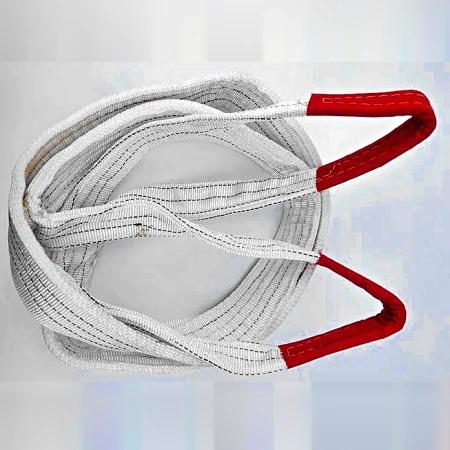
Polyester is rated from −40 °C to +100 °C and resists most oils and solvents; it is attacked by concentrated acids and by alkalis at strength. It also stretches less than nylon under the same load, štai kodėl a 2 t polyester band is the usual choice where the load must not sink after it leaves the ground. Cones, hooks and shackles that go with the band are listed under kėlimo įrenginiai.
Žymėjimas, and what has to be on the label
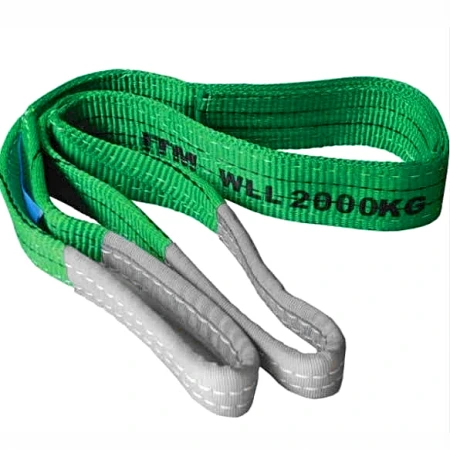
Every sling leaves with a sewn label carrying the working load limit, ilgis, medžiaga, the batch number, the design factor and the standard it was made to. The band is also printed with WLL in figures large enough to read from the ground, because the label is under the load once the lift starts.
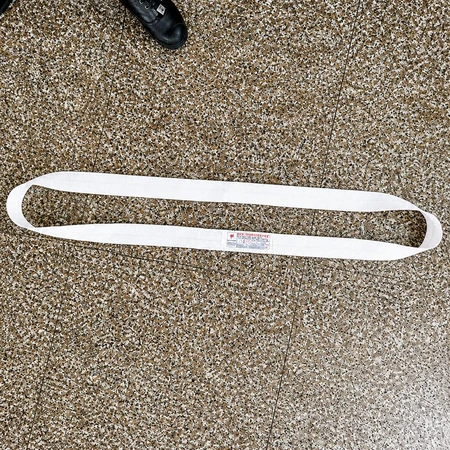
- Batch traceability. The batch number on the label ties back to the webbing roll and the test record, which is what an auditor asks for when a one-trip sling is used on a project.
- CE ženklinimas. Applies to the 7:1 series under Directive 2006/42/EC. Other design factors are supplied with type-test reports instead, so state the factor on the enquiry if CE matters to your market.
- Dokumentacija. Batch material certificate, test report and declaration of conformity travel with the shipment. Certification scope is set out under sertifikavimas.
- Private label. Your own label layout and part numbers can be printed, provided WLL and standard stay legible.
Single use, and what it does not excuse
Buyers come to this page for one reason: they want a 2000KG single use lifting sling rated for one lift, without paying for a band that will last ten years. That is a reasonable purchase, and the cost saving is real — it comes from the paperwork, the packaging and the fact that nobody will inspect the sling again, not from a thinner band.
Three things do not change on a one-way sling:
- The working load limit is still a limit, and the hitch still derates it.
- The sling still has to be inspected before the lift — one trip is one trip, not zero checks.
- The band still has to be stored away from heat, sunlight and chemicals between the factory and the lift, because polyester loses strength long before it looks damaged.
If the sling is coming back into stock and will be used again, buy the repeat-service webbing sling vietoj to. The two products look alike and are not interchangeable in a safety system.
Ordering a 2000KG single use lifting sling
Six lines on an enquiry are enough to quote and to make the sling correctly the first time:
- Rating and build: 2000 kg, vieno sluoksnio 60 mm or double ply 30 mm.
- Ilgis: between the inside of the eyes, e.g. 2.5 m.
- Baigiasi: flat eye both ends, or one eye and one hook; reinforced eyes if the hooks are steel.
- Apsauga: sleeves, pads, or none.
- Žymėjimas: standard label or private label; CE required or type-test report only.
- Quantity and destination: pieces, and the port or door the cartons go to.
Send the list through contact us and the reply comes back with the band width, the length tolerance and the carton weight, so the freight can be calculated before the order is placed. For containerised loads that need lashing rather than lifting, į krovinio tvirtinimas range uses the same webbing on a different rating basis, and should not be substituted for a lifting sling.
Dažnai klausiama
How much does a 2000KG single use lifting sling weigh?
Apie 0.45 kg per metre in single ply and 0.50 kg per metre in double ply, taigi a 2 m single ply sling is roughly 0.9 kg of band. Packed weight is 15–20 % higher once the bag, label and carton are counted.
Why is the 2 t sling green?
Green is the EN 1492-1 colour for a two tonne working load limit. It lets a supervisor check a sling at a glance, but the label governs — the colour is not a rating.
Is double ply stronger than single ply at the same tonnage?
Nr. Both builds are rated 2,000 kg. Double ply packs the same strength into half the width and twice the thickness; single ply spreads it over a wider face. Choose on the eye you have to pass through and the surface you are lifting.
What is the minimum length?
1.2 m in single ply and 1.5 m in double ply, measured between the inside of the eyes. Below that the eye splice takes up too much of the band to sew a reliable joint.
Can one sling be used for several lifts?
A single use sling is bought for one consignment and is not normally recovered, inspected and returned to service. If it is coming back, specify a repeat-service sling with the same rating and keep it in an inspection regime.
Kur eiti toliau
- Vienpusis stropas — the whole category, by tonnage and format.
- Vienkartiniai stropai — the range this 2 t sling belongs to.
- Begalinio tipo juostinis diržas — same band, loop construction, repeat service.
- Begaliniai kėlimo stropai — round slings for loads that need a soft, conforming choke.
- Webbing sling manufacture — how the band, the stitch and the label are made.
- Apie mus — the factory behind the label.
Data note: band dimensions, metre weights and minimum lengths follow the published 2 t rows of the standard size table (single ply and double ply). Weights by length in Table 2 are calculated from those metre rates. Hitch figures in Table 4 apply the standard leg-angle factors to the published basket rating.