

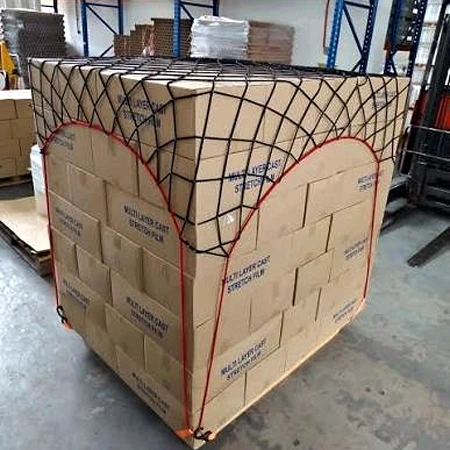
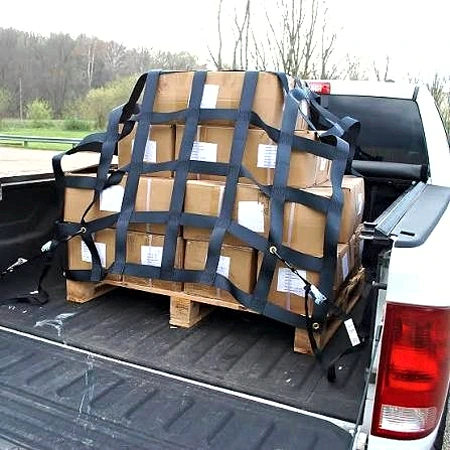
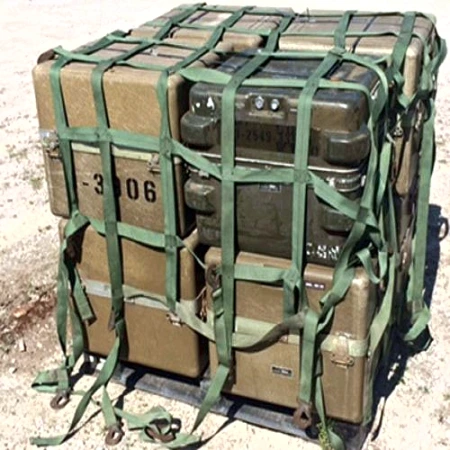
Lift sling rigging company produce Cargo Securing Net,Load Securing Net,Small mesh cargo securing net,Container securing net,Cargo secure webbing net.
Cargo Securing Net
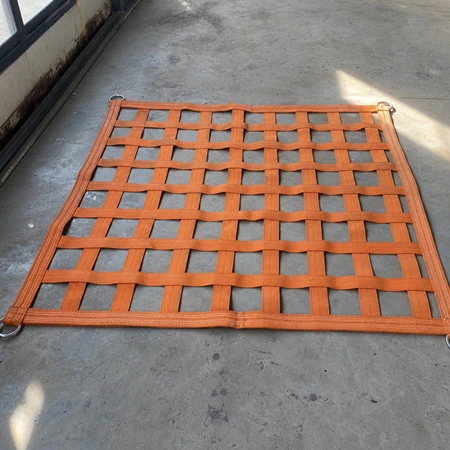
A cargo securing net is a flat-belt restraint net laid over a load and tensioned down to the deck, so that the cargo cannot slide, rock or topple on the way. The belts are woven from high-tenacity polyester into an open lattice, the border is folded and double-stitched, and the edge carries rated attachment points that are pulled down with ratchet tensioners until the load is pressed onto the vehicle or container floor.
The distinction that matters on this product is duty, not appearance. A cargo securing net restrains; it does not lift. Its label carries a lashing capacity (LC) and a standard tension force (STF) daN, the arrangement is calculated to EN 12195-1 and the belts are type-tested to EN 12195-2 – not to a lifting working load limit. We weave the belts in our own mill in Taizhou, so net size, tinklelis, belt width, fittings and markings are set to your load, your vehicle and your anchor points.
- Restraint rating, ne kėlimo reitingas – LC and STF marked in daN, calculated to EN 12195-1, belts type-tested to EN 12195-2.
- Flat high-tenacity polyester belts – 25 mm iki 100 mm, single or duplex, Stabilizuotas UV spinduliais ir atsparus puvimui.
- Sized to the load or the aperture – cover nets, container doorway nets, partition nets and bag form, all made to order.
- Rated fittings and tensioners – ratchets, kabliukai, D-rings and lashing points, with anti-slip mats where the deck friction is low.
- Sertifikuota CE ir GS – austi, susiuvama, marked and tested in one plant, su ISO 9001, CNAS ir DNV už jo.
Restraint is not lifting – and the label says which one you have
The two products look alike, are made from the same belt and are often bought by the same fleet. Jie nekeičiami, and the difference is not a formality: one is sized so a load cannot move, the other is sized so a load cannot fall. Using a restraint net on a crane hook, or a lifting net as a tensioned tie-down, is a safety failure rather than a paperwork problem.
Lentelė 1 – Why a securing rating and a lifting rating are not interchangeable.
| Palyginimo taškas | Krovinio tvirtinimo tinklas (šį puslapį) | Kėlimo tinklas |
|---|---|---|
| Ką tai daro | Sulaiko krovinį, kuris lieka ant transporto priemonės | Neša visą krovinio svorį ore |
| Valdoma | IN 12195-1 (tvirtinimo jėgų skaičiavimas) ir EN 12195-2 (juostiniai raiščiai) | Kėlimo standartai, with webbing rated on the EN 1492-1 pagrindu |
| Įvertinta | Tvirtinimo pajėgumas (LC) ir standartinė įtempimo jėga (STF), daN | Darbinės apkrovos riba (WLL), tonomis |
| How it is sized | Sized to resist the acceleration and friction case for the journey | Dydis su a 5:1, 6:1 arba 7:1 faktorius ir patikrintas kiekvieno stropo |
| How it is tested | Belt and tensioner type-tested to EN 12195-2 | Every sling break-tested on our own 1000 t mašina |
| How it fails | The load moves – a road accident | The sling breaks – a dropped load |
If the requirement is to lift – a pallet onto a roof, a bag into a hold – the right product is a lifting net: į krano padėklų krovinių tinklas, į poliesterio kėlimo tinklas arba sunkiasvoris nailoninis krovinių tinklo diržas. If the requirement is to keep a load still from the loading bay to the delivery point, this page is the right one.
The forces the net has to answer for
A load on a moving vehicle is pushed in three directions, and each one is a design case rather than an accident. The accelerations below are the ones EN 12195-1 uses for road transport; other modes and national rules differ, which is why we ask where the load is travelling before we size the net.
Lentelė 2 – Design accelerations for road transport and what resists each one.
| Direction | Design acceleration | What resists it |
|---|---|---|
| Forward (braking) | 0.8 g | Blocking or a headboard first, then direct lashings to the front; friction contributes |
| Rearward (acceleration) | 0.5 g | Rear lashings and a tailboard; the net’s rear edge lines |
| Sideways (cornering) | 0.5 g | Side lashings, containment by the lattice, and friction from the pre-tension |
| Vertikalus | Not a road design case | Held down by pre-tension and containment; a net reduces bounce but is not a substitute for blocking |
The practical consequence is that a net alone rarely carries the whole case. Blocking against a headboard does more for the braking case than any strap, and a net laid over the top does the rest. A good securing arrangement is a combination, and we will say so when a net is the wrong answer for your load.
Kaip plokščias diržas išlaiko krovinį
Apsauginis tinklas vienu metu veikia trimis mechanizmais. Which one dominates depends on how the net is fitted, and that is decided at the vehicle rather than at the factory.
Lentelė 3 – The three mechanisms a securing net uses.
| Mechanizmas | Kaip tai veikia | What it depends on |
|---|---|---|
| Trintis (pririšimas) | Įtemptas tinklas spaudžia krovinį ant denio, o trintis tarp krovinio ir denio neleidžia slysti. This is the main effect of a cover net | A švarus, dry deck or anti-slip mats. Be trinties tas pats tinklas sulaiko daug mažiau |
| Sulaikymas | Grotelės fiziškai sustabdo krovinio plitimą, rocking, or throwing individual items out | A mesh fine enough for the smallest item, and a net fitted tight rather than draped |
| Direct lashing | Where the edge belts run down to rated points on the vehicle, pats diržas neša suvaržymo jėgą | Certified anchor points on the vehicle – never a random protrusion or a load’s own packaging |
Two numbers decide whether the arrangement works, and both are usually ignored. The first is the angle: a tie-down belt is most effective between 75 ir 90 laipsnių iki denio, and its effective capacity follows LC_eff = LC × sin α. At 30 degrees you keep roughly half the belt’s rating, so a net pulled down almost flat looks tidy and holds very little. The second is friction: the coefficient between a steel load and a steel deck is about 0.1 į 0.2, steel on timber about 0.2 į 0.3, timber on timber about 0.3 į 0.4, and a good anti-slip mat takes a pallet on a deck to about 0.5 į 0.6. Šlapias, oily or icy surfaces take all of these figures down, which is why the same net restrains very different loads on two different days.
Techniniai parametrai
The figures below cover the standard securing range. Belt, tinklelis, net size, edge fittings and tensioners are all made to order, todėl šią lentelę laikykite citatos atskaitos tašku, o ne fiksuotu katalogu.
Lentelė 4 – Krovinio tvirtinimo tinklas: techniniai parametrai.
| Parametras | Specifikacija |
|---|---|
| Produkto tipas | Krovinio tvirtinimo tinklas (apkrovos ribojimo tinklas) – cover net, partition net, container doorway net or bag form. Ne kėlimo įrenginys |
| Belt material | 100 % didelio atsparumo poliesteris (PET); didelio atsparumo nailonas pagal užsakymą |
| Belt width | 25 / 35 / 50 / 75 / 100 mm |
| Belt construction | Vieno sluoksnio arba dvipusis, austas kraštas, ne nupjautas kraštas |
| Belt thickness | 1.8 mm – 4.0 mm, priklausomai nuo pločio ir sluoksnių skaičiaus |
| Tinklo atidarymas | 100 × 100 mm standartas; 50 mm – 300 mm pagaminti pagal užsakymą |
| Grynasis dydis | Pagaminta pagal apkrovos pėdsaką, transporto priemonės lova, arba konteinerio ar durų angą |
| Tvirtinimo pajėgumas (LC) | Apie 750 daN on a 25 mm belt to about 5,000 daN on a 100 mm duplex belt, marked per net |
| Išankstinė įtampa (STF) | 250 – 500 daN depending on the tensioner supplied; pažymėta etiketėje |
| Standartinis pagrindas | IN 12195-1 for the securing calculation; IN 12195-2 for the webbing lashing |
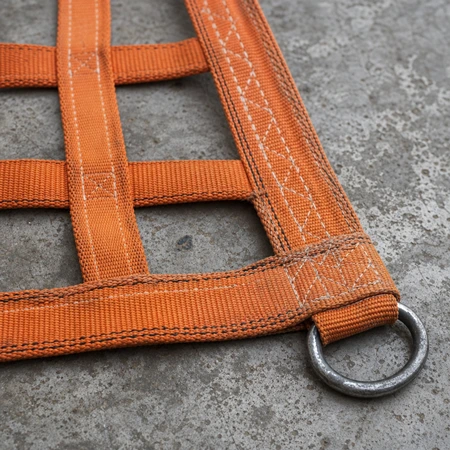
| Sienos | Sulankstytas ir dvigubas susiuvimas; sutvirtintas kiekviename tvirtinimo taške |
| Armatūra | Raketiniai įtempikliai, kabliukai, D-žiedai, cam buckles and lashing points, laipsnis 80 steel where steel is used |
| Spalva | Orange for high visibility as standard; mėlyna, žalias, black or a custom colour |
| Gydymas | UV stabilizuotas, anti-senėjimo, atsparus dilimui ir plyšimui, atsparus puvimui |
| Darbinė temperatūra | -40 °C iki +100 °C |
| Sertifikavimas | CE, GS, ISO 9001, JIS pagal pageidavimą; CNAS laboratorija; DNV |
| Tinkinimas | OĮG / ODM dydis, spalva, printed belt, etiketė, logotipas ir pakuotė |
| HS kodas | 6307.90 – tinklai ir tinkleliai iš tekstilės medžiagų |
Standartiniai dydžiai, mesh and lashing capacity
A securing net is sized to the load it covers or the aperture it closes, never to a tonnage. The load has to be fully covered, and the border has to land on the deck or on the anchor points instead of hanging in mid-air, because an unsupported edge is an edge that can be pulled sideways.
Lentelė 5 – Standard securing net sizes, with the belt and capacity that normally go with them.
| Grynasis dydis (L × W) | Tinklelis | Belt | LC per edge line | Tipiškas naudojimas |
|---|---|---|---|---|
| 1.2 × 1.2 m (4 × 4 ft) | 100 mm | 35 – 50 mm | 1,000 – 2,000 Ir | Single pallet in a van or light truck |
| 2.5 × 1.2 m (8 × 4 ft) | 100 mm | 50 mm | 2,000 Ir | Two pallets abreast in a van or curtain-sider |
| 2.5 × 2.5 m | 100 mm | 50 mm | 2,000 Ir | Plokštės apkrovos, mašinos, mišrus krovinys |
| 5.0 × 2.5 m | 100 – 150 mm | 50 – 75 mm | 2,000 – 3,500 Ir | Viso ilgio bortinių ir priekabų kroviniai |
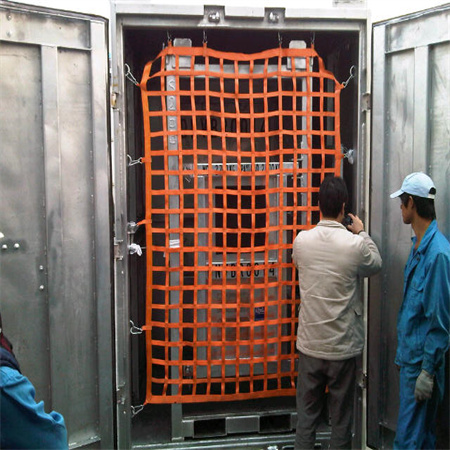
| 2.4 × 2.6 m (konteineris) | 100 mm | 75 mm | 3,500 Ir | Container doorway net, load held back from the doors |
| 1.5 × 1.5 m bag form | 50 – 100 mm | 50 mm | 2,000 Ir | Loose or bagged goods that would spread on the deck |
| Pagaminta pagal piešinį | 50 – 300 mm | 25 – 100 mm | To calculation | Any footprint, aperture or vehicle bed |
The capacity column is the restraint available per edge line, not a lifting limit. The number of edge lines, their angle and the friction under the load decide what the arrangement actually restrains.
Four forms of securing net
The same lattice is supplied in four arrangements, and choosing the right one is most of the job. Prietaisai tarp jų skiriasi; suvaržymo principas ne.
Lentelė 6 – Viršelis, partition, container and bag forms.
| Forma | Kaip jis sumontuotas | Naudojamas kai |
|---|---|---|
| Dengiantis tinklas | Spread over the load and tensioned down to the deck or to the vehicle’s rated points | Plokščiasis, curtain-sider and container loads that must not move in any direction – the most common arrangement |
| Partition net | Fixed upright across the vehicle body and tensioned against its own frame | Separating two loads in one vehicle, or holding cargo away from a bulkhead |
| Container doorway net | Fitted across the door aperture and hooked to the container’s own rings | Stopping cargo migrating to the doors during the journey, so the container is safe to open |
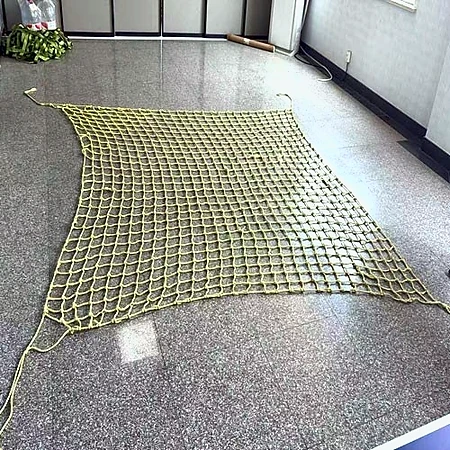
| Maišelio forma | Closed at the bottom, with the cargo sitting inside the lattice | Loose or bagged goods that would otherwise spread across the deck |
Armatūra, tensioners and anti-slip
A securing net is only as good as the tensioner that pre-tensions it and the anchor point it pulls against. These are the parts that get specified last and fail first.
Lentelė 7 – Jungiamosios detalės ir įtempikliai.
| Montavimas | Naudotas su | Pastaba |
|---|---|---|
| Reketo įtampa | Dengiantis tinklas, maišelio forma | Nustato išankstinę įtampą (STF). A ratchet that cannot reach the marked STF makes the net ineffective, whatever its LC |
| Kumštelio sagtis | Lengva apkrova | Faster than a ratchet but reaches a much lower pre-tension – for light loads only |
| Kabliukai ir D žiedai | Bet koks susitarimas | The link between net and anchor point; laipsnis 80 plieno, kai naudojama plieninė jungiamoji detalė |
| Tvirtinimo taškai | Dengiantis tinklas | Rated anchor points in the vehicle structure – the restraint force has to go somewhere rated |
| Neslystantis kilimėlis | Trinties suvaržymas | Raises the friction coefficient under the load; usually the single most effective addition on a smooth deck |
| Apsauginė rankovė | Apkrovos aštriais kraštais | Fits over the belt at the contact point; pigiausias būdas prailginti neto naudojimo laiką |
| Remonto komplektas | Fleet maintenance | Matching belt, siuvimo siūlas ir atsarginis įtempiklis |
Žymėjimas, colour and identification
A securing net is checked by the driver before every trip and by an inspector at the roadside, so the marking has to be readable at a distance and has to survive being dragged over a deck.
- Lashing capacity and standard tension force printed along the belt in daN – the units load securing is actually calculated in.
- Net size and date of manufacture printed as well, so the net can be matched to the vehicle and its age judged on the spot.
- A sewn capacity label in addition to the print, taigi tinklas ir jo dokumentai visada sutaria.
- Orange as the standard high-visibility colour, with blue, žalias, black or a house colour for fleet identification.
- OEM orders can carry your brand, ant diržo išspausdintas įspėjamasis tekstas arba sertifikato numeris.
- Nets ship folded into a bag or a crate – a fleet order takes a fraction of the space of the same number of loose straps.
Testavimas, sertifikavimas ir atsekamumas
- Keturiasdešimt metų kėlimo įrangos gamyba – įkurtas m 1985 Taidžou mieste, Dziangsu, su daugiau nei 200 darbuotojų.
- Belts woven in our own mill, toks plotis, layer count and colour are under our control rather than bought in.
- Webbing strength-tested on our own 1000 t horizontal machine before it is cut into nets.
- Belts supplied to the EN 12195-2 material requirements for securing duty, with the securing calculation following EN 12195-1.
- CE atitikties deklaracija ir GS sertifikatas, with JIS on export orders; ISO 9001, CNAS laboratory accreditation and DNV certification behind the plant.
- Kiekvienas tinklas pažymėtas jo tvirtinimo pajėgumu, išankstinė įtampa, dydis ir tinklelis prieš pakuojant, and supplied with a material test report on request.
Sertifikatus ir bandymų ataskaitas galima gauti PDF formatu konkurso bylai arba muitinės patikrai – pamatyti visą sertifikavimas rinkinys.
Kur naudojami krovinio tvirtinimo tinklai
The same net covers a road trailer, a container, a rail wagon and a barge. What changes is the number of anchor points, the mesh and how the net is tensioned – not the product itself.
Lentelė 8 – Applications by transport mode.
| Režimas arba sektorius | Ką sulaiko tinklas | Kodėl tam tinka plokščias diržas |
|---|---|---|
| Kelias – plokščias | Mašinos, plieno, mediena, padėklai, būgnai ir mišrūs kroviniai | Vienu veiksmu padengia visą krovinį ir sujungia trintį su sulaikymu |
| Kelias – užuolaidinė sienelė | Palletised and boxed goods that shift against a soft curtain | Sudėtyje yra krovinys, kur pati užuolaida nevaržo |
| Konteinerių gabenimas | Kroviniai už durų, and cargo that must not migrate in transit | A doorway net makes the container safe to open and stops the load moving forward |
| Krovinių gabenimas geležinkeliu | Palletised and loose cargo in wagons and on flat wagons | Ilgi tinklai dengia vagono lovą ir gali būti reguliariai įtempiami |
| Jūra ir vidaus vandenys | Denio krovinys, ir kroviniai baržose ir triumuose | Atsparus puvimui, UV stabilised and unaffected by salt water |
| Heavy haulage and project cargo | Transformatoriai, plant and out-of-gauge loads | Combined with direct lashings and blocking for indivisible loads |
| Waste, recycling and agriculture | Bales, refuse, compost and bulk loads on open vehicles | Containment stops loose material leaving the vehicle in transit |
| Military and relief transport | Palletised and loose cargo in trucks and aircraft | One net per load, quick to apply and reusable over many trips |
Priežiūra, patikrinimas ir išėjimas į pensiją
- Check the net before every trip and record the check: the tensioner first, then the stitching at every attachment point, then the belts.
- Atmeskite bet kokį diržą su įpjovomis, krašto pažeidimas, sulaužytas susiuvimas, cheminis dažymas, šiluminis stiklinimas, or the colour and gloss change that signals UV degradation.
- Check the vehicle’s anchor points as carefully as the net. A perfect net on a corroded lashing point restrains nothing.
- Laikykite denį švarų ir sausą, and fit anti-slip mats wherever load-to-deck friction is low. That is a securing measure, ne patobulinimas.
- Never use a securing net to lift, and never use a lifting net as a tensioned tie-down unless its label carries both ratings.
- Laikyti švariai ir sausai, nuo žemės ir nuo tiesioginių saulės spindulių; never repair a webbing belt by knotting, suvirinant ar kaitinant.
- Withdraw the net if a belt, pažeista dygsnio linija arba įtempiklis, and have nets inspected by a competent person at the interval your fleet requires.
Dažnai užduodami klausimai
Can a cargo securing net be used to lift a load?
Nr. It is rated for restraint, nekelia, and the two are calculated on completely different bases. If the load has to go onto a hook, use a lifting net with a working load limit and a per-sling proof test – the crane pallet cargo net or the polyester lifting hoisting net, both linked earlier on this page.
What is the difference between LC and STF?
LC (rišimo pajėgumas) is the restraint force the belt is rated to carry. STF (standartinė įtempimo jėga) is how hard the ratchet tensioner can pre-tension the belt. Both are marked in daN. LC matters most in direct lashing, where the belt itself holds the load; STF matters most in tie-down lashing, where the pre-tension creates the friction that does the holding.
Koks turi būti tinklelis?
Pakankamai įtemptas, kad pasiektų etiketėje pažymėtą išankstinį įtempimą, with the belts running as steeply to the deck as the load allows – 75 į 90 degrees is where a tie-down belt works best. A belt laid almost flat keeps only about half its capacity, todėl tinklelis, kuris atrodo tvarkingai uždengtas, gali tilpti labai mažai.
Ar man reikia neslystančių kilimėlių?
If the restraint relies on friction – which is what a cover net does – then usually yes. On steel, aluminium or plastic surfaces the friction coefficient is low, and a mat often adds more restraint than an extra strap does. A švarus, dry deck is the other half of the same measure.
Kiek tvirtinimo taškų ar tvirtinimo taškų man reikia?
Tai išplaukia iš apkrovos, denio trintis, the vehicle and the journey rather than from a rule of thumb. Direct lashing normally needs at least four anchor lines, two per side and crossed, with the vertical and plan-view angles between 30 ir 60 laipsnių. Atsiųskite mums krovinio ir transporto priemonės duomenis ir mes susitarsime su jumis.
Will a net stop cargo moving inside a container?
Durų anga arba pertvarų tinklas sustabdo krovinio judėjimą link durų ir užtikrina saugų konteinerio atidarymą. For the journey itself the load still has to be restrained as a whole, taigi konteineris dažniausiai tvirtinamas pertvariniu tinklu ir blokavimu arba dangteliu, o ne tik tinklu.
Kokią tinklelio angą turėčiau pasirinkti?
Fine enough that the smallest item in the load cannot pass through. 100 mm yra mūsų standartas ir telpa padėklai, dėžutės, krepšiai ir būgnai; laisviems ar smulkiems daiktams reikia tvirtesnio tinklelio, o dideli nedalomi kroviniai gali paimti platesnį.
Ką dar gaminate krovinių tvarkymui?
The same belts go into our juostos stropai ir begalės apvalių stropų, the wire rope range is under vielinių lynų stropai, the rope itself under nailono virvės, and RoRo and breakbulk work is covered by the transporto priemonių kėlimo tinklas. The lifting side of the net range starts at krovinių kėlimo tinklai.
Prašyti citatos
Send the transport mode, the load weight and dimensions, ar jis gali plisti ar nuvirsti, the deck material, tinklo arba angos dydis, the belt width and the anchor points you have – or a drawing of the load and the vehicle. Mūsų inžinieriai patvirtins tinklą, armatūra, tvirtinimo linijų skaičius ir įpakavimas, ir cituoti jį viename atsakyme. Pirmiausia pasikalbėti, susisiekite su mūsų inžinieriais.
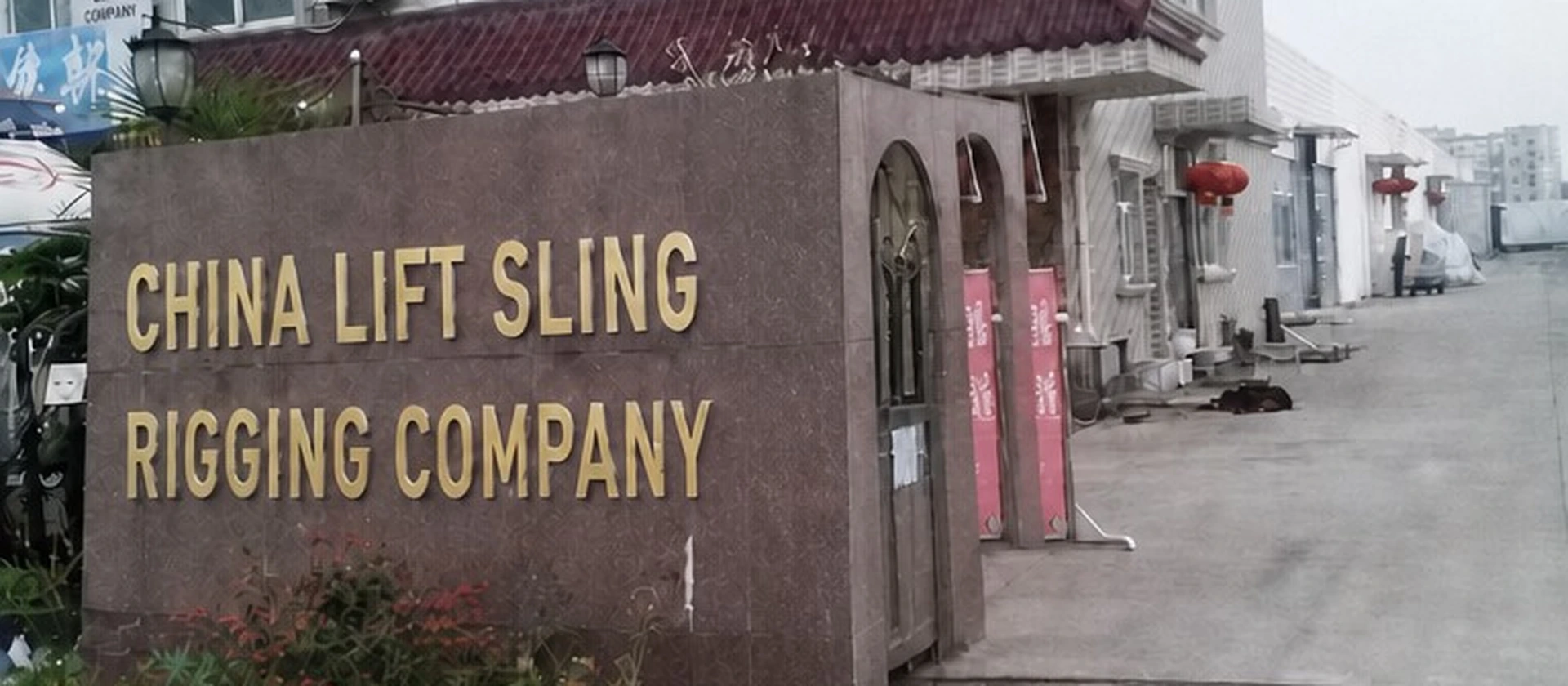
Lift Sling takelažas įmonė – Lifutės pramonės parkas, Taidžou miestas, Dziangsu provincija, Kinija
Tel: +86 523 8693 5818 | WhatsApp: +86 180 6600 2268 | paštas: lift98@jslift.com