

Stopping Drone Attacks — Are You Still Buying Steel Wire Ferrule Nets?
Low-altitude threats are now routine: FPV kamikaze drones, loitering munitions and smuggler UAVs probing military posts, substations, refineries and government sites. Physical interception is the only passive, all-weather, radar-silent layer — but the net you choose decides whether the drone is stopped or merely annoyed.
- 100% continuous para-aramid
- Heat-set knotted construction
- 6 mm: 2.6 t · 10 mm: 7.0 t
- Third-party pull test on every batch
-
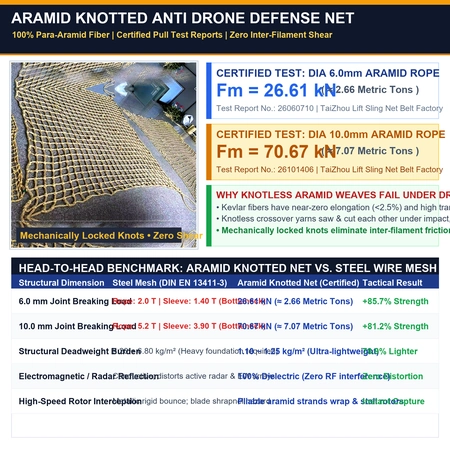
Knotted Aramid Anti Drone Net
1. Why Stainless Steel Ferrule Nets Fail the Kinetic Test
Ferrule-type stainless steel rope mesh is a proven product — for zoo enclosures, aviary cages and architectural fall protection. Against a fast, heavy drone it is the wrong tool, because the weakest point is not the rope at all: it is the aluminium sleeve crimped across the crossing.
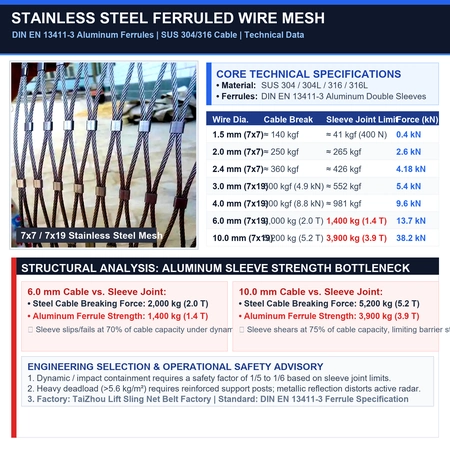
| Seil Ø | Seel Konstruktioun | Rope MBF | Ferrule node (est.) | Share of rope MBF |
|---|---|---|---|---|
| 1.5–1.6 mm | 7× 7 | 2.17 kN | 0.5 - 0.9 kN | 23 - 41% |
| 2.0 mm | 7× 7 | 3.17 kN | 0.8 - 1.3 kN | 25 - 41% |
| 2.4 mm | 7× 7 | 4.18 kN | 1.0 - 1.7 kN | 24 - 41% |
| 3.0 mm | 7× 19 | 5.4 kN | 1.8 - 2.3 kN | 24 - 41% |
| 3.2 mm | 7× 19 | 7.38 kN | 1.8 - 3.0 kN | 24 - 41% |
| 4.0 mm | 7× 19 | 9.6 kN | 3.4 - 4.0 kN (est.) | 35 - 41% |
In practice the failure mode is consistent. The sleeve slips first: crimped length is only 2–3 × rope diameter with one or two crimps, while EN 13411-3 requires a certified terminal to hold ≥90% of rope breaking force. When an FPV drone hits at 80–120 km/h, the dynamic load spikes, the sleeve body ruptures or the rope slides through it, the mesh unravels, and the drone passes through the gap.
Ferrule node: 24–41%
Only the thin tube wall of the aluminium sleeve carries the crossing load. Design loads must be taken at 1/5–1/6 of that figure for impact duty.
Sleeves are single-use
Once crimped, a ferrule cannot be re-bent or reused. A damaged section means cutting the mesh and re-crimping on site — rarely possible on a forward position.
Heavy and conductive
Steel mesh runs 5–10 kg/m² and needs heavy masts and deep foundations. The metal grid also scatters radar and invites lightning risk near antennas.
Rigid wire deflects rotors
A rigid metal strand tends to flick a spinning propeller aside, shattering blades without binding the airframe. The drone often keeps flying.
2. The Knotted Aramid Anti Drone Net: Built for Kinetic Interception
Déi Knotted Anti Drone Net is woven from 100% continuous filament para-aramid (Kevlar) and heat-set knot by knot. There is no sleeve, no ferrule, no clamp anywhere in the mesh body: every intersection is a knot, and every load path runs knot-to-knot through the full fiber strength of the rope.
That construction difference matters more than the rope figure on the datasheet. Aramid filament has almost no elongation — roughly 3% an der Paus. In a knotless woven mesh, the crossing yarns cannot redistribute load, so they cut into each other at the crossover; strength collapses and the net fails far below its rope MBF. A knot, by contrast, consolidates the load in a stable body of fiber before the yarns can shear.
| Bau | Load path | Failure behaviour under drone impact | Uerteel |
|---|---|---|---|
| Knotted aramid (heat-set) | Knot to knot, full fiber body | Load is redistributed across neighbouring knots; propellers entangle and stall | Interception grade |
| Knotless aramid (gewunnt) | Yarn against yarn at crossover | Shear at the crossover, notch stress, net fails below rope MBF | Not for impact duty |
| Stainless wire + aluminium ferrule | Thin sleeve wall at crossing | Sleeve slips or ruptures at 24–41% of rope MBF; mesh unravels | Static barrier only |
3. Certified Pull Test Data — Not a Datasheet Claim
Every production batch is broken on the factory horizontal tensile bed and shipped with its own test report. Two current certificates from TaiZhou Lift Sling Net Belt Factory (XULFT):

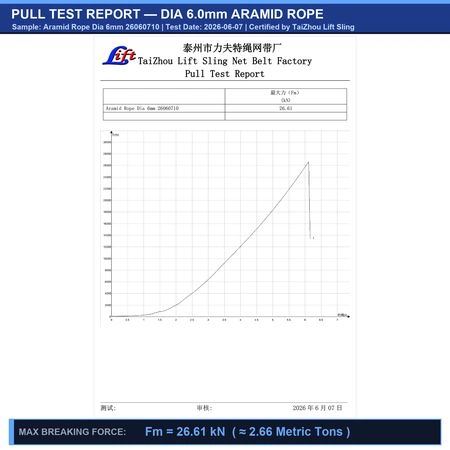
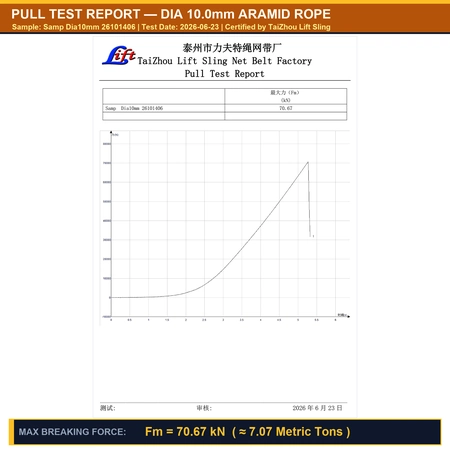
| Test | Sample ID | Maximum force Fm | Metric tonne | Report date |
|---|---|---|---|---|
| Aramid rope Ø6 mm | 26060710 | 26.61 kN | 2.6 t | 2026-06-07 |
| Aramid rope Ø10 mm | 26101406 | 70.67 kN | 7.0 t | 2026-06-23 |
Full PDF originals are available on request for tender and acceptance documentation.
4. Standard Specifications of the Knotted Aramid Anti Drone Net
| Seil Ø | Standard mesh | Break Kraaft | Areal weight | Temperaturbereich | Recommended target |
|---|---|---|---|---|---|
| 4.0 mm | 50 × 50 / 80 × 80 mm | 1.2 t (11.8 kN) | 180 - 240 g/m² | -196 °C bis +350 °C | Micro & mini recon drones (<2 kg) |
| 6.0 mm | 80 × 80 / 100 × 100 mm | 2.6 t (25.5 kN) | 320 - 410 g/m² | -196 °C bis +350 °C | Commercial FPV kamikaze drones (<10 kg) |
| 8.0 mm | 100 × 100 / 120 × 120 mm | 4.8 t (47.1 kN) | 480 - 590 g/m² | -196 °C bis +350 °C | Heavy FPV & loitering munitions (<25 kg) |
| 10.0 mm | 120 × 120 / 150 × 150 mm | 7.0 t (70.67 kN certified) | 680 - 820 g/m² | -196 °C bis +350 °C | Military strike UAVs, fixed-wing targets (>50 kg) |
Mesh opening from 50 mm zu 200 mm, rope diameter from 4 mm zu 12 mm, heavy-duty border rope, STAINLESS Thimbles, cam-tensioning buckles and custom panel sizes are all factory options. Flammability: LOI >28%, selbstläscht.
5. Head-to-Head: Knotted Aramid Net vs Stainless Wire Ferrule Net
| Performance dimension | Knotted aramid anti drone net | Stainless wire + aluminium ferrule |
|---|---|---|
| Strength-to-weight | 5–6× steel at equal weight; light masts | 5–10 kg/m², heavy steel structure required |
| Node integrity | Heat-set knot, no slip path | Sleeve is the weak link, 24–41% of rope MBF |
| Rotor engagement | Flexible fiber wraps and stalls propellers | Rigid wire deflects blades, airframe escapes |
| Electromagnetic behaviour | Fully dielectric, zero radar clutter | Conductive grid, radar scatter and lightning risk |
| Hëtzt / fire | LOI >28%, stable to 350 °C | Aluminium sleeve softens well below that |
| Deployment | Foldable, two-person lift, no crane | Kran, tensioning gear, deep foundations |
| Reparatur | Re-knot or patch a panel | Ferrule single-use, re-crimp on site |
6. Deployment Configurations
Vertical airspace curtain
<Suspended between composite or galvanised steel masts around barracks, Raffinerien, substations and government compounds to block horizontal FPV attack vectors.
Overhead horizontal canopy
Spanned above command posts, equipment parks and open storage bays to intercept diving loitering munitions.
Vehicle-mounted / net-gun cartridge
Pre-folded and packed for pneumatic net launchers and mobile counter-UAS vehicles that need a fast second shot.
Prison & critical-infrastructure cage
Contraband-drop and payload-delivery suppression over yards, rooftops and detention facilities.
Related products from the same factory: Sécherheet Seel Netzer, héich-Kraaft aramid anti-drone barrier netting and heavy-duty cargo Ophiewe Netzer.
7. Oft gestallte Froen
Is a knotted anti drone net stronger than a steel wire ferrule net?
Yes for impact duty. A 10 mm knotted aramid net is certified at 70.67 kN (7.0 t) as a finished net, while an aluminium ferrule node on stainless wire carries only 24–41% of the rope’s own breaking force. The aramid net also weighs a fraction of the steel mesh, so the support structure is lighter and cheaper.
Why does a knotless aramid net lose so much strength?
Para-aramid elongates only about 3% before break. In a knotless weave the crossing yarns cannot slide to redistribute load, so they cut into one another at the crossover and the net fails well below its rope MBF — an estimated 65–75% loss under impact.
Will the net interfere with radar or radio communications?
Nee. The net is 100% dielectric aramid fiber with no metal ferrules or wire, so there is no radar reflection, no RF scattering and no lightning conductor effect — suitable for sites with antennas and radar nearby.
Can you supply the certified pull test report with the goods?
Jo. Each batch is tested on the factory horizontal tensile bed and shipped with its report, such as Ø6 mm 26.61 kN and Ø10 mm 70.67 kN. Full PDF originals are provided for tender and acceptance files.
What mesh size should I choose for a 5 kg FPV drone?
For sub-10 kg FPV threats we normally recommend 6 mm rope with 80 × 80 mm oder 100 × 100 mm mesh; for sub-2 kg recon drones, 4 mm rope with 50 × 50 mm mesh gives a denser, lighter curtain. Final selection depends on approach speed and span.
Protect Your Airspace With a Certified Knotted Anti Drone Net
Send us your span, Héicht, wind load and target drone class. We will return a mesh specification, mast layout and pull-test certificate — direct from the factory.