

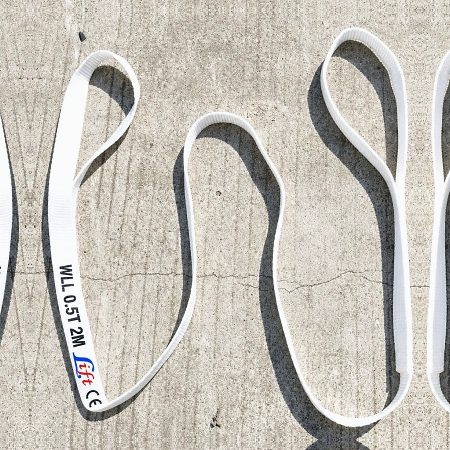
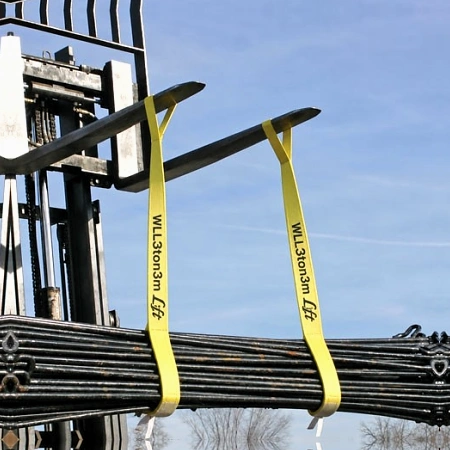
Lift sling rigging company produce One Time Use Lifting Slings,Round Endless Single Use Lifting Sling,PROMPTU Pre-Slung Cargo Slings,One-Way Use Sling.
One Way Sling · Single Trip
One Time Use Lifting Slings
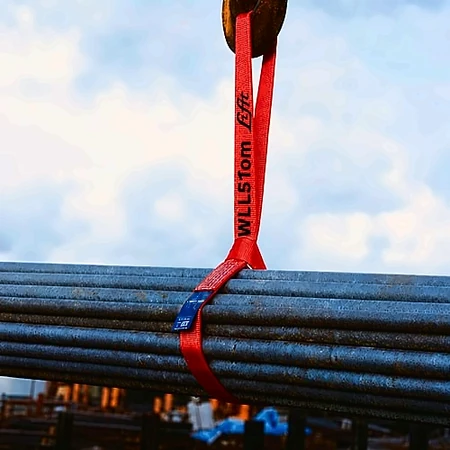
A one-time sling is bought by the thousand and used once. It travels with the consignment from the mill or the packing shed to the receiver, does its single lift at the far end, and is cut off and thrown away. That changes what matters in the specification: not service life but the printed figures, because after it leaves your yard the marking on the band is the only thing the receiver has to judge it by. haec sunt one time use lifting slings in flat, ring and looped-end form, 1-10 t *, with the working load limit, length and single-use statement printed or labelled on every band, supplied folded in bundles.
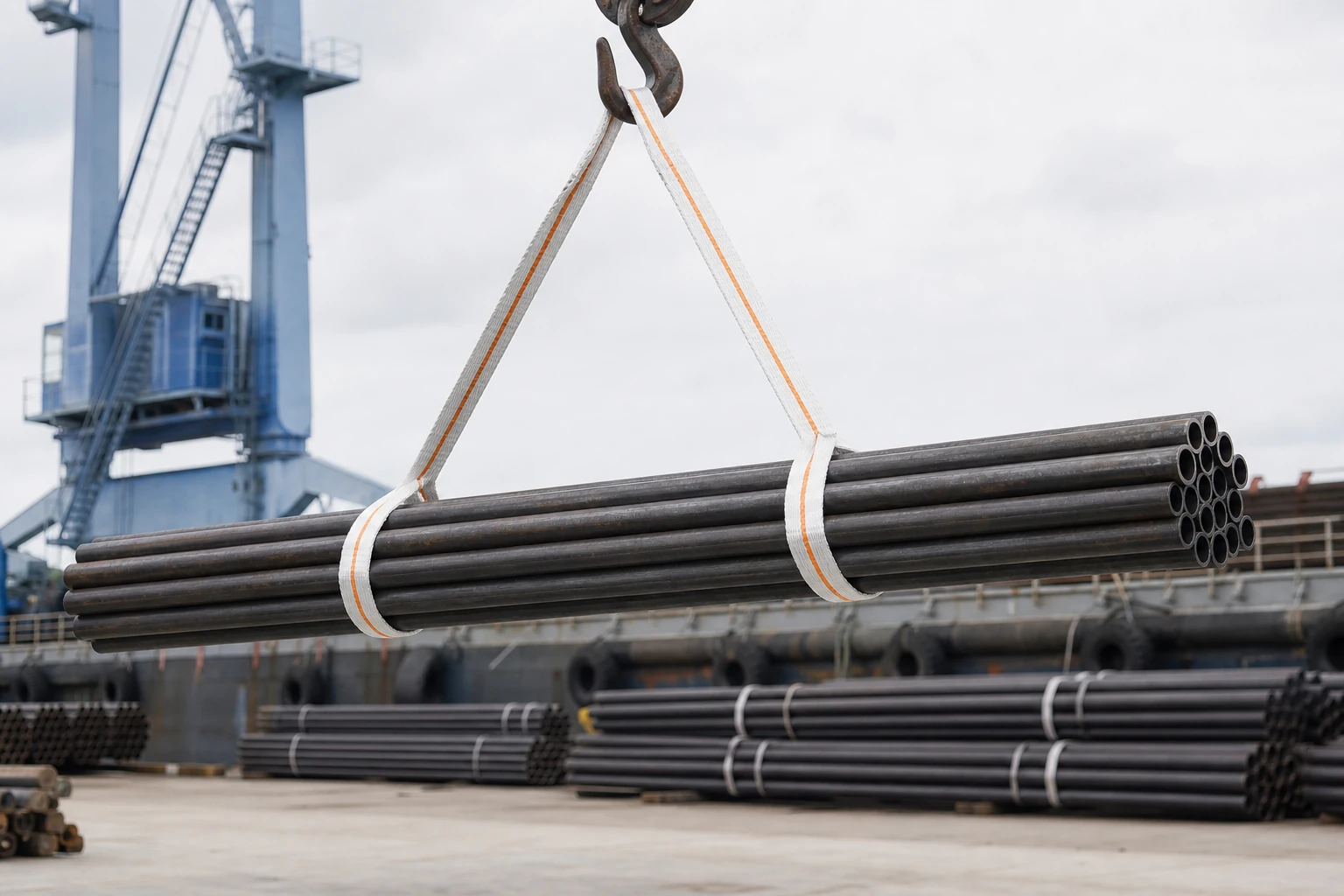
Single trip is a marking decision before it is a cost decision
The article itself is ordinary: summus tenacitas polyester webbing, formed eyes or a closed ring, stitched and bar-tacked in the same shop as the returnable range. What separates a one-time sling from a reusable one is the number printed on it and the discipline around that number. A band that says uno usu must never be put back into general rigging, and a band that does not say it will be, whatever the buyer intended. So the first line of any one-time enquiry is not the quantity, it is what the label has to say.
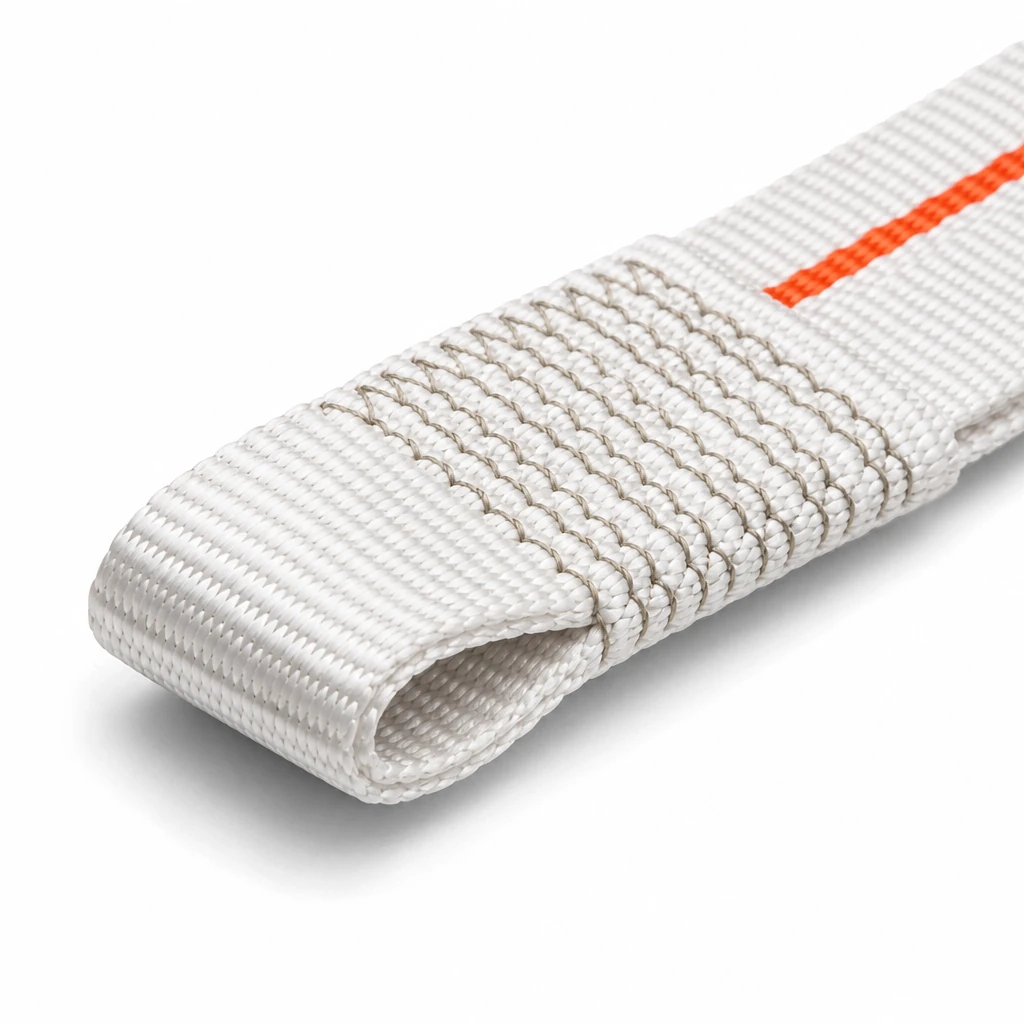
5:1 or * 7:1 — the one number to settle first
A reusable webbing sling to EN 1492-1 carries a 7:1 factor. Single-trip slings are frequently built to 5:1, because band mass follows the factor: at 5:1 idem 2 t duty can be met with a lighter, narrower band, which is cheaper per piece and lighter in the bundle. That is a legitimate trade, but only while both of these hold:
- the band is marked as single use, et
- it never returns to general rigging, and never gets handed to a rigger who has not read the label.
Where either is uncertain — a receiver who will keep the sling, a site that pools slings, a consignment that may be re-slung at the far end — specify 7:1 and treat it as a normal sling with a normal life. We build to whichever the purchase specification states, and the factor is printed, so the two versions cannot be confused in a store.
| 5:1 uno itinere | 7:1 duo unum 1492-1 | |
|---|---|---|
| Vestigium | WLL + “uno usu” printed or labelled | WLL, longitudo, vexillum, batch |
| Band for the same duty | Lighter and narrower | Gravius, wider |
| May be reused | No — destroyed after the trip | Ita, subiectum ad inspectionem |
| Cost per lift | Lowest, if it really is one lift | Higher per piece, but recoverable |
| Utere ea cum | Pre-slung export cargo, cut off at destination | Receiver may keep or re-use the sling |
The forms we make
Four forms cover almost every one-time job, and the choice is driven by how the sling is fitted to the load, not by the load weight.
| Forma | How it is fitted | Typical onus | Nota |
|---|---|---|---|
| Cohors plana, eye both ends | Hooked or basketed, two ends to place | Pipe, ligna, tabulata, bundles | The general form; length is measured eye to eye |
| Clausum anulum (sine fine) | Wrapped round the load, no ends to thread | Fasciculi, gyros, round sections | Rotate inter levo; length is half the circumference |
| Ansas finis | Loop passed through loop, or hooked as a pair | Sacculi, Crates, mixed cargo | Adjustable on the load, non hardware " |
| Circum (mollis) fundibulum | Wrapped, cover protects the core | Abrasive or edged cargo | Cover takes the wear; better on rough bundles |
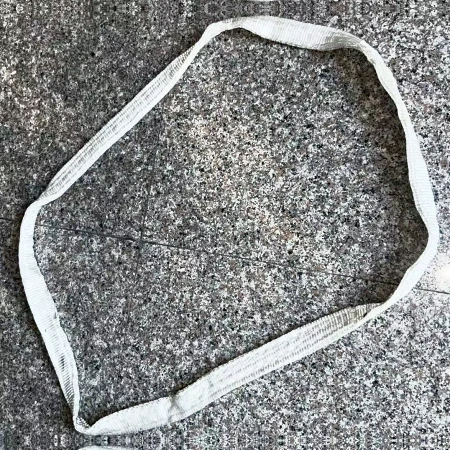
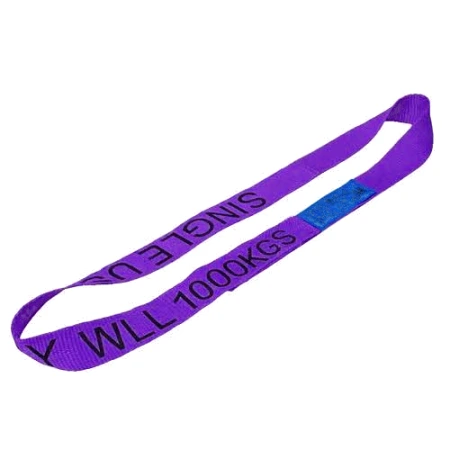
The closed ring form: una continua loop, nihil ad filum, nothing to lose. Orange stripe identifies the range; the load figures sit on the label panel.
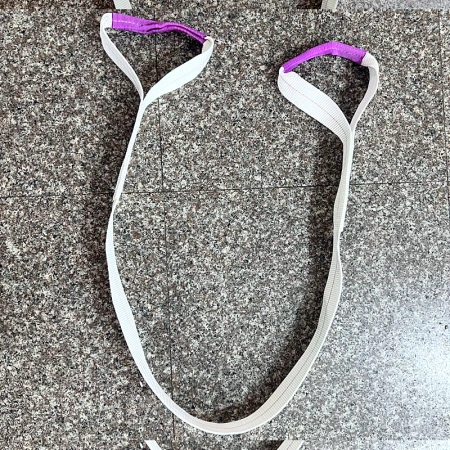
Size range and the colour that goes with it
The WLL series follows the EN 1492-1 color code, which is worth keeping even on a throw-away article: colour is what a receiver reads first, before the print, and it is what stops a 1 t band being put on a 3 t bundle. Widths below are a guide — for pre-slung cargo the band is often one size wider than the pure strength requirement, because a wider band spreads the load on a bundle and chafes less in transit.
| WLL | Color | Cohors latitudo (dux) | Forma | Typical pre-slung load |
|---|---|---|---|---|
| 0.5 t | No code at this size | 25-30 mm | Flat / anulus | Sacculi, small crates, samples |
| 1 t | Viola | 25-50 mm | Flat / anulus / looped | Small pipe bundles, ligna sarcinas |
| 2 t | Viridis | 50-75 mm | Flat / anulus | Standard pipe and tube bundles |
| 3 t | flavum | 75-100 mm | Flat / anulus | Heavier tube, box sections |
| 4 t | Gray | 100–125 mm | Flat | Structural sections, plate packs |
| 5 t | Red | 125-150 mm | Flat | Coils, heavy bundles |
| 6 t | Brown | 150–180 mm | Flat | Consignments above standard band |
| 8-10 t * | Blue / orange | 200-300 mm | Flat | Heavy export lifts, usually with a beam |
Length is set at the far end, not at yours
This is the specification mistake that costs most on pre-slung cargo. The sling is fitted in your yard, but it is used under somebody else’s crane, with a hook height you have not seen and a spreader you may not know about. Two rules avoid the problem:
- Ask for the receiver’s hook height and lift arrangement, not just the bundle circumference. A sling that is 300 mm short has to be choked; 300 mm too long and the legs go wide, which costs capacity and headroom.
- State the length convention on the order. Eye-to-eye for a flat sling; half the circumference for a closed ring. Both are correct conventions and they are not the same number for the same band, so write which one you mean.
Pre-slung cargo: what the sling has to survive on the way
Once fitted, a one-time sling stops being a lifting accessory and becomes part of the packaging. It will spend weeks on a flat rack, in a container or on deck, and it has to still be readable and sound when it arrives.
- UV and weather. Polyester resists sunlight and takes up little water, which is why it is the default for deck stowage. Do not let the bands sit in standing water in a hold, and do not stow them against hot steel.
- Chafe in transit. Steel on steel vibrates; a band between two bundles will wear through in transit long before it is asked to lift. Sleeves or a round-sling cover at the contact points solve it.
- The label must survive. Printing on the band, or a label behind a clear window, is chosen for the journey, not for the showroom. If the receiving crew cannot read the WLL, the sling will be cut off and the bundle lifted with whatever is at hand.
- unus fundibulum, one bundle. Bands are cheap; a re-rig at the far end is not. Fit enough bands that the receiver can lift the bundle with their own hook without adding anything.
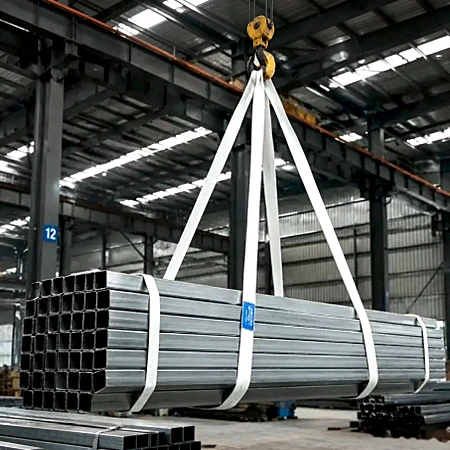
Buying them by the thousand
One-time slings are ordered as a quantity, and the quantity is arithmetic rather than guesswork: lifts per shipment × shipments per period, plus a working spare, because a consignment that is one band short gets re-rigged on site. Where the count is high they are supplied folded and bundled, counted by bundle, with the WLL and length on the bundle label as well as on each band — which is what makes them issueable without opening every bundle.
Folded and labelled for issue: the band figures are visible with the bundle still closed, which is how a store counts them.
The only inspection that matters
A single-trip sling is inspected once, ad exitus, and that check is the one that changes anything: texere ubi onus occurremus, suturis vel sleeving ad fines, and the legibility of the print. A band that fails is destroyed, not returned to the rack — a band that goes back into the store will be issued again, and its marking will then be claiming something that is no longer true.
The wider forms, and the reasoning behind one-way purchasing, are on the uno modo fundae category page. For the returnable equivalent see the infinita generis webbing fundae, and for pipe-specific pre-slinging the steel pipe one way webbing sling.
Saepe quaesivit quaestiones
Is a one time use sling weaker than a reusable one?
Not necessarily — it depends on the factor you order. At 5:1 it is built lighter than a 7:1 reusable sling of the same WLL, and that is the point; at 7:1 it is the same article as a returnable sling with different marking. The WLL printed on the band is the WLL either way.
Can we use it twice if it still looks new?
No. Una levare non visibiliter aetatem a sponda spontanea, sic “looks new” is not evidence of anything. A second use is an uninspected article doing a job nobody rated, and it is exactly what the single-use marking exists to prevent.
Does the colour code still apply?
Ita, and it is worth keeping. The EN 1492-1 colours up to 10 t give a receiver a capacity reading before they read any print. Infra 1 t there is no colour in the code, so the print carries it.
Quid est longitudinem metiri?
For a flat sling with eyes, oculum ad oculum. For a closed ring, half the circumference = working length. For looped-end slings, the length in the loop as supplied. State the convention on the order — the same band can be quoted as two different numbers.
Can the slings be printed with our own reference?
Ita. Consignment or contract references are usually printed alongside the WLL, which is what ties a band back to the batch and the specification after it has travelled. Tell us the wording and the language at enquiry stage.
What is the minimum order?
These are made in runs rather than one at a time, so the practical minimum is a bundle or a carton per size and length. Send the count per shipment and the number of shipments and we will quote against that.
What we need to quote
One time use lifting slings are specified by the consignment, so these six lines get you a drawing and a price:
- Forma: flat with eyes, closed ring, traxi finem, or round
- WLL per band, and the factor: 5:1 single trip or 7:1 duo unum 1492-1
- Length and the convention you mean (oculum ad oculum, or half circumference)
- Load: what the band will wrap, and whether sleeves are needed at the contact points
- Vestigium: WLL, single-use wording, consignment reference, lingua
- Quantity per shipment and per year, and whether bundle labels are required
Request a single-trip sling quotation
Telephone / WeChat: +86 180 6600 2268 | E-mail: 702461526@qq.com
Oratio: Vitare Industrial Park, Taizhou urbs, Provinciae Jiangsu, China | HS code 630790