

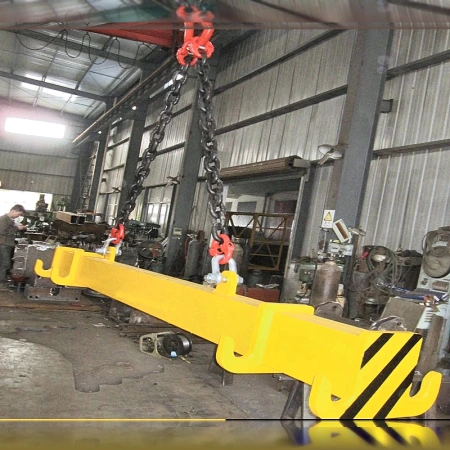
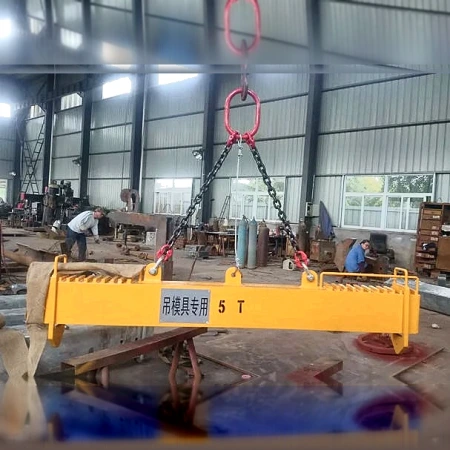
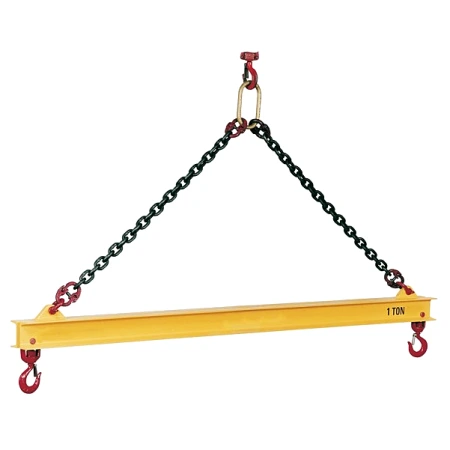
Lift sling rigging company produce Dual Crane Lifting Beam,Tandem Two Hoist Beams,Twin Hoist Lifting Beam,Double crane spreader beam,2 Point Lifting Beams,2 Point Adjustable Lifting Beam,Double Point Lifting Beams.
Dual Crane Lifting Beam
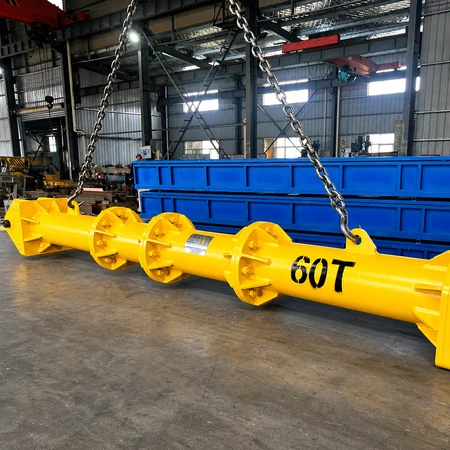
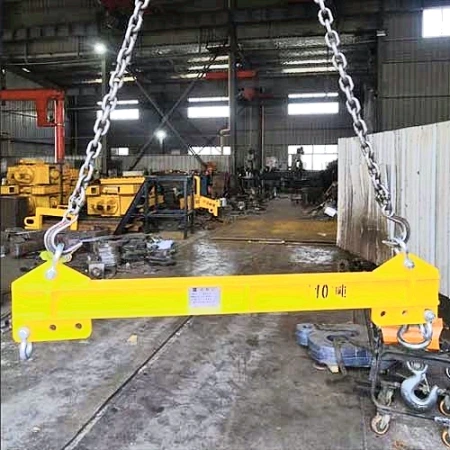
A dual crane lifting beam puts two crane hooks – or two hoists on one gantry – onto a single load, and takes the question of who is carrying what out of the hands of two operators. The two top points are set apart at the hook spacing, the bottom point or points take the load, and the beam decides the share: fixed, or through a central pivot that lets the two hooks equalise themselves. Built in the same range as the rest of our beams – 100 kg to 180 t rated capacity, spans up to 25 m, box, H-section or truss construction, proof load tested to 125 % before dispatch and marked with rated capacity, tare weight, serial number and year.
Quid? “Dual Crane” Changes
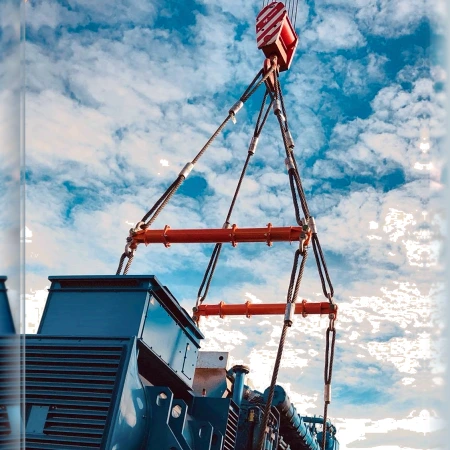
Lifting with two cranes is not lifting with two slings. A sling set shares load by geometry that settles in seconds; two cranes share it through two operators, two hoist speeds and two load charts, and the arrangement has to stay honest while the load swings and is set down. The beam does four jobs at once.
- It fixes the hook spacing. Two cranes cannot be driven to an exact distance apart and held there; a beam holds the two top points at a set spacing, so the geometry of the pick stops being a variable.
- It sets the share of each hook. On a fixed beam the share is geometry – each hook takes the proportion of the load nearest to it. On an equalizing beam a central pivot lets the share move until the two hooks agree.
- It keeps each crane’s slings vertical. Legs hanging at an angle multiply their own tension and pull the load inwards; vertical legs from a beam work at their rated capacity and squeeze nothing.
- It absorbs the difference between the two cranes. Two hooks are never at exactly the same height, never travel at exactly the same speed, and are rarely the same capacity. The beam is the member that carries that difference instead of the load.
Two Arrangements, Often Confused
The phrase “two point lifting beam” is used for both of these, and they are not the same product. Ordering the wrong one is the most common mistake on this page.
| Ordinatio | Top points | Bottom points | What it is for |
|---|---|---|---|
| Tandem / dual crane beam (hanc paginam) |
duo, at the hook spacing | One, two or more | Two cranes or two hoists on one load: the beam sets the hook spacing and the share |
| Spreader beam (one crane) |
One | duo, four or more | One hook, load picked at two separated points: keeps the slings vertical and the load unsqueezed |
| Equalizing / balance beam | One, on a central pivot | Two or four | One hook, load with an off-centre or unknown centre of gravity |
If your lift has one hook and two pick points, you want the propagator trabem page rather than this one. If it has two hooks and one load, this is the right family – and the next decision is whether the beam is fixed or equalizing.
Fixed or Equalizing, When There Are Two Cranes
On a fixed beam the two top points are welded at a set spacing, so the share is decided by where the load’s centre of gravity sits relative to the two hooks. That is fine – and cheaper, lighter and simpler – when the two cranes are the same capacity, the load is symmetrical, and the hook spacing can be set to put the centre of gravity in the middle.
An equalizing beam carries a pivot between the two top points. The share is then free to move until the two hooks agree, which covers three situations that a fixed beam cannot: a load whose centre of gravity is not where the drawing says, two cranes of unequal capacity, and a pick where the available hook positions are dictated by the site rather than by the load.
| Condition on site | Fixed beam | Equalizing beam |
|---|---|---|
| Two cranes of the same capacity, commensus onus | Suitable | Suitable, but not needed |
| Two cranes of different capacity | Workable only if the share is calculated and the weaker crane is not exceeded | The share still has to be checked; the pivot equalises, it does not make the weaker crane stronger |
| Centre of gravity off the mid-point | Hooks must be placed off-centre to compensate, if the geometry allows | Absorbs the offset by itself, within the beam’s rated capacity |
| Hook spacing fixed by the site | Beam must be built to that exact spacing | Tolerates a spacing range |
| Dead weight and headroom | Lighter and shallower | Heavier, taller, more to inspect |
One thing an equalizing pivot does not do: it does not protect a crane from being overloaded by its partner. The share is only equal while both hooks are free to move. A crane that is held, braked or set down early takes whatever the other one imposes. The load chart check stays with the lift plan, not with the beam.
The Share, in Numbers
For two hooks at a spacing L, carrying a load whose centre of gravity sits a distance a from the left hook, each hook takes the proportion of the load nearest the other one:
Rleft = W × (L – a) / L Rius = W × a / L
| Centre of gravity from the left hook | Left hook | Right hook | Quid est? |
|---|---|---|---|
| 3.0 m (mid-point) | 10.0 t | 10.0 t | The balanced case everyone assumes |
| 2.4 m | 12.0 t | 8.0 t | A 20 % offset moves 20 % of the load |
| 1.8 m | 14.0 t | 6.0 t | Half a metre of offset on a 6 m spacing is already 40 / 60 |
| 1.2 m | 16.0 t | 4.0 t | Two equal cranes, one at 80 % of the load |
That is the argument for measuring the centre of gravity instead of assuming it, and for an equalizing beam where it cannot be measured at all. The rated capacity still comes from the marking on the beam and from each crane’s load chart at the radius it works at.
What the Beam Has to Carry
The rated capacity on a dual crane beam is not the same figure as the load. Three things sit on top of it, and they are the three that most often go missing from an enquiry.
- The beam’s own mass. It is lifted by both cranes and is part of what each load chart sees. On a long beam this is not a small number.
- The rigging. Slings, shackles and the bottom fittings hang below the beam and count against the load, not against the beam.
- The unequal share. If the centre of gravity is off-centre, one hook can be carrying well over half – the beam must be rated for the total, and each crane must be checked against its own share.
Specifications
| Parameter | Options |
|---|---|
| Product | Dual crane lifting beam / tandem two hoist beam / twin hoist lifting beam / double crane spreader beam |
| Facultatem rated (WLL) | 100 kg to 180 t standard range; larger custom designs quoted on request |
| Span / overall length | 0.5 m to 25 m depending on capacity and section |
| Top suspension | Two fixed lugs at the hook spacing · two lugs on a central equalizing pivot · double lug · adjustable balance point |
| Bottom points | 1, 2, 4 or more; welded end lugs · multi-position hook holes · sliding adjustable brackets · swivel hooks |
| Tignum sectionem | Welded box section · welded H-section · lattice truss for long spans and high capacities |
| Materia | Q235B / Q345B (S235JR / S355JR); high-strength steel for large-tonnage designs |
| Welding | Full-penetration welds by qualified welders; weld inspection records on request |
| Design factor | Applied against rated capacity per the applicable standard and service class – typically 3:1 to 5:1, confirmed per project |
| Proof load test | 125 % of rated capacity before dispatch, with a load test certificate |
| Superficiem metam | Shot blast to Sa 2.5 + epoxy primer + polyurethane topcoat (safety yellow); optional hot-dip galvanising |
| Vestigium | Facultatem rated (WLL), tare weight, serial number and year of manufacture on the beam |
| Documentation | General arrangement drawing, material certificate, weld record, proof load test certificate |
| Reference signa | Designed and manufactured with reference to ASME B30.20 / ASME BTH-1 and EN 13155 usu – confirm the standard and factor that apply in your market |
| HS code | 842890 |
Capacity and Span Bands
A beam cannot be scaled up in a straight line: for the same capacity, doubling the span multiplies the bending moment, so the section and the dead weight both grow quickly. The bands below show the practical span for each capacity and the section normally used, which is what a tender needs before a drawing exists.
| Facultatem rated (WLL) | Typical span | Bottom points | Typical section |
|---|---|---|---|
| 1 t | 1.0 – 3.0 m | 2 | Box |
| 3 t | 2.0 – 5.0 m | 2 | Box |
| 5 t | 2.5 – 6.0 m | 2 | Box |
| 10 t | 3.0 – 8.0 m | 2 or * 4 | Box / welded H |
| 16 t | 4.0 – 10.0 m | 2 or * 4 | Welded H |
| 20 t | 5.0 – 12.0 m | 2 or * 4 | Welded H |
| 32 t | 6.0 – 14.0 m | 4 | Welded H / truss |
| 50 t | 8.0 – 16.0 m | 4 | Welded H / truss |
| 80 t | 10.0 – 18.0 m | 4 | Truss |
| 180 t | 12.0 – 25 m (custom) | 4 or more | Custom truss |
These are the bands of our beam range, and the final span, section and tare weight are confirmed against your load case. A tandem pick usually takes one band down on capacity compared with the same span on a single-hook spreader beam, because the beam is carrying an uneven share and has to be sized for the worst case.
What to Send
Seven figures turn a dual crane enquiry into a drawing. Without them the answer is a guess, and a beam is not a catalogue item.
| Figura | Why the beam needs it |
|---|---|
| Load mass, and the mass of beam plus rigging | Sets the rated capacity, which is not the same number as the load |
| Hook spacing available on site | Sets the distance between the two top points |
| Centre of gravity, or a drawing that shows it | Decides whether a fixed beam can be used or the pick needs a pivot |
| Capacity of each crane at the working radius | Both load charts are binding; the weaker one governs the share |
| Clear height under each hook | A beam costs headroom, and the two hooks are rarely at the same height |
| Bottom point arrangement | One, two or four; alliges, hamo, pin or sling; fixed or sliding |
| Environment and finish | Indoors, at the water, galvanized, or a colour of your own |
Testis, Vestigium, Records
Every dual crane lifting beam is proof load tested to 125 % of its rated capacity before dispatch and is issued with a test certificate; the rated capacity, tare weight, serial number and year of manufacture are marked on the beam itself. A dual crane beam should be treated as equipment in its own right – its own marking, its own records, its own inspection interval – and not as an accessory to the slings it works with. Where a particular standard or a market-specific certification is required, say so before the order so the design, the testing and the paperwork are set up for it.
Frequenter Interrogata
What is a dual crane lifting beam?
A beam with two top suspension points, set at the spacing of two crane hooks or two hoists, used to lift one load with both. It fixes the hook spacing, sets or equalises the share each hook carries, and keeps each crane’s slings vertical so neither capacity is given away to a sling angle.
What is the difference between a dual crane beam and a spreader beam?
The number of top points. A spreader beam hangs from one hook and spreads two or four bottom points apart to keep the slings vertical. A dual crane beam hangs from two hooks and its job is the share between them. Both may have two or four bottom points, which is why “two point lifting beam” is an ambiguous description.
Fixed or equalizing beam – which one do I need?
Equalizing if the centre of gravity is not between the hooks or is not known, or if the two cranes differ in capacity, or if the site fixes the hook spacing. Fixed if the load is symmetrical, the cranes match, and the spacing can be set to put the centre of gravity in the middle – it is lighter, shallower and cheaper.
Does an equalizing beam make two unequal cranes safe?
No. It equalises the share while both hooks are free to move; it does not raise the capacity of the weaker crane, and it cannot help once one hook is held or set down. Both load charts still have to be checked against the share.
How is the load shared between the two hooks?
By geometry: each hook takes the proportion of the load nearest to the other hook. With hooks L apart and the centre of gravity a distance a from the left hook, the left takes W x (L – a) / L. A 20 % offset moves 20 % of the load, which on a 6 m spacing is 4 t out of 20 for every 1.2 m of offset.
What capacity and span can you build?
100 kg to 180 t rated, with spans from 0.5 m to 25 m in box, H-section or truss construction. The practical span falls as the capacity rises – a 5 t beam is comfortable at 6 m, a 100 t beam belongs in truss at 20 m – and the final section and tare weight are confirmed against your load case.
Is the beam tested, and what comes with it?
Proof load tested to 125 % of rated capacity with a test certificate, and supplied with the general arrangement drawing, material certificate and weld record on request. Facultatem rated, tare weight, serial number and year are marked on the beam.
Request a Quotation
Send your dual crane lift details for a beam proposal
Telephone / WeChat: +86 180 6600 2268 | E-mail: 702461526@qq.com
Oratio: Vitare Industrial Park, Taizhou urbs, Provinciae Jiangsu, China | HS code: 842890