Categories Products

Polyester elevatio Net

Brevis Descriptio:

Fundis armari turba producere Polyester elevatio Net,Polyester Cargo Net,Salus elevatio Net Strap,Bungee Cargo Net,Polyester Cargo elevatio Net,Elevatio funda Net,Funis elevatio Net,Pallet Cargo Net,Hortus Scandere Net.

Polyester elevatio Net

A polyester lifting hoisting net is a soft bag woven from high-tenacity polyester webbing, built to move bagged goods and bulk material in a single crane lift. The load is tipped into the bag, or the bag is laid flat and drawn up around a stack, and four corner loops carry the whole consignment to the hook. There is no pallet to return, no strapping to cut, and nothing to re-handle at the far end.

Because we weave the webbing in our own mill in Taizhou, Jiangsu, reticulum ostium, bag footprint, profundum, bottom construction and working load limit are all set to the cargo rather than to a fixed catalogue. Standard nets cover 0.5 t to 20 t and * 0.6 m * ut supra 10 m³, every net is proof-load tested before packing, and each shipment travels with a material test report. Nets are CE and GS certified, with webbing rated to the EN 1492-1 basis.

  • Fully custom build – reticulum, sacculi magnitudine, profundum, colour and safety factor (5:1, 6:1 or * 7:1) set to your specification.
  • High-tenacity polyester webbing – 25 mm to 100 mm vincula, una, duplex or triplex, UV stabilised and rot-proof.
  • Wear and heat resistant – working range -40 °C to +100 °C, with a reinforced bottom for abrasive loads.
  • Mollis, flexible and light – the flat band contacts the load over a wide area, so bags, cartons and finished surfaces are neither crushed nor marked.
  • CE et GS certified – probata nostro 1000 apparatus T, with an ISO 9001 quality system and a CNAS-accredited laboratory behind it.
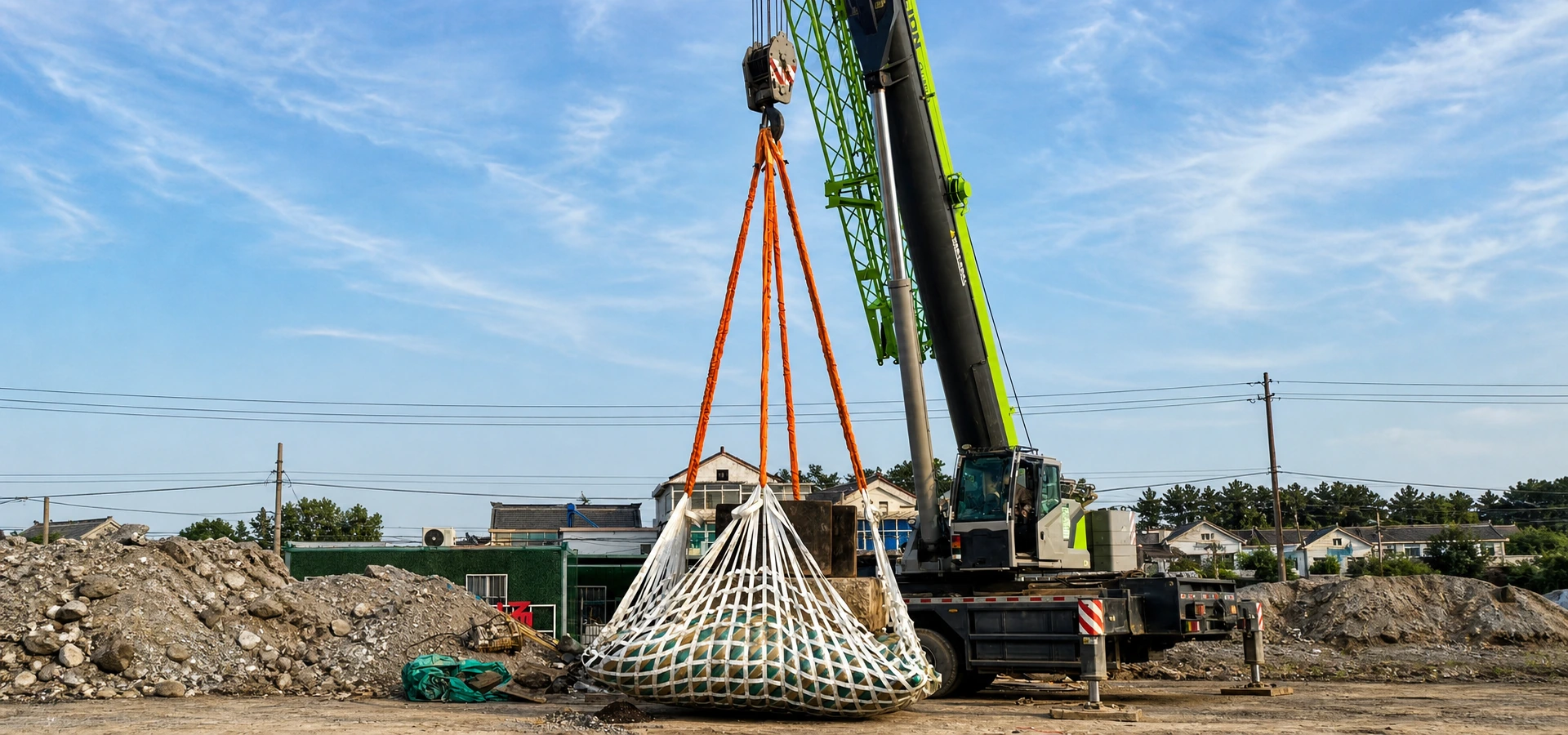
Polyester lifting hoisting net under a mobile crane carrying broken stone
A polyester lifting hoisting net in bulk service – the bag is filled with broken stone and lifted from its four loops by a mobile crane.

Why a webbing net bag, and not a rope net or a big bag

Three products are sold for the same job and they behave very differently once the load is in the air. A rope net concentrates the load on a few contact points. A big bag carries one free-flowing product and is itself the package. A webbing net bag spreads the pressure across flat bands, holds a stacked or mixed load together, and goes back to the store empty.

Mensa 1 – How the four common ways of lifting loose cargo compare.

Option Construction Contactus cum onere Best cargo Limitation
Polyester webbing net bag Flat woven bands, 25-100 mm, 25-300 mm reticulum Wide flat bands, low pressure per cm² Bagged, reclinant, mixed and bulk cargo Needs a crane or hook; not a sealed package for powder
Nylon funem retis Knotted or braided rope, 8-24 mm Line contact at every rope Irregular and heavy single items Ropes mark soft cargo; a tight mesh adds weight
FIBC / big bag Woven PP fabric with a liner Full surface, sealed One free-flowing product per bag Single product only; the bag is the packaging
Pallet and strapping Timber or plastic pallet plus bands Rigid base Unitised cartons Pallet returned or lost; bands cut and discarded; no drainage
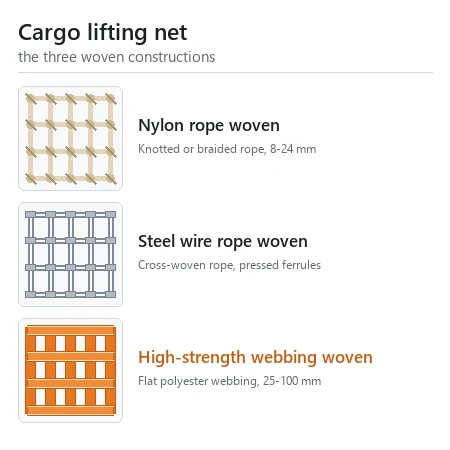
Diagram comparing nylon rope, steel wire rope and polyester webbing net constructions
Three woven constructions for cargo nets: nylon funem, steel wire rope and high-strength polyester webbing.

Five decisions that set the specification

A polyester lifting hoisting net is quoted from five numbers. Get them right and the net arrives right; get the mesh wrong and no amount of extra tonnage will fix it later.

Mensa 2 – What we need to know, and why each answer changes the net.

Decision Quid constituit? What to tell us
1. Cargo form Whether the net is a bag or a flat sheet, and how the bottom is built How the cargo arrives: sacci, magnus sacculos, involucris, or loose material
2. Weight per lift Band width and layer count, and therefore the rated capacity Crasso pondere vis tollere, not the weight of the net
3. Repleti volumine Footprint and depth of the bag mole densitatis (t/m³) for loose material, or the height of the stack for bagged goods
4. Mesh ostium The largest gap the cargo can pass through The smallest unit in the load: a 25 kg bag, granum, aggregate or scrap
5. Dimittite modum Clausa, tetrico, RECUMBO vel eidem fundo Whether the bag is tipped, untied over a hopper, or emptied by hand

Weight and volume are two separate limits, and for light bulk the volume arrives first. Frumenti fere 0.7 t / m * et lignum eu fere 0.3 t / m * et replete a * 3.6 m³ bag, but one lift weighs about 2.5 t and the other about 1 t. Send the bulk density with the tonnage and we will size the bag so that a full bag is also a legal bag.
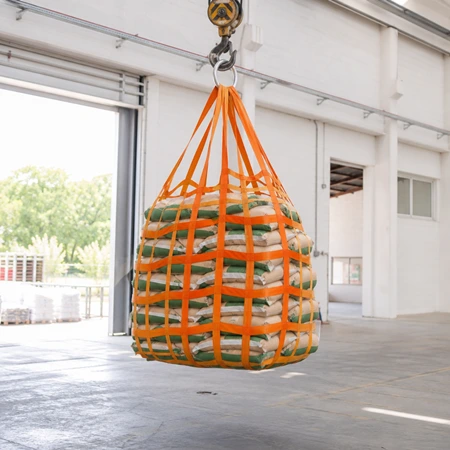
Polyester net bag lifting stacked 25 kg sacks in one crane lift
Bagged cargo in a polyester net bag – a stack of 25 kg sacks is closed in by the mesh and lifted as a single load.

Technical parametri

Figurae infra vexillum bagged et amplitudines tegunt. Mesh, vestigium, profundum, bottom, loops and capacity are made to order, so treat this as the starting point for a quotation rather than a fixed catalogue.

Mensa 3 – Polyester lifting hoisting net: technica parametri.

Parameter Specification
Product nomen Polyester lifting hoisting net (polyester webbing net bag)
Configurationes Closed bag, release-bottom bag, or flat lifting net
Webbing material 100 % summus tenacitas polyester (PET); summus contumacia nylon ad petitionem
Cohors latitudo 25 / 38 / 50 / 75 / 100 mm (50 mm vexillum)
Band construction una tabula, duplex or triplex; woven selvedge, not a cut edge
Cohors crassitudine 1.8 mm – 4.5 mm fretus latitudine et iacuit comitem
Mesh ostium 100 × 100 mm vexillum; 25 – 300 mm est ut
Net magnitudine Factum est vestigium onus, truck bed or receiving hopper; see Table 4
Sacculum profundum 0.8 m – 2.5 m, aut drawing
Repleti volumine De 0.6 m * ut supra 10 m³, set by footprint and depth
Terminus Folded and double-stitched, reinforced at every lifting point
puncta elevatio Quattuor anguli ansas vexillum; octo ad spreader trabem; ora summis rogatus
Facultatem rated (WLL) 0.5 t – 20 t, set per cohortem, iacuit comitem et tollens Ordinatio
salus factor 5:1 / 6:1 / 7:1
Prolongatio ad WLL 7 % vel minus
Color Colour code by working load limit, aut consuetudo domus color
opus temperatus -40 °C to +100 °C
Weather and chemical UV confirmatae, rot-proof, unaffected by rain, sea water and wash-down
Vestigium WLL, mesh and batch printed on the belt, plus a sewn capacity label
Standard basis Webbing rated ad EN 1492-1
Certification CE, GS, ISO 9001, JIS on request; CNAS officinarum; DNV
Customization OEM / ODM magnitudine, color, typis logo, Pittacium et stipare
HS code 6307.90 – nets and netting of textile materials

Vexillum magnitudinum, volumes and working load limits

These six lines cover the great majority of bagged and bulk work. Filled volume is calculated from the footprint and the depth with an allowance for the rounded shape a loaded bag takes, so a material that settles well will carry slightly more and one that bridges will carry less.

Mensa 4 – Standard net sizes at four corner loops gathered on one hook.

Net magnitudine (L W) Depth Repleti volumine Mesh Band WLL Typical navis
1.0 × 1.0 m 1.0 m 0.6 m³ 50-100 mm 50 mm singula 0.5-1.5 t 25 kg sacculos, sacci, involucris
1.5 × 1.5 m 1.2 m 1.6 m³ 50-100 mm 50 mm duplex 1-2.5 t Bagged frumenti, stercorat, produce
2.0 × 2.0 m 1.5 m 3.6 m³ 50-100 mm 50 mm duplex 2-4 t mole grani, arena, lapis contritus
2.5 × 2.5 m 1.8 m 6.8 m³ 50-150 mm 75 mm duplex 3-6 t Mole stercorat, calculus, FRAGMENTUM, piscis
3.0 × 3.0 m 2.0 m 10.8 m³ 100-150 mm 75 mm duplex 4-8 t Magna mole onerat, quay tenete opus
To drawing 0.8-2.5 m Ad mandatum 25-300 mm 25-100 mm 0.5-20 t Quis vestigium, profundum et navis

The working load limits above assume a four-loop lift. A two-loop basket de-rates the net – ask for the derated figure rather than reading across from this table.

Mesh ostium, chosen from the cargo

Mesh is the one dimension that cannot be adjusted after the net is sewn, so it is sized from the smallest unit in the load rather than from the total weight.

Mensa 5 – Mesh opening by cargo.

Cargo Commendatur reticulum Reason
50 kg saccis, magnus sacculos, involucris 100 mm The sacks are far larger than the opening; the mesh only has to keep the stack together
25 kg sacculos, sacci 50-75 mm Small bags can squeeze through 100 mm once the load settles in the air
Frumentum, semen, exaruit germen 25-50 mm, aut clausa liner Fine material must not sift out on the hook or in transit
Fertilizer, prills, pulveres 25-50 mm, aut clausa liner Fine and moisture-sensitive: a liner keeps the product in and the weather out
Sand, glarea, lapis contritus 50-100 mm Pulchre satis ad molem, open enough for rainwater to drain
Coal, Coke 100-150 mm Large lumps; reticulum latiore servat rete lucem et bene exhaurit
Scrap metallum, offcuts 100-150 mm Open mesh with a reinforced bottom and wear pads at the contact points
Piscium, conchilia, infectum fructus 25-50 mm Holds the catch, drains freely, keeps the weight honest
Acta publica omnia, lignorum, magna offcuts 150-300 mm Indivisible pieces: a wide mesh saves weight without losing the load
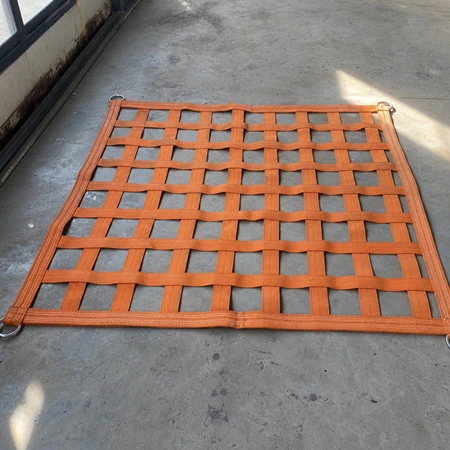
Orange polyester webbing lifting net laid flat with steel corner rings
A square polyester webbing net laid out flat: 100 mm reticulum, 50 mm vincula, reinforced border and a steel ring at each corner.

Bottom construction and discharge

How the load comes out is a design decision in its own right. For bagged cargo the answer is usually a person with a knife; for bulk it is usually gravity.

Mensa 6 – Bottom options and how each one is emptied.

Bottom Quomodo operatur Chosen when
Clausa, plene consuti The bag holds the cargo permanently and is emptied by tipping or by hand Bagged navis, and bulk tipped over a hopper or onto a pile
Release bottom, tetrico Tectum commissura trans fundum solvitur ad missionem punctum et onus excidit Free-flowing bulk – arena, granum, aggregatum – discharged without tipping the bag
Imo Chuttus The bag narrows to a chute opened over the receiving hopper Controlled discharge into a hopper, a nabat aut TRADUCTOR
Closed with a liner A liner fabricae sedet intra rete Dusty or moisture-sensitive bulk: granum, stercorat, pulveres
Imo panel roborati An extra layer of webbing is stitched across the base Abrasive and heavy bulk: aggregatum, ore, FRAGMENTUM
Loops top and bottom Loops at both ends, so the bag can be lifted either way up Loading at height, et exinanitione peram in hamo invertendo

Lifting arrangements and fittings

Quomodo loculus suspensus iudicat quantum oneris vere portat?, et mole irremissibile est, quia onus intra sacculum servat movens dum est in aere.

  • Four loops on the hook – the standard for bagged and bulk work; the loops gather on the hook or a master ring and the bag closes around the cargo as the crane takes up the slack.
  • Eight loops on a spreader beam – the bag stays square, onus manet planum, et quodlibet ansam portat praedictio participes; the right arrangement for large bags and high tonnage, vide noster exaltans expander trabem range.
  • Two-loop basket – faster to rig, sed de-rates in rete; ask for the derated capacity instead of reading across from the four-loop figure.
  • Loops top and bottom – lets the bag be lifted either way up, quod est quomodo pera clausa vacuatur invertendo super hopper.

Fittings supplied or fitted on request: sewn webbing loops, master ring or master link, gradus 80 compedes, laced release bottoms, chutes and discharge sleeves, inner liners, wear pads and protection sleeves for scrap and aggregate, and repair kits for fleets that maintain their own equipment.

Materia, stitching and finish

The belt is the product. We weave it on needle looms from high-tenacity polyester yarn, with a woven selvedge rather than a cut edge, so the band does not fray from the outside in.

  • 100 % summus tenacitas polyester, humilis elongationem (7 % vel minus apud WLL), UV confirmatae, rot-proof and unaffected by moisture.
  • Locked stitching in high-tenacity polyester thread, run in multiple rows along the border and box-X at every loop – on a cheap net it is the stitch line, non balteus, that fails first.
  • Complicatum et duplex sutilis terminus, so the edge of the mesh cannot unravel under load.
  • Galvanised or stainless steel rings and master links on request.
  • Polyester holds its strength from -40 °C to +100 °C; above that, or in chemical exposure, tell us and we will quote nylon or another construction.
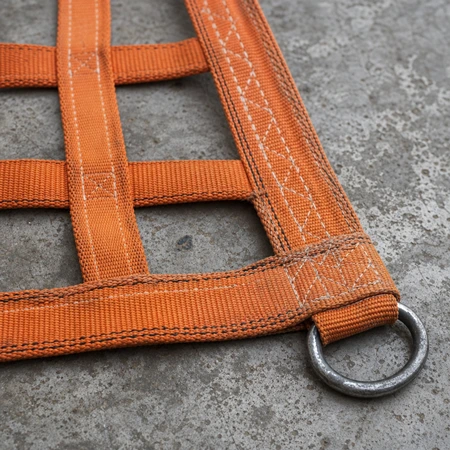
Close-up of webbing net border stitching and a galvanised D-ring
Border stitching and a galvanised D-ring at the corner – the two places a webbing net bag is most often overloaded.

Testis, certification and traceability

  • Forty years of lifting equipment manufacturing – condita in 1985 in Taizhou, Jiangsu, per quam 200 employees and one of China’s largest lifting sling and net production bases.
  • Every net is proof-load tested on our own 1000 T horizontalis test machina – probata, not sampled.
  • A material test report travels with each shipment, quoting the belt batch and the test load.
  • CE declaration of conformity and GS certification, cum JIS certificatione in educendo mandatis.
  • ISO 9001 quality management system, a CNAS-accredited laboratory and DNV certification behind the plant.
  • Every net is marked with its working load limit, reticulum, rated volume and batch number before packing, sic pera et ejus literis semper assentior.

Certificates and test reports are available as PDFs for your tender or customs file – see the full certificatione set.

Where these nets work

A polyester lifting hoisting net is used wherever loose cargo has to travel between a stack and a hook – quay, molendinum, quarry, yard or hold. The sectors below are the ones where the bagged and bulk version earns its place.

Mensa 7 – Applications in regione.

Sector Quid rete ansas Cur retia decet polyester?
Portus, crepidines et terminales Bagged navis, granum, fertilizer and bulk between quay, barge and hold Una pera per vitae, non grabatum, et onus exhaurit quod euolat
Molendina agricultura et pascere Semen, granum, pascere, stercorat et bagged productum A stricta reticulum vel liner custodit factum in et tempestate e
Aedification materiae Sand, glarea, fracto lapide et bagged caementa Pulchre satis ad molem, open enough for rainwater to drain
fodienda et lapicidinae Subgenera, et minera mole Imo confirmatum accipit abrasionem quae rete gerit
Piscationes et cibum processus infectum piscis, concharum genera Patefacio haurit reticulum gratis, which keeps the weight honest
Et vastum redivivus solve materia plastica, vitrum, metallum et mixta materia Contains loose material that would otherwise blow or fall
Biomass and power Lignum eu, latrare, globulos et cibus mole Magna peram in modico tonagium, matched usque ad terminum volumine
Construction sites and relief work Bagged materials raised to upper floors, field cargo No pallet, nulla coeuntibus, et evacuetur recta in terram
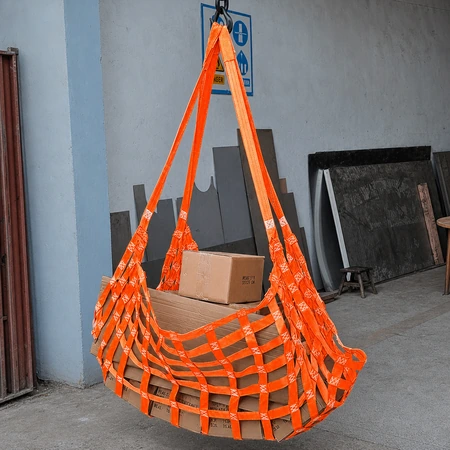
Orange webbing net bag lifting a carton with soft wide bands
Mixed cargo on site: a net bag takes a carton as readily as a stack of sacks, and the flat webbing spreads the load rather than cutting into it.

Customisation and branding

A net that moves between quays, holds and yards has to be identifiable from a distance and has to keep its marking. Color, typis logo, working load limit and cargo type are all applied in our own plant, so the marking cannot be washed off or pulled away with a label.

  • Colour code by working load limit, or a custom house colour to separate your fleet from a competitor’s.
  • Logo, brand name, warning text or certificate number printed on the belt, or woven in on larger orders.
  • Cargo type printed on the bag, which stops a fine-mesh grain net being sent out for scrap.
  • Sewn capacity label in addition to the print, so the net and its paperwork agree at every inspection.
  • Packing folded into a bag or a crate – a set of ten net bags takes the space of one pallet.
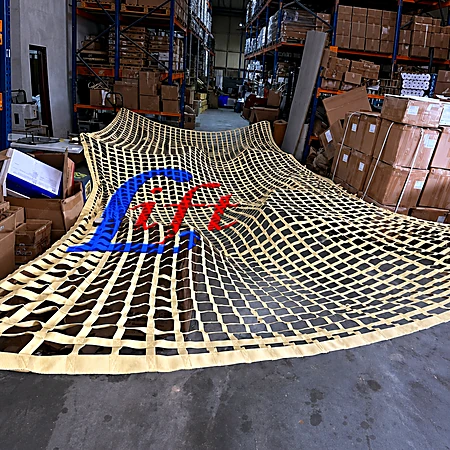
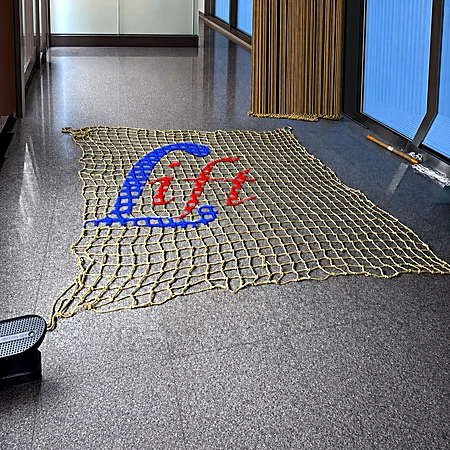
Polyester webbing cargo net printed with a customer logo in a warehouse
Buyer branding applied at the mill: the customer mark is printed directly on the webbing bands, not on a tag.
Beige polyester webbing net with printed logo laid out for inspection
Final inspection before packing – color, typis logo, mesh and working load limit are checked on the finished net.

Curae, inspectionem et secessus

  • Inspect the loops and their stitching first, tum terminus, then the bottom closure – on a bulk net the bottom and the corners wear before the mesh does.
  • Exinanire sacculum ante repono; material left inside holds moisture, addit pondus et coria damnum.
  • Vide cuts, abrasione, Fracti suturis, eget tinguere, calor linitionis et color vel glossa mutatio quod annuit UV degradatio.
  • Weigh a wet bag before lifting it. Pluvia, sea water and wet bulk can add far more than the cargo was rated at, et rete differentiam non cognoscit.
  • Numquam excedit facultatem rated, numquam in paucioribus quam in plena paro of ansas, et non trahunt onusto peram in obliquum cum gruibus.
  • Condite mundum et aridam, off terram et ex directo solis; never repair webbing by knotting, glutino vel calefaciendo.

Saepe quaesivit quaestiones

What is the difference between a polyester lifting hoisting net and a cargo net?

A lifting net is rated, marked and tested to carry a load on a crane hook. A cargo net is a restraint: it holds a load down in transit and is not designed to be lifted. If the net is going onto a hook, it must be the rated version – vide noster navis securitate rete for the tie-down case.

How do I choose the mesh opening?

From the smallest unit in the load, non ex tonagium. A 25 kg bag needs 50-75 mm; grain or fertilizer needs 25-50 mm or a closed liner; scrap and coal can take 100-150 mm. Once the net is sewn the mesh cannot be changed, so this is the one number worth checking twice.

Why does the volume matter as much as the weight?

Quia lux moles replet sacculum antequam pondus aestimatum attingit. A bag that is full at half its rating doubles the number of lifts and the crane time. Give us the bulk density with the tonnage and we will size the bag so a full bag is also a legal bag.

Potest sacculum evacuetur sine tipping eam?

Ita. A laced release bottom or a chute bottom lets a free-flowing load be discharged straight into a hopper, a nabat aut TRADUCTOR. Bagged cargo is normally emptied by hand or with a forklift at the far end.

Infectum erit rete navis?

The net itself is unaffected – polyester does not absorb water and does not rot, so rain, sea water and wash-down do no harm. Duo cautiones: wet cargo is heavier, and fine wet material can clog the mesh, quae addit pondus et sistat haurientem.

How is the working load limit proved?

Sponsio aestimatur ad EN 1492-1 basis et retia praebentur at 5:1, 6:1 or * 7:1 ut certa. Every net is proof-load tested on our own 1000 apparatus T, a material test report travels with the order, et fructus portant CE et GS certificationem.

Do you make a flat version for palletised cargo?

Ita – the flat lifting net is the grus grabatus navis rete, and the material-led range is covered by the polyester webbing rete levandi. The rope constructions sit alongside as the nylon navis elevatio rete et " grave officium nylon navis rete fundae.

What else do you make from the same webbing?

The same belt goes into our webbing fundis et sine fine per fundas, and the wider cargo range is listed under navis elevatio retia – including the webbing navis elevatio rete for flat work.

Peto a quotation

Send the cargo and whether it is bagged or bulk, in mole densitate si nosti, pondus vis per levo, reticulum ostium, the discharge method and the environment the net will work in – or a sketch of the bag you have in mind. Nostrorum fabrum amplitudo confirmabit rete, profundum, deorsum constructione, band and packing and quote it in one reply. Per prius loqui eam, contact nostros fabrum.

Leva fundam amisso clavo – Vitare Industrial Park, Taizhou urbs, Provinciae Jiangsu, China
Tel: +86 523 8693 5818 | whatsapp: +86 180 6600 2268 | E-mail: lift98@jslift.com

Product Detail

Fundis armari turba producere Polyester elevatio Net,Polyester Cargo Net,Salus elevatio Net Strap,Bungee Cargo Net,Polyester Cargo elevatio Net,Elevatio funda Net,Funis elevatio Net,Pallet Cargo Net,Hortus Scandere Net.

Polyester elevatio Net

A polyester lifting hoisting net is a soft bag woven from high-tenacity polyester webbing, built to move bagged goods and bulk material in a single crane lift. The load is tipped into the bag, or the bag is laid flat and drawn up around a stack, and four corner loops carry the whole consignment to the hook. There is no pallet to return, no strapping to cut, and nothing to re-handle at the far end.

Because we weave the webbing in our own mill in Taizhou, Jiangsu, reticulum ostium, bag footprint, profundum, bottom construction and working load limit are all set to the cargo rather than to a fixed catalogue. Standard nets cover 0.5 t to 20 t and * 0.6 m * ut supra 10 m³, every net is proof-load tested before packing, and each shipment travels with a material test report. Nets are CE and GS certified, with webbing rated to the EN 1492-1 basis.

  • Fully custom build – reticulum, sacculi magnitudine, profundum, colour and safety factor (5:1, 6:1 or * 7:1) set to your specification.
  • High-tenacity polyester webbing – 25 mm to 100 mm vincula, una, duplex or triplex, UV stabilised and rot-proof.
  • Wear and heat resistant – working range -40 °C to +100 °C, with a reinforced bottom for abrasive loads.
  • Mollis, flexible and light – the flat band contacts the load over a wide area, so bags, cartons and finished surfaces are neither crushed nor marked.
  • CE et GS certified – probata nostro 1000 apparatus T, with an ISO 9001 quality system and a CNAS-accredited laboratory behind it.
Polyester lifting hoisting net under a mobile crane carrying broken stone
A polyester lifting hoisting net in bulk service – the bag is filled with broken stone and lifted from its four loops by a mobile crane.

Why a webbing net bag, and not a rope net or a big bag

Three products are sold for the same job and they behave very differently once the load is in the air. A rope net concentrates the load on a few contact points. A big bag carries one free-flowing product and is itself the package. A webbing net bag spreads the pressure across flat bands, holds a stacked or mixed load together, and goes back to the store empty.

Mensa 1 – How the four common ways of lifting loose cargo compare.

Option Construction Contactus cum onere Best cargo Limitation
Polyester webbing net bag Flat woven bands, 25-100 mm, 25-300 mm reticulum Wide flat bands, low pressure per cm² Bagged, reclinant, mixed and bulk cargo Needs a crane or hook; not a sealed package for powder
Nylon funem retis Knotted or braided rope, 8-24 mm Line contact at every rope Irregular and heavy single items Ropes mark soft cargo; a tight mesh adds weight
FIBC / big bag Woven PP fabric with a liner Full surface, sealed One free-flowing product per bag Single product only; the bag is the packaging
Pallet and strapping Timber or plastic pallet plus bands Rigid base Unitised cartons Pallet returned or lost; bands cut and discarded; no drainage
Diagram comparing nylon rope, steel wire rope and polyester webbing net constructions
Three woven constructions for cargo nets: nylon funem, steel wire rope and high-strength polyester webbing.

Five decisions that set the specification

A polyester lifting hoisting net is quoted from five numbers. Get them right and the net arrives right; get the mesh wrong and no amount of extra tonnage will fix it later.

Mensa 2 – What we need to know, and why each answer changes the net.

Decision Quid constituit? What to tell us
1. Cargo form Whether the net is a bag or a flat sheet, and how the bottom is built How the cargo arrives: sacci, magnus sacculos, involucris, or loose material
2. Weight per lift Band width and layer count, and therefore the rated capacity Crasso pondere vis tollere, not the weight of the net
3. Repleti volumine Footprint and depth of the bag mole densitatis (t/m³) for loose material, or the height of the stack for bagged goods
4. Mesh ostium The largest gap the cargo can pass through The smallest unit in the load: a 25 kg bag, granum, aggregate or scrap
5. Dimittite modum Clausa, tetrico, RECUMBO vel eidem fundo Whether the bag is tipped, untied over a hopper, or emptied by hand

Weight and volume are two separate limits, and for light bulk the volume arrives first. Frumenti fere 0.7 t / m * et lignum eu fere 0.3 t / m * et replete a * 3.6 m³ bag, but one lift weighs about 2.5 t and the other about 1 t. Send the bulk density with the tonnage and we will size the bag so that a full bag is also a legal bag.

Polyester net bag lifting stacked 25 kg sacks in one crane lift
Bagged cargo in a polyester net bag – a stack of 25 kg sacks is closed in by the mesh and lifted as a single load.

Technical parametri

Figurae infra vexillum bagged et amplitudines tegunt. Mesh, vestigium, profundum, bottom, loops and capacity are made to order, so treat this as the starting point for a quotation rather than a fixed catalogue.

Mensa 3 – Polyester lifting hoisting net: technica parametri.

Parameter Specification
Product nomen Polyester lifting hoisting net (polyester webbing net bag)
Configurationes Closed bag, release-bottom bag, or flat lifting net
Webbing material 100 % summus tenacitas polyester (PET); summus contumacia nylon ad petitionem
Cohors latitudo 25 / 38 / 50 / 75 / 100 mm (50 mm vexillum)
Band construction una tabula, duplex or triplex; woven selvedge, not a cut edge
Cohors crassitudine 1.8 mm – 4.5 mm fretus latitudine et iacuit comitem
Mesh ostium 100 × 100 mm vexillum; 25 – 300 mm est ut
Net magnitudine Factum est vestigium onus, truck bed or receiving hopper; see Table 4
Sacculum profundum 0.8 m – 2.5 m, aut drawing
Repleti volumine De 0.6 m * ut supra 10 m³, set by footprint and depth
Terminus Folded and double-stitched, reinforced at every lifting point
puncta elevatio Quattuor anguli ansas vexillum; octo ad spreader trabem; ora summis rogatus
Facultatem rated (WLL) 0.5 t – 20 t, set per cohortem, iacuit comitem et tollens Ordinatio
salus factor 5:1 / 6:1 / 7:1
Prolongatio ad WLL 7 % vel minus
Color Colour code by working load limit, aut consuetudo domus color
opus temperatus -40 °C to +100 °C
Weather and chemical UV confirmatae, rot-proof, unaffected by rain, sea water and wash-down
Vestigium WLL, mesh and batch printed on the belt, plus a sewn capacity label
Standard basis Webbing rated ad EN 1492-1
Certification CE, GS, ISO 9001, JIS on request; CNAS officinarum; DNV
Customization OEM / ODM magnitudine, color, typis logo, Pittacium et stipare
HS code 6307.90 – nets and netting of textile materials

Vexillum magnitudinum, volumes and working load limits

These six lines cover the great majority of bagged and bulk work. Filled volume is calculated from the footprint and the depth with an allowance for the rounded shape a loaded bag takes, so a material that settles well will carry slightly more and one that bridges will carry less.

Mensa 4 – Standard net sizes at four corner loops gathered on one hook.

Net magnitudine (L W) Depth Repleti volumine Mesh Band WLL Typical navis
1.0 × 1.0 m 1.0 m 0.6 m³ 50-100 mm 50 mm singula 0.5-1.5 t 25 kg sacculos, sacci, involucris
1.5 × 1.5 m 1.2 m 1.6 m³ 50-100 mm 50 mm duplex 1-2.5 t Bagged frumenti, stercorat, produce
2.0 × 2.0 m 1.5 m 3.6 m³ 50-100 mm 50 mm duplex 2-4 t mole grani, arena, lapis contritus
2.5 × 2.5 m 1.8 m 6.8 m³ 50-150 mm 75 mm duplex 3-6 t Mole stercorat, calculus, FRAGMENTUM, piscis
3.0 × 3.0 m 2.0 m 10.8 m³ 100-150 mm 75 mm duplex 4-8 t Magna mole onerat, quay tenete opus
To drawing 0.8-2.5 m Ad mandatum 25-300 mm 25-100 mm 0.5-20 t Quis vestigium, profundum et navis

The working load limits above assume a four-loop lift. A two-loop basket de-rates the net – ask for the derated figure rather than reading across from this table.

Mesh ostium, chosen from the cargo

Mesh is the one dimension that cannot be adjusted after the net is sewn, so it is sized from the smallest unit in the load rather than from the total weight.

Mensa 5 – Mesh opening by cargo.

Cargo Commendatur reticulum Reason
50 kg saccis, magnus sacculos, involucris 100 mm The sacks are far larger than the opening; the mesh only has to keep the stack together
25 kg sacculos, sacci 50-75 mm Small bags can squeeze through 100 mm once the load settles in the air
Frumentum, semen, exaruit germen 25-50 mm, aut clausa liner Fine material must not sift out on the hook or in transit
Fertilizer, prills, pulveres 25-50 mm, aut clausa liner Fine and moisture-sensitive: a liner keeps the product in and the weather out
Sand, glarea, lapis contritus 50-100 mm Pulchre satis ad molem, open enough for rainwater to drain
Coal, Coke 100-150 mm Large lumps; reticulum latiore servat rete lucem et bene exhaurit
Scrap metallum, offcuts 100-150 mm Open mesh with a reinforced bottom and wear pads at the contact points
Piscium, conchilia, infectum fructus 25-50 mm Holds the catch, drains freely, keeps the weight honest
Acta publica omnia, lignorum, magna offcuts 150-300 mm Indivisible pieces: a wide mesh saves weight without losing the load
Orange polyester webbing lifting net laid flat with steel corner rings
A square polyester webbing net laid out flat: 100 mm reticulum, 50 mm vincula, reinforced border and a steel ring at each corner.

Bottom construction and discharge

How the load comes out is a design decision in its own right. For bagged cargo the answer is usually a person with a knife; for bulk it is usually gravity.

Mensa 6 – Bottom options and how each one is emptied.

Bottom Quomodo operatur Chosen when
Clausa, plene consuti The bag holds the cargo permanently and is emptied by tipping or by hand Bagged navis, and bulk tipped over a hopper or onto a pile
Release bottom, tetrico Tectum commissura trans fundum solvitur ad missionem punctum et onus excidit Free-flowing bulk – arena, granum, aggregatum – discharged without tipping the bag
Imo Chuttus The bag narrows to a chute opened over the receiving hopper Controlled discharge into a hopper, a nabat aut TRADUCTOR
Closed with a liner A liner fabricae sedet intra rete Dusty or moisture-sensitive bulk: granum, stercorat, pulveres
Imo panel roborati An extra layer of webbing is stitched across the base Abrasive and heavy bulk: aggregatum, ore, FRAGMENTUM
Loops top and bottom Loops at both ends, so the bag can be lifted either way up Loading at height, et exinanitione peram in hamo invertendo

Lifting arrangements and fittings

Quomodo loculus suspensus iudicat quantum oneris vere portat?, et mole irremissibile est, quia onus intra sacculum servat movens dum est in aere.

  • Four loops on the hook – the standard for bagged and bulk work; the loops gather on the hook or a master ring and the bag closes around the cargo as the crane takes up the slack.
  • Eight loops on a spreader beam – the bag stays square, onus manet planum, et quodlibet ansam portat praedictio participes; the right arrangement for large bags and high tonnage, vide noster exaltans expander trabem range.
  • Two-loop basket – faster to rig, sed de-rates in rete; ask for the derated capacity instead of reading across from the four-loop figure.
  • Loops top and bottom – lets the bag be lifted either way up, quod est quomodo pera clausa vacuatur invertendo super hopper.

Fittings supplied or fitted on request: sewn webbing loops, master ring or master link, gradus 80 compedes, laced release bottoms, chutes and discharge sleeves, inner liners, wear pads and protection sleeves for scrap and aggregate, and repair kits for fleets that maintain their own equipment.

Materia, stitching and finish

The belt is the product. We weave it on needle looms from high-tenacity polyester yarn, with a woven selvedge rather than a cut edge, so the band does not fray from the outside in.

  • 100 % summus tenacitas polyester, humilis elongationem (7 % vel minus apud WLL), UV confirmatae, rot-proof and unaffected by moisture.
  • Locked stitching in high-tenacity polyester thread, run in multiple rows along the border and box-X at every loop – on a cheap net it is the stitch line, non balteus, that fails first.
  • Complicatum et duplex sutilis terminus, so the edge of the mesh cannot unravel under load.
  • Galvanised or stainless steel rings and master links on request.
  • Polyester holds its strength from -40 °C to +100 °C; above that, or in chemical exposure, tell us and we will quote nylon or another construction.
Close-up of webbing net border stitching and a galvanised D-ring
Border stitching and a galvanised D-ring at the corner – the two places a webbing net bag is most often overloaded.

Testis, certification and traceability

  • Forty years of lifting equipment manufacturing – condita in 1985 in Taizhou, Jiangsu, per quam 200 employees and one of China’s largest lifting sling and net production bases.
  • Every net is proof-load tested on our own 1000 T horizontalis test machina – probata, not sampled.
  • A material test report travels with each shipment, quoting the belt batch and the test load.
  • CE declaration of conformity and GS certification, cum JIS certificatione in educendo mandatis.
  • ISO 9001 quality management system, a CNAS-accredited laboratory and DNV certification behind the plant.
  • Every net is marked with its working load limit, reticulum, rated volume and batch number before packing, sic pera et ejus literis semper assentior.

Certificates and test reports are available as PDFs for your tender or customs file – see the full certificatione set.

Where these nets work

A polyester lifting hoisting net is used wherever loose cargo has to travel between a stack and a hook – quay, molendinum, quarry, yard or hold. The sectors below are the ones where the bagged and bulk version earns its place.

Mensa 7 – Applications in regione.

Sector Quid rete ansas Cur retia decet polyester?
Portus, crepidines et terminales Bagged navis, granum, fertilizer and bulk between quay, barge and hold Una pera per vitae, non grabatum, et onus exhaurit quod euolat
Molendina agricultura et pascere Semen, granum, pascere, stercorat et bagged productum A stricta reticulum vel liner custodit factum in et tempestate e
Aedification materiae Sand, glarea, fracto lapide et bagged caementa Pulchre satis ad molem, open enough for rainwater to drain
fodienda et lapicidinae Subgenera, et minera mole Imo confirmatum accipit abrasionem quae rete gerit
Piscationes et cibum processus infectum piscis, concharum genera Patefacio haurit reticulum gratis, which keeps the weight honest
Et vastum redivivus solve materia plastica, vitrum, metallum et mixta materia Contains loose material that would otherwise blow or fall
Biomass and power Lignum eu, latrare, globulos et cibus mole Magna peram in modico tonagium, matched usque ad terminum volumine
Construction sites and relief work Bagged materials raised to upper floors, field cargo No pallet, nulla coeuntibus, et evacuetur recta in terram
Orange webbing net bag lifting a carton with soft wide bands
Mixed cargo on site: a net bag takes a carton as readily as a stack of sacks, and the flat webbing spreads the load rather than cutting into it.

Customisation and branding

A net that moves between quays, holds and yards has to be identifiable from a distance and has to keep its marking. Color, typis logo, working load limit and cargo type are all applied in our own plant, so the marking cannot be washed off or pulled away with a label.

  • Colour code by working load limit, or a custom house colour to separate your fleet from a competitor’s.
  • Logo, brand name, warning text or certificate number printed on the belt, or woven in on larger orders.
  • Cargo type printed on the bag, which stops a fine-mesh grain net being sent out for scrap.
  • Sewn capacity label in addition to the print, so the net and its paperwork agree at every inspection.
  • Packing folded into a bag or a crate – a set of ten net bags takes the space of one pallet.
Polyester webbing cargo net printed with a customer logo in a warehouse
Buyer branding applied at the mill: the customer mark is printed directly on the webbing bands, not on a tag.
Beige polyester webbing net with printed logo laid out for inspection
Final inspection before packing – color, typis logo, mesh and working load limit are checked on the finished net.

Curae, inspectionem et secessus

  • Inspect the loops and their stitching first, tum terminus, then the bottom closure – on a bulk net the bottom and the corners wear before the mesh does.
  • Exinanire sacculum ante repono; material left inside holds moisture, addit pondus et coria damnum.
  • Vide cuts, abrasione, Fracti suturis, eget tinguere, calor linitionis et color vel glossa mutatio quod annuit UV degradatio.
  • Weigh a wet bag before lifting it. Pluvia, sea water and wet bulk can add far more than the cargo was rated at, et rete differentiam non cognoscit.
  • Numquam excedit facultatem rated, numquam in paucioribus quam in plena paro of ansas, et non trahunt onusto peram in obliquum cum gruibus.
  • Condite mundum et aridam, off terram et ex directo solis; never repair webbing by knotting, glutino vel calefaciendo.

Saepe quaesivit quaestiones

What is the difference between a polyester lifting hoisting net and a cargo net?

A lifting net is rated, marked and tested to carry a load on a crane hook. A cargo net is a restraint: it holds a load down in transit and is not designed to be lifted. If the net is going onto a hook, it must be the rated version – vide noster navis securitate rete for the tie-down case.

How do I choose the mesh opening?

From the smallest unit in the load, non ex tonagium. A 25 kg bag needs 50-75 mm; grain or fertilizer needs 25-50 mm or a closed liner; scrap and coal can take 100-150 mm. Once the net is sewn the mesh cannot be changed, so this is the one number worth checking twice.

Why does the volume matter as much as the weight?

Quia lux moles replet sacculum antequam pondus aestimatum attingit. A bag that is full at half its rating doubles the number of lifts and the crane time. Give us the bulk density with the tonnage and we will size the bag so a full bag is also a legal bag.

Potest sacculum evacuetur sine tipping eam?

Ita. A laced release bottom or a chute bottom lets a free-flowing load be discharged straight into a hopper, a nabat aut TRADUCTOR. Bagged cargo is normally emptied by hand or with a forklift at the far end.

Infectum erit rete navis?

The net itself is unaffected – polyester does not absorb water and does not rot, so rain, sea water and wash-down do no harm. Duo cautiones: wet cargo is heavier, and fine wet material can clog the mesh, quae addit pondus et sistat haurientem.

How is the working load limit proved?

Sponsio aestimatur ad EN 1492-1 basis et retia praebentur at 5:1, 6:1 or * 7:1 ut certa. Every net is proof-load tested on our own 1000 apparatus T, a material test report travels with the order, et fructus portant CE et GS certificationem.

Do you make a flat version for palletised cargo?

Ita – the flat lifting net is the grus grabatus navis rete, and the material-led range is covered by the polyester webbing rete levandi. The rope constructions sit alongside as the nylon navis elevatio rete et " grave officium nylon navis rete fundae.

What else do you make from the same webbing?

The same belt goes into our webbing fundis et sine fine per fundas, and the wider cargo range is listed under navis elevatio retia – including the webbing navis elevatio rete for flat work.

Peto a quotation

Send the cargo and whether it is bagged or bulk, in mole densitate si nosti, pondus vis per levo, reticulum ostium, the discharge method and the environment the net will work in – or a sketch of the bag you have in mind. Nostrorum fabrum amplitudo confirmabit rete, profundum, deorsum constructione, band and packing and quote it in one reply. Per prius loqui eam, contact nostros fabrum.

Leva fundam amisso clavo – Vitare Industrial Park, Taizhou urbs, Provinciae Jiangsu, China
Tel: +86 523 8693 5818 | whatsapp: +86 180 6600 2268 | E-mail: lift98@jslift.com

Relinquere Your Message

Volumen ad Top