

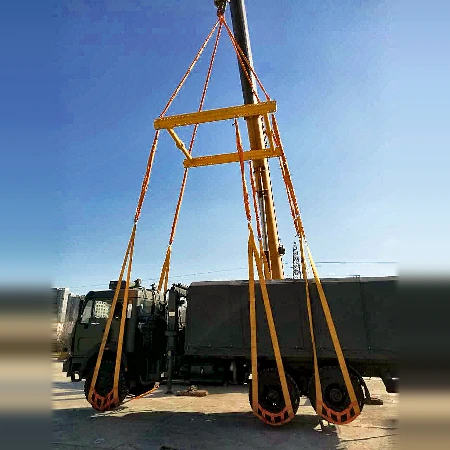
Lift sling rigging company manufacture Truck Lifting gear with polyester net,Vehicle Lifting gear with polyester net,Car Lifting Gear With Polyester Net.
Truck Lifting Gear with Polyester Net
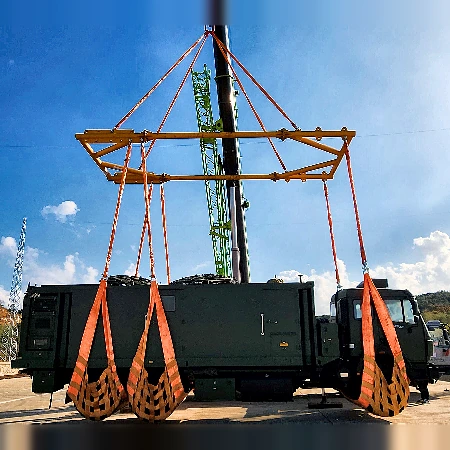
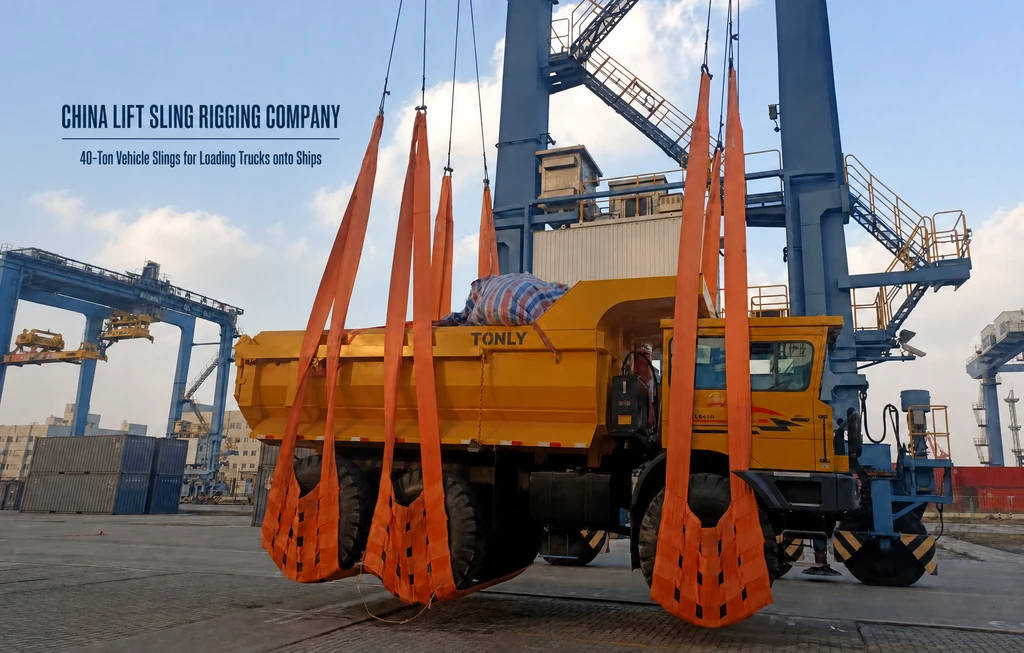
A truck cannot be lifted the way a machine part is lifted. Chains and four-leg slings concentrate the whole weight on a few contact points, and on a finished vehicle that means crushed panels, a buckled floor, torn brake lines and a repaint. Truck lifting gear with a polyester net works the other way round: a soft, wide webbing net is laid under the vehicle, the four corner loops are gathered onto the crane hook, and the load is carried across the whole underside of the chassis instead of at four small points.
Every net is woven and stitched to order in Taizhou, çîn, for port terminals, RoRo and breakbulk operations, vehicle transport yards, plant hire and recovery work. Because we weave the webbing ourselves, the panel size, mesh, webbing width and capacity are set to your vehicle rather than picked from a catalogue.
How the gear is built
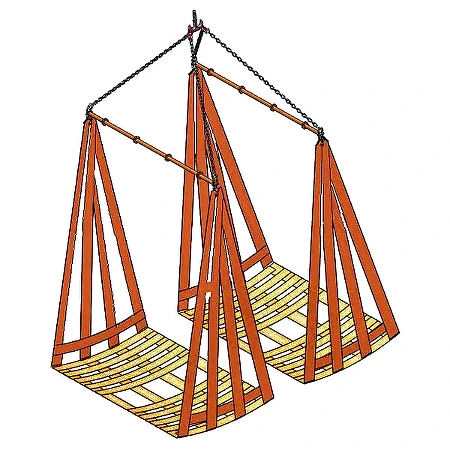
The gear is a set: the net that carries the vehicle, the legs and corner fittings that take it to the crane, and — where the legs would foul the bodywork — a rigid frame above. Only the first two are always needed.
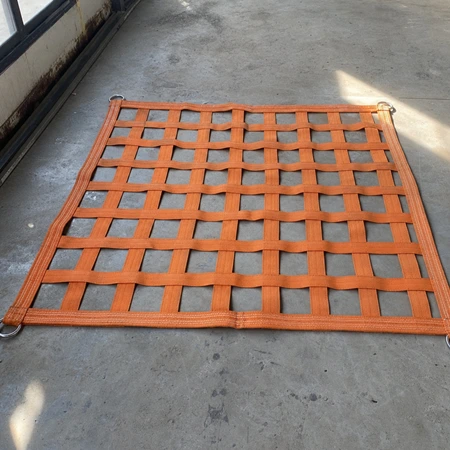
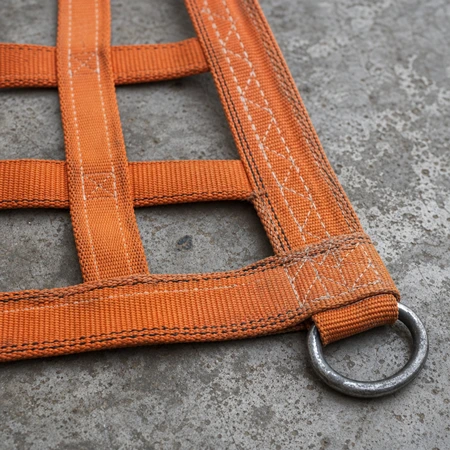
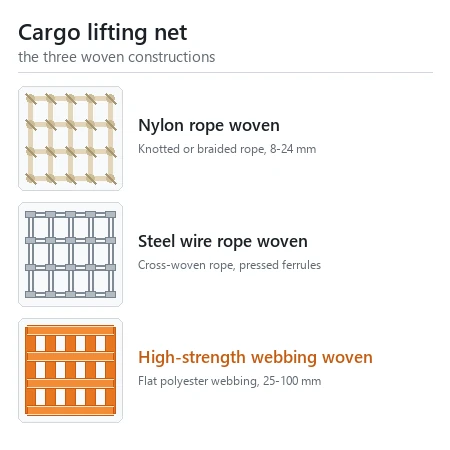
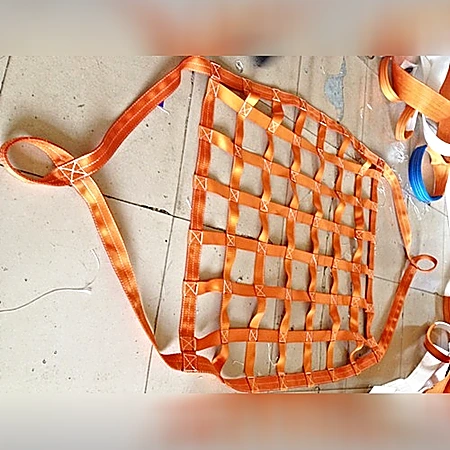
- The net or cradle — 100% high-tenacity polyester webbing, 50 mm wide as standard, woven into a 100 × 100 mm square mesh. It sits under the chassis and spreads the load. Larger vehicles use 75 mm or 100 mm webbing.
- The border — a double-layer stitched border runs right round the net, so the edge bands cannot unroll or pull out under load. This is what carries the load from the mesh into the corners.
- The corner loops — four reinforced corner loops as standard, stitched through the border. Long-wheelbase trucks, buses and coaches normally take six or eight, so the net is supported along its whole length and does not sag in the middle.
- The legs — flat polyester webbing slings from the corner loops up to a master ring, master link or the hook. Legs are kept as vertical as the crane allows, because a leg that slopes loses capacity.
- The frame (optional) — a rigid twin-beam spreader above the net when the hook is low or the legs would rub the cab. That device is covered separately under truck double beam lifting gear.
Why polyester, and why a net
Polyester is the band we recommend for vehicle work, and the reason is measurable rather than traditional.
- Low stretch — about 7 % at the working load limit, the lowest of the soft fibres. The net does not creep away from the vehicle as the crane takes up the slack, so the mesh keeps its shape and the vehicle stays square in the cradle.
- It does not absorb water and does not rot, so a net that has been used on a wet quay or in the rain can be stored without mildewing.
- Better UV resistance than nylon, which matters for a net that lives on an open truck bed or on a terminal.
- Soft, non-marking contact — the net will not scratch paint, plating or machined faces the way a chain or a wire rope does.
- Light enough to handle — one person can carry and fold a net that replaces a set of chains, and it will not rust.
Technical parameters
Material values are our standard webbing specification. Panel size, capacity and the number of lifting points are made to order and fixed on the approved drawing before manufacture.
| Parametre | Specification |
|---|---|
| Model reference | XLF-TLG-PES (assigned per set) |
| Mal | 100% high-tenacity polyester (PES) webbing; nylon or polypropylene on request |
| Webbing width | 50 mm standard; 75 mm / 100 mm for heavier vehicles (25–100 mm range) |
| Mesh opening | 100 × 100 mm square mesh standard; smaller or larger to order |
| Net / cradle panel size | Made to the vehicle footprint — typically 2.5 × 6 m up to approx. 12 × 3 m |
| Rated capacity | 5 t – 60 t per set; heavier built to order |
| Faktora ewlehiyê | 7:1 (EN 1492-1 webbing practice); 5:1 available under ASME B30.9 |
| Elongation at WLL | Approx. 7 % (polyester — the lowest of the soft fibres) |
| Border | Double-layer reinforced stitched border around the full perimeter |
| Lifting points | 4 corner loops standard; 6 an 8 for long-wheelbase trucks, buses and coaches |
| Corner fittings | Reinforced webbing loops; master ring, master link or D-shackle on request |
| Colour | Orange high-visibility standard; blue, black, green or custom for fleet identification |
| Treatment | UV-resistant, anti-aging, wear and abrasion resistant |
| Germahiya xebatê | -40 °C heta +100 °C |
| Marking | Capacity label and set serial number; own-brand label on OEM orders |
| Şehadet | CE / ISO 9001; material test report with each order |
| Optional top frame | Twin-beam spreader or lifting beam where the hook is low or the legs would foul the bodywork |
Where the gear is used
- Loading vehicles onto ships — RoRo, breakbulk and terminal work, where the net spreads the vehicle’s weight over the hold floor and the bodywork has to arrive unmarked.
- Vehicle transport and storage yards — lifting cars, vans, trucks and plant between decks, ramps and stands.
- Machinery and plant hire — excavators, loaders and access platforms that cannot be driven to where they are needed.
- Recovery and salvage — pulling a vehicle out of a position where it cannot be driven, without adding damage.
- Boatyards — lifting craft where a wide soft cradle is needed instead of a strap.
Testing, marking and documentation
Every net is made from webbing we weave ourselves and is proof loaded on our own 1,000-tonne horizontal testing machine before dispatch. Each set leaves with a capacity label stitched into the border, a material test report and the declaration of conformity your site requires. Our facilities hold ISO 9001, ISO 14001 and ISO 45001, and test reports are issued through a CNAS-accredited laboratory.
What to send us for a quotation
- Vehicle type and complete kerb weight
- Overall length, width and wheelbase — the net has to be larger than the footprint
- What is under the vehicle and how low it hangs — the net carries the load from underneath, so this sets the mesh and the webbing width
- How many lifting points you can use, and whether they can be kept vertical
- The crane, hook height and available headroom
- The working load limit and safety factor your site applies
Nexşeyek bişînin, a photograph of the vehicle or simply the handling conditions through our contact page and our engineers will confirm the net, the legs and the fittings in one reply. For cargo rather than vehicles, see the general webbing cargo lifting net and the polyester webbing net for lifting.
Pirsên pir caran têne pirsîn
Why use a net instead of four slings?
A net touches the vehicle over a wide area of its underside rather than at four small points, so the weight is spread across the chassis and axle area. Panels, lûleyên, fuel tanks and paintwork cannot be crushed or marked, and the net follows the shape of the underside instead of pulling on one corner.
What is the net made from, and how much does it stretch?
100% high-tenacity polyester webbing, 50 mm wide as standard, with a 100 × 100 mm square mesh and a double-layer stitched border. Polyester has the lowest stretch of the soft fibres — about 7 % at the working load limit — so the net stays tight against the vehicle and the mesh does not creep open over thousands of lifts.
Can the net be made to my vehicle, and how many lifting points do I need?
Erê. The panel size is made to the vehicle footprint and the mesh is chosen from the smallest item under the vehicle. Four corner points suit cars, vans and light trucks; long-wheelbase trucks, buses and coaches normally need six or eight, so the net is supported along its whole length.
Do I need the twin-beam frame as well?
Not always. Where the hook is high enough and the corner legs can run clear of the cab, the net can be lifted straight from the hook. Where the legs would rub the bodywork, or the hook height is limited, the net is hung from a rigid twin-beam frame — the truck double beam lifting gear.
berhemên Related
- Cargo lifting net — the full range of flat nets, net bags and heavy-duty nets.
- Truck double beam lifting gear — the rigid frame that holds the legs square and clear of the cab.
- Vehicle lifting net — soft-contact nets for loading vehicles and machinery onto ships.
- Polyester webbing slings — the flat webbing used for the corner legs.
- Round slings — soft round slings for heavier picks.
- Lifting spreader beam — rigid beams that spread the legs over a long vehicle.
- Heavy duty nylon cargo net sling — for scrap, demolition and abrasive cargo.
- Aramid fall protection safety net — heat and flame resistant netting.
Request a quotation for your truck lifting gear with polyester net — tell us the vehicle and we will size the net, the mesh and the legs to it.