

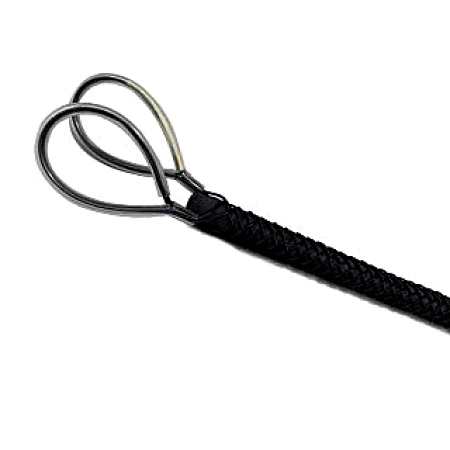
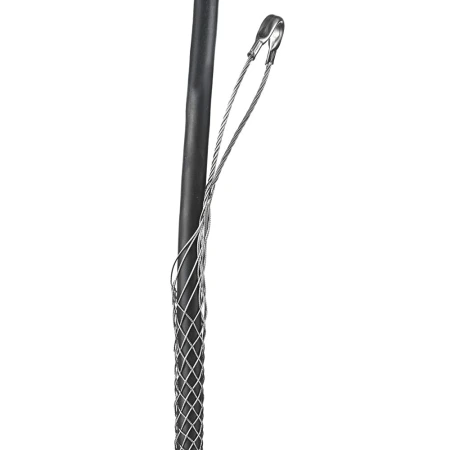
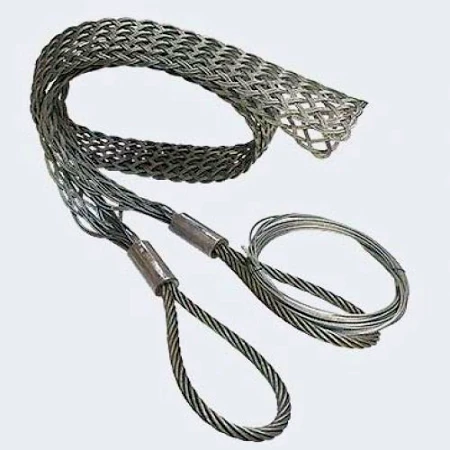
Lift sling rigging company produce Non-Metallic Cable Pulling Grips,Non-Metallic Cable Grip,Non-Metallic Pulling Grip,Non-Metallic Aramid Offset Eye Cable Grip,Offset Eye Non – Metallic Pulling or Support Grip,Non-Metallic (Aramid) Double Eye Cable Grip,Offset Eye Non-Metallic Aramid Cable Grip,Non-Metallic Aramid Cable Grip,Double Eye Non-Metallic Cable Pulling Grip .
Non-Metallic Cable Pulling Grips
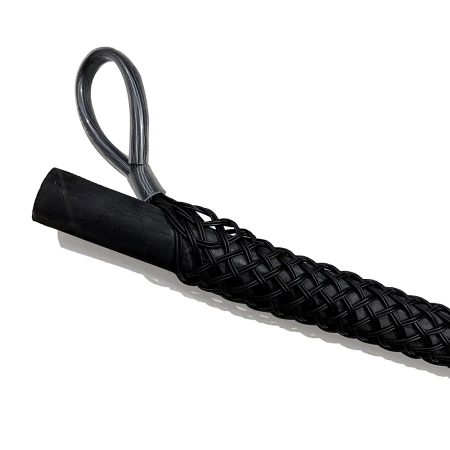
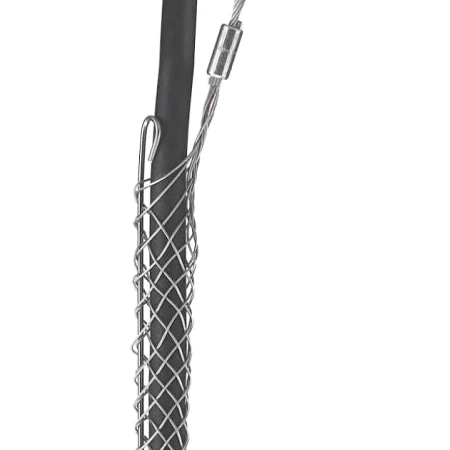
Non-metallic cable pulling grips are woven from aramid (or polyester) yarn instead of steel wire, so no metal touches the cable at any point. That matters in three situations: work beside energised circuits, where a loose wire end is a hazard; cable with a soft or coated jacket that a steel mesh would mark or abrade; and wet, coastal or chemical sites where galvanised mesh corrodes. The mesh tightens on the jacket as tension rises and grips by friction alone, with no clamps and no crushed insulation.
Why Specify a Non-Metallic Grip?
- No metal near the conductor. Aramid and polyester mesh contain no wire, no ferrule and no thimble, so nothing conductive or sharp sits against the jacket. This is a handling advantage, not a rated insulation – keep to your live-line procedure.
- No jacket marking. Soft yarn bears on the sheath without the wire cross-points that can polish, score or imprint coated, LSZH and fibre optic cable.
- No corrosion. Nothing to rust in tunnels, coastal yards, ships or chemical plants; the grip stays clean and does not stain white or light-coloured cable.
- Lighter and easier to handle. A fraction of the weight of a steel sock of the same size, which matters on long pulls and when the grip is fitted at height.
- Kind to the hands and to the drum. No wire ends to catch gloves or score a cable drum, and no spark risk if the grip is dropped near live equipment.
Aramid or Polyester Mesh?
Both are non-metallic; the yarn decides the duty. Aramid (para-aramid, the fibre family commonly known as Kevlar) carries more load for the same mesh and holds strength at higher temperature. Polyester is the lower-cost option for light pulls and general handling.
| Yarn | Strength / temperature | Best for |
|---|---|---|
| Aramid (para-aramid) | Highest strength-to-weight of the two; keeps working strength at elevated temperature | Heavy pulls, long runs, hot plant rooms, offshore and marine |
| ಪಾಲಿಯೆಸ್ಟರ್ (ಪಿಇಟಿ) | Moderate strength; soft hand; low cost | Light pulls, cable handling, fibre optic and coated jacket work |
| Polyamide (nylon) | High elongation, good abrasion resistance | Short pulls where a little stretch is acceptable |
Non-Metallic Cable Pulling Grips – Specifications
The table below is the standard build. Cable range, mesh length, yarn, eye type and lacing are fixed at order – send the cable outside diameter and the duty, and we match the model.
| Parameter | Specification |
|---|---|
| Product name | Non-metallic cable pulling grip / aramid cable grip / non-metallic support grip |
| Mesh material | Para-aramid yarn (standard heavy duty); polyester or polyamide on request |
| Metal content | None in the mesh, eye or lacing – no wire, ferrule or thimble |
| Structure | Double-layer cross-woven tubular mesh, closed head with braided eye |
| Cable diameter range | 9-16 mm up to 130-160 mm in standard models; larger sizes made to order |
| Mesh (grip) ಉದ್ದ | 300 / 450 / 600 / 700 / 900 / 1200 / 1500 ಮಿಮೀ; custom up to 3000 ಮಿಮೀ |
| ಕಣ್ಣಿನ ಪ್ರಕಾರ | Single eye, double eye, or offset eye – all braided in the same yarn |
| Body type | Closed head (slide-on) or lace-up split mesh |
| Lacing | Polyester cord as standard; aramid cord on request |
| ಸುರಕ್ಷತಾ ಅಂಶ | 5:1 on the rated breaking strength of the finished mesh |
| ಬಣ್ಣ | Natural / black / yellow; colour coding to order |
| ಕೆಲಸದ ತಾಪಮಾನ | Aramid mesh to +180 °C short term; polyester to +90 °C |
| ಗ್ರಾಹಕೀಕರಣ | Custom length, eye, ಬಣ್ಣ, braided logo, private label packing |
| Origin | ಲಿಫ್ಟ್ ಸ್ಲಿಂಗ್ ರಿಗ್ಗಿಂಗ್ ಕಂ., Ltd – Taizhou, Jiangsu, ಚೀನಾ |
Model Selection Chart
Choose by the measured cable outside diameter first, then set the mesh length against the load and the run. Because the working load of a textile grip depends on the yarn and the weave, each model is rated individually – give us the load and we confirm the rating with the quotation.
| Model | Cable Ø range (ಮಿಮೀ) | Mesh length (ಮಿಮೀ) | Standard yarn | Eye | Rated capacity |
|---|---|---|---|---|---|
| NMPS-16 | 9-16 | 300 | Aramid | Single | Per model |
| NMPS-25 | 16-25 | 450 | Aramid | Single | Per model |
| NMPS-38 | 25-38 | 600 | Aramid | Single | Per model |
| NMPS-50 | 38-50 | 700 | Aramid | Single | Per model |
| NMPS-75 | 50-75 | 900 | Aramid | Single | Per model |
| NMPS-100 | 75-100 | 1200 | Aramid | Single | Per model |
| NMPS-160 | 130-160 | 1500 | Aramid | Single | Per model |
Rated capacity is confirmed per model: a textile grip is rated on the finished weave, not on a nominal wire size, and the figure changes with yarn, mesh length, eye and lacing. Send the cable diameter and the pulling or support load and we return the rating with the model number. Order one size above the measured diameter when the cable is within 1 mm of a range limit.
How to Choose the Right Model
- Measure the cable outside diameter where the mesh will grip, not the nominal cable size; for a bundle use the overall diameter.
- Decide the yarn – aramid for heavy pulls, hot plant rooms and long runs; polyester for light handling, fibre optic and coated jacket work.
- Choose the eye – single eye for a straight pull, double eye for two-point hanging or balanced pulls, offset eye where the line must clear the cable.
- Choose the body – closed head if the cable end is free, lace-up if the cable is already terminated and cannot be fed through.
- Set the mesh length from the load, using at least 4-5 times the cable diameter of engagement for heavy pulls.
- State the load and the environment (heat, chemicals, UV, abrasion) so the yarn, mesh length and lacing are confirmed together.
Eye and Body Options
- Single eye – one braided eye in line with the mesh; the standard pulling configuration.
- Double eye – two eyes sharing the load, for two-point hanging, bridle rigs and pulls that must stay balanced.
- Offset eye – eye set to one side of the axis so the cable hangs plumb and the line clears the jacket.
- Lace-up split mesh – wraps and laces around cable that is already terminated, with a polyester or aramid cord.
- ಬಣ್ಣ – natural, black or yellow, or colour-coded by cable range for site stores.
Typical Applications
- Pulling and supporting cable near energised equipment, where loose wire ends are a hazard
- Fibre optic, data and control cable where the jacket must not be marked or crushed
- LSZH, lead-sheathed and painted cable that cannot be scored by a steel mesh
- Tunnels, ships, offshore and coastal sites where galvanised mesh would corrode
- Substations, rail and telecom work where non-sparking handling is preferred
- Mid-span support and riser work on installed cable, using the lace-up version
Installation and Safe Use
- Inspect mesh, eye and stitching before every pull; discard any grip with cut yarns, a frayed eye or a pulled stitch.
- Slide the mesh on until the cable end reaches the head – never pull with the cable only half inserted.
- Keep the pull axial. Side loading at a duct mouth is the most common cause of damage, and a textile mesh will not warn you with a bent wire.
- Keep the mesh away from sharp edges, hot surfaces and weld spatter; aramid resists heat but a cut yarn loses strength immediately.
- Do not exceed the rated load for the model supplied, and do not use a pulling grip for overhead lifting unless the model is rated and marked for lifting duty.
- Store dry and out of sunlight; inspect textile grips at least annually in permanent support duty.
Quality Control
ಲಿಫ್ಟ್ ಸ್ಲಿಂಗ್ ರಿಗ್ಗಿಂಗ್ ಕಂ., Ltd has manufactured wire rope and mesh rigging in Taizhou, Jiangsu since 1985. Mesh is woven from yarn we select, eyes are braided to a controlled length, and samples are proof-loaded before despatch in our own laboratory. Pre-shipment inspection reports and third-party testing can be arranged on request.
Frequently Asked Questions
What is a non-metallic cable pulling grip used for?
It pulls or supports cable where no metal may touch the jacket – beside energised equipment, on coated or fibre optic cable, and on wet or coastal sites where steel mesh would corrode.
Is it safe to use near live circuits?
The grip contains no metal, so nothing conductive sits against the cable. It is not a rated insulating tool, though – it is a handling aid, and your live-line procedure still governs the work.
Aramid or polyester – how do I choose?
Aramid for heavy pulls, long runs and hot locations; polyester for light pulls, fibre optic and general handling where cost matters more than strength. Send the load and the environment and we confirm the yarn.
Can you supply an offset eye or a lace-up body?
ಹೌದು. Single, double and offset eyes are all braided in the same yarn, and the body is available closed-head or lace-up split mesh for cable that is already terminated.
How is the capacity rated?
Each model is rated on the finished weave at 5:1, and the figure depends on yarn, mesh length, eye and lacing – so we confirm it per model with the quotation rather than publishing a single number for the range.
Request a Quotation
Send the cable outside diameter, the load, the duty (pull or support), mesh length, yarn preference and eye type – or a photo of the cable and the route – and our engineers will confirm the model, the rating and the price. Custom lengths, colours, braided logo and private label are standard business for us.
Send your cable details for a quotation
ಫೋನ್ / WhatsApp: +86 180 6600 2268 | ಇಮೇಲ್: 702461526@qq.com
ವಿಳಾಸ: ಲೈಫ್ಯೂಟ್ ಇಂಡಸ್ಟ್ರಿಯಲ್ ಪಾರ್ಕ್, ತೈಝೌ ನಗರ, ಜಿಯಾಂಗ್ಸು ಪ್ರಾಂತ್ಯ, ಚೀನಾ