

Lift sling rigging company produce 100 Тонналық итарқа,100Ton Flat Lifting Belt,100T Lifting Sling,100Tonne UHMWPE Flat Webbing Sling,100 Ton Lifting Strap.
100 Тонналық итарқа.
Сағат 100 tonnes a webbing sling stops being an article you hang on a hook and starts being an engineered assembly: four matched legs, a master link sized to the crane, lengths that agree with each other to within a few millimetres, and a certificate that names each leg. This page is about the decisions that come with the extra forty tonnes over a 60 t sling — not about the band being bigger.
The short answer. А 100 tonne webbing sling is a flat polyester (or UHMWPE) band rated 100,000 kg in vertical hitch, 80,000 kg choked and 200,000 kg in basket, built on a 6:1 factor to a minimum breaking load of 600,000 кг, and normally supplied as a matched multi-leg assembly with a master link rather than as a single strap. It lifts finished, painted or machined loads that a wire rope would mark, and it is marked per EN 1492-1 with a figure for each hitch.
The figure applies per hitch, and at this size it decides the crane
Below about 20 т, a buyer picks a sling and the crane is somebody else’s problem. Сағат 100 t the two are the same decision: the basket rating is 200 т, which is more than most mobile cranes can pick, and the choked rating is 80 т, which is where a 100 t sling quietly becomes the wrong tool for a 90 t lift.
| Аранжировка | Factor | Сыйымдылығы | Where it bites |
|---|---|---|---|
| Тік | 1.0 | 100 т | One leg, straight up. The figure everything else is derived from. |
| Тұншығып қалды | 0.8 | 80 т | Round the load and back through its own eye; the figure that surprises buyers. |
| Себет, 0–45° | 2.0 | 200 т | Under the load, both eyes on the hook — more than the crane can usually pick. |
| Себет, 45–60° | 1.4 | 140 т | Legs spread; the spread costs 60 t of capacity. |
| Two legs, 0–45° | 1.4 | 140 t assembly | Pair to a master link, legs near vertical. |
| Two legs, 45–60° | 1.0 | 100 t assembly | The same pair spread: no more than one leg. |
| Four legs, 0–45° | 2.1 | 210 t assembly | Multi-leg, not four times the single. Load sharing is assumed, not guaranteed. |
| Four legs, 45–60° | 1.5 | 150 t assembly | The same four spread. |
Mode factors per EN 1492-1; assembly capacity is the single-sling WLL × factor. The label on the article governs.
Сағат 100 tonnes the sling is an assembly
A single 100 t leg is a legitimate article and we build them, but most of what leaves the works at this figure is a set: four legs, a master link, and often a spreader. Three reasons:
- The load is a fabricated item, not a billet. Nacelles, transformers, precast segments and modules pick from four points, and four points want four legs of a size that can be handled, not one enormous one.
- The crane hook wants one attachment. Four eyes on a hook is a rigging error; four eyes on a master link sized for the assembly is the standard answer.
- The angle has to be controlled. Where the pick points are wide or the load must not be squeezed, а көтеру таратқыш арқалық takes the horizontal component out and the legs work vertically again — which is the difference between 210 t of assembly capacity and 150 т.
Matched sets, and why length tolerance is the whole game
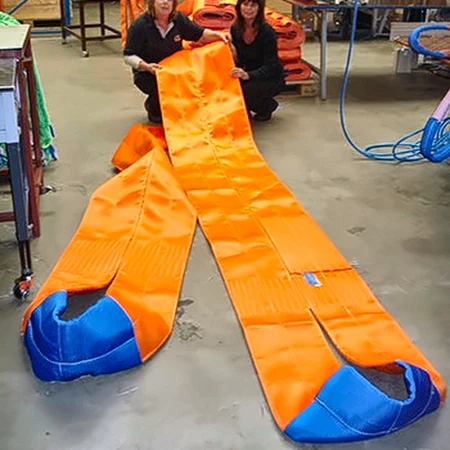
Four legs share a load only if they are the same length. Put a 20 m leg and a 20.1 m leg in the same set and the short one takes the load first; the difference is small until you multiply it by 100 т. This is the part of a large-tonnage order that gets the least attention at enquiry and causes the most trouble on site.
So a set leaves here as a set: legs cut and measured against each other, marked with the set number, tolerance held to ±0.5 % between legs inside a ±2 % absolute length tolerance, and certified together. Legs from two different orders are not interchangeable, and a replacement leg is made to the set record rather than to the nominal length.
The question to ask a supplier. Not “what is your length tolerance” but “what is the tolerance between the legs of my set, and is it on the certificate?” A supplier who answers the first and not the second has not built many four-leg assemblies above 50 т.
Polyester or UHMWPE: сағ 100 t the fibre is a handling decision
The band has to be carried, laid out, hooked and inspected by people. Сағат 60 t that is a two-person job; сағ 100 т, in polyester, it is a job with a pallet truck or a small crane. That is the real reason the UHMWPE webbing sling exists in this size.
| Polyester (стандартты) | UHMWPE (сұраныс бойынша) | |
|---|---|---|
| Mass for the same break | The reference. | In the region of a quarter — the reason it is bought at this size. |
| WLL кезінде созылу | ≤ 3 % | Lower still; the band barely gives. |
| Heat | Comfortable to about 100 °C. | Far less: it softens around 145 °C and must be kept away from hot work. |
| Sustained load | Stable in storage and in a set left rigged. | Creeps under long-term steady tension; not the fibre for a load left hanging. |
| Cost | The economical answer. | Several times the price, and worth it where the handling is the risk. |
Where the load is hot — a casting, a recently welded fabrication, a furnace area — neither fibre is right at 100 т: the answer is a high temperature webbing sling in aramid, sized for the job rather than for the tonnage.
Не 600 tonnes of break looks like in a workshop
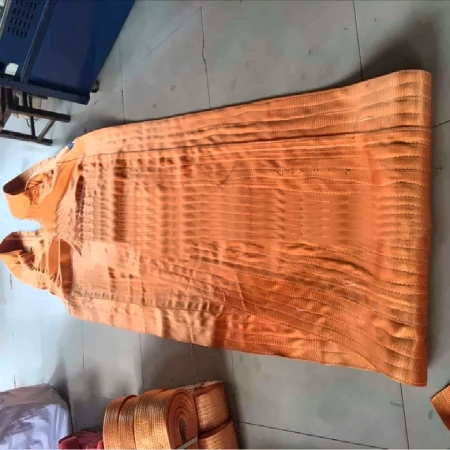
The band is woven in polyester yarn, assembled in plies, and the ply count is what carries the figure — at 400 mm and multi-ply, the cross-section of load-bearing yarn is roughly the area of a dinner plate. Three details matter more than the number:
- The stitching is the joint, and it is designed rather than specified: rows of polyester thread in a pattern that puts the load into shear across the full width, not into the last row of stitches. Six rows is the norm at this size, and the row nearest the eye is the one that tells you the sling has been overloaded.
- The eye is sleeved, because at 100 t the eye is pressed against a shackle bow that is harder than the webbing. The sleeve is a wear item and is meant to be replaced before the weave is touched.
- The proof load needs a test bed, not a forklift. Every sling and every set is proof loaded and inspected before it leaves, and the certificate quotes the serial of the article rather than the batch.
Bearing pressure: не 100 t does to the load
400 mm of web at 100,000 kg is 250 kg for every millimetre of width. On a painted steel fabrication that is the figure that decides whether the coating survives; on a machined shaft it is the figure that decides whether the band crushes what it is holding; on a precast edge it is the figure that decides whether the concrete spalls.
The answer is not a thicker band but a wider contact: a sleeve, a pad, or a different hitch. A basket spreads the same load over two thicknesses of band and halves the pressure — which is one of the reasons a basket is rated at 2.0 rather than 1.0.
Өңдеу, storage and the end of a 100 т итарқа
- Lay it out, do not drag it. A band of this size wears fastest at the edges, and dragging it across concrete is the fastest way to wear them.
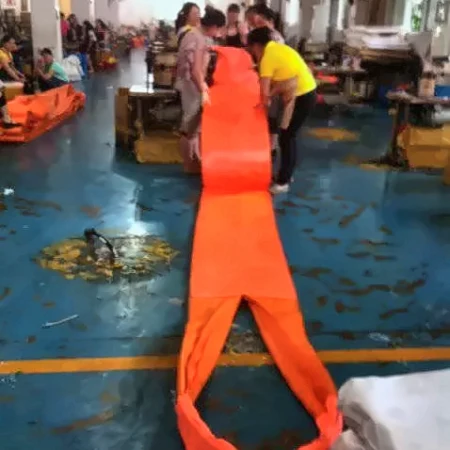
- Plan the lift of the sling itself. Where the mass exceeds what two people can handle, the drawing quotes the mass and the coil diameter so the site can plan a pallet truck or a small crane.
- Store coiled, dry, off the floor, out of sunlight, with the set record and certificate. A four-leg set stored as four separate coils is a set that will be rigged mismatched.
- Әрбір лифт алдында тексеріңіз and formally at the interval the site sets: кесу, snags, punctures, сынған тігіс, a worn or distorted eye, heat glazing, chemical damage, an unreadable label. Any one of those retires the leg — and a leg retired from a set retires the set until it is replaced to the record.
Where 100 tonnes is bought
- Offshore and onshore modules — skids, packaged plant, pipe racks
- Wind — nacelles, hubs, blade root fixtures and tower sections
- Power transformers and heavy electrical plant, where the tank must not be marked
- Precast concrete — segments, tunnel rings, bridge beams
- Shipbuilding — blocks and modules in the yard
- Steel structures — trusses and girders with a finished coating
In most of these the 100 t sling is one article in a chain: а wire rope sling where the environment is abrasive, а дөңгелек ілмек where the band has to turn a corner, а жүк көтеру торы where the load is a bundle. The 60 ton webbing sling is the step below, and the construction is the same in fewer plies.
Ұзындығы, and the mass that comes with it
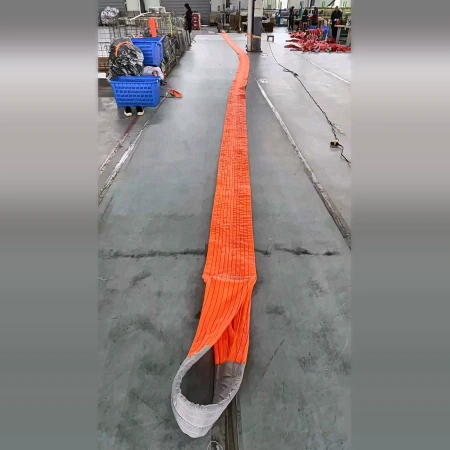
А 100 t sling at 4 m and the same sling at 20 m are different projects. Length sets the stand-off from the load, the angle at the pick point, and the mass to be handled: the band is quoted per metre so the drawing carries a figure rather than an adjective.
Sizing it in six answers
- What is the load, and is the figure per leg or for the whole assembly?
- How will it be hitched — vertical, choked, basket — and at what leg angle?
- How many pick points, and are they designed points or fabricated lugs?
- What holds the top: ілмек, master link, spreader, or a crane block?
- What is the surface, the temperature and the environment?
- How long are the legs, and how will the set be stored and inspected?
Questions we are asked about the 100 tonne sling
Is a 100 t webbing sling one band or four?
Either, but they are different products. A single 100 t leg is one article; a four-leg set is an assembly rated 210 t at 0–45°, with its own marking and its own certificate. The set is not four times the leg.
Why is the choked rating only 80 т?
Because the band is loaded against itself and the wrap grips, so the fibres work in a way the vertical rating does not describe. It is normal, it is on the label, and it is why a 90 t choke needs the next size up.
Can I mix legs from two orders into one set?
Жоқ. Legs are matched within a set to ±0.5 % of each other and the set has a record. A leg from another order will be a different length within tolerance, and at 100 t that difference decides which leg carries the load.
Polyester or UHMWPE?
Polyester unless the handling is the problem. UHMWPE gives the same rating at roughly a quarter of the mass, but it dislikes heat and creeps under sustained load, so it is the wrong answer for a hot fabrication or a load left hanging.
How is a 600 t break verified?
By proof loading the finished article on a test bed and issuing a certificate against its serial, plus batch testing of the webbing and the stitching. А 3.1 certificate quoting the serial is available where the project requires traceability.
Is it a 100 ton flat lifting belt or a 100 T lifting sling?
The same article under different names: 100 tonne webbing sling, 100 ton webbing sling, 100 ton flat lifting belt, 100 T lifting sling, and 100T UHMWPE flat webbing sling where the fibre is UHMWPE. The name changes nothing about the product; the label on the article states the WLL per hitch and the standard it was built to.
What is the lead time?
Longer than a small sling and driven by the test bed rather than the weaving. Confirm the drawing and the set configuration first; a set built to the wrong leg lengths is a set that has to be rebuilt.
Related: flat webbing slings · WLL 60 ton polyester webbing slings · heavy duty eye & eye flat web sling · heavy eye webbing sling · heavy duty endless lifting web slings · UHMWPE webbing sling · lifting spreader beams · дөңгелек итарқалар · сым арқандар · жүк көтеру торлары
Send the load and the pick points
Tell us what is being lifted, the mass per leg, the number of pick points and what holds the top, and we will come back with ply count, ені, leg lengths, set tolerance and the assembly figure — on a drawing, before anything is woven.
Lift Sling Rigging Co., Ltd · Lifting & rigging division of China Lifute Sling Group
Тел / WeChat +86 180 6600 2268 · 702461526@qq.com
Лифут индустриалды паркі, Тайчжоу қаласы, Цзянсу провинциясы, China · HS code 630790
Figures quoted are for the standard build to EN 1492-1 сағ 6:1. ASME B30.9 builds at 5:1 are available; the labelled WLL always governs the lift.