

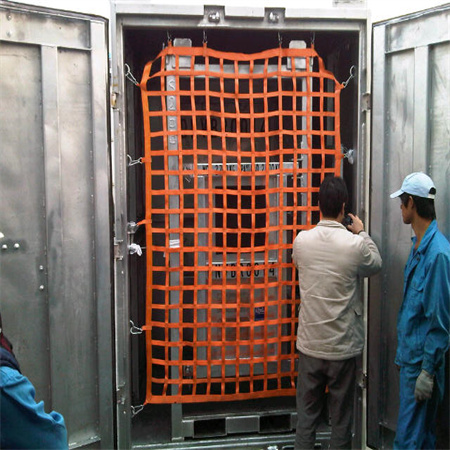
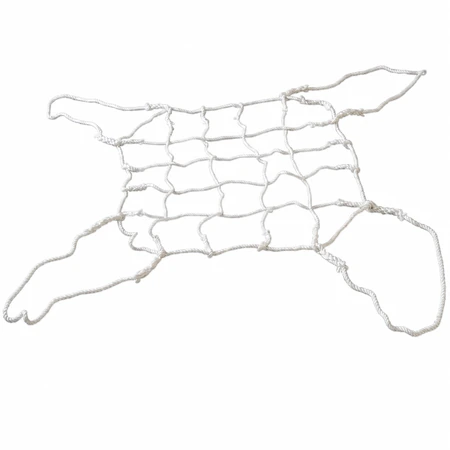
L'azienda di sollevamento con imbracatura produce reti di sollevamento in poliestere,Rete di carico in poliestere,Cinghia per rete di sollevamento di sicurezza,Rete di carico elastica,Rete di sollevamento del carico in poliestere,Rete per imbracatura di sollevamento,Rete di sollevamento a fune,Rete di carico per pallet,Rete da arrampicata da giardino.
Rete di sollevamento in poliestere
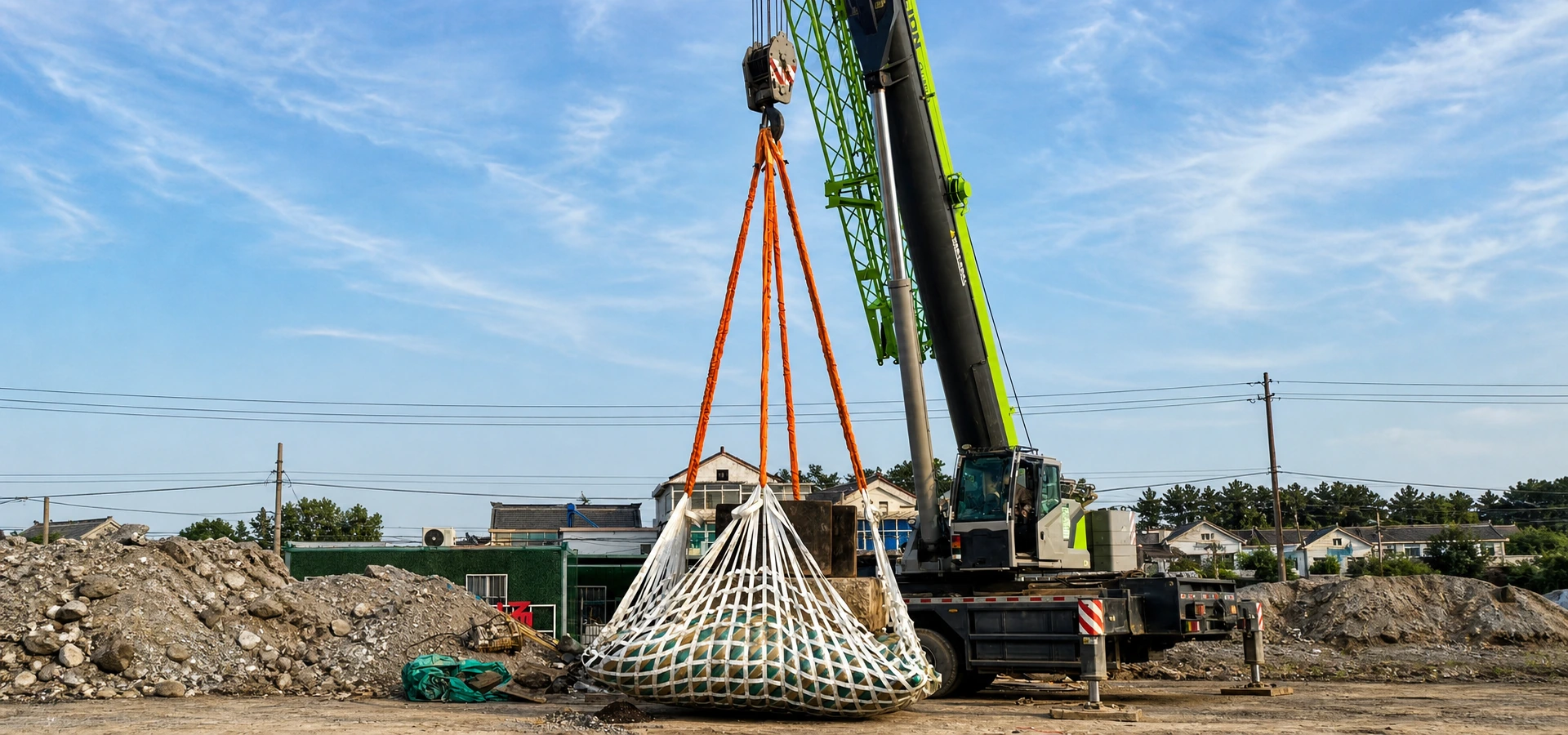
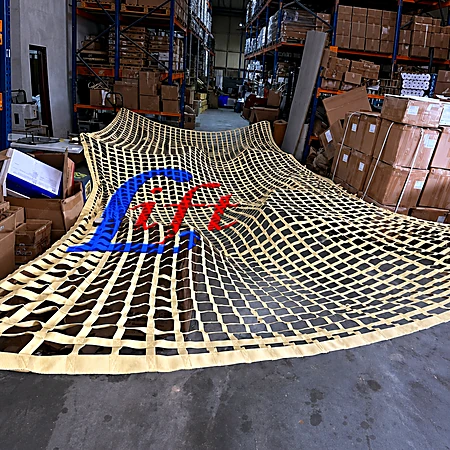
A polyester lifting hoisting net is a soft bag woven from high-tenacity polyester webbing, built to move bagged goods and bulk material in a single crane lift. The load is tipped into the bag, or the bag is laid flat and drawn up around a stack, and four corner loops carry the whole consignment to the hook. There is no pallet to return, no strapping to cut, and nothing to re-handle at the far end.
Because we weave the webbing in our own mill in Taizhou, Jiangsu, l'apertura della rete, bag footprint, profondità, bottom construction and working load limit are all set to the cargo rather than to a fixed catalogue. Standard nets cover 0.5 t a 20 t e 0.6 m³ oltre 10 m³, every net is proof-load tested before packing, and each shipment travels with a material test report. Nets are CE and GS certified, with webbing rated to the EN 1492-1 base.
- Fully custom build – maglia, dimensione della borsa, profondità, colour and safety factor (5:1, 6:1 O 7:1) set to your specification.
- High-tenacity polyester webbing – 25 mm a 100 fasce da mm, separare, duplex or triplex, Stabilizzato ai raggi UV e imputrescibile.
- Wear and heat resistant – working range -40 °C a +100 °C, with a reinforced bottom for abrasive loads.
- Morbido, flessibile e leggero – the flat band contacts the load over a wide area, so bags, cartons and finished surfaces are neither crushed nor marked.
- Certificato CE e GS – tested on our own 1000 macchina, with an ISO 9001 quality system and a CNAS-accredited laboratory behind it.
Why a webbing net bag, and not a rope net or a big bag
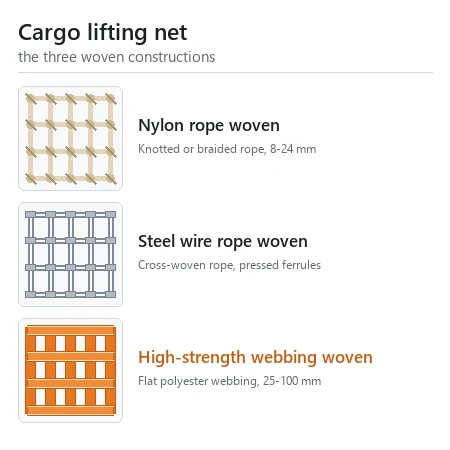
Three products are sold for the same job and they behave very differently once the load is in the air. A rope net concentrates the load on a few contact points. A big bag carries one free-flowing product and is itself the package. A webbing net bag spreads the pressure across flat bands, holds a stacked or mixed load together, and goes back to the store empty.
Tavolo 1 – How the four common ways of lifting loose cargo compare.
| Opzione | Costruzione | Contatto con il carico | Best cargo | Limitation |
|---|---|---|---|---|
| Polyester webbing net bag | Flat woven bands, 25-100 mm, 25-300 maglia da mm | Wide flat bands, low pressure per cm² | Insaccato, impilati, mixed and bulk cargo | Needs a crane or hook; not a sealed package for powder |
| Rete in corda di nylon | Knotted or braided rope, 8-24 mm | Line contact at every rope | Irregular and heavy single items | Ropes mark soft cargo; a tight mesh adds weight |
| FIBC / big bag | Woven PP fabric with a liner | Full surface, sealed | One free-flowing product per bag | Single product only; the bag is the packaging |
| Pallet and strapping | Timber or plastic pallet plus bands | Rigid base | Unitised cartons | Pallet returned or lost; bands cut and discarded; no drainage |
Five decisions that set the specification
A polyester lifting hoisting net is quoted from five numbers. Get them right and the net arrives right; get the mesh wrong and no amount of extra tonnage will fix it later.
Tavolo 2 – What we need to know, and why each answer changes the net.
| Decision | Cosa risolve | What to tell us |
|---|---|---|
| 1. Cargo form | Whether the net is a bag or a flat sheet, and how the bottom is built | How the cargo arrives: sacchi, grandi borse, balle, or loose material |
| 2. Weight per lift | Band width and layer count, and therefore the rated capacity | Il peso lordo che intendi sollevare, not the weight of the net |
| 3. Volume pieno | Footprint and depth of the bag | Densità apparente (t/m³) for loose material, or the height of the stack for bagged goods |
| 4. Apertura a rete | The largest gap the cargo can pass through | The smallest unit in the load: UN 25 kg bag, grano, aggregate or scrap |
| 5. Metodo di scarico | Chiuso, allacciato, scivolo o fondo rivestito | Whether the bag is tipped, untied over a hopper, or emptied by hand |
Weight and volume are two separate limits, and for light bulk the volume arrives first. Grain at about 0.7 t/m³ and wood chips at about 0.3 t/m³ both fill a 3.6 m³ bag, but one lift weighs about 2.5 t and the other about 1 T. Send the bulk density with the tonnage and we will size the bag so that a full bag is also a legal bag.
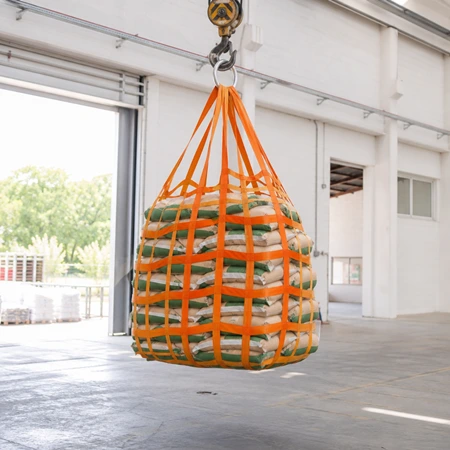
Parametri tecnici
Le figure seguenti coprono la gamma standard in sacchi e sfusa. Maglia, orma, profondità, bottom, loops and capacity are made to order, so treat this as the starting point for a quotation rather than a fixed catalogue.
Tavolo 3 – Polyester lifting hoisting net: parametri tecnici.
| Parametro | Specifica |
|---|---|
| Nome del prodotto | Polyester lifting hoisting net (polyester webbing net bag) |
| Configurations | Closed bag, release-bottom bag, or flat lifting net |
| Materiale della cinghia | 100 % poliestere ad alta tenacità (ANIMALE DOMESTICO); nylon ad alta tenacità su richiesta |
| Larghezza della banda | 25 / 38 / 50 / 75 / 100 mm (50 norma mm) |
| Band construction | Strato singolo, duplex or triplex; cimosa tessuta, non un bordo tagliato |
| Spessore della fascia | 1.8 mm – 4.5 mm a seconda della larghezza e del numero di strati |
| Apertura a rete | 100 × 100 norma mm; 25 – 300 mm su ordinazione |
| Dimensione netta | Fatto per l'ingombro del carico, truck bed or receiving hopper; see Table 4 |
| Profondità della borsa | 0.8 M – 2.5 M, o al disegno |
| Volume pieno | Di 0.6 m³ oltre 10 m³, set by footprint and depth |
| Confine | Piegato e doppia cucitura, reinforced at every lifting point |
| Punti di sollevamento | Standard a quattro anelli angolari; otto per una trave di diffusione; passanti superiori e inferiori su richiesta |
| Capacità nominale (WLL) | 0.5 T – 20 T, impostato per banda, conteggio degli strati e disposizione di sollevamento |
| Fattore di sicurezza | 5:1 / 6:1 / 7:1 |
| Allungamento al WLL | 7 % o meno |
| Colore | Colour code by working load limit, o un colore della casa personalizzato |
| Temperatura di lavoro | -40 °C a +100 °C |
| Weather and chemical | Stabilizzato ai raggi UV, imputrescibile, unaffected by rain, sea water and wash-down |
| Marcatura | WLL, mesh and batch printed on the belt, plus a sewn capacity label |
| Base standard | Fettuccia classificata EN 1492-1 |
| Certificazione | CE, GS, ISO 9001, JIS su richiesta; Laboratorio del CNAS; DNV |
| Personalizzazione | OEM / Dimensioni dell'ODM, colore, logo stampato, etichetta e imballaggio |
| Codice SA | 6307.90 – reti e reti in materiali tessili |
Dimensioni standard, volumes and working load limits
These six lines cover the great majority of bagged and bulk work. Filled volume is calculated from the footprint and the depth with an allowance for the rounded shape a loaded bag takes, so a material that settles well will carry slightly more and one that bridges will carry less.
Tavolo 4 – Standard net sizes at four corner loops gathered on one hook.
| Dimensione netta (L x P) | Depth | Volume pieno | Maglia | Banda | WLL | Carico tipico |
|---|---|---|---|---|---|---|
| 1.0 × 1.0 M | 1.0 M | 0.6 m³ | 50-100 mm | 50 mm singolo | 0.5-1.5 T | 25 sacchi da kg, piccoli sacchi, balle |
| 1.5 × 1.5 M | 1.2 M | 1.6 m³ | 50-100 mm | 50 duplex da mm | 1-2.5 T | Grano insaccato, fertilizzante, produrre |
| 2.0 × 2.0 M | 1.5 M | 3.6 m³ | 50-100 mm | 50 duplex da mm | 2-4 T | Grano sfuso, sabbia, pietra frantumata |
| 2.5 × 2.5 M | 1.8 M | 6.8 m³ | 50-150 mm | 75 duplex da mm | 3-6 T | Fertilizzante sfuso, carbone, rottame, pescare |
| 3.0 × 3.0 M | 2.0 M | 10.8 m³ | 100-150 mm | 75 duplex da mm | 4-8 T | Grandi carichi sfusi, banchina e tenere il lavoro |
| To drawing | 0.8-2.5 M | Per ordinare | 25-300 mm | 25-100 mm | 0.5-20 T | Qualsiasi impronta, profondità e carico |
The working load limits above assume a four-loop lift. A two-loop basket de-rates the net – ask for the derated figure rather than reading across from this table.
Apertura a rete, chosen from the cargo
Mesh is the one dimension that cannot be adjusted after the net is sewn, so it is sized from the smallest unit in the load rather than from the total weight.
Tavolo 5 – Mesh opening by cargo.
| Carico | Maglia consigliata | Motivo |
|---|---|---|
| 50 sacchi da kg, grandi borse, balle | 100 mm | The sacks are far larger than the opening; the mesh only has to keep the stack together |
| 25 sacchi da kg, piccoli sacchi | 50-75 mm | Small bags can squeeze through 100 mm once the load settles in the air |
| Grano, seme, prodotti secchi | 25-50 mm, o un rivestimento chiuso | Fine material must not sift out on the hook or in transit |
| Fertilizzante, prill, polveri | 25-50 mm, o un rivestimento chiuso | Fine and moisture-sensitive: a liner keeps the product in and the weather out |
| Sabbia, ghiaia, pietra frantumata | 50-100 mm | Abbastanza fine da contenere la maggior parte, open enough for rainwater to drain |
| Carbone, coke | 100-150 mm | Large lumps; una maglia più ampia mantiene la rete leggera e drena bene |
| Rottami metallici, ritagli | 100-150 mm | Open mesh with a reinforced bottom and wear pads at the contact points |
| Pescare, crostacei, prodotti umidi | 25-50 mm | Holds the catch, drains freely, keeps the weight honest |
| Registri, legna da ardere, grandi ritagli | 150-300 mm | Indivisible pieces: a wide mesh saves weight without losing the load |
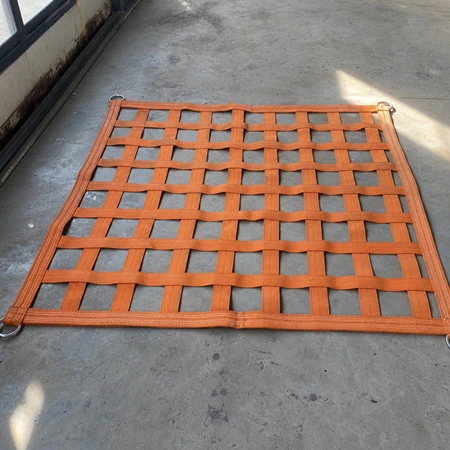
Bottom construction and discharge
How the load comes out is a design decision in its own right. For bagged cargo the answer is usually a person with a knife; for bulk it is usually gravity.
Tavolo 6 – Bottom options and how each one is emptied.
| Metter il fondo a | Come funziona | Chosen when |
|---|---|---|
| Chiuso, completamente cucito | The bag holds the cargo permanently and is emptied by tipping or by hand | Carico in sacchi, and bulk tipped over a hopper or onto a pile |
| Release bottom, allacciato | Una cucitura sul fondo viene sciolta nel punto di scarico e il carico cade | Free-flowing bulk – sabbia, grano, aggregato – discharged without tipping the bag |
| Fondo dello scivolo | The bag narrows to a chute opened over the receiving hopper | Controlled discharge into a hopper, una chiatta o un trasportatore |
| Closed with a liner | All'interno della rete si trova una fodera in tessuto | Dusty or moisture-sensitive bulk: grano, fertilizzante, polveri |
| Pannello inferiore rinforzato | An extra layer of webbing is stitched across the base | Abrasive and heavy bulk: aggregato, minerale, rottame |
| Loops top and bottom | Loops at both ends, so the bag can be lifted either way up | Loading at height, e svuotamento capovolgendo il sacco sul gancio |
Lifting arrangements and fittings
Il modo in cui viene appesa la borsa determina la quantità di carico che trasporta effettivamente, e l'ingombro non perdona perché il carico continua a muoversi all'interno della borsa mentre è in aria.
- Four loops on the hook – the standard for bagged and bulk work; the loops gather on the hook or a master ring and the bag closes around the cargo as the crane takes up the slack.
- Eight loops on a spreader beam – the bag stays square, il carico rimane in piano, e ogni ciclo porta una quota prevedibile; the right arrangement for large bags and high tonnage, vedi il nostro trave di sollevamento allineare.
- Two-loop basket – faster to rig, ma svaluta la rete; ask for the derated capacity instead of reading across from the four-loop figure.
- Loops top and bottom – lets the bag be lifted either way up, ecco come si svuota un sacco chiuso capovolgendolo su una tramoggia.
Fittings supplied or fitted on request: sewn webbing loops, master ring or master link, grado 80 catene, laced release bottoms, chutes and discharge sleeves, inner liners, wear pads and protection sleeves for scrap and aggregate, and repair kits for fleets that maintain their own equipment.
Materiale, stitching and finish
The belt is the product. We weave it on needle looms from high-tenacity polyester yarn, with a woven selvedge rather than a cut edge, so the band does not fray from the outside in.
- 100 % poliestere ad alta tenacità, basso allungamento (7 % o meno a WLL), Stabilizzato ai raggi UV, rot-proof and unaffected by moisture.
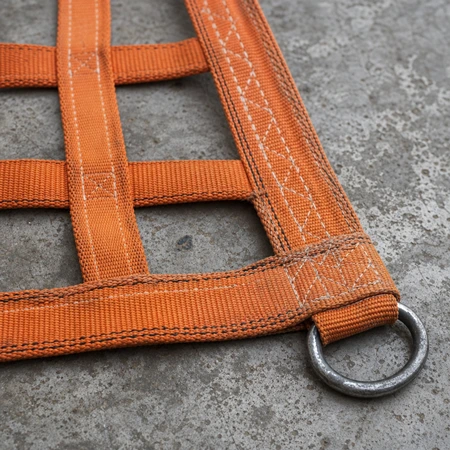
- Locked stitching in high-tenacity polyester thread, run in multiple rows along the border and box-X at every loop – on a cheap net it is the stitch line, non la cintura, that fails first.
- Bordo piegato e doppia cucitura, so the edge of the mesh cannot unravel under load.
- Galvanised or stainless steel rings and master links on request.
- Polyester holds its strength from -40 °C a +100 °C; above that, or in chemical exposure, tell us and we will quote nylon or another construction.
Test, certificazione e tracciabilità
- Quarant'anni di produzione di attrezzature per il sollevamento – fondata nel 1985 a Taizhou, Jiangsu, con più di 200 employees and one of China’s largest lifting sling and net production bases.
- Every net is proof-load tested on our own 1000 t macchina di prova orizzontale – testato, not sampled.
- A material test report travels with each shipment, quoting the belt batch and the test load.
- Dichiarazione di conformità CE e certificazione GS, con certificazione JIS sugli ordini di esportazione.
- ISO 9001 quality management system, a CNAS-accredited laboratory and DNV certification behind the plant.
- Every net is marked with its working load limit, maglia, rated volume and batch number before packing, quindi la borsa e la sua documentazione vanno sempre d'accordo.
Certificates and test reports are available as PDFs for your tender or customs file – vedere l'intero certificazione impostato.
Where these nets work
A polyester lifting hoisting net is used wherever loose cargo has to travel between a stack and a hook – quay, mulino, quarry, yard or hold. The sectors below are the ones where the bagged and bulk version earns its place.
Tavolo 7 – Applicazioni per settore.
| Settore | Cosa gestisce la rete | Perché è adatta una rete in poliestere |
|---|---|---|
| Porti, banchine e terminal | Carico in sacchi, grano, fertilizer and bulk between quay, barge and hold | Un bagaglio per ascensore, nessuna paletta, e il carico si scarica mentre viaggia |
| Agricoltura e mangimifici | Seme, grano, foraggio, fertilizzante e prodotto in sacchi | Una rete stretta o una fodera mantengono il prodotto dentro e fuori dalle intemperie |
| Materiali da costruzione | Sabbia, ghiaia, pietrisco e cemento in sacchi | Abbastanza fine da contenere la maggior parte, open enough for rainwater to drain |
| Estrazione mineraria ed estrattiva | Aggregato, minerale e minerali sfusi | Un fondo rinforzato elimina l'abrasione che consuma una rete |
| Pesca e trasformazione alimentare | Pesce bagnato, crostacei e prodotti | La rete aperta scarica liberamente, which keeps the weight honest |
| Riciclaggio e rifiuti | Plastiche sciolte, bicchiere, metallo e materiale misto | Contains loose material that would otherwise blow or fall |
| Biomass and power | Trucioli di legno, abbaio, pellet e combustibile sfuso | Una borsa grande per una stazza modesta, corrispondente al limite del volume |
| Construction sites and relief work | Bagged materials raised to upper floors, field cargo | No pallet, nessuna fasciatura, e può essere svuotato direttamente a terra |
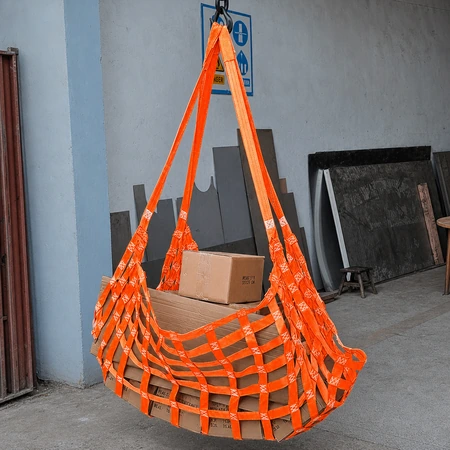
Customisation and branding
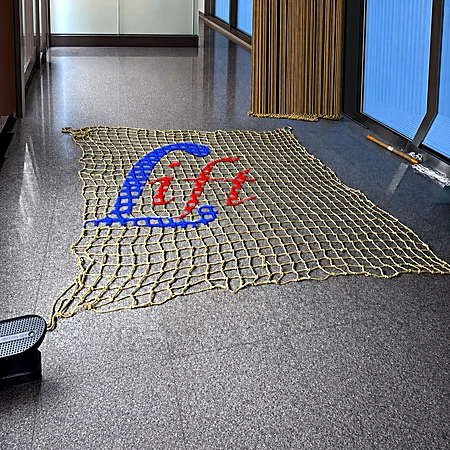
A net that moves between quays, holds and yards has to be identifiable from a distance and has to keep its marking. Colore, logo stampato, working load limit and cargo type are all applied in our own plant, so the marking cannot be washed off or pulled away with a label.
- Colour code by working load limit, or a custom house colour to separate your fleet from a competitor’s.
- Logo, brand name, testo di avvertenza o numero di certificato stampato sulla cintura, or woven in on larger orders.
- Cargo type printed on the bag, which stops a fine-mesh grain net being sent out for scrap.
- Sewn capacity label in addition to the print, so the net and its paperwork agree at every inspection.
- Packing folded into a bag or a crate – a set of ten net bags takes the space of one pallet.
Cura, ispezione e pensionamento
- Inspect the loops and their stitching first, then the border, then the bottom closure – on a bulk net the bottom and the corners wear before the mesh does.
- Empty the bag completely before storage; material left inside holds moisture, adds weight and hides damage.
- Cerca i tagli, abrasione, cuciture rotte, colorazione chimica, la smaltatura termica e il cambiamento di colore o lucentezza che segnala il degrado UV.
- Weigh a wet bag before lifting it. Piovere, sea water and wet bulk can add far more than the cargo was rated at, e una rete non conosce la differenza.
- Non superare mai la capacità nominale, non sollevare mai meno della serie completa di anelli, e non trascinare mai lateralmente un sacco carico con la gru.
- Conservare pulito e asciutto, da terra e al riparo dal sole diretto; never repair webbing by knotting, saldarlo o riscaldarlo.
Domande frequenti
What is the difference between a polyester lifting hoisting net and a cargo net?
A lifting net is rated, marked and tested to carry a load on a crane hook. A cargo net is a restraint: it holds a load down in transit and is not designed to be lifted. If the net is going onto a hook, it must be the rated version – vedi il nostro rete di fissaggio del carico for the tie-down case.
How do I choose the mesh opening?
From the smallest unit in the load, non dalla stazza. UN 25 kg bag needs 50-75 mm; grain or fertilizer needs 25-50 mm or a closed liner; scrap and coal can take 100-150 mm. Once the net is sewn the mesh cannot be changed, so this is the one number worth checking twice.
Why does the volume matter as much as the weight?
Because light bulk fills the bag before it reaches the rated weight. A bag that is full at half its rating doubles the number of lifts and the crane time. Give us the bulk density with the tonnage and we will size the bag so a full bag is also a legal bag.
Can the bag be emptied without tipping it?
SÌ. A laced release bottom or a chute bottom lets a free-flowing load be discharged straight into a hopper, una chiatta o un trasportatore. Bagged cargo is normally emptied by hand or with a forklift at the far end.
La rete tratterrà il carico bagnato??
The net itself is unaffected – polyester does not absorb water and does not rot, so rain, sea water and wash-down do no harm. Due avvertenze: wet cargo is heavier, and fine wet material can clog the mesh, che aggiunge peso e ne impedisce lo scarico.
How is the working load limit proved?
La cinghia è classificata secondo la norma EN 1492-1 base e le reti sono fornite a 5:1, 6:1 O 7:1 come specificato. Every net is proof-load tested on our own 1000 macchina, a material test report travels with the order, e i prodotti portano la certificazione CE e GS.
Do you make a flat version for palletised cargo?
SÌ – the flat lifting net is the rete di carico per pallet con gru, and the material-led range is covered by the rete in poliestere per il sollevamento. The rope constructions sit alongside as the rete di sollevamento merci in nylon e il Imbracatura per rete da carico in nylon resistente.
What else do you make from the same webbing?
The same belt goes into our imbracature in fettuccia E imbracature rotonde infinite, and the wider cargo range is listed under reti di sollevamento merci – including the rete di sollevamento del carico in tessuto for flat work.
Richiedi un preventivo
Send the cargo and whether it is bagged or bulk, la densità apparente se la conosci, il peso desiderato per sollevamento, l'apertura della rete, the discharge method and the environment the net will work in – or a sketch of the bag you have in mind. I nostri ingegneri confermeranno la dimensione netta, profondità, costruzione del fondo, band and packing and quote it in one reply. Per parlarne prima, contatta i nostri ingegneri.
Azienda di sollevamento con imbracatura – Parco industriale di Lifute, Città di Taizhou, Provincia di Jiangsu, Cina
tel: +86 523 8693 5818 | Whatsapp: +86 180 6600 2268 | E-mail: lift98@jslift.com