

Lifting sling rigging fyrirtæki framleiða Cargo Securing Net,Hleðsluöryggisnet,Lítið möskva farmöryggisnet,Gámaöryggisnet,Varanlegt net fyrir farm.
Farmöryggisnet
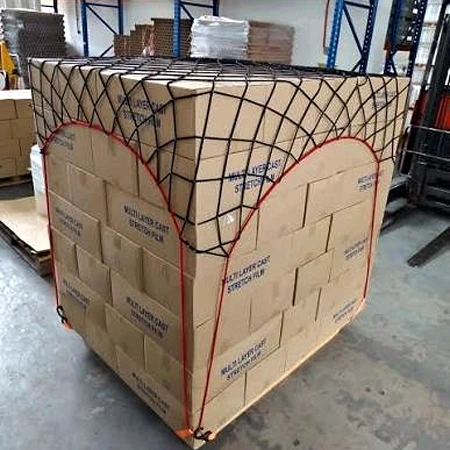
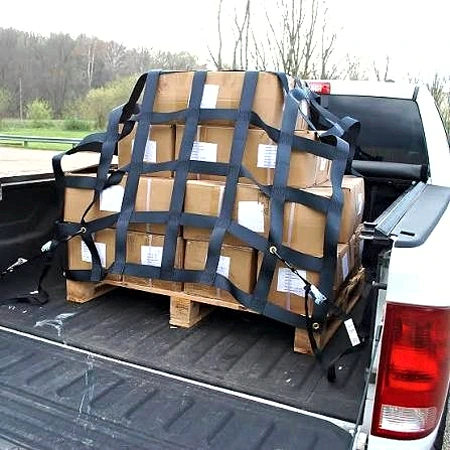
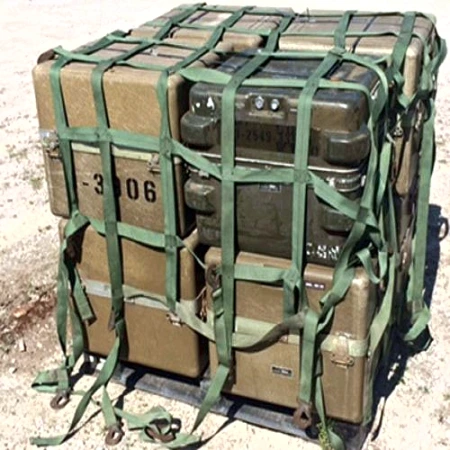
A cargo securing net is a flat-belt restraint net laid over a load and tensioned down to the deck, so that the cargo cannot slide, rock or topple on the way. The belts are woven from high-tenacity polyester into an open lattice, the border is folded and double-stitched, and the edge carries rated attachment points that are pulled down with ratchet tensioners until the load is pressed onto the vehicle or container floor.
The distinction that matters on this product is duty, not appearance. A cargo securing net restrains; it does not lift. Its label carries a lashing capacity (LC) and a standard tension force (STF) í daN, the arrangement is calculated to EN 12195-1 and the belts are type-tested to EN 12195-2 – not to a lifting working load limit. We weave the belts in our own mill in Taizhou, so net size, möskva, belt width, fittings and markings are set to your load, your vehicle and your anchor points.
- Restraint rating, ekki hækkandi einkunn – LC and STF marked in daN, calculated to EN 12195-1, belts type-tested to EN 12195-2.
- Flat high-tenacity polyester belts – 25 mm til 100 mm, single or duplex, UV stabilised and rot-proof.
- Sized to the load or the aperture – cover nets, container doorway nets, partition nets and bag form, all made to order.
- Rated fittings and tensioners – ratchets, krókar, D-rings and lashing points, with anti-slip mats where the deck friction is low.
- CE og GS vottuð – ofið, saumað, marked and tested in one plant, með ISO 9001, CNAS and DNV behind it.

Restraint is not lifting – and the label says which one you have
The two products look alike, are made from the same belt and are often bought by the same fleet. Þau eru ekki skiptanleg, and the difference is not a formality: one is sized so a load cannot move, the other is sized so a load cannot fall. Using a restraint net on a crane hook, or a lifting net as a tensioned tie-down, is a safety failure rather than a paperwork problem.
Tafla 1 – Why a securing rating and a lifting rating are not interchangeable.
| Samanburðarpunktur | Farmöryggisnet (þessari síðu) | Lyftingarnet |
|---|---|---|
| Hvað það gerir | Heldur byrði sem helst á ökutækinu | Ber fulla þyngd farms í loftinu |
| Stjórnast af | IN 12195-1 (útreikningur á tryggingarkrafti) og EN 12195-2 (festingar úr vefjum) | Lyftistaðlar, with webbing rated on the EN 1492-1 grundvelli |
| Metið í | Festingargeta (LC) og venjulegur spennukraftur (STF), í daN | Vinnuálagsmörk (WLL), í tonnum |
| How it is sized | Sized to resist the acceleration and friction case for the journey | Stærð með a 5:1, 6:1 eða 7:1 stuðull og sönnunarprófað á hverja stropp |
| How it is tested | Belt and tensioner type-tested to EN 12195-2 | Every sling break-tested on our own 1000 t vél |
| Hvernig það mistekst | The load moves – a road accident | The sling breaks – a dropped load |
If the requirement is to lift – a pallet onto a roof, a bag into a hold – the right product is a lifting net: the krana bretti farmnet, the pólýester lyfti net eða the þungur nælon netslingur. If the requirement is to keep a load still from the loading bay to the delivery point, this page is the right one.
The forces the net has to answer for
A load on a moving vehicle is pushed in three directions, and each one is a design case rather than an accident. The accelerations below are the ones EN 12195-1 uses for road transport; other modes and national rules differ, which is why we ask where the load is travelling before we size the net.
Tafla 2 – Design accelerations for road transport and what resists each one.
| Direction | Design acceleration | What resists it |
|---|---|---|
| Forward (braking) | 0.8 g | Blocking or a headboard first, then direct lashings to the front; friction contributes |
| Rearward (acceleration) | 0.5 g | Rear lashings and a tailboard; the net’s rear edge lines |
| Til hliðar (cornering) | 0.5 g | Side lashings, containment by the lattice, and friction from the pre-tension |
| Lóðrétt | Not a road design case | Held down by pre-tension and containment; a net reduces bounce but is not a substitute for blocking |
The practical consequence is that a net alone rarely carries the whole case. Blocking against a headboard does more for the braking case than any strap, and a net laid over the top does the rest. A good securing arrangement is a combination, and we will say so when a net is the wrong answer for your load.
Hvernig flatbeltanet heldur álagi
Öryggisnet vinnur í gegnum þrjár aðferðir í einu. Which one dominates depends on how the net is fitted, and that is decided at the vehicle rather than at the factory.
Tafla 3 – The three mechanisms a securing net uses.
| Vélbúnaður | Hvernig það virkar | What it depends on |
|---|---|---|
| Núningur (binda niður) | Strekkta netið þrýstir farminum upp á þilfarið, og núningur milli hleðslu og þilfars þolir að renna. This is the main effect of a cover net | A hreinn, dry deck or anti-slip mats. Án núnings takmarkar sama netið mun minna |
| Innihald | Grindurnar stöðva líkamlega dreifingu álagsins, rocking, or throwing individual items out | A mesh fine enough for the smallest item, and a net fitted tight rather than draped |
| Direct lashing | Where the edge belts run down to rated points on the vehicle, beltið sjálft ber aðhaldskraftinn | Certified anchor points on the vehicle – never a random protrusion or a load’s own packaging |
Two numbers decide whether the arrangement works, and both are usually ignored. The first is the angle: a tie-down belt is most effective between 75 og 90 gráður á þilfari, and its effective capacity follows LC_eff = LC × sin α. Kl 30 degrees you keep roughly half the belt’s rating, so a net pulled down almost flat looks tidy and holds very little. The second is friction: the coefficient between a steel load and a steel deck is about 0.1 til 0.2, steel on timber about 0.2 til 0.3, timber on timber about 0.3 til 0.4, and a good anti-slip mat takes a pallet on a deck to about 0.5 til 0.6. Blautt, oily or icy surfaces take all of these figures down, which is why the same net restrains very different loads on two different days.
Tæknilegar breytur
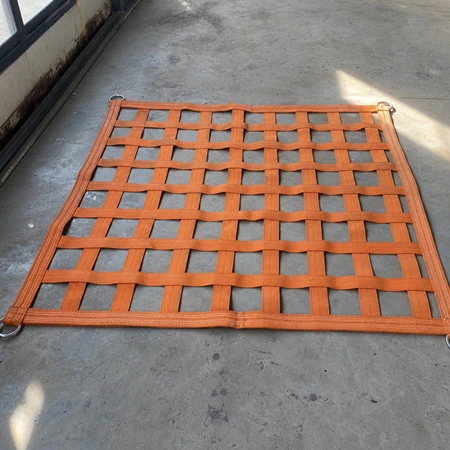
Myndirnar hér að neðan ná yfir staðlað öryggissvið. Belt, möskva, nettó stærð, Kantfestingar og strekkjarar eru allar eftir pöntun, þannig að meðhöndla þessa töflu sem upphafspunkt fyrir tilvitnun frekar en fasta vörulista.
Tafla 4 – Farmöryggisnet: tæknilegar breytur.
| Parameter | Forskrift |
|---|---|
| Vörutegund | Farmöryggisnet (hleðslunet) – cover net, partition net, container doorway net or bag form. Ekki lyftibúnaður |
| Belt material | 100 % hárþéttni pólýester (PET); hárþéttni nylon sé þess óskað |
| Beltisbreidd | 25 / 35 / 50 / 75 / 100 mm |
| Belt construction | Eitt lag eða tvíhliða, ofinn sjálfkantur, ekki skorið brún |
| Belt thickness | 1.8 mm – 4.0 mm eftir breidd og lagafjölda |
| Möskvaop | 100 × 100 mm staðall; 50 mm – 300 mm eftir pöntun |
| Nettó stærð | Gert að álagsfótsporinu, rúm ökutækisins, eða ílátið eða opið í hurðaropinu |
| Festingargeta (LC) | Um 750 daN on a 25 mm belt to about 5,000 daN on a 100 mm duplex belt, marked per net |
| Forspenna (STF) | 250 – 500 daN depending on the tensioner supplied; merkt á miðanum |
| Venjulegur grunnur | IN 12195-1 for the securing calculation; IN 12195-2 for the webbing lashing |
| Landamæri | Folded and double-stitched; styrkt á hverjum festingarstað |
| Innréttingar | Skrallstrekkjarar, krókar, D-hringir, cam buckles and lashing points, bekk 80 steel where steel is used |
| Litur | Orange for high visibility as standard; blár, grænn, black or a custom colour |
| Meðferð | UV stöðugt, gegn öldrun, slitþolið og slitþolið, rotþolið |
| Vinnuhitastig | -40 °C til +100 °C |
| Vottun | CE, GS, ISO 9001, JIS sé þess óskað; CNAS rannsóknarstofu; DNV |
| Sérsniðin | OEM / ODM stærð, lit, printed belt, merki, lógó og umbúðir |
| HS kóða | 6307.90 – nets and netting of textile materials |
Staðlaðar stærðir, mesh and lashing capacity
A securing net is sized to the load it covers or the aperture it closes, never to a tonnage. The load has to be fully covered, and the border has to land on the deck or on the anchor points instead of hanging in mid-air, because an unsupported edge is an edge that can be pulled sideways.
Tafla 5 – Standard securing net sizes, with the belt and capacity that normally go with them.
| Nettó stærð (L × B) | Möskva | Belt | LC per edge line | Dæmigert notkun |
|---|---|---|---|---|
| 1.2 × 1.2 m (4 × 4 ft) | 100 mm | 35 – 50 mm | 1,000 – 2,000 Og | Single pallet in a van or light truck |
| 2.5 × 1.2 m (8 × 4 ft) | 100 mm | 50 mm | 2,000 Og | Two pallets abreast in a van or curtain-sider |
| 2.5 × 2.5 m | 100 mm | 50 mm | 2,000 Og | Flatbed hleðslur, vélar, mixed cargo |
| 5.0 × 2.5 m | 100 – 150 mm | 50 – 75 mm | 2,000 – 3,500 Og | Flötur og tengivagnar í fullri lengd |
| 2.4 × 2.6 m (ílát) | 100 mm | 75 mm | 3,500 Og | Container doorway net, load held back from the doors |
| 1.5 × 1.5 m bag form | 50 – 100 mm | 50 mm | 2,000 Og | Loose or bagged goods that would spread on the deck |
| Búið til að teikna | 50 – 300 mm | 25 – 100 mm | To calculation | Hvaða fótspor sem er, aperture or vehicle bed |
The capacity column is the restraint available per edge line, not a lifting limit. The number of edge lines, their angle and the friction under the load decide what the arrangement actually restrains.
Four forms of securing net
The same lattice is supplied in four arrangements, and choosing the right one is most of the job. Innréttingar eru mismunandi á milli þeirra; aðhaldsreglan gerir það ekki.
Tafla 6 – Kápa, partition, container and bag forms.
| Form | Hvernig það er komið fyrir | Notað þegar |
|---|---|---|
| Loka net | Spread over the load and tensioned down to the deck or to the vehicle’s rated points | Flatbed, curtain-sider and container loads that must not move in any direction – the most common arrangement |
| Partition net | Fixed upright across the vehicle body and tensioned against its own frame | Separating two loads in one vehicle, or holding cargo away from a bulkhead |
| Container doorway net | Fitted across the door aperture and hooked to the container’s own rings | Stopping cargo migrating to the doors during the journey, so the container is safe to open |
| Pokaform | Closed at the bottom, with the cargo sitting inside the lattice | Loose or bagged goods that would otherwise spread across the deck |
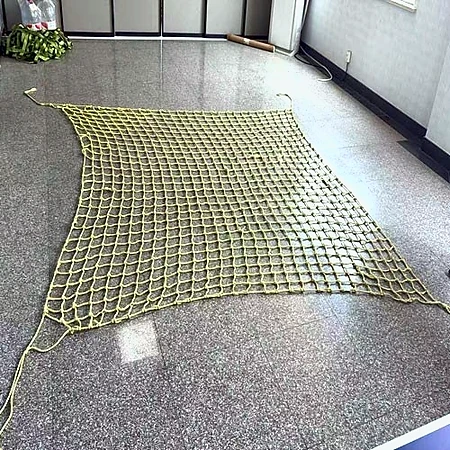
Innréttingar, tensioners and anti-slip
A securing net is only as good as the tensioner that pre-tensions it and the anchor point it pulls against. These are the parts that get specified last and fail first.
Tafla 7 – Festingar og spennur.
| Mátun | Notað með | Athugið |
|---|---|---|
| Ratchet spennur | Loka net, pokaformi | Stillir forspennuna (STF). A ratchet that cannot reach the marked STF makes the net ineffective, whatever its LC |
| Cam sylgja | Létt skyldustörf | Faster than a ratchet but reaches a much lower pre-tension – for light loads only |
| Krókar og D-hringir | Hvaða fyrirkomulag sem er | The link between net and anchor point; bekk 80 stál þar sem stálfesting er notuð |
| Festingarpunktar | Loka net | Rated anchor points in the vehicle structure – the restraint force has to go somewhere rated |
| Hálvarnarmotta | Núningsaðhald | Raises the friction coefficient under the load; usually the single most effective addition on a smooth deck |
| Hlífðarhylki | Skarpar hleðslur | Fits over the belt at the contact point; ódýrasta leiðin til að lengja nettó líftíma |
| Viðgerðarsett | Fleet maintenance | Matching belt, stitching thread and a spare tensioner |
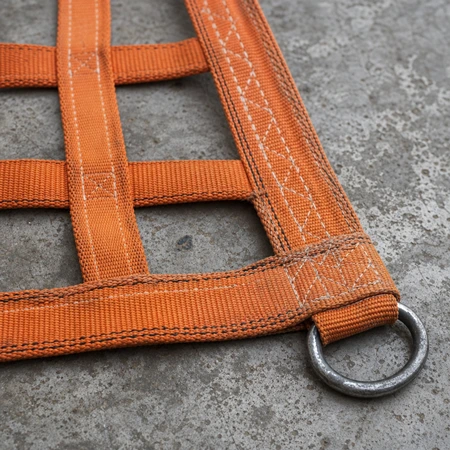
Merking, colour and identification
A securing net is checked by the driver before every trip and by an inspector at the roadside, so the marking has to be readable at a distance and has to survive being dragged over a deck.
- Lashing capacity and standard tension force printed along the belt in daN – the units load securing is actually calculated in.
- Net size and date of manufacture printed as well, so the net can be matched to the vehicle and its age judged on the spot.
- A sewn capacity label in addition to the print, þannig að netið og pappírarnir eru alltaf sammála.
- Orange as the standard high-visibility colour, with blue, grænn, black or a house colour for fleet identification.
- OEM orders can carry your brand, warning text or certificate number printed on the belt.
- Nets ship folded into a bag or a crate – a fleet order takes a fraction of the space of the same number of loose straps.
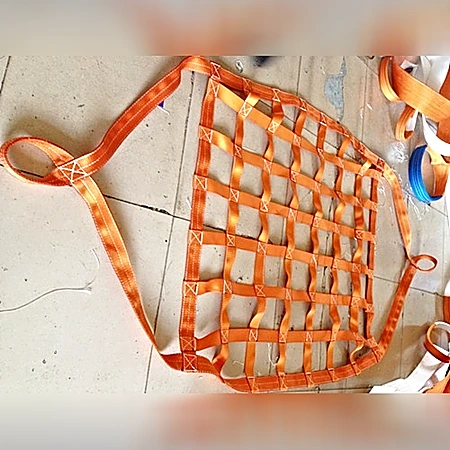
Prófanir, certification and traceability
- Forty years of lifting equipment manufacturing – stofnað í 1985 í Taizhou, Jiangsu, með meira en 200 starfsmenn.
- Belts woven in our own mill, svo breidd, layer count and colour are under our control rather than bought in.
- Webbing strength-tested on our own 1000 t horizontal machine before it is cut into nets.
- Belts supplied to the EN 12195-2 material requirements for securing duty, with the securing calculation following EN 12195-1.
- CE samræmisyfirlýsing og GS vottun, with JIS on export orders; ISO 9001, CNAS laboratory accreditation and DNV certification behind the plant.
- Sérhvert net merkt með festingargetu, forspenna, size and mesh before packing, and supplied with a material test report on request.
Vottorð og prófunarskýrslur eru fáanlegar sem PDF-skjöl fyrir útboðsskrá eða tollskoðun – sjá til fulls vottun sett.
Þar sem net eru notuð til að tryggja farm
The same net covers a road trailer, a container, a rail wagon and a barge. What changes is the number of anchor points, the mesh and how the net is tensioned – not the product itself.
Tafla 8 – Applications by transport mode.
| Háttur eða geiri | Það sem netið hamlar | Hvers vegna flatbeltanet hentar því |
|---|---|---|
| Vegur – flatbreiðsla | Vélar, stáli, timbri, bretti, trommur og blandaður farm | Hylur allt álagið í einni aðgerð og sameinar núning með innilokun |
| Vegur – gluggatjöld | Palletised and boxed goods that shift against a soft curtain | Inniheldur hleðsluna þar sem fortjaldið sjálft hefur ekkert aðhald |
| Gámaflutningar | Farmur á bak við hurðir, and cargo that must not migrate in transit | A doorway net makes the container safe to open and stops the load moving forward |
| Frakt með járnbrautum | Palletised and loose cargo in wagons and on flat wagons | Löng net þekja vagnrúm og hægt er að spenna þau með reglulegu millibili |
| Sjór og skipgenginn farvegur | Dekkfarmur, og farmur inni í prömmum og lestum | Rotþétt, UV stabilised and unaffected by salt water |
| Þungaflutningar og verkefnafarmur | Transformers, álverið og álag sem er utan máls | Samsett með beinum festingum og blokkun fyrir óskiptanlegt álag |
| Úrgangur, endurvinnslu og landbúnaði | Balar, neita, rotmassa og magn álags á opnum farartækjum | Innilokun kemur í veg fyrir að laus efni fari frá ökutækinu í flutningi |
| Military and relief transport | Palletised and loose cargo in trucks and aircraft | Eitt net á hverja farm, fljótur í notkun og endurnýtanlegur í mörgum ferðum |
Umhyggja, skoðun og starfslok
- Check the net before every trip and record the check: the tensioner first, þá sauma á hverjum festingarstað, svo beltin.
- Hafnaðu hvaða belti sem er með skurði, brún skemmdir, brotinn saumur, efnalitun, hita glerjun, or the colour and gloss change that signals UV degradation.
- Check the vehicle’s anchor points as carefully as the net. A perfect net on a corroded lashing point restrains nothing.
- Haltu þilfarinu hreinu og þurru, and fit anti-slip mats wherever load-to-deck friction is low. That is a securing measure, ekki fágun.
- Never use a securing net to lift, and never use a lifting net as a tensioned tie-down unless its label carries both ratings.
- Geymið hreint og þurrt, frá jörðu niðri og úr beinni sól; never repair a webbing belt by knotting, suða eða hita hann.
- Withdraw the net if a belt, saumalína eða strekkjari er skemmd, og láta skoða netin af hæfum aðila á því tímabili sem flotinn þinn krefst.
Algengar spurningar
Can a cargo securing net be used to lift a load?
Nei. It is rated for restraint, ekki að lyfta, og þetta tvennt er reiknað á gjörólíkum grunni. If the load has to go onto a hook, use a lifting net with a working load limit and a per-sling proof test – the crane pallet cargo net or the polyester lifting hoisting net, both linked earlier on this page.
Hver er munurinn á LC og STF?
LC (festingargetu) er aðhaldskrafturinn sem beltið er metið til að bera. STF (staðall spennukraftur) er hversu erfitt skrallstrekkjarinn getur forspennt beltið. Both are marked in daN. LC skiptir mestu máli í beinni festingu, þar sem beltið sjálft heldur álaginu; STF skiptir mestu máli í festingum, where the pre-tension creates the friction that does the holding.
Hversu þétt ætti netið að vera?
Nógu þétt til að ná forspennunni sem merkt er á miðanum, with the belts running as steeply to the deck as the load allows – 75 til 90 degrees is where a tie-down belt works best. A belt laid almost flat keeps only about half its capacity, þannig að net sem lítur vel út getur haldið mjög litlu.
Þarf ég hálkumottur?
If the restraint relies on friction – which is what a cover net does – then usually yes. On steel, aluminium or plastic surfaces the friction coefficient is low, and a mat often adds more restraint than an extra strap does. A hreinn, dry deck is the other half of the same measure.
Hversu margar festingar eða festingarpunkta þarf ég?
Það leiðir af álaginu, þilfarsnúningurinn, the vehicle and the journey rather than from a rule of thumb. Direct lashing normally needs at least four anchor lines, tveir á hlið og yfir, with the vertical and plan-view angles between 30 og 60 gráður. Sendu okkur upplýsingar um hleðslu og ökutæki og við vinnum fyrirkomulagið með þér.
Will a net stop cargo moving inside a container?
Dyraop eða millinet stöðvar farminn að flytjast í átt að hurðunum og gerir gáminn óhætt að opna. For the journey itself the load still has to be restrained as a whole, þannig að gámur er venjulega tryggður með millineti ásamt lokun eða dunage frekar en með neti einu sér.
Hvaða möskvaop ætti ég að velja?
Fine enough that the smallest item in the load cannot pass through. 100 mm er staðallinn okkar og tekur bretti, öskjur, töskur og trommur; lausir eða smáir hlutir þurfa þéttari möskva, og stór óskiptanlegur farmur getur tekið breiðari.
Hvað gerir þú annars fyrir hleðslu?
The same belts go into our bandslengjur og endalausar kringlóttar slöngur, the wire rope range is under vír reipi slings, the rope itself under nylon reipi, and RoRo and breakbulk work is covered by the lyftanet ökutækja. The lifting side of the net range starts at vörulyftinganet.
Óska eftir tilboði
Send the transport mode, the load weight and dimensions, hvort það geti breiðst út eða fallið, the deck material, net- eða ljósopsstærð, the belt width and the anchor points you have – or a drawing of the load and the vehicle. Verkfræðingar okkar munu staðfesta netið, innréttingarnar, fjölda festingarlína og pökkun, og vitna í það í einu svari. Til að tala um það fyrst, hafðu samband við verkfræðinga okkar.
Lift Sling Rigging Company – Lifute iðnaðargarðurinn, Taizhou borg, Jiangsu héraði, Kína
Sími: +86 523 8693 5818 | WhatsApp: +86 180 6600 2268 | Tölvupóstur: lift98@jslift.com