

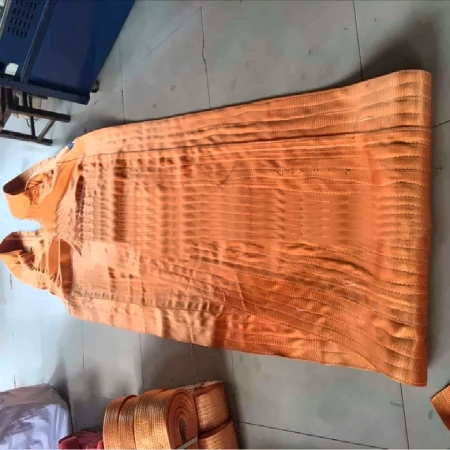
Ụlọ ọrụ na-ebuli sling rigging na-emepụta ihe 3 Ply Webbing Sling,3 Ply Polyester Web Sling,Three-Ply Webbing Sling,3 Ply Polyester Web Sling,3 Ply Endless Nylon Lifting Sling,Eye and Eye 3 Ply Lifting Sling,
3 Ply Webbing Sling: 3 t ka 30 t Polyester Web Slings to EN 1492-1
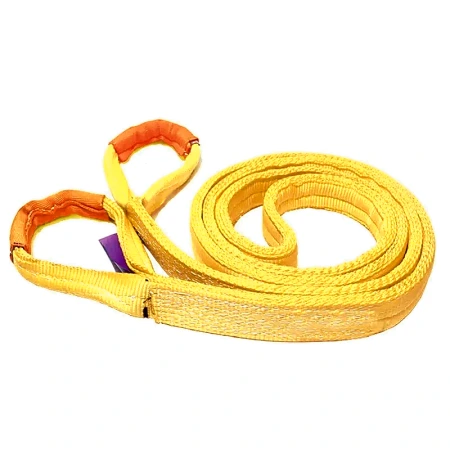
A 3 ply webbing sling carries three full layers of load-bearing polyester inside one flat body. That is how a 50 mm sling reaches a 3 t working load limit and a 300 mm sling reaches 30 t, while staying light enough for one rigger to handle and soft enough to sit against a painted or machined load without marking it. We weave, stitch, inspect and label every sling in our own factory: obosara 50-300 mm, working load limits 3-30 t, 7:1 ihe nchekwa, colour coded to EN 1492-1, and proof data from a 1,000 t horizontal test bed behind every batch.
- WLL 3-30 t
- Ihe nchekwa 7:1
- Obosara 50-300 mm
- N'ime 1492-1 / ASME B30.9
- -40 C na +100 C
- Ogologo oge <=3% at WLL
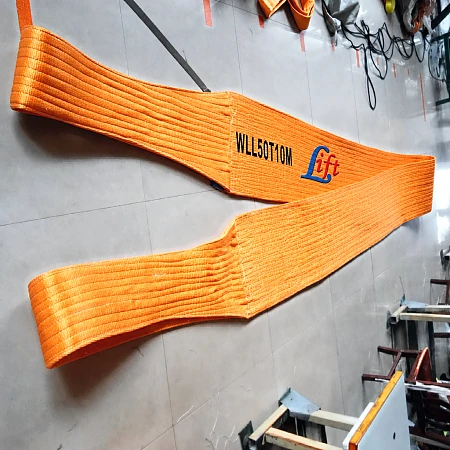
Why three plies: more capacity per millimetre of width
A webbing sling’s capacity comes from the amount of load-bearing yarn in the body. A single-ply sling is one woven band; a 3 ply webbing sling stacks three full layers inside the same flat cover, so capacity rises with the ply count while the sling stays thin, flexible and easy to choke around a bundle. To match a 50 mm three-ply sling a single-ply sling needs roughly three times the width – width that will not fit a narrow hook or a tight pipe bundle.
Three plies also buy wear life. The outer plies take the abrasion from concrete, scaffold tube and steel edges while the inner plies keep carrying the load, so a worn three-ply sling shows its condition on the surface long before the core is compromised. That extra layer is why a three-ply body usually outlasts two single-ply slings of the same rating on rough sites.
The trade-off is stiffness. N'elu ike ike 15 t the body becomes hard to handle and a 4 ply webbing sling ma ọ bụ ihe endless flat synthetic fibre sling is often the better answer. N'etiti 3 t na 12 t, three plies remains the best balance of capacity, weight and cost – which is why it is the ply count we ship most.
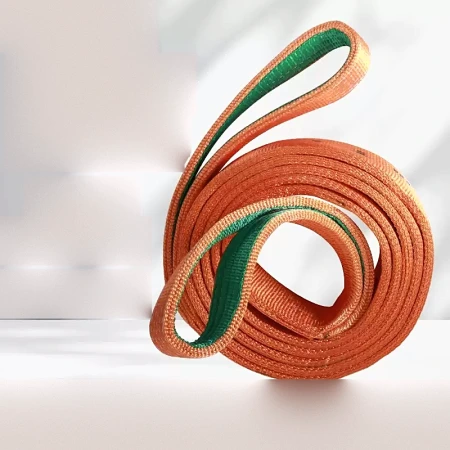
Ihe owuwu: what sits inside a 3 ply sling
- 100% polyester dị elu (PES). Low elongation – 3% or less at WLL – and no loss of strength when wet, so the sling behaves the same in a shipyard as in a dry store.
- Ugboro atọ, kpara akpa. Each ply is a continuous woven band; the plies are aligned and closed with double-lock stitching in four rows of contrasting thread.
- Anya agbasiri ike. Flat eyes as standard; twisted (reverse) eyes for narrow hooks and tight shackles; wear pads where the eye meets a crane hook.
- Red warning yarn. A red yarn runs inside the core – once a cut or deep abrasion exposes red, the sling is withdrawn. No judgement call on site.
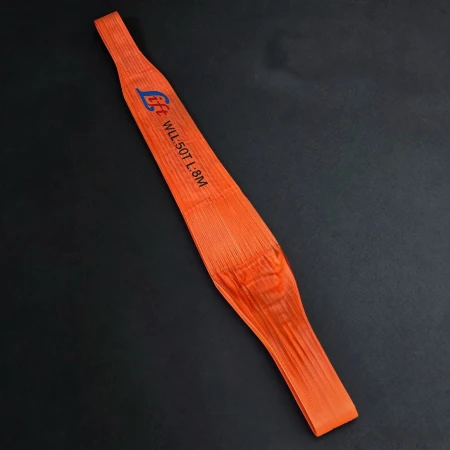
- Akara akara. WLL, ogologo, pịpị, ọkọlọtọ, nọmba usoro n'usoro, date of manufacture and our name, stitched on so it survives washing and sunlight.
- Nhọrọ. PU impregnation for abrasion and water, flame-retardant finish, anti-static yarn, and branded labels for distributors.
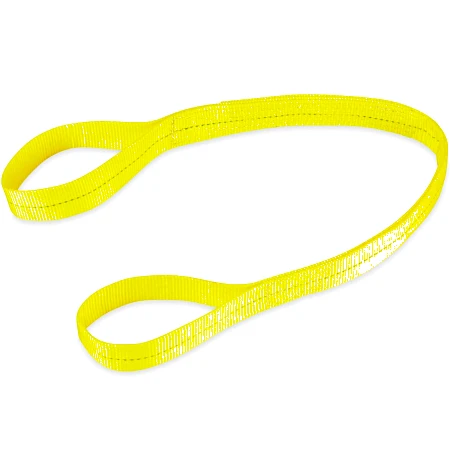
Technical data: 3 ply webbing sling sizes
Typical catalogue ratings for eye-and-eye three-ply slings in vertical hitch. Every order is confirmed on a drawing before production, and the label and test certificate issued with the goods are the governing values.
3 ply webbing sling – typical ratings
| Obosara (mm) | WLL vetikal (n'arọ) | MBL na 7:1 (n'arọ) | N'ime 1492-1 agba | Ahụ |
|---|---|---|---|---|
| 50 | 3,000 | 21,000 | Odo | 3 pịpị |
| 60 | 4,000 | 28,000 | Agba ntụ | 3 pịpị |
| 75 | 5,000 | 35,000 | Uhie | 3 pịpị |
| 90 | 6,000 | 42,000 | Agba aja aja | 3 pịpị |
| 100 | 8,000 | 56,000 | Acha anụnụ anụnụ | 3 pịpị |
| 125 | 10,000 | 70,000 | oroma | 3 pịpị |
| 150 | 12,000 | 84,000 | High-visibility | 3 pịpị |
| 180 | 15,000 | 105,000 | High-visibility | 3 pịpị |
| 200 | 20,000 | 140,000 | High-visibility | 3 pịpị |
| 250 | 25,000 | 175,000 | High-visibility | 3 pịpị |
| 300 | 30,000 | 210,000 | High-visibility | 3 pịpị |
Other widths up to 300 mm, lengths from 1 m na 12 m, 2-ply and 4-ply bodies, twisted eyes and higher working load limits are made to order. Lee n'uju 2/3/4/6/8 ply sling if you are still choosing a ply count.
Colour coding: a quick check, never the rating
N'ime 1492-1 assigns a colour to each working load limit so a sling can be identified across the yard. The colour is a convenience: akara sewn bụ ikike.
N'ime 1492-1 colour code
| WLL | Agba |
|---|---|
| 1,000 n'arọ | Violet |
| 2,000 n'arọ | Akwụkwọ ndụ akwụkwọ ndụ |
| 3,000 n'arọ | Odo |
| 4,000 n'arọ | Agba ntụ |
| 5,000 n'arọ | Uhie |
| 6,000 n'arọ | Agba aja aja |
| 8,000 n'arọ | Acha anụnụ anụnụ |
| 10,000 n'arọ | oroma |
N'elu 10 t we fit a high-visibility cover with an oversized WLL label, because colour coding alone stops being reliable at that size.
Working load limit by hitch
The load a sling may lift depends on how it is rigged. These are the EN 1492-1 factors applied to the vertical WLL printed on the label.
Load factors by hitch and leg angle
| Hitch | Factor on vertical WLL |
|---|---|
| kwụ ọtọ / elu kwụ ọtọ | 1.0 |
| Choked hitch | 0.8 |
| Basket hitch (two vertical legs) | 2.0 |
| 2-leg assembly, 0-45 deg from vertical | 1.4 |
| 2-leg assembly, 45-60 deg from vertical | 1.0 |
| 3- and 4-leg assembly, 0-45 deg | 2.1 |
| 3- and 4-leg assembly, 45-60 deg | 1.5 |
Symmetric loading is assumed. Asymmetric loads, unprotected sharp edges, or angles beyond 60 deg from vertical all reduce capacity further – send us the lift and we will calculate the rating for the assembly.
Ebee 3 ply slings do the work
Three plies suits any lift where the load is flat or round, the surface must not be marked, and the sling has to be carried up by hand.
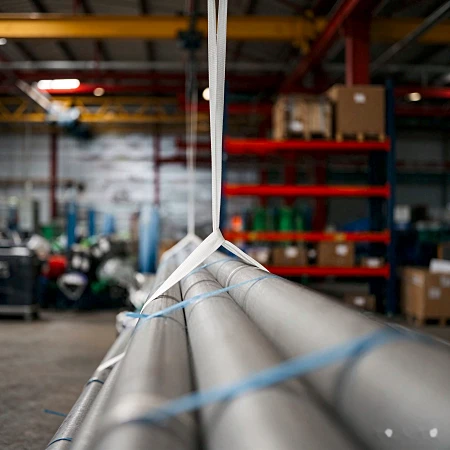
- Steel pipe and tube bundles – basket or double-wrap hitch, ihu dị nro, no damage to the coating.
- Precast concrete panels and beams – the wide body spreads pressure; edge sleeves optional.
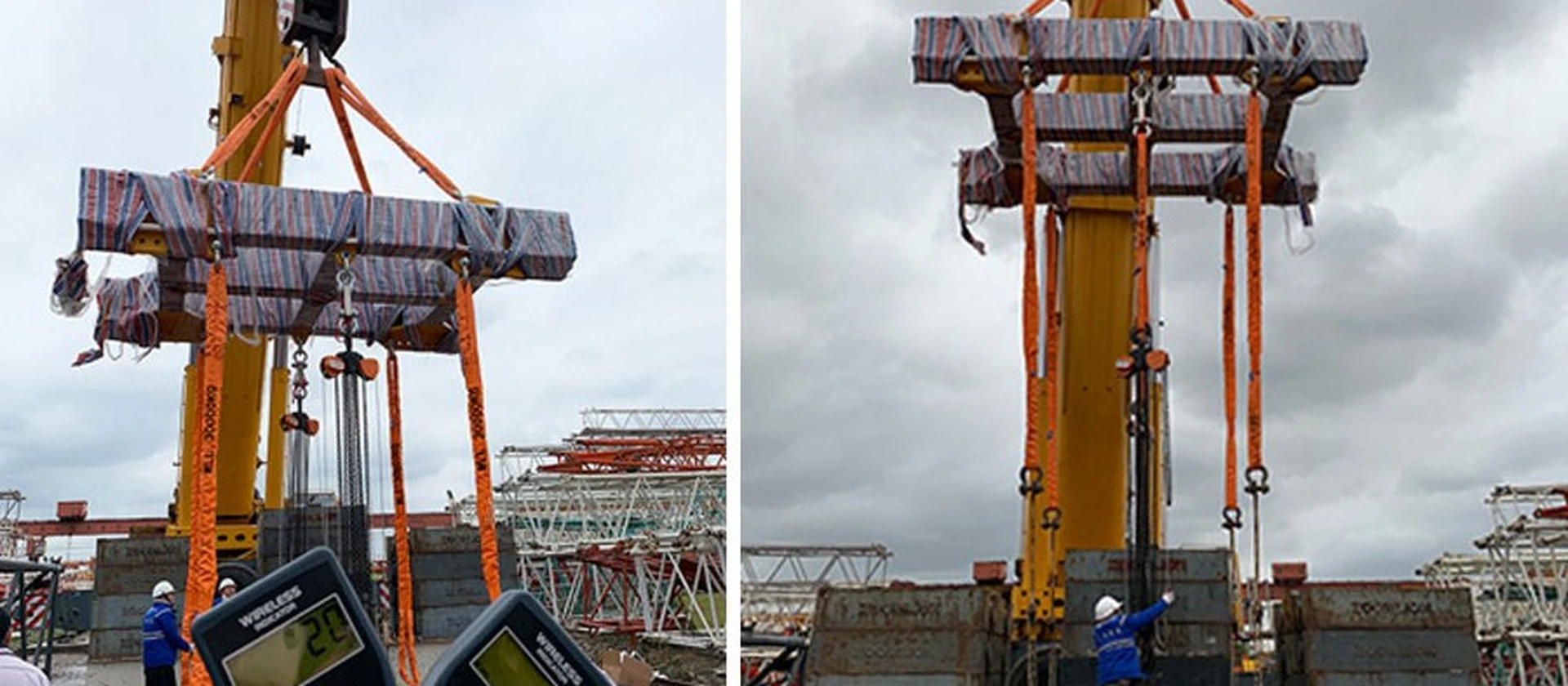
- Shipyard blocks and fabricated steel – 10 t ka 30 t slings in two-leg or four-leg assemblies.
- Wind and heavy machinery components – narrow width fits tight lifting points.
- Glass, stone and machined parts – enweghị kọntaktị metal, no scratches on the finished face.
- Port and warehouse lifting – colour-coded sets let a supervisor pick the right sling at a glance.
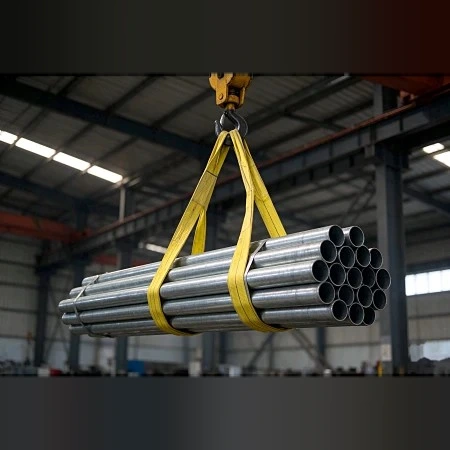
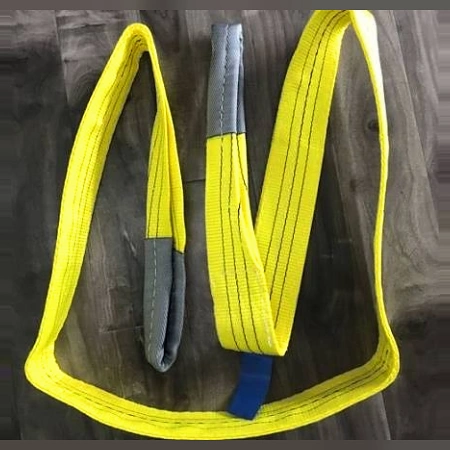
Most orders ship as assemblies rather than single slings: two-leg or four-leg sets with a master link, shackles and shortening hooks, matched so every leg carries an equal share. We build the set, mark each leg with its own WLL and supply a single certificate covering the assembly and its components.
3 ply webbing sling vs wire rope and chain
The choice is rarely about pure strength. It is about what the sling does to the load and what the load does to the sling.
Comparison for 3 t ka 12 t lifts
| 3 ply webbing sling | Iberibe eriri waya | Chain sling | |
|---|---|---|---|
| Load surface | Dị nro, no marking of paint or machined faces | Can scratch and bruise | Marks and dents |
| Arọ na otu WLL | Nke kacha dị mfe, carried by one rigger | Dị arọ, stiffer | Heaviest |
| Mmụba na WLL | 3% or less | Dị ala, but stores energy | Dị nnọọ ala |
| Nkọ nkọ | Needs sleeves or pads | Tolerant | Tolerant |
| Ọnọdụ okpomọkụ na-arụ ọrụ | -40 C na +100 C | Elu | Elu |
| Nyocha | Anya, plus red warning yarn and sewn label | Wire breaks, corrosion, terminations | Ogologo oge, cracks, wear |
Where the load is finished, painted or easily marked – precast panels, stainless pipe, coated steel, glass – the webbing sling wins on the first line of that table alone. Where the load is hot, sharp or abrasive, wire rope or chain is still the right tool, and a three-ply sling becomes the second choice for a different lift. We make both, so the recommendation you get is not driven by what we would rather sell.
Ijikwa, storage and service life
A three-ply sling lasts longer when it is treated like a load-bearing textile rather than a rope. Coil it, do not knot it; keep it off the floor and out of UV where possible; never drag it across concrete; and use edge protection wherever the body crosses a corner. Store it hung on a rack, away from heat, oil and chemical spills – polyester is attacked by strong acids and by some solvents, and a sling that has been soaked in either should be withdrawn until it has been assessed.
Inspection is visual and quick: run the full length through your hands, look for cuts, snags, agbaji agbaji, heat glazing or exposed red yarn, and read the label. A sling with a missing label has lost its rating, however good it looks.
Tested before it is labelled
Every production batch is sampled and pulled to destruction in our own laboratory – CNAS accredited, ya na a 1,000 t horizontal test bed for the large slings that most suppliers cannot test in house. Each sling is then inspected, measured and labelled one by one; the certificate travels with the shipment and quotes the serial number on the label. Our facilities hold CE and DNV certification, and we test to EN 1492-1 and ASME B30.9.
Ndepụta ndenye aha: eight lines, otu eserese
- Working load limit and the hitch you will use.
- Ogologo, na-ebu ibu, in metres.
- Ụdị anya: dị larịị, twisted / reverse, or with wear pads.
- Maximum width your hook, shackle or bundle allows.
- Quantity per size, and whether you need matched sets.
- Standard and certificate language: N'ime 1492-1, ASME B30.9, or your national code.
- Ịka akara: logo gị, part number or colour of label.
- Delivery date and destination port.
Send these eight lines and you get a drawing back instead of a question list. For a mixed order, contact our lifting engineers with the full schedule and we will quote the set, ọ bụghị onye èbè.
Ajụjụ a na-ajụkarị
- What is the difference between a 3 ply and a 4 ply webbing sling?
- Ply count sets capacity per millimetre of width. Three plies covers 3 t ka 12 t; four plies takes the same width to a higher rating and adds another wear layer. N'elu 15 t, or where the sling will drag over concrete, go to a 4 ply webbing sling.
- What does the colour of the sling mean?
- The colour follows the working load limit in EN 1492-1 – yellow for 3 t, red for 5 t, blue for 8 t, orange for 10 t. Use it as a quick check only; the sewn label carries the rating that counts.
- Nwere ike a 3 ply sling be used in a basket hitch?
- Ee. A basket hitch with two vertical legs gives about twice the vertical WLL. Keep both legs vertical, load the sling symmetrically, and protect edges – a basket hitch doubles the load on the sling body as well as the capacity.
- How often should a webbing sling be inspected?
- Visually before every use, plus a documented periodic inspection by a competent person at the interval set by your risk assessment – commonly every six months under LOLER and comparable regimes elsewhere.
- When should a 3 ply sling be taken out of service?
- Mbelata, snags, broken or worn stitching, chemical damage, okpomọkụ glazing, or any red warning yarn showing through the cover. If the label is missing or unreadable, retire the sling – the rating cannot be verified without it.
- Do you make custom lengths and OEM labels?
- Ee. Lengths from 1 m na 12 m, obosara ka 300 mm, twisted eyes, PU coating, and labels printed with your brand and part numbers. Send a drawing or a sample and we will match it.
Send the lift, get a specification
Gwa anyị ibu, nsogbu ahụ, the length and the quantity. Our engineers confirm the ply count, width and eye type, then send a drawing, a price and a lead time – usually within one working day. contact our lifting engineers.