

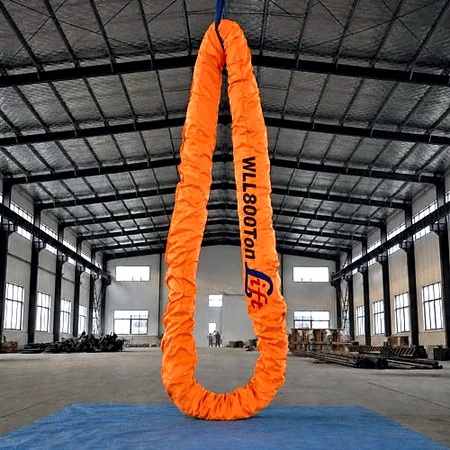
Lift sling rigging company produce WLL 40T Polyester Round Slings,40 Ton Round sling,WLL 40T 40000kg Polyester Round Slings, Heavy Duty Round Lifting Sling,40tonne HMPE Roundsling with HMPE Cover.
WLL 40T 40000kg Polyester Round Slings
40,000 kg per leg · 280,000 kg breaking · 7:1 · heavy duty sleeve · 1–30 m made to length
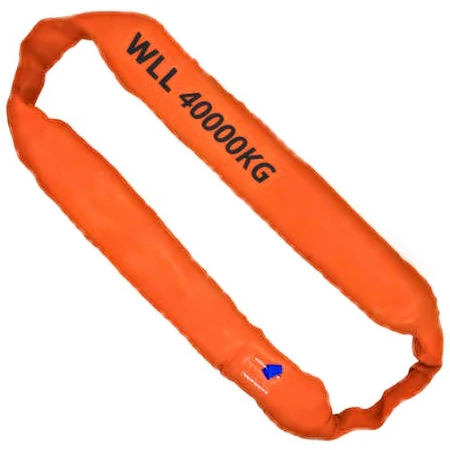
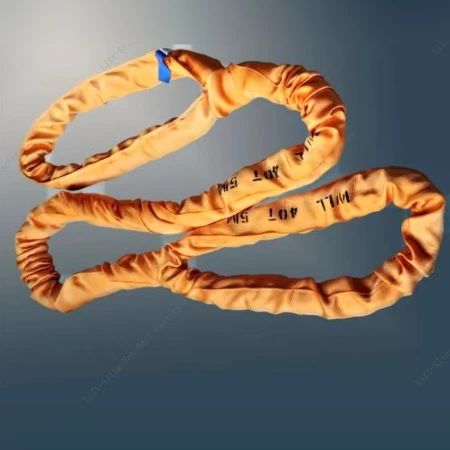
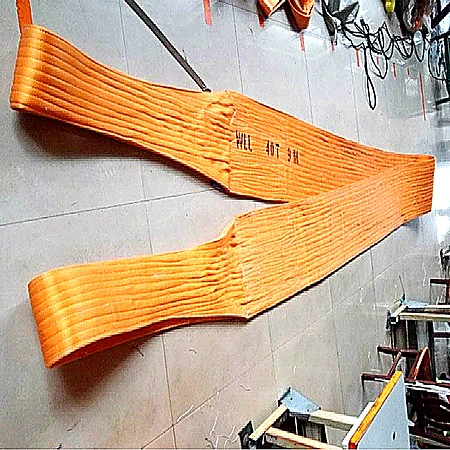
- 40,000 kgWLL, vertical
- 280,000 kgBreaking load
- 7:1Safety factor
- 1–30 mEffective length
Forty tonnes is the tier where the sling stops being the strongest thing in the lift. A 40 t sling will carry 80 t in a basket, but the hook above it rarely can, and the eye it passes through is usually the smallest opening in the set. These are the heavy duty WLL 40T 40000kg polyester round slings — and this page is about the tier as a rigging problem, not just a capacity.
Endless body, polyester core, heavy duty woven sleeve, single or double. Every sling is proof loaded and carries its own serial number.
The 40 t sling is rarely the limiting item
A lift at this size has five parts in the load path, and the sling is only one of them. Each part carries its own rating; the lift is limited by the lowest one — and at 40 t that is usually the hook, the beam or the lifting point rather than the sling.
| Part | What it has to be rated for | What catches people out |
|---|---|---|
| Sling, vertical | 40,000 kg per leg | The rating is per leg and vertical; everything else is derived from it |
| Shackle or master link | At least the leg load, with the pin through the sling | A bigger shackle is not a wider jaw — the pin has to pass the bundle |
| Crane hook | The whole set load, at the angle used | A basket doubles what the sling carries, not what the hook can |
| Spreader beam | The total under it | A beam rated 50 t is a 50 t total, not 50 t per leg |
| Lifting points | Each point for its share of the load | A four-point lift is calculated on three loaded legs, and a welded point is often the weakest link in the set |
The load path at 40 t. The sling is usually the easiest part to get right — which is why we ask what it will be hung from before we confirm the length.
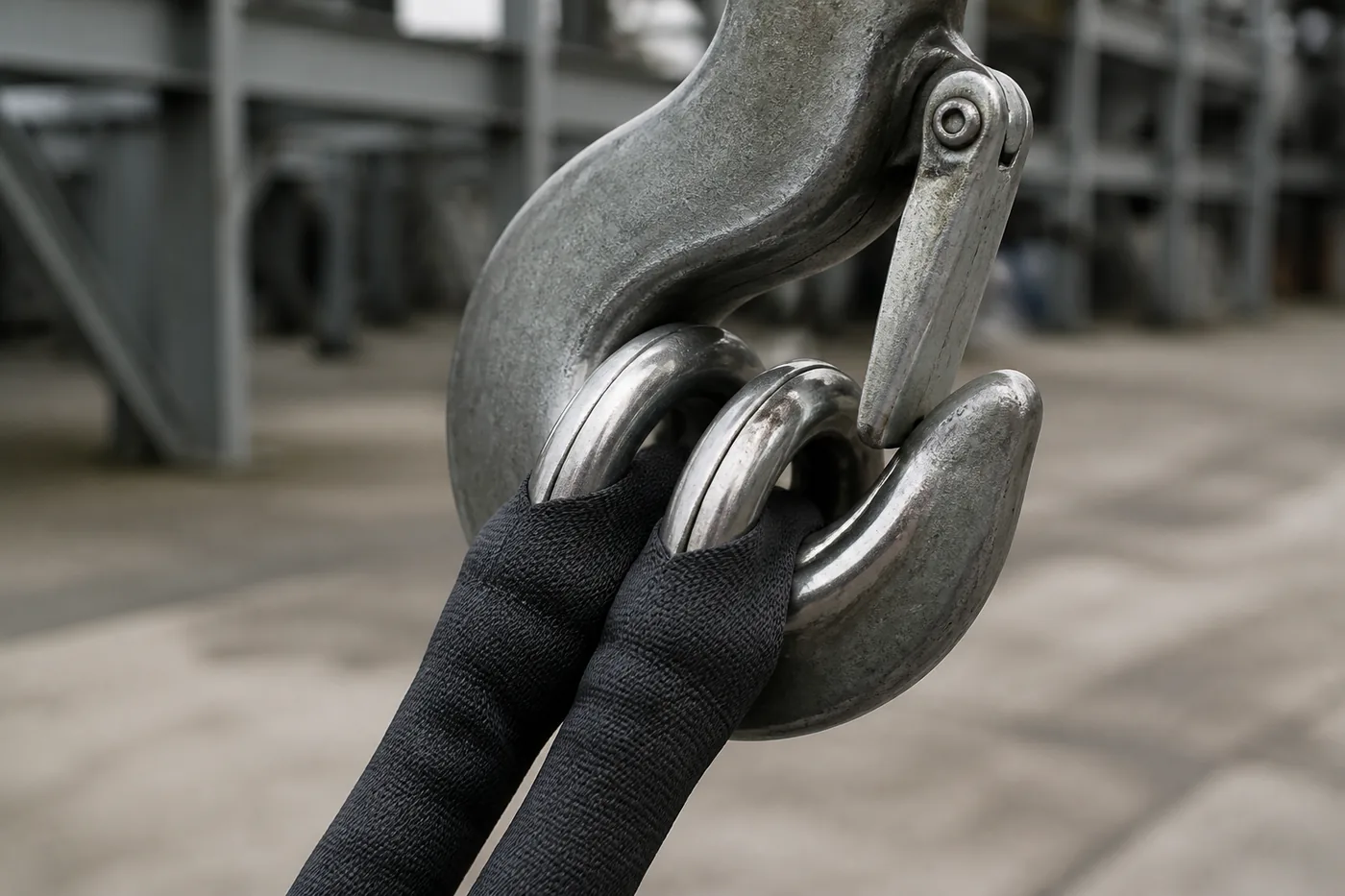
Two legs seated in the hook bowl. At 40 t the bowl, the pin and the jaw decide the rigging long before the sleeve does.
Where 40 t of capacity goes: the basket
One 40 t sling in a basket is rated 80 t at 0–7°. The figure is real, but it is a sling figure: it describes what the sleeve and core will take, not what the crane can put on the hook. At this tier the basket is chosen for how it holds a coil or a curved shell, and the tonnage it unlocks is usually spent on the crane limit rather than on the load.
| Arrangement | Figure for one sling | What it usually exceeds first |
|---|---|---|
| Vertical | 40 t | The load itself, if the lift is truly single-leg |
| Choked | 32 t | Nothing — a choke is a rigging choice, not a way to save a smaller sling |
| Basket at 0–7° | 80 t | The hook, master link or beam above it |
| Basket at 45–60° | 40 t | The angle, which quietly takes the doubling back |
A basket is the only arrangement that gives more than the sleeve says — and at 40 t it is also the one where the crane runs out first.
In practice, 30–40 t coils and plate packs go into a basket for grip and for the way a round body follows a curve, and the crane is chosen for the load rather than for the sling’s basket rating. If the plan relies on 80 t of basket, send us the hook rating with the enquiry — it changes the answer.
One 40 t, two 20 t, or one 50 t?
The tier is not automatic. Below 40 t there are three legitimate ways to rig the same load, and they are not equivalent.
| Set | What it carries | What you gain | Choose it when |
|---|---|---|---|
| One 40 t sling, vertical | 40 t | One body, one label, one inspection | Single-point lift, or a basket where the 80 t sling figure is wanted |
| Two 20 t slings, 0–45° | 28 t | Lighter bodies, easier to rig by hand | The load has two points and shares evenly — but not for a 40 t load |
| Two 30 t slings, 0–45° | 42 t | Redundancy, and two wear points | A 35–40 t load on two legs, where neither leg should sit at its limit |
| One 50 t sling | 50 t | Headroom for a load that grows | Unknown weights, or a fleet sling that has to cover several jobs |
Mode factors applied to the single-leg rating. Two 20 t slings do not make 40 t — the pair carries 28 t once the legs are 0–45° from vertical.
If the load is genuinely 40 t on two legs, the answer is a pair of 30 t slings at 0–45° (42 t, with a little margin) or 40 t slings once the legs open beyond 45°. A single 30 tonne round sling is a different lift again; the tier table on this page is how the choice is made without over-buying.
Forty tonnes in the works
- Plate packs and coil. Basket under the pack, sleeve against the plate edge. The round body follows the coil’s curve instead of bearing on a line.
- Mill rolls and forged shafts. Choked close to the journal, where the body can wrap the neck without touching the bearing surface.
- Precast girders and bridge segments. One sling at each end, girder lifted level; the girth of the section, not the tonnage, sets the length.
- Ship and module blocks. Four-point with a beam above, where the sling angle is the variable that decides the set.
- Tank shells and vessel sections. Basket around the shell so no metal touches the coating — and the paint comes out of the lift intact.
- Counterweights and test blocks. Repeated identical lifts, where a defined length matters more than another tonne of rating.
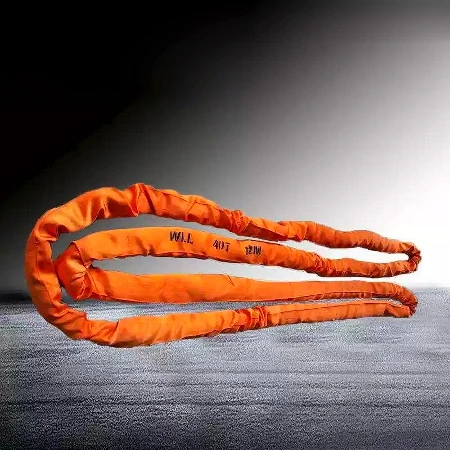
A 12 m body. At 40 t the length is a handling decision as much as a geometry one: the longer the body, the more of it has to be carried and coiled on site.
The heavy duty build — and what it does not mean
At 40 t the core is a dense parallel bundle of high-tenacity polyester filament and the sleeve is a heavier weave than on the small sizes. Two consequences are worth stating plainly, because they are where this tier behaves differently from a 10 t sling.
Heavy duty is a build, not a rating
The term describes the sleeve and the standard of make. A 40 t sling is 40 t whatever the sleeve, and a second layer buys wear life rather than capacity — the full logic is on the double sleeve round sling page. Where the load is abrasive or the yard is rough, that is still the version to specify.
A stiff body needs room
A 40 t body does not bend round a tight radius the way a 10 t one does. As a working rule — a reference value, not a standard — below about 2 m effective length the sling has no slack to seat in the hook and starts to fight the rigging. Tight geometry is usually answered with a longer body, a beam, or a round sling with eyes made to a measured length.
A 40 t sling is heavy enough to be a two-person article. Coil it on a stillage, move it with the forklift, and keep it off the floor — the wear that retires these slings happens in the yard, not in the lift.
Technical parameters
| Product | WLL 40T 40000kg polyester round slings — heavy duty endless round sling, 40 tonne round sling, 40,000 kg round lifting sling |
| Construction | Continuous parallel filament core in a woven tubular sleeve, closed into an endless loop; no metal in the load path |
| Core | High-tenacity polyester (PES) multifilament, parallel lay, waxed |
| Sleeve | Heavy duty woven high-tenacity polyester, single layer as standard; double sleeve to order |
| Working load limit | 40,000 kg (40 t) vertical, single leg |
| Breaking load | 280,000 kg at a 7:1 factor |
| Safety factor | 7:1 as standard; other factors produced to order where the market requires |
| Elongation at WLL | Kira-kira. 2–3% |
| Service temperature | −40 °C to +100 °C |
| Effective length | 1–30 m, made to order; minimum length applies at this capacity |
| Colour | Orange as standard; other sleeve colours to order |
| Marking | WLL and length printed on the sleeve; sewn label with WLL, length, serial, standard and date |
| Standard | DI DALAM 1492-2 and ASME B30.9 construction practice |
| Testing | Proof loaded before dispatch; test record matched to the serial number |
| Packing | Coil in a poly bag, labelled carton; pallet or crate on request |
| MOQ & OEM | Low MOQ for a trial order; OEM on length, sleeve colour, core fibre, label layout and packing |
Body diameter and unit mass follow the length and sleeve option, and are shown on the drawing issued with the quotation.
Inspection at 40 t: the sleeve first, then the ground it sits on
The inspection itself is the same as any round sling — sleeve, loop ends, label — but at 40 t the failure mode is decided before the sling is rigged. These bodies are dragged, stored on concrete and lifted by the coil; the sleeve at the bearing point is where the damage shows first, and it is what takes the sling out of service.
- Bearing points. Look where the sling meets the load and the hook, not at the middle of the body.
- Sleeve integrity. A cut through to the core retires the sling even if the core looks sound.
- Label and print. At 40 t the colour does not identify the sling — the print and the label do. If they cannot be read, the sling cannot be verified.
- Penyimpanan. Coiled on a stillage, off the floor, out of daylight, and never dragged under load.
Frequently asked
Can a 40 t round sling lift 80 tonnes in a basket?
On the sling side, yes — 80 t at 0–7°. In practice the hook, master link or beam above it also has to be rated for 80 t, and at this size the crane usually is not. That is why the basket at 40 t is a grip decision first and a capacity decision second.
Can I use two 20 t slings instead of one 40 t sling?
Not for a 40 t load. Two 20 t slings carry 28 t at 0–45° from vertical. A 40 t load on two legs needs 30 t slings at 0–45° (42 t), Dan 40 t slings once the legs open past 45°.
What is the breaking load, and what comes with the certificate?
280,000 kg at 7:1. The sling is proof loaded before dispatch and the test record is matched to the serial on the label; a fibre certificate and batch figures are supplied on request.
Why is the minimum length longer at 40 t?
The core is dense and the body is stiff, so a very short sling has no slack to seat in the hook. As a working rule, below about 2 m effective length the rigging starts to fight the sling — use a longer body, a lifting beam to bring the legs closer to vertical, or an eye-and-eye sling made to a measured length.
Tell us what the sling hangs from
Send the load, the number of legs, the angle, the hook rating and the smallest opening the sling has to pass through. The last two decide more at 40 t than the tonnage does — and they are the two that are most often left off an enquiry.
Request a 40 t round sling quotation
Factory-direct price, drawing, proof-load certificate and a sample sling. Trial orders from low MOQ; OEM on length, colour, marking and packing.
Angkat Sling Rigging Co., Ltd · Lifute Industrial Park, Taizhou, Jiangsu, China · HS code 630790