

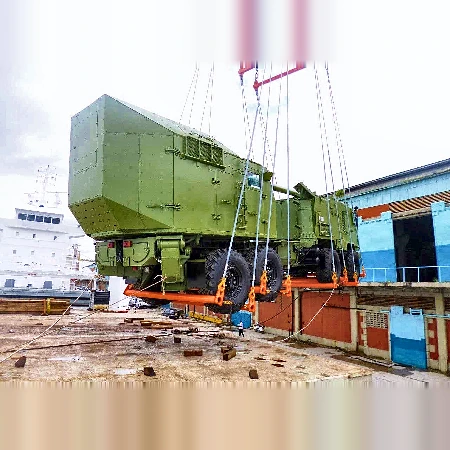
Lift sling rigging company manufacture Truck double beam lifting gear,vehicle double beam lifting gear,Truck double beam Lifting Gear with polyester webbing Net,truck lifting gear with polyester net, vehicle lifting spreader beam,double beam spreader for trucks ,40 ton vehicle sling.
Truck Double Beam Lifting Gear
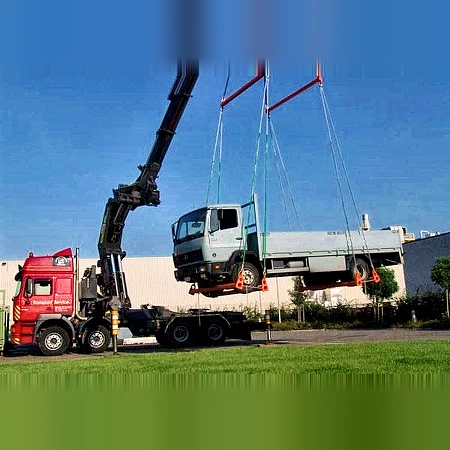
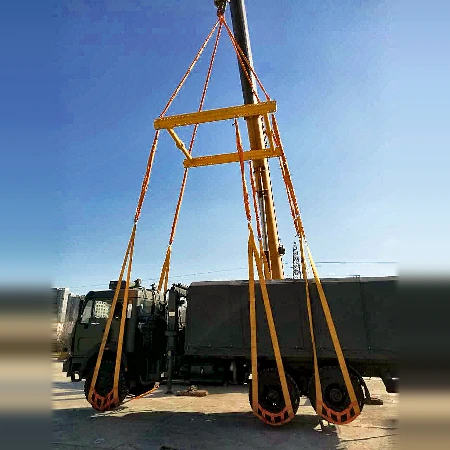
To lift a complete truck, bus or item of plant without marking the bodywork, you need two things at the same time: soft, wide contact under the vehicle and a rigid frame above it that keeps the slings vertical and clear of the cab. Our truck double beam lifting gear does both. It is a twin-beam lifting frame — two parallel steel beams, fixed or adjustable in spacing — hung from the crane hook and connected to a polyester webbing net or a four-leg webbing sling set that cradles the vehicle from underneath.
Every set is built to order in Taizhou, Kína, for port terminals, RoRo and breakbulk operations, mines and quarries, military depots and vehicle recovery work — anywhere a vehicle has to be lifted as a complete unit rather than towed or dismantled.
Why a double beam, and not four slings alone
- The legs stay vertical. Four slings hung straight from the hook pull inward; the tighter the angle, the lower the load each leg can carry. Rigid beams hold the sling angle where it was calculated, so the gear keeps its full rated working load limit.
- Nothing touches the bodywork. The spread keeps the slings and net off the cab, mirrors, exhaust stack and any roof equipment, which is what damages a vehicle in a careless lift.
- The vehicle lifts flat. A double beam holds the pick points square to the chassis, so the vehicle rises level instead of twisting around one corner.
- The load is spread, not concentrated. A polyester webbing net carries the weight across the chassis and axle area rather than at four small contact points, so panels and paintwork survive the lift.
How the gear is built
The gear is a set, not a single part: two beams on top, the rigging that connects them to the crane, and the net or slings that carry the vehicle below. Each element is sized from the vehicle, not chosen from a catalogue.
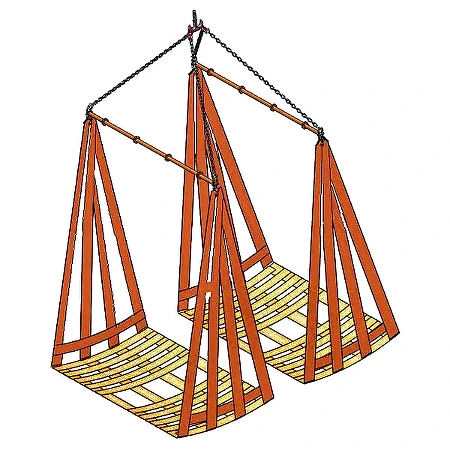
- Twin beams — welded steel box section, or two channels back to back on the smaller sizes. Shot blasted, primed and finished in safety yellow.
- Beam spacing — fixed when the gear serves a single vehicle type; pin-adjustable or telescopic when one set has to cover a mixed fleet of widths.
- Top rigging — four-leg wire rope, webbing or chain converging on a forged master link. A two-point version for two crane hooks is available.
- End assemblies — forged D-shackles or welded plate lugs at each beam end, with a tagline eye to control rotation.
- Bottom connection — a polyester webbing net, or four flat webbing slings taken to the chassis and axle pick points, with anti-abrasion sleeves at the edges.
Technical parameters
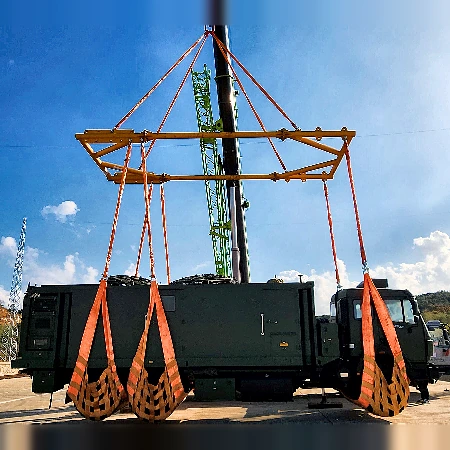
Values below are the ranges we build to. Final figures are fixed on the approved drawing before manufacture, against your vehicle weight, dimensions and crane.
| Paraméter | Specifikáció |
|---|---|
| Model reference | XLF-TDB (assigned per set) |
| Working load limit (WLL) | 3 t to 60 t per set; heavier on request |
| Beam construction | Twin welded steel beams — box section (back-to-back channel on smaller sizes), Q345B / S355JR |
| Beam span, centre to centre | 1,500 mm – 6,000 mm |
| Beam section | 100 × 100 mm up to 250 × 250 mm |
| Spacing adjustment | Fixed · pin-adjustable (multi-hole) · telescopic |
| Top rigging | 4-leg webbing, wire rope or chain to one forged master link; 2-point on request |
| Bottom connection | Polyester webbing net, or 4-leg flat webbing slings |
| Net / sling material | High-tenacity polyester (PES); nylon, polypropylene, UHMWPE or aramid on request |
| Webbing width | 50 mm – 300 mm |
| Net mesh | 100 × 100 mm – 300 × 300 mm |
| Net panel size | Made to the vehicle footprint, up to approx. 12,000 × 3,000 mm |
| Net corner points | 4 as standard; 6 or 8 on request |
| Connection hardware | Forged D-shackles, plate lugs, master link, swivel hook |
| Textile safety factor | 5:1 (ASME B30.9) or 7:1 (EN 1492-1) |
| Beam design basis | Below-the-hook lifting device practice, ASME BTH-1 / B30.20, design factor ≈ 3:1 |
| Surface finish | Beam in safety yellow paint; hot-dip galvanised on request |
| Jelzés | WLL, set serial number, standard and CE plate |
| Dokumentáció | Test certificate, declaration of conformity, operating manual |
Where the gear is used
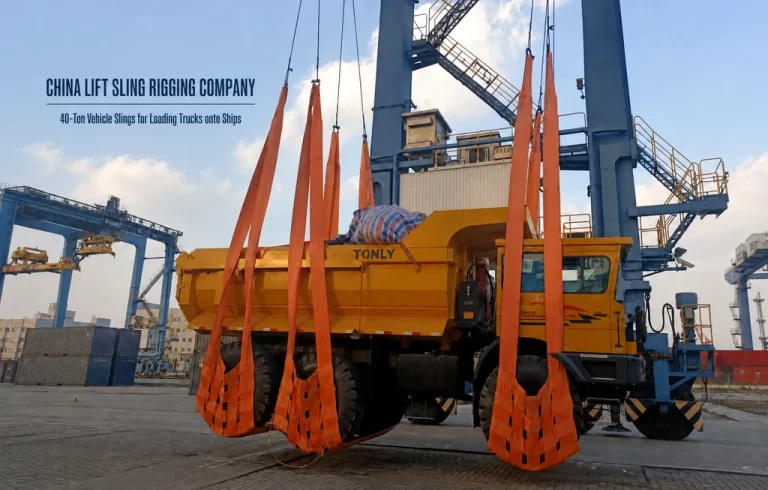
Most sets we build go to ports and terminals for loading vehicles onto ships, and to operators who have to lift a complete vehicle where a normal sling set would mark it or pull it out of shape.
- RoRo and breakbulk terminals — loading trucks, buses, coaches, dump trucks and wheel loaders into a hold. See the vehicle lifting net used for the same job.
- Mines and quarries — recovering or relocating heavy rigid dump trucks where they cannot be driven.
- Military and special vehicles — handling launcher, radar and engineering vehicles that must be lifted complete and unmarked.
- Factories and yards — moving a finished vehicle onto a test bed, weighbridge or into a container.
- Boatyards — lifting craft where a soft, wide cradle is needed instead of a strap.
Testing and documentation
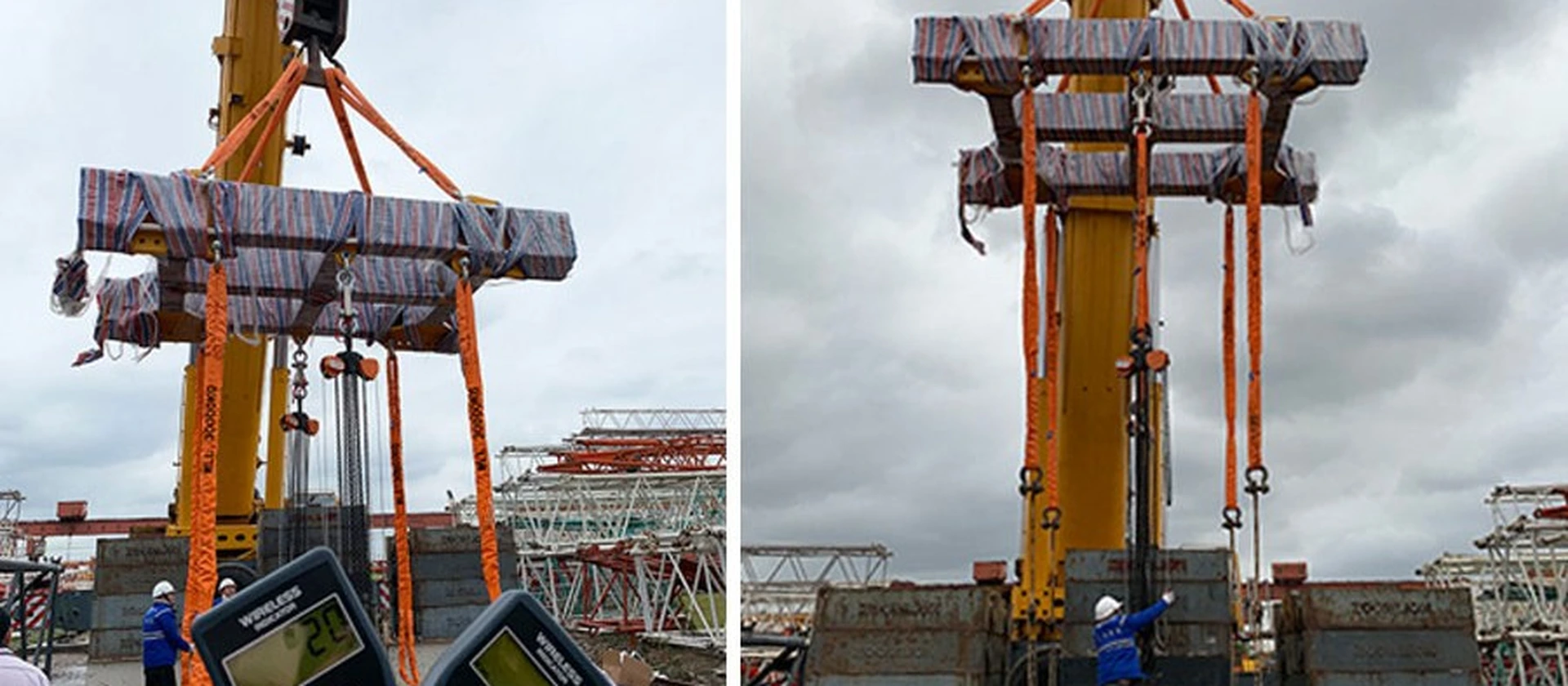
Textile parts and the beam frame are both proof loaded before dispatch on our own 1,000-tonne horizontal testing machine. Each set leaves with a test certificate, a permanent capacity plate and the declaration of conformity your site requires. Our facilities hold ISO 9001, ISO 14001 and ISO 45001, and our test reports are issued through a CNAS-accredited laboratory.
What to send us for a quotation
- Vehicle type and complete kerb weight
- Overall length, width, height and wheelbase
- Where the vehicle can be picked up — chassis, axles, wheels or a marked lifting point
- The crane, hook height and available headroom
- The working load limit and safety factor your site applies, and the standard behind it
- Whether the set is for repeated lifts or a one-off move
Send a drawing, a photograph of the vehicle or just the handling conditions through our contact page and our engineers will come back with a recommended beam size, net and an itemised quotation. If you only need the net or the sling set rather than the complete gear, the truck lifting gear with polyester net covers that version.
Frequently asked questions
Can the gear be made for one specific vehicle?
Igen. Beam span, beam section, net panel size, mesh and the number of lifting points are all sized from the vehicle you need to lift. Give us the kerb weight, overall dimensions, wheelbase and hook height and we will build to it.
Do you supply the net as well as the beams?
Both. You can order the complete set — twin beams, top rigging, bottom slings and the polyester net — or the beam frame on its own if you already have slings and nets in service.
Is a double beam better than four slings alone?
For a complete vehicle, yes. Four slings hung straight from the hook pull inward, so the legs press on the bodywork and the capacity falls as the angle tightens. The double beam holds the legs vertical and keeps the full rated capacity, while keeping the slings and net clear of the cab and roof equipment.
What safety factor does the gear use?
The textile parts are made to 5:1 under ASME B30.9 or 7:1 under EN 1492-1. The steel beam frame follows below-the-hook lifting device practice under ASME BTH-1 and B30.20, where the design factor is about 3:1. Tell us the standard your site works to and the set will be marked and certified to it.
Kapcsolódó termékek
- Lifting devices — coil lifters, C-hooks, tongs and clamps built to a specific load.
- Lifting spreader beam — rigid beams that spread slings over a wide or long load.
- Cargo lifting net — flat nets, net bags and heavy-duty nets for loose or stacked cargo.
- Polyester webbing slings — the soft-contact slings used in this gear set.
- Round slings — from 1 t to 1,000 t for heavier picks.
- C-hooks and coil lifters — where the load is a coil rather than a vehicle.
Request a quotation for your truck double beam lifting gear — tell us the vehicle and we will size the beam, the net and the rigging to it.