 702461526
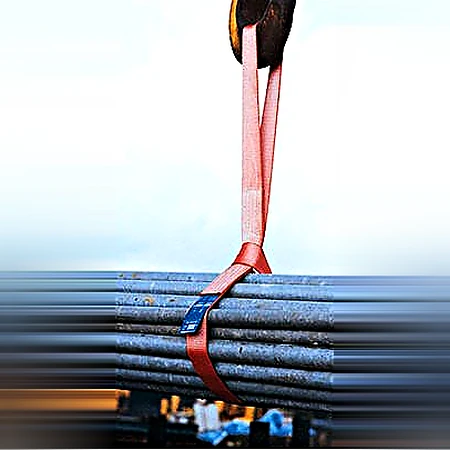
Lift sling rigging company produce Endless Web Sling.
Endless Web Sling
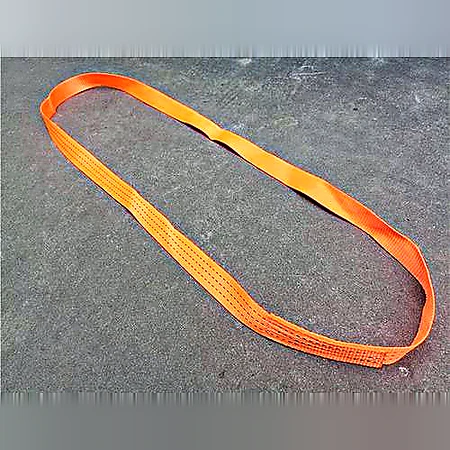
An endless web sling is a flat woven webbing band closed into a continuous loop — no ends, no eyes and no metal fittings. Because the band is joined to itself, there is nothing to thread, nothing to line up and nothing to lose. In use it is endless: the loop simply sits over the hook, and the whole circumference is a soft, load-bearing face. Under EN 1492-1 this article is the endless type A flat woven webbing sling; in North America it is the type 5 web sling.
Lift Sling Rigging Company has woven flat webbing slings in Taizhou, Jiangsu since 1985. Every endless web sling we supply is woven from 100% high-tenacity polyester yarn, colour coded to the EN 1492-1 capacity convention with one black transverse stripe per tonne, closed by a lapped and stitched joint, fitted with a sewn working load limit label, and proof tested in our own laboratory before it leaves the mill.

What an Endless Web Sling Is — and What It Is Not
“Endless” is the most overloaded word in the lifting trade, and this page is about one specific meaning of it. Two different textile articles, plus a wire rope article, are sold under the name. This page covers the flat one.
- Endless web sling (this page) — a flat woven band closed into a loop by lapping its two ends over one another and stitching the lap. Section: flat and rectangular. Standard: EN 1492-1, type A. See also our flat webbing sling range and the endless polyester flat webbing sling.
- Endless round sling — a parallel fibre core inside a woven tubular sleeve, closed into a loop with no joint in the core at all. Section: round tube. Standard: EN 1492-2.
- Endless grommet wire rope sling — a steel rope grommet closed on itself. A different material with a different set of inspection and discard rules.
If your enquiry says only “endless sling”, say web or flat if you want the band, and round if you want the tubular one. One word added to the enquiry removes the entire ambiguity. For the wider family see our endless lifting sling category.
What the Closed Loop Changes on the Job
- Nothing to hook and nothing to lose. No eye, no shackle, no thimble on the article — the loop passes over the hook and that is the whole rigging.
- Turn it and the wear moves. With no fixed ends, the bearing point, the hook contact point and the joint can all be rotated around the loop. Worn in one spot is not the same as worn out — if you rotate it.
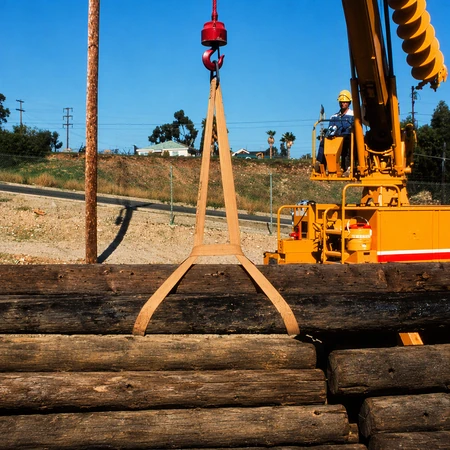
- One loop, four hitches. Straight, choked, basket and double wrap all come from the same loop, so one size on the rack covers the job.
- The bearing is broad and flat. The band lies flat and spreads the load across its whole width, which is what leaves plate, sections and crates unmarked.
- Everything that carries the load is on the outside. Unlike a round sling, a web sling shows you its entire load path — the quiet inspection advantage of the flat article.
The One Joint in an Endless Web Sling
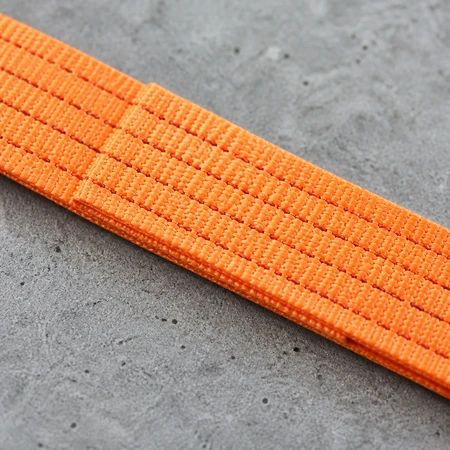
Be clear about this before you buy: an endless web sling is endless in use, not seamless. The loop is closed by laying the two ends of the band over one another and stitching the lap — a full-strength lap closed by dense parallel rows of stitching, with a step at each end where the second layer begins and ends. That joint is where the loop is made, and it is the first thing to inspect. If you need a closed loop with no joint at all in the load-bearing element, that is the round sling, where only the outer sleeve is a tube and the core is continuous.
Technical Parameters — Endless Web Sling (EN 1492-1)
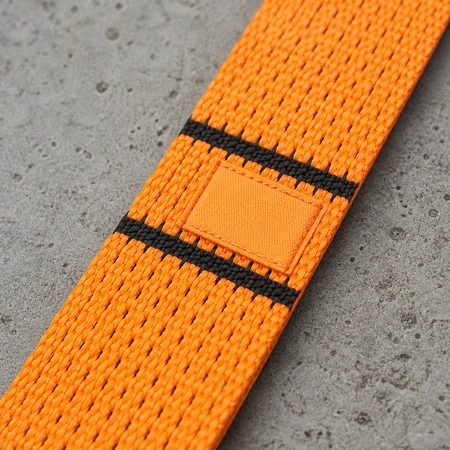
The table below is our standard endless web sling ladder to EN 1492-1. The webbing colour certifies the working load limit band in straight lift, and the black transverse stripes give the tonne figure so the two markings can be cross-checked. Reference widths are the published series for this range; the final width is stated on the order acknowledgement.
| WLL (straight lift) | Webbing colour | Black stripes | Reference width | Approx. thickness | Choked (× 0.8) | Weight per metre |
|---|---|---|---|---|---|---|
| 1 t | Violet | 1 | Confirm on order | 4 mm | 0.8 t | 0.22 kg/m |
| 2 t | Green | 2 | 50 mm | 4 mm | 1.6 t | 0.35 kg/m |
| 3 t | Yellow | 3 | 75 mm | 4 mm | 2.4 t | 0.52 kg/m |
| 4 t | Grey | 4 | 100 mm | 4 mm | 3.2 t | 0.80 kg/m |
| 5 t | Red | 5 | 125 mm | 4 mm | 4.0 t | 0.85 kg/m |
| 6 t | Brown | 6 | 150 mm | 4 mm | 4.8 t | 0.96 kg/m |
| 8 t | Blue | 8 | 200 mm | 4 mm | 6.4 t | 1.34 kg/m |
| 10 t | Orange | 10 | 250 mm | 4 mm | 8.0 t | 1.64 kg/m |
Table 1 — Endless web sling, standard EN 1492-1 ladder (safety factor 7:1). Intermediate bands and higher capacities are built to order; above 10 t the sewn label governs.
Material and Construction Specification
| Characteristic | Specification |
|---|---|
| Product names | Endless web sling · endless flat webbing sling · endless type A flat woven webbing sling · circular webbing sling · type 5 web sling |
| Type | Endless type A flat woven webbing sling to EN 1492-1 — the band lapped back over itself and stitched to close the loop |
| Material | 100% high-tenacity polyester (PES) as standard; polyamide (nylon) and polypropylene also available |
| Construction | Single layer as standard; double layer (duplex) on request |
| Load-bearing element | The flat woven webbing itself — nothing hidden |
| Joint | One lapped and stitched closure with dense parallel stitch rows |
| Working load limit | 1 t to 30 t in the EN 1492-1 band ladder; intermediate bands and higher capacities to order |
| Safety factor | 7:1 to EN 1492-1 as standard; 5:1 to ASME B30.9 and 8:1 to AS 1353 built to order |
| Elongation | Maximum 3% at the working load limit; maximum 10% at the breaking load |
| Colour and marking | EN 1492-1 capacity colour with one black transverse stripe per tonne, plus a sewn label carrying the straight-lift WLL, the material, the standard reference, the manufacturer, the length and a traceability code |
| Length | 1 m to 12 m as standard, longer on request; quoted by circumference or by effective working length |
| Temperature range | −40 °C to +100 °C for the standard polyester build |
| Testing | Batch tested; test certificate supplied per batch on request |
| Packing | Coiled and bagged, labelled carton; custom export packing |
| MOQ and OEM | Low MOQ for trial orders; full OEM on band, ply, width, length, fibre, colour, label layout and packing |
Table 2 — Material and construction specification.
Working Load Limit, Colour and Safety Factor
Both markings on an endless web sling say the same thing in two ways, and reading them together is the fastest check there is. The webbing colour gives the EN 1492-1 capacity band — violet 1 t, green 2 t, yellow 3 t, grey 4 t, red 5 t, brown 6 t, blue 8 t, orange 10 t — and the black transverse stripes give the tonne figure, one stripe per tonne. Above 10 t there is no colour to read, so the working load limit on the sewn label governs.
The same red 5 t sling can be three different objects, which is why the standard matters as much as the band. The colour tells you the band; it does not tell you how much the sling will take before it breaks. The same band can be built to EN 1492-1 at 7:1, to ASME B30.9 at 5:1, or to AS 1353 at 8:1 — and all three look identical on a rack.
How the Length of an Endless Web Sling Is Specified
A closed loop has no ends, so there is nothing to measure end to end. It is quoted in one of two ways, and the two differ by about a factor of two — the most common cause of an endless sling arriving at the wrong length.
- Circumference — the total perimeter of the loop: the length of material in the finished sling.
- Effective working length — the usable height you actually get, which works out at roughly half the circumference, because the loop is doubled when it hangs.
| Circumference ordered | Approx. effective working length | Typical use |
|---|---|---|
| 2 m | 1 m | Chokes and short lifts, tight rigging |
| 4 m | 2 m | The general-purpose size |
| 6 m | 3 m | Basket lifts on plant and fabrications |
| 8 m | 4 m | Long sections, bundles and pipework |
| 10 m | 5 m | Structure and large plant |
| 12 m | 6 m | Standard longest; longer to order |
Table 3 — Length conventions. Illustrative: the relationship is the point. State which convention your figure is in and we will confirm it on the order acknowledgement.
If you would rather, just tell us how far the hook will be from the load — that is the figure you actually care about, and we will size the loop to it.
Rigging the Loop — Hitches and Mode Factors
The label figure is the straight lift rating. Every other arrangement is derived from it by a mode factor. These factors reduce or increase the rated figure — the basket figure does not give the sling a second, higher capacity of its own.
| Hitch or mode | Mode factor | What it means |
|---|---|---|
| Straight lift | 1.0 | The label figure. The loop hangs as a U with both parts on the hook. |
| Choked | 0.8 | The loop passes round the load and back through itself so it grips as it takes the weight. The natural way to pick up a section or a bundle — and it costs a fifth of the rating. |
| Basket, 0–7° | 2.0 | The loop passes under the load with both legs on the hook, legs within 7 degrees of vertical. |
| Basket, 7–45° | 1.4 | As the legs open out, the tension in each rises and the usable capacity falls. |
| Basket, 45–60° | 1.0 | At this spread the basket gives no more than a straight lift. |
| Angled choke at 45° | 0.7 | Choked, and the legs then open away from vertical. A choke placed straight onto the hook keeps 0.8. |
| Angled choke at 60° | 0.5 | The most heavily reduced arrangement in common use — check this figure before the lift, not after. |
Table 4 — Mode factor by hitch or mode. The angle is the angle of the leg to the vertical.
Round Sling or Flat Web Sling? The Section Decides
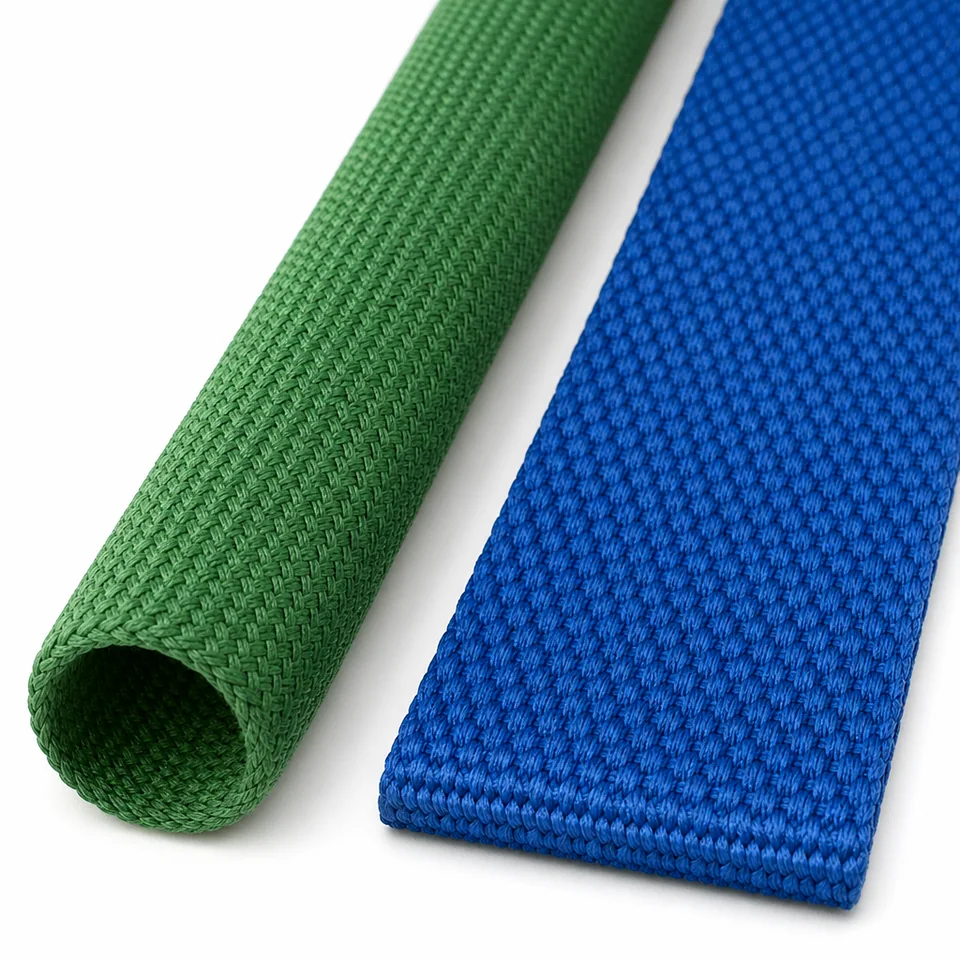
Both are endless, both are textiles, and they are good at different shapes. Match the section to the load and the rest follows.
| Property | Endless round sling | Endless web sling (flat) |
|---|---|---|
| Standard | EN 1492-2 | EN 1492-1 |
| Section | Round tube, circular | Flat band, rectangular |
| What carries the load | A continuous parallel fibre core inside the sleeve | The flat woven webbing itself |
| Joint | None in the core — it is continuous | One lapped and stitched joint closes the loop |
| Round and curved loads | Excellent — conforms and grips the curvature | Fair — a flat band is less happy around tight curves |
| Flat, wide loads | Fair — the bearing concentrates on a narrower line | Excellent — lies flat and spreads the bearing across the width |
| Bearing pressure on the load | Higher — a narrow contact line | Lower — a broad contact patch |
| Capacity we build | 1 t to 1000 t | 1 t to 30 t in the standard bands |
| First inspection point | The sleeve over the whole loop, because the core is hidden | The lap joint and the bearing points, because everything is visible |
| If it is cut | A cut sleeve is visible, but the core behind it may also be damaged and cannot be seen | Immediately visible and immediately serious — the load path is the band you are looking at |
| Best for | Pipe, coils, rolls, curved castings, machined and finished parts, and anything above the webbing ladder | Plate, sections, box girders, crates, stillages, machinery, precast units and any flat or boxy load with edges |
Table 5 — Round or flat? Compare the section with the load. See the full round sling range alongside our flat webbing sling range.
Applications of an Endless Web Sling
The flat band is chosen for one reason above all others: it bears on the load over a broad, soft, flat contact patch, and everything that carries the load is on the outside where you can see it.
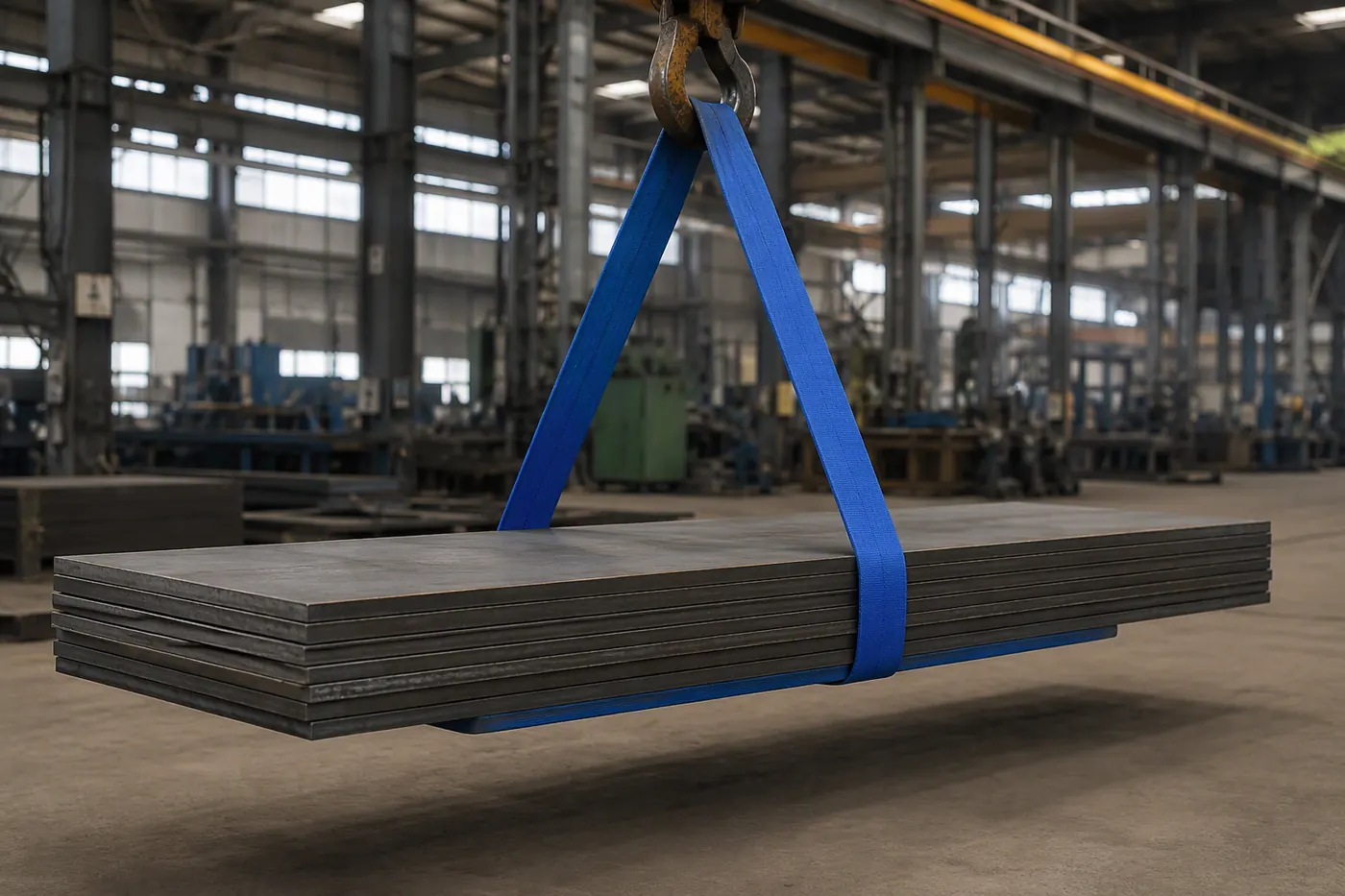
Plate, sections and box girders
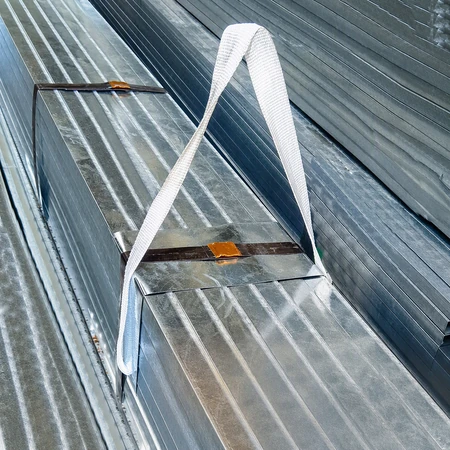
The band lies flat across the surface and spreads the bearing, which is why a plate stack or a box girder comes off the lift unmarked. In a basket arrangement the load takes the strain across the full band width rather than on a narrow contact line.
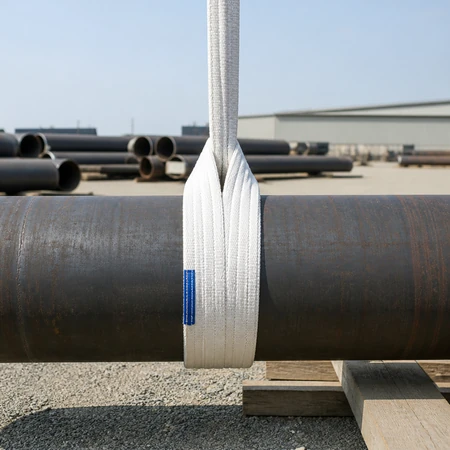
Pipe, tube and bundles — choked
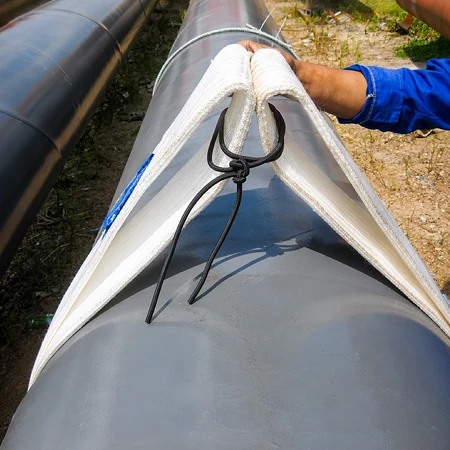
A choke is the natural way to pick up a section or a round bundle: the loop passes round the load and back through itself so the wrap grips as it takes the weight. Remember the arithmetic — a choke keeps 0.8 of the straight-lift figure, and the same rule applies where pipe has to be lifted without a mark. For pipe duty specifically see our steel pipe lifting strap.
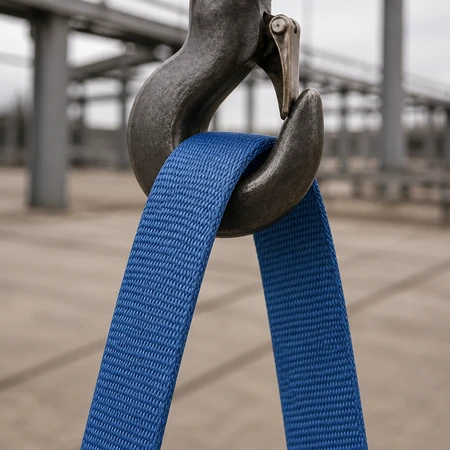
Over the hook — nothing to rig
There is no eye to line up and no fitting to inspect. The loop goes over the hook and the lift can start, which is part of why an endless web sling is often faster to rig than a sling with eyes — and part of why it can be turned in place between lifts.
Other loads this article is regularly bought for: crates and stillages, precast concrete units, machinery and machine beds, timber packs, fabricated assemblies, and general yard, depot, port and site work where one sling has to serve many different lifts. Where the figure is large and the band heavy, see our heavy duty endless lifting web slings; where the sling travels with the cargo and never comes back, see the single use endless webbing sling. Related flat-web forms include the endless flat webbing sling and the endless type webbing sling.
Edge Protection — Part of the Specification, Not an Accessory
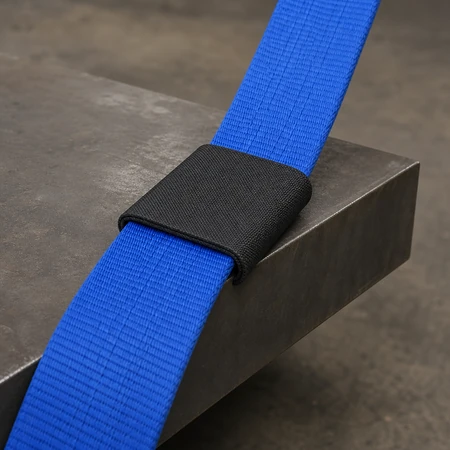
A band cut by an edge starts as a small notch and ends as a failure, and edge damage is the classic flat webbing failure. Where the load has a sharp corner, a machined lip, a burr or a weld spatter, either the band is sleeved and the sleeve is part of the article, or the corner is protected with a pad that travels with the sling. Ask for it at the enquiry stage — a sleeve cannot be retro-fitted to a band already woven.
Inspection and Safe Use of an Endless Web Sling
A flat web sling shows you its load path, so inspect it in the order the load travels. Inspect before every use, and formally at the interval your site rules set.
- The lap joint first. Every stitch row across the whole lap, the webbing at the step at each end of the lap, and that the two layers are still lying flat and parallel. Broken, slack or pulled stitching condemns the sling.
- The bearing points — cuts, abrasion, glazing or a worn edge where the band has wrapped loads.
- The hook contact area, and where the webbing folds over itself.
- The rest of the band. A flat band carries the load across its whole width, so a cut at any point matters.
- Edges — cuts from the load’s own corners, the classic failure and the classic reason an edge protector was needed.
- Glazing and hardening — a band gone shiny or stiff has met heat or sustained friction.
Rotate as policy, not as repair. Turn the loop after each lift so the bearing point, the hook point and the joint keep moving. On a sling with ends this is impossible; on an endless sling it costs nothing, and it is the single habit that decides whether the sling lasts one season or three. Never repair a sling — no stitching, no splicing, no knotting, and a knot in a webbing sling can lose half its capacity. Keep the band flat and untwisted in use, store it clean, dry and out of sunlight, and log the lifts and any damage so a wear pattern is visible before it becomes a failure.
Safety notice: lifting operations are inherently dangerous. Follow the instructions of the equipment manufacturer, the practice of your national governing body and the training you have received, and never exceed the working load limit for the configuration you are using — a straight lift, a choke and a basket are three different ratings on the same sling. If you are unsure whether a sling is fit for use, or which article is right for your load, ask us before you lift — and if in doubt, take it out of service.
Customisation, OEM and Quality Control
- Band and construction — single layer standard, double layer (duplex) on request, in polyester, polyamide or polypropylene.
- Capacity and length — 1 t to 30 t in the standard bands, 1 m to 12 m as standard, longer on request, quoted by circumference or by effective working length.
- Protection — edge protectors, wear sleeves and pads for the bearing points.
- Marking — standard capacity colour and stripes, or your own scheme where the market allows, with your label layout, language and figures.
- How we hold the figure on the label — founded in 1985, 40 years in rigging, more than 200 employees and annual exports exceeding USD 10,260,000, with 15 authorised patents. Our own laboratory and a 1000 t horizontal testing machine, with CNAS, CE and DNV certification, means the figure on the label is a figure we have pulled. Every length is checked before it is cut, every closure is checked on its stitch rows, and every finished sling is checked on its length, marking, label and traceability code before packing.
Frequently Asked Questions
What is an endless web sling?
It is a flat woven webbing band closed into a continuous loop with no ends, no eyes and no metal fittings. It is built to EN 1492-1 as the endless type A flat woven webbing sling, and in North America it is the type 5 web sling. The loop is closed by laying the two ends of the band over one another and stitching the lap.
Is an endless web sling really seamless?
No. It is endless in use because there are no ends and no fittings, but the loop is closed by a lapped and stitched joint, so there is one made connection in the load path. That joint is a full-strength lap closed by dense parallel rows of stitching, and it is the first thing to inspect.
What is the safety factor?
7:1 to EN 1492-1 is standard. The same 5 t sling can also be built as a 25 t object to ASME B30.9 at 5:1, or a 40 t object to AS 1353 at 8:1 — so read the standard as well as the band.
How is the length specified?
Either by circumference, which is the total perimeter of the loop, or by effective working length, which is the usable height and works out at roughly half the circumference. The two differ by about a factor of two, so state which convention your figure is in.
What do the colour and the black stripe mean?
The colour gives the EN 1492-1 capacity band: 1 t violet, 2 t green, 3 t yellow, 4 t grey, 5 t red, 6 t brown, 8 t blue, 10 t orange. The black transverse stripes give the tonne figure, one per tonne, so the two markings can be cross-checked. Above 10 t the sewn label governs.
Can it lift more in a basket than in a straight lift?
Yes — up to 2 times the label figure in a basket with the legs within about 7 degrees of vertical, falling to 1.4 times between 7 and 45 degrees and to 1.0 between 45 and 60 degrees. A choke reduces the figure to 0.8, and an angled choke to 0.7 at 45 degrees and 0.5 at 60 degrees. A 4 t load in a choker needs a 5 t sling.
Round sling or flat web sling?
Match the section to the load. A round sling conforms to round, curved and awkward loads and reaches 1000 t, but it hides its load path inside the sleeve. A flat web sling lies flat, spreads its bearing across the full band width and shows the whole load path — the right choice for plate, sections, box girders, crates and stillages.
Related Products
- Endless lifting sling — the full closed-loop family
- Flat webbing sling — the eye-and-eye and endless web sling range
- Endless flat webbing sling
- Endless type webbing sling
- Endless polyester flat webbing sling
- Heavy duty endless lifting web slings
- Single use endless webbing sling
- Steel pipe lifting strap
- Endless round sling
- Round sling
- Wire rope sling
- Endless grommet wire rope sling
Request a Quotation for an Endless Web Sling
Send us the load and its shape, the hitch you intend to use, the working load limit you need, whether your length figure is a circumference or an effective working length, and the standard and destination market the sling must be built to. We will come back with an article, a capacity, a length, a sample and a factory-direct price.
Lift Sling Rigging Company — Lifute Industrial Park, Taizhou City, Jiangsu Province, China. Tel: +86 523 8693 5818 | WhatsApp: +86 180 6600 2268 | E-mail: 702461526@qq.com | HS code 630790