

Lift sling rigging company produce Aramid Anti-Drone Nets,knotted Aramid Anti-Drone Net,high strength Anti-Drone Net,Aramid Anti-Drone Net for Restricted Area Protection,Para Aramid Safety Net,Heavy Duty Aramid Fabric Netting for Anti-Drone Defense/Perimeter Protection/Security Facilities.
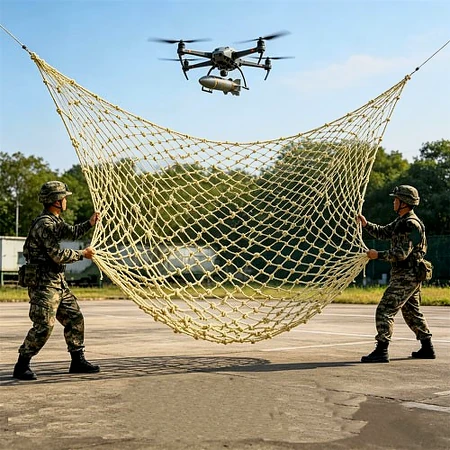
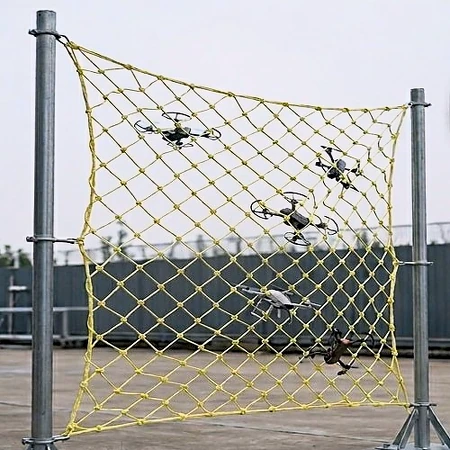
Yon aramid anti-drone net is a knotted rope panel hung across the line a small unmanned aircraft would fly through. We supply it as a complete assembly rather than a loose piece of netting: knotted aramid panel, spliced border, corner eyes, tensioners and anchors, quoted per opening so that the panel, the border and the fixings carry the same load.
Two rope sizes cover almost every installation. A 6 mm braided aramid rope breaks at 2.6 t and is the panel for perimeter work, prisons, schools and anywhere the aperture has to be fine without the panel becoming heavy. A 10 mm braided aramid rope breaks at 7 t and is the panel for real kinetic impact — refineries, substations, pò, airfields. Both are knotted, both are spliced into the border, and both are supplied with the fittings that take the load out of the mesh and into the structure.
At a glance
- 6 mm braided aramid rope — breaking force 2.6 t
- 10 mm braided aramid rope — breaking force 7 t (70.67 kN measured on a 10 mm sample)
- Knotted mesh 40–120 mm, panno pou 10 × 20 m
- Supplied with border, corner eyes, tensioners and anchors
- No power, no radar, no operator — passive interception
- Pa fonn: carbonise soti nan apeprè 400 °C epi li kenbe fòm li yo
On this page
What the assembly is made of
Four elements decide whether the barrier works, and only one of them is the rope.
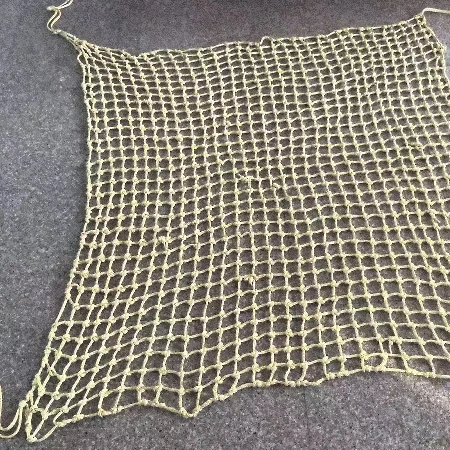
- The panel. A 12-strand braided aramid rope, double-knotted into square or diamond mesh. The knot gathers four rope ends, so the load entering from one direction leaves through the other three instead of passing through a clamp.
- The border. The same braid or one size up, double-laid and spliced — never knotted — around the perimeter. The border collects everything the mesh gathers and hands it to the corner eyes.
- The corner eyes and fixing points. Spliced eyes with stainless thimbles at the corners, eyelets or D-rings along the edge at your anchor spacing.
- The anchors. Posts, wall plates or stand-off brackets. A panel that is strong enough and tied to a post that is not will fail at the post.
The construction detail behind the knot, the braid and the fire behaviour is set out on the high strength anti-drone rope net paj; this page carries the specification and the fittings you need to place an order.
Paramèt teknik
The figures below are the manufacturing range. The batch certificate supplied with the panel governs, and the installed barrier is only as strong as its border and anchors.
| Atik | Aramid anti-drone net — standard build |
|---|---|
| Fib | Para-aramid (Kalite kevlar), UV-estabilize; polyester available for light duty |
| Konstriksyon kòd | 12-strand galon, coreless; 8-strand on 6 mm and below |
| Dyamèt kòd | 6 mm ak 10 mm estanda; 4 / 8 / 12 mm bay lòd |
| Breaking force — 6 mm | 2.6 t (≈25.5 kN) |
| Breaking force — 10 mm | 7 t (≈68.6 kN; 70.67 kN measured on sample Dia10mm, 23 June 2026) |
| Elongasyon | ≈3.5 % nan repo; anba 1.5 % nan chaj travay |
| May | 40 / 50 / 60 / 80 / 100 / 120 mm, kare oswa dyaman |
| Konstriksyon | Noue, double knot hand-set and locked |
| Gwosè panèl | 5 × 10 m, 10 × 10 m, 10 × 20 m as single panels; larger openings as joined panels |
| Pwa | ≈1.6 kg/m² at 10 mm / 100 mm may; ≈0.6 kg/m² at 6 mm / 100 mm |
| Thermal | No melting point in service; continuous to ≈200 °C; carbonises from ≈400 °C |
| Koulè | Lò natirèl aramid, nwa, oswa bay lòd |
| Kouch | San kouvwi, oswa PU / neoprene dipped for UV and abrasion on permanent outdoor panels |
| Marking | Tag ak gwosè panèl, dyamèt kòd, may, fib ak nimewo pakèt |
| Devwa | Physical interception — never fall arrest, never lifting |
Tablo 1 — Aramid anti-drone net, standard build.
Fwontyè, fittings and anchor schedule
Buyers rarely fail on the panel and often fail on what it is tied to. The schedule below is what we supply with a standard opening; every line is confirmed on the approval drawing before the panel is woven.
| Atik | Spesifikasyon | Materyèl / fini | Nòt |
|---|---|---|---|
| Fwontyè kòd | 10 mm 12-strand aramid, doub-mete, spliced | Aramid, optional PU dip | Never knotted — a knot in the border puts the panel through a single joint at its most loaded point |
| Corner eye | 80 × 160 mm spliced eye, stainless thimble | AISI 316 kouto | One per corner as standard; extra eyes on long spans |
| Edge eyelets | Ø 12 mm, nan 500 mm sant | Stainless, pressed | For lacing to a frame or to a second panel |
| D-ring / delta ring | Ø 12 mm, 60 × 110 mm | Zinc-plated or AISI 316 | Where a ratchet tensioner is used instead of a turnbuckle |
| Tansyonè | M12 turnbuckle, oswa 50 mm ratchet tensioner | Galvanize / zinc-plated | Take the slack out and stop; over-tensioning creeps the knots |
| Anchor post | Ø 60 × 3.0 mm or Ø 76 × 3.0 mm tube, 3–6 m | Hot-dip galvanised | Base plate 200 × 200 × 10 mm, 4 × M16; post size to be confirmed against design wind |
| Wall / anchor plate | 150 × 150 × 8 mm, 4 × M12 | Hot-dip galvanised | For fixing to concrete or steel structure |
| Stand-off bracket | 300 / 500 / 1000 mm arm | Galvanize | Keeps 1 m clear behind the panel for a caught aircraft to deform into |
| Eye bolt | M12 × 120 mm | Galvanize | Anchor point at the post or wall |
| Wire rope clip set | M6 / M8 with thimble | Galvanize | For anchor tails and temporary fixings |
| Wear sleeve | 500 mm, open tubular | PU-coated polyester | Where the panel crosses structure or a sharp edge |
| Twous reparasyon | 3 m matching braid + splicing fid | Aramid | One damaged mesh is re-knotted on site and recorded |
| Panel tag | 60 × 120 mm | Woven polyester | Gwosè panèl, kòd, may, fib, nimewo pakèt |
Tablo 2 — Fittings supplied with a standard opening. Load ratings of anchors and tensioners are confirmed against the panel design on the approval drawing.
Aramid against steel wire mesh
Steel wire mesh is the barrier most buyers compare against, and the comparison is usually made on the wire. It should be made on the joint. A clamped stainless mesh is pressed together with aluminium double ferrules, one at every crossing, and the ferrule — not the wire — sets the limit of the panel.
The following is the specification the steel mesh trade works to, translated from the Chinese original supplied with the material.
| Rope Ø (mm) | Strand | Ferrule joint, min. breaking force | kN | Tòn |
|---|---|---|---|---|
| 1.2 | 7 × 7 | not published for mesh joints | — | — |
| 1.5 | 7 × 7 | ≈41 kgf (≈400 N) | 0.4 | 0.04 |
| 1.6 | 7 × 7 | not published for mesh joints | — | — |
| 2.0 | 7 × 7 | ≈265 kgf | 2.6 | 0.27 |
| 2.4 (3/32″) | 7 × 7 | ≈426 kgf (4.18 kN) | 4.18 | 0.43 |
| 3.0 | 7 × 19 | ≈552 kgf | 5.4 | 0.55 |
| 4.0 | 7 × 19 | ≈981 kgf | 9.6 | 0.98 |
| 6 / 8 / 10 / 12 | 7 × 19 | no ferrule rating published for mesh joints | — | — |
Tablo 3 — Stainless steel wire rope mesh, aluminium double ferrule to DIN EN 13411-3, SUS 304 / 304L / 316 / 316L. Ferrule joints must not be bent again or re-used after pressing; for dynamic, impact or personnel duty the working load is taken as 1/5 pou 1/6 of the breaking force.
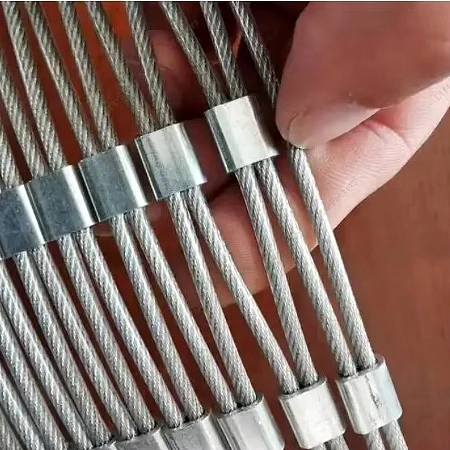
Steel wire mesh: a pressed aluminium ferrule at every crossing. The largest standard ferrule breaks at about 0.98 t — and that joint repeats across the whole panel.
Put the two tables side by side and the difference is not marginal.
| Eleman | Breaking force | Against the 4.0 mm ferrule |
|---|---|---|
| 10 mm aramid rope, noue | 7 t (≈68.6 kN) | 7.1 × |
| 10 mm aramid, nan 50 % knot efficiency | ≈3.6 t (35 kN) | 3.7 × |
| 6 mm aramid rope, noue | 2.6 t (≈25.5 kN) | 2.7 × |
| 4.0 mm steel wire + aluminium ferrule | 0.98 t (9.6 kN) | 1.0 × |
| 3.0 mm steel wire + aluminium ferrule | 0.55 t (5.4 kN) | 0.56 × |
Tablo 4 — Like for like: one element of net against one element of net.
Even the lightest rope we put in an anti-drone panel — 6 mm, 2.6 t — carries 2.7 times the load of the heaviest ferrule in the steel table, and it does so at roughly a tenth of the weight per square metre. The gap matters for a second reason: a steel mesh repeats its weakest joint hundreds of times across an opening, so a drone finds the nearest one, while a knotted panel spreads the impact through neighbouring meshes and degrades instead of unzipping.
Steel mesh is still the right answer for rigid screens, heavy debris and abrasion, and we make wire rope assemblies on the same presses — see kòd fil fistibal. It is not the right answer for a fast, light aircraft, because the ferrule sets the limit at about a tonne.
Choosing rope and mesh
Two decisions, nan lòd sa a: what has to be stopped, then what has to be seen through.
| Situation | Kòd | May | Poukisa |
|---|---|---|---|
| Perimeter screening, prisons, schools, events | 6 mm | 60–80 mm | Limyè, low wind area, deployable by two people; the threat is a small multirotor or a contraband drop |
| Substations, data centres, fuel points | 10 mm | 80-100 mm | Real kinetic impact and a dropped payload; needs the joint strength and the fire behaviour |
| Raffineries, tank farms, hot process areas | 10 mm | 80-100 mm | Panel must not melt or drip; aramid carbonises and holds its geometry |
| Airfields, helipads, approach zones | 10 mm | 100-120 mm | Larger airframes; wind load usually governs the anchors rather than the aircraft |
| Fine screens, sparks, small debris | 6 mm | 40-50 mm | Aperture smaller than the smallest part that must not pass |
Tablo 5 — Selection guide. Where the fire case governs rather than the impact, wè prevansyon dife anti abèy may.
Installation and stand-off
- Kanpe-off. Keep at least 1 m clear behind the panel. A caught aircraft has to deform into space, not into the asset.
- Espas lank. 2 m oswa pi pre sou fwontyè a. The border spans between anchors and carries everything the panel collects.
- Tansyon. Take the slack out and stop. A knotted aramid panel sets under its first load; over-tensioning creeps the knots and works the anchors loose.
- Retounen do kay. A vertical wall can be flown over. Anything above about 6 m needs a return or a top curtain.
- No cut mesh. Never cut an aperture for access or a service. Put a reinforced opening on the drawing.
- Van. A 100 mm nèt se apeprè 30 % solid; kalkile panèl la kòm yon sifas ki mouye nan presyon van lokal debaz la, and size the posts to that, not to the drone.
Marking, packing and documents
Each panel is rolled, strapped and tagged, with the tag carrying panel size, dyamèt kòd, may, fib ak nimewo pakèt. Panels travel in a PVC bag inside a woven outer, or on a pallet for multi-panel orders. Batch test records, a packing list and a declaration of conformity are supplied with the shipment; state the standard your site or customs authority needs and the documents are prepared to it.
Kòd HS 630790. Orijin: Lift Sling Rigging Co., Ltd, Lifute Endistriyèl Park, Taizhou City, Pwovens Jiangsu, Lachin.
Questions buyers ask
How strong is an aramid anti-drone net against a steel wire mesh?
A 6 mm aramid rope breaks at 2.6 t and a 10 mm at 7 t. The largest standard ferrule on steel wire mesh — 4.0 mm rope — breaks at 981 kgf, sou 0.98 t. On joint strength the 10 mm aramid element carries about seven times the best steel mesh joint, and even the 6 mm element carries 2.7 times as much.
What mesh size do I specify?
40–60 mm for small multirotors, so a propeller blade cannot pass; 80–100 mm for larger multirotors and fixed-wing airframes; 120 mm where panel weight and wind area matter more than aperture. The rule is that the aperture must be smaller than the part that would arrive first, measured between rope centres unless a clear opening is specified.
Is it a panel or a complete assembly?
A complete assembly: knotted panel, spliced border, corner eyes with stainless thimbles, edge eyelets where specified, tensioners and anchors, tagged and documented. Panels can be supplied loose where you already have the anchors and only need the net.
Will it stop a drone carrying a munition?
The net stops the delivery, not the warhead, and that is the whole point of netting a position. A 5 kg munition arriving at 100 m/s is arrested with about 62.5 kN if it is stopped over 0.4 m; shared across the four ropes of an engaged mesh that is roughly 16 kN per rope, against about 34 kN carried by a knotted 10 mm element even at 50 % knot efficiency. Break the delivery and the warhead never arrives.
Can a damaged panel be repaired on site?
Yes on knotted construction. One damaged mesh is re-knotted with the same braid and the repair is recorded. Yon kòd fwontyè domaje, a pulled corner eye or a large damaged area is replaced rather than patched.
Does the net need power or detection?
Non. It is a passive physical barrier: no power, no radar, no operator. That is also why it still works against fibre-optic and pre-programmed drones that electronic countermeasures cannot reach.
Pwodwi ki gen rapò
- High strength anti-drone rope net — the engineering behind the knot, the braid and the joint
- Aramid nèt ak ne — construction options and strength per braid
- Prevansyon dife anti-abèy may — where flame, not impact, governs the fibre
- Durable safety netting for fall protection — the same netting tradition where a person has to be caught
- Safety rope nets — the full category, with panels, may ak detay kwen
- Nayilonn kòd and braided aramid rope — the line our panels are knotted from
Voye ouvèti a, get a panel you can install
Tell us the width and height of the opening, what the panel fixes to and at what spacing, the stand-off behind it, the aircraft you are designing against and the design wind speed. We come back with rope diameter, may, border specification, fittings list and price — with the breaking force at the knot, pa sèlman sou bobin la.
Imèl : lift98@jslift.com· Telephone and WeChat +8618066002268