

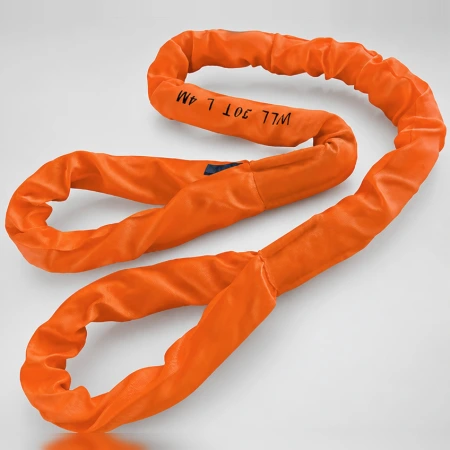
Lift sling rigging company manufacture WLL 800T Polyester Round Slings,800000kg Heavy Duty Round Lifting Sling,WLL 800 Ton Industrial Grade Orange Endless Round Sling,800 Tonne Heavy Duty UHMWPE Endless Round Sling,WLL 800 Ton Heavy Duty Endless Round Lifting Slings.
WLL 800T Polyester Round Slings
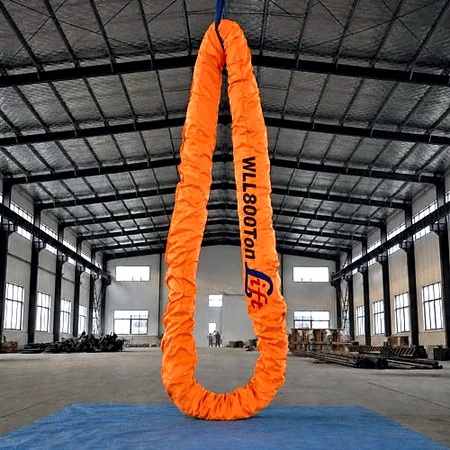
A WLL 800T polyester round sling is rated 800,000 kg on a single vertical leg — a continuous loop of high-tenacity polyester yarn inside a heavy duty woven sleeve, with a minimum breaking load of 5,600,000 kg nan 7:1 and a 1,600,000 kg proof load applied to every body before it is marked.
Every mode-factor table stops at four legs. 800 tonnes is the size that makes you notice.
Four legs at 0–45° rate 1,680,000 kg, and that figure is the end of the published arithmetic — there is no factor for six legs, none for eight, and none for two hooks. Above it the capacity of a lift stops being something you look up and becomes something you engineer, with equalising gear and a plan you can sign. That is the subject of this page.
Where the Table Ends
The standard assembly factors are 1.4 for two legs, 2.1 for three or four, falling to 1.0 epi 1.5 between 45° and 60°. Nothing above four legs appears in them — not for six, not for eight, not for a pair of cranes. So for this sling the tabled ceiling is:
| Sling | Sum of four labels | Rated four-leg set |
|---|---|---|
| 600 t | 2,400,000 kg | 1,260,000 kg |
| 700 t | 2,800,000 kg | 1,470,000 kg |
| 800 t | 3,200,000 kg | 1,680,000 kg |
Two of the four labels are gone before the set has a rating at all — one to the angle, one to the fact that only three legs are assumed to share. The arithmetic behind that is worked through on the 700 t page; here it is the ceiling it produces that matters.
Above 1,680 Tonnes: Three Routes
A 2,000 t lift does not need a bigger sling. It needs a different arrangement, and there are only three that get used.
| Route | What it buys | What it demands |
|---|---|---|
| Six or eight legs on an equalising beam | More pick points without lengthening the legs or opening the angle | A beam rated for the total, legs held vertical, and a plan that proves the share each leg takes |
| Two bodies per leg, in basket | Roughly double capacity on each existing leg at a narrow basket angle | Twice the bodies, twice the length, and a hook or shackle wide enough for both |
| Two-hook tandem lift | Capacity spread across two cranes and two hooks | A load-share calculation, two rated hooks, one signal, and a stop condition if either crane reaches its limit |
The Equalising Problem
Eight legs hung at 45° would sum to 4,525,000 kg if every leg carried its share. No standard lets you assume that, and the reason is physical: a soft sling carries load in proportion to its length and stiffness, so the shortest leg — or the one tightened first — takes more, and the rest follow as the slings extend.
Run the numbers on a 2,000 t module on six legs at 45°. If the six share perfectly, each carries 471,000 kg — 59% of an 800 t sling. That 41% margin looks generous until you notice what it is for: it absorbs unequal sharing of up to 1.7 times the nominal share. A set without equalising gear can exceed that on a rigid load, and then the plan is no longer conservative.
- Equalise mechanically — a spreader beam with matched lower attachment points, or an equalising sling, so the legs are held at a known geometry.
- Equal length, one drawing — every body in the set measured the same way and marked with the set number, so the geometry does not change between lifts.
- State the assumed share — the plan has to say what share each leg is credited with, and the gear has to enforce it. A capacity figure without that assumption behind it is a guess.
What 800 Tonnes Changes in the Body
The coil is plant, not equipment
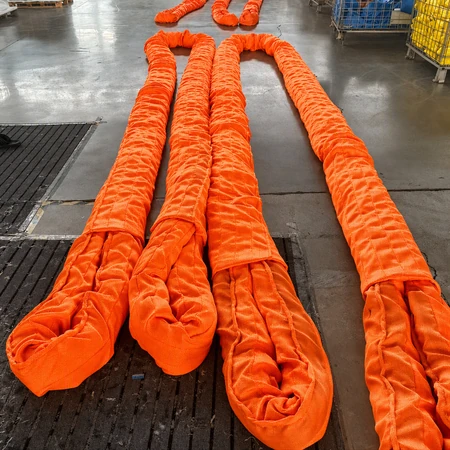
Yon 800 t body ships coiled and is moved by crane or forklift at both ends of the journey. That is a booking, a pallet position and a storage plan — costed with the lift, not after it.
Its own weight starts to matter
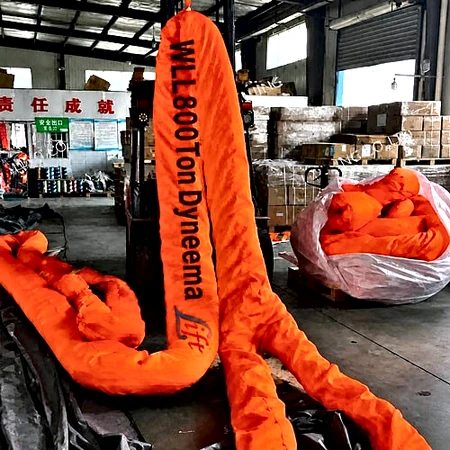
At 800 t the mass of the sling itself is a handling problem as much as a rigging one, and it is the reason a second version exists: the same 800,000 kg rating in a UHMWPE (Dyneema) core, which is lighter for the same strength. Both are rated identically; one is easier to dress, carry and store.
Stretch is a rigging dimension
Polyester extends roughly 2–3% at working load: 500–750 mm on a 25 m body. On a six-leg lift that extension is also what lets the angle open as the load comes on, which changes the share each leg carries — the reason the plan is checked at working load, not at hand-tight.
The Sling on Its Own
| Arrangement | Mode factor | Working load limit |
|---|---|---|
| Vertical | 1.0 | 800,000 kg (800 t) |
| Choked | 0.8 | 640,000 kg (640 t) |
| Basket, 0–7° | 2.0 | 1,600,000 kg (1,600 t) |
| Basket, 7–45° | 1.4 | 1,120,000 kg (1,120 t) |
| Basket, 45–60° | 1.0 | 800,000 kg (800 t) |
Technical Specifications
| Product | WLL 800T polyester round sling / 800 tonne round sling / 800,000 kg heavy duty endless round lifting sling |
|---|---|
| Standard | AS 4497:2018; EN 1492-2 and ISO 4878 sou demann |
| Working load limit (vertical) | 800,000 kg (800 t) |
| Minimum breaking load | 5,600,000 kg (7 × WLL) |
| Proof load | 1,600,000 kg (2 × WLL), applied to every sling |
| Safety factor | 7:1 |
| Configuration | Endless loop as standard; two stitched eyes on request |
| Core | High-tenacity polyester parallel yarn, continuous loop, no splice in the load path; UHMWPE (Dyneema) core for a lighter body at the same rating |
| Sleeve | Heavy duty woven polyester, double layer; wear pads at the choke point on request |
| Elongation at WLL | Apeprè. 2–3% |
| Tanperati travay | -40 °C pou +100 °C with a polyester core; an aramid round sling for hotter loads |
| Effective length | Made to the approval drawing — lay-flat length or full circumference |
| Marking | Sewn label: WLL in kg, effective length, standard, manufacturer, serial or batch, set number |
| Anbalaj | Coiled and strapped, poly-wrapped, labelled crate or pallet for export |
| Kòd HS | 630790 |
Marking, Proof and Set Records
Each body is proof loaded to 1,600,000 kg and the figure recorded against its serial number before marking. What is not tested is the assembly: a six- or eight-leg set is not proof loaded as a set anywhere in the world, so the set rating rests on the drawing, the equalising gear and the plan. That is precisely why the paperwork matters more at 800 t than the label does.
In Service
- Read the whole loop, every lift. The core is hidden; cuts, glazing, hardening or core show-through anywhere on the loop retire the sling.
- Keep the set together. One leg replaced from a different batch changes the geometry of the set, so replacements are made to the same drawing and the same length convention.
- Wear pads at the choke. The sleeve is the wear layer, and at this size the choke point is where it goes first.
- Store coiled and dry, off the floor and out of sustained sunlight, with the drawing and proof record on the crate.
Applications
- Modules and skids above 1,500 t, carried on six or eight legs from an equalising beam
- Reactor shells, vessel sections and heavy fabrications that cannot be re-rigged mid-lift
- Steel plate and coil packs where a soft, non-marking bearing is required
- Long loads picked from two hooks, where the share between cranes has to be calculated
- Port, shipyard and heavy fabrication work where water and grit rule out a fibre that rots
- Any lift where the rigging weight itself is a handling constraint — the case for the UHMWPE core
Kesyon yo poze souvan
How much can four WLL 800T slings lift?
1,680,000 kg at 0–45° to vertical, epi 1,200,000 kg at 45–60°. It is also the ceiling of the tabled arithmetic for this sling: four legs is as far as the standard factors go.
Is there a load factor for six or eight legs?
No. Standard mode factors run from one to four legs and stop. A six- or eight-leg lift is an engineered plan — the capacity is what the plan and the equalising gear can prove, not a number from a table.
What is the proof load of an 800 t round sling?
1,600,000 kg, twice the vertical working load limit, applied to each sling individually and recorded against its serial. A multi-leg assembly is not proof loaded as an assembly.
Polyester or Dyneema at this size?
Polyester as standard, for the widest temperature and cost envelope. A UHMWPE (Dyneema) core is chosen at 800 t to cut the weight of the sling itself — a handling decision, not a capacity one. Both are rated 800,000 kg.
Is 800 tonnes the largest round sling you make?
It is the largest single endless body in the range. Above it the answer is an engineered arrangement — six or eight legs on a beam, two bodies per leg in basket, or a two-hook lift — rather than a bigger single sling.
Request a Quote for an 800 Tonne Sling
Send the lift plan: load and centre of gravity, leg count and angle, the equalising gear, the hook or master link rating, length convention and delivery port. We will size the set against the tables above and tell you where the plan leaves the tabled arithmetic.
lift98@jslift.com · WhatsApp +86 180 6600 2268