

Lift sling rigging company produce Single-Use Lifting Slings for One-Trip Lifts,Single Use Endless Lifting Slings,Single Trip Lifting Slings,Addressing the issue of one trip slings,Disposable Pre-Slung Cargo Slings.
Single-Use Lifting Slings for One-Trip Lifts
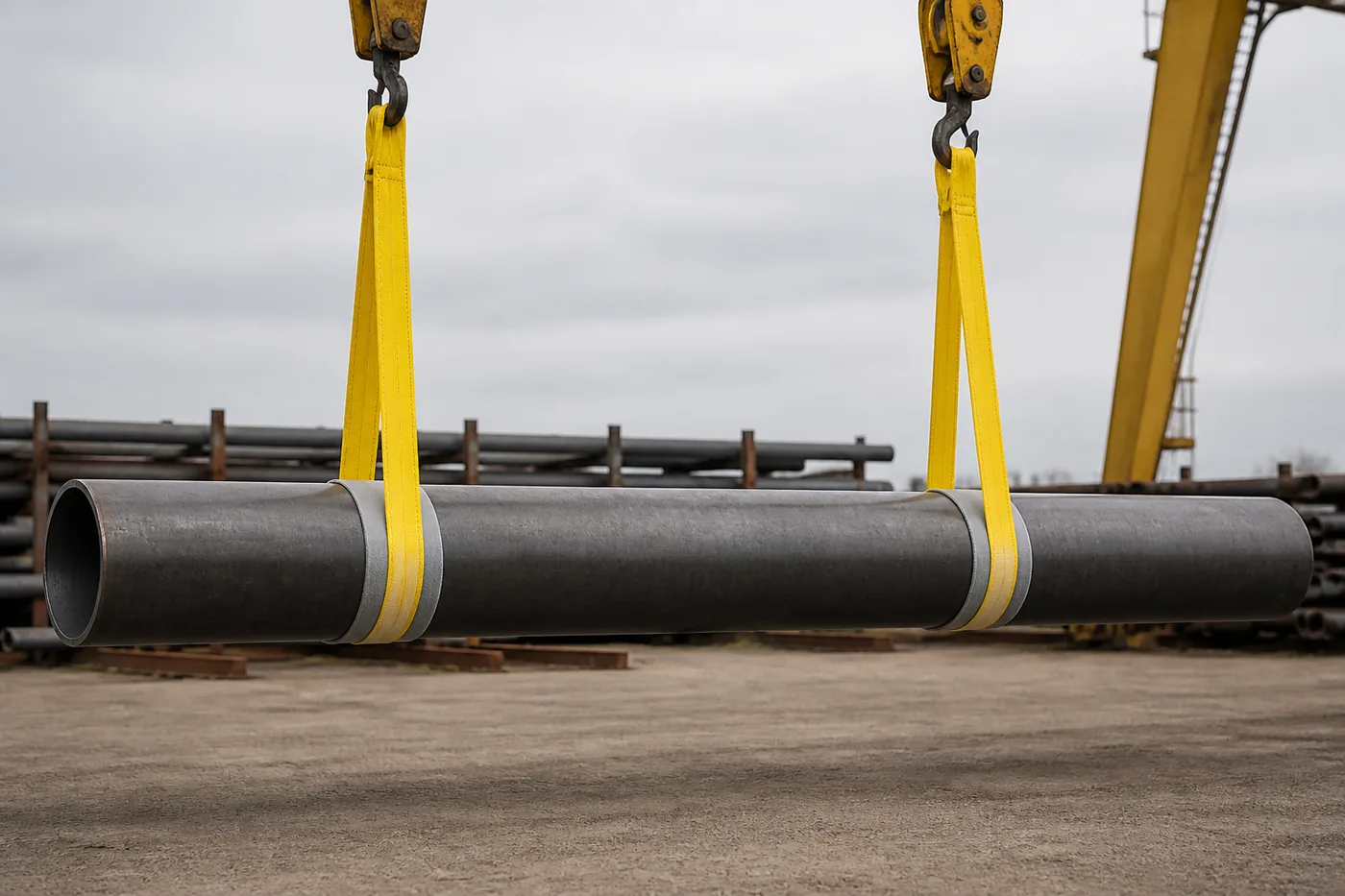
Single-use lifting slings for one-trip lifts are bought against an event, not against a store. The lift happens once — a machine set on its plinth, a failed unit swapped out, a fabrication placed by crane — so there is no second band on the rack, no re-inspection interval and no chance to discover at the hook that the length is wrong. Everything the lift needs has to be in the specification: the mass on each leg, sekous la, the leg angle, the geometry between hook and pick, ak sifas bann lan pa dwe make. Ranje estanda: 1 t pou 12 t sèl pli, 30 mm pou 300 mm nan a 7:1 faktè, 0.5 m pou 100 m, plat trikote Polyester, marked to BS EN 1492-1.
On this page
What a one-trip lift changes, and what it does not
A production lift runs every shift, so the sling becomes equipment: it is drawn from a store, inspected at intervals, and kept because it will be needed again. A one-trip lift is the opposite shape. It is planned once, executed once, and the article that lifts it has no life afterwards. That single difference moves the whole emphasis of the purchase — from condition monitoring to specification.
- There is no second choice at the hook. A returnable set has spares in the store. A one-trip set has what was delivered, so a band cut 300 mm short stops the lift rather than delaying it. Longè, eye size and quantity have to be right on the drawing.
- There is one inspection, before the load. It happens at issue, while a replacement can still come from the same consignment. After the lift there is nothing to inspect, because the article is retired.
- The print is the record. Pa gen enskri, no periodic examination, no history: limit chaj travay la, longè, factor and batch on the band, plus the packing list, are the entire traceability of the lift. That is a specification line, not paperwork.
- Nothing changes about the engineering. Fib la, mare, lajè, factor and WLL are specified exactly as for a sling used for years. Buying a lower factor or a narrower band because the lift is only once removes margin the lift still needs.
Buy the sling for the event, or hire it
For a lift that runs for one day, the honest comparison is not price per sling against price per sling. It is the cost of the whole loop: getting the article to site, proving it, and getting it back out again.
| Single-itilize, bought for the lift | Hired or returnable | |
|---|---|---|
| What you pay for | The band, made to the length and mark the lift needs | The band, plus a hire period and usually a deposit |
| Getting it to site | Delivered with the rest of the lift’s equipment | Delivered, booked out, and on a return date that has to be met |
| Proof of condition | One inspection at issue, recorded against the lift | Sètifika tès, periodic examination, damage assessment on return |
| The return leg | None — the band is retired at the end of the lift | Collected, cleaned, enspekte, re-certified or charged for |
| Where it ends up | With the load, sou sit, or in the skip | Back in a store that has to hold and administer it |
| The case for it | The lift is once, or away from your own store, or the band will not come back intact | The same slings are used month after month from one yard |
The decision usually turns on the return leg. Where a yard lifts every week, a returnable set inspected between lifts is the cheaper article over a year; where the lift is a single event, the return leg is a cost with no lift attached to it. What the arithmetic should never do is shorten the band: a single-use sling is a rated article, and the saving is in the journey, not in the margin.
The five lines of a one-trip lift plan
Five numbers decide the band, and on a lift that runs once they have to be settled before the webbing is cut. Each line below is a question the works asks on the enquiry, and each one is a failure mode when it is left to the site.
| Liy la | Ki sa li fikse | The failure it prevents |
|---|---|---|
| 1. Mass on each leg | Limit chaj travay la, before the factor is applied | A band sized on the total mass of the load instead of on the pick that carries it |
| 2. Sekous la - vètikal, toufe oswa panyen | The mode factor, and therefore the figure the band actually holds | A choke forgotten at 0.8, konsa yon 4.5 t load goes onto a 5 t bann |
| 3. The angle at the hook | Leg tension, and the assembly factor for a multi-leg set | Legs opened to 60° from vertical, doubling the tension in each band |
| 4. The geometry — hook height to pick point | The cut length, eye to eye or round the loop | A band too short to reach both picks, discovered with the crane standing by |
| 5. The surface at the contact | Lajè, ply and any sleeve or protector | A pressure mark or a cut edge that turns a finished item into a rejection |
Specification of the single-use lifting sling
The table describes the standard build. Width follows the working load limit and the factor; the end form, the print and the packing follow the lift. Nothing here is a stock size — the band is made to the line on the drawing.
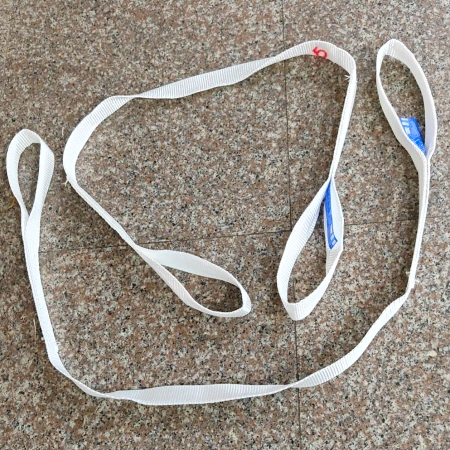
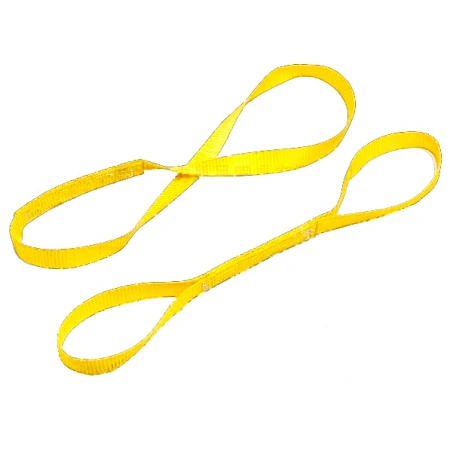
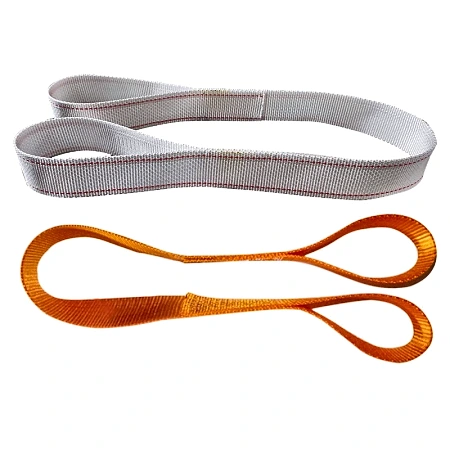
| Pwodwi | Single-use lifting sling for a one-trip lift; eye-eye, bouk kontinuèl, single eye or ring and buckle |
|---|---|
| Bati | Single ply standard; double ply where a higher figure is needed at the same width, or a stiffer bearing face |
| Fib | High tenacity polyester webbing (PES); nilon (PA) for a snatch load, polypropylene on request |
| Web thickness | 4 mm estanda; 7.5 mm for the heavier block of the range |
| Limit chaj travay | 1 t - 12 t single ply at 7:1; 2 t - 24 t in the 7.5 mm and double ply builds |
| Band lajè | 30 mm - 300 mm at 7:1; 25 mm - 300 mm at 5:1 epi 6:1 |
| Faktè sekirite | 7:1 to BS EN 1492-1 (usual in Europe); 5:1 pou ASME B30.9 (usual in North America); 6:1 between the two |
| Longè | 0.5 m - 100 m; minimum rises with width, not with tonnage |
| Elongasyon | ≤ 7 % nan limit chaj travay la, epi li refè lè chaj la desann |
| Tanperati travay | -40 °C pou +100 °C kontinyèl; polyester melts at about 258 °C — no hot work without a sleeve |
| Koulè | BS EN 1492-1 capacity colour — 1 t vyolèt, 2 t vèt, 3 t jòn, 4 t gri, 5 t wouj, 6 t mawon, 8 t ble, 10 t zoranj; undyed white and special colours on request |
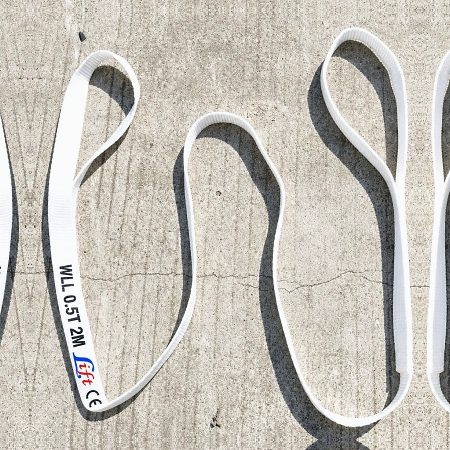
| Marking | Limit chaj travay, longè, faktè sekirite, batch and your lift reference; printed on the band and repeated on a sewn label |
| Anbalaj | Mawonnen ak make, banded bales or cartons, labelled per lift or per pack against the packing list |
| Kòd HS | 630790 |
From the load to the working load limit
The figure on the band is per sling, in a stated arrangement. Getting from the load to that figure is one division: chay la, divided by the mode factor of the arrangement. The factors below are the ones BS EN 1492-1 uses, and the multi-leg figures are deliberately conservative.
| Aranjman | Faktè | Sou yon 5 t fistibal | Remak |
|---|---|---|---|
| Yon sèl janm, vètikal | 1.0 | 5.0 t | The figure as printed |
| Yon sèl janm, toufe | 0.8 | 4.0 t | Round the load and back through itself |
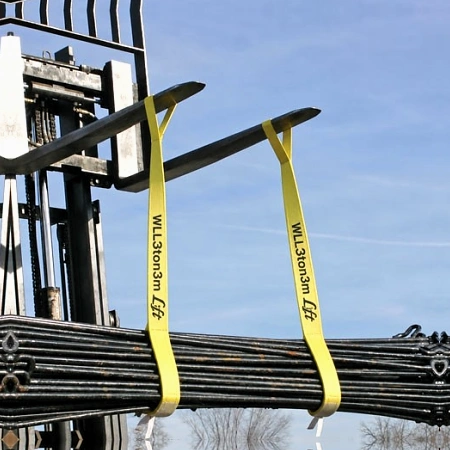
| Yon sèl janm, panyen, parallel legs | 2.0 | 10.0 t | Two parts of the band carry |
| Yon sèl janm, panyen, 0-45° | 1.4 | 7.0 t | Legs opening away from the load |
| Two-leg assembly, 0-45 ° soti nan vètikal | 1.4 | 7.0 t | 0.7 pou chak janm |
| Two-leg assembly, 45-60° | 1.0 | 5.0 t | 0.5 pou chak janm |
| Twa- or four-leg assembly, 0-45° | 2.1 | 10.5 t | Assumes only three legs carry |
| Twa- or four-leg assembly, 45-60° | 1.5 | 7.5 t | Same assumption, wider angle |
La 2.1 for a four-leg set is the line buyers query most, because four legs at 0.7 each would read 2.8. The standard does not rate it that way: a four-leg lift is assumed to be carried by three legs, because a rigid load rarely sits evenly on four. A 9 t machine on four legs at 30° therefore needs 9 ÷ 2.1 = 4.3 t per sling — a 5 t bann, pa yon 3 t youn.
The angle decides more than the tonnage
A leg standing vertically carries its share of the load. A leg leaning away carries more, in exact proportion to the cosine of its angle from vertical — and on a one-trip lift the angle is set by the hook height and the pick spacing, both of which are fixed before the band is ordered.
| Angle of the leg from vertical | Tension in one leg | Kat-janm mete, 8 t chaje | What it looks like |
|---|---|---|---|
| 0° — vertical | 1.00 × share | 2.00 t pou chak janm | Hook directly over the pick |
| 15° | 1.04 × share | 2.07 t pou chak janm | Barely visible spread |
| 30° | 1.15 × share | 2.31 t pou chak janm | The usual working spread |
| 45° | 1.41 × share | 2.83 t pou chak janm | Legs at the corner of a square from the hook |
| 60° | 2.00 × share | 4.00 t pou chak janm | Hook low over a wide load — double the tension |
Two consequences matter on a lift that runs once. The first is that a short band, pulled tight between two picks, is the classic overload: the band is asked to reach, the legs open, and the tension rises without the load changing at all. The second is that the assembly factor already allows for this up to 45°, se poutèt sa 2.1 figure is safe at a normal spread and why a 60° spread needs a larger sling rather than a longer one.
The four end forms, and which the lift needs
The ends are decided by what is at each end of the band: hardware at both ends means eyes; a load that is wrapped means a loop; a load that has to be closed on itself means a ring or a buckle. One band cannot be two of these, and a lift that needs both ends up as two articles.
| Fòm | Ki sa li ye | Where the lift needs it |
|---|---|---|
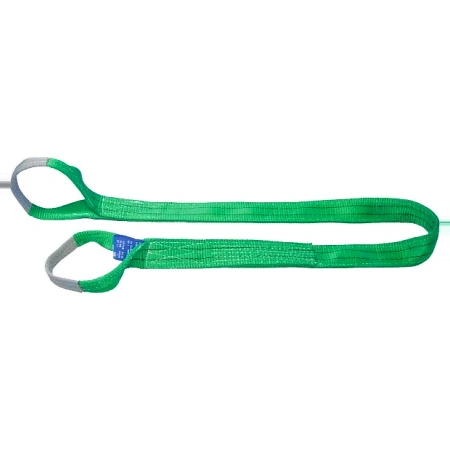
| Je-je | Yon bann plat ak yon je fòme nan chak bout, stitched from the same webbing | A hook, shackle or pin at both ends — the general-purpose form. Gade la jetab yon sèl fason fistibal paj. |
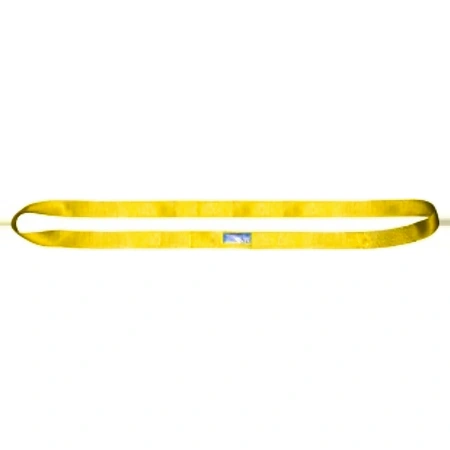
| Bouk kontinuèl | The band joined to itself, with no eye and no fitting | Wrapped and choked loads: tiyo, bobin, tanbou, wòch. Gade la yon sèl fason fistibal sangle paj. |
| Je sèl | An eye at one end, a plain or sleeved end at the other | One hook above, one end passed round or through the load. Gade disposable webbing sling one eye. |
| Bag ak bouk | A flat band finished with a ring or a buckle at each end | A band that has to be made up around the load where no hook can reach. |
Eye size is a separate line from tonnage, and on a one-trip lift it is the line that cannot be corrected on site: an eye that will not pass the shackle bow becomes a knot, and a knot is a sling taken out of service. Send the hook or the shackle with the enquiry and the eye is made to sit in it — the same discipline as the aparèy leve at the other end of the set.
Length and headroom: the geometry that fails
On a band with eyes, the length quoted is normally the effective working length between the bearing points of the two eyes; on a loop, it is normally the circumference. Both are legitimate and they are not interchangeable, which is why the drawing states the convention. The measurement that matters is taken on site, at the pick height, with the hook where it will actually hang.
- Measure hook to pick, not pick to pick. The band has to span the vertical distance and the horizontal spread at once, and it is longer than the straight line between the picks.
- Add the eye. An eye has length; a 3 m bann avek 300 mm eyes and a 3 m bann avek 150 mm eyes are different articles at the same tonnage.
- Leave headroom for the hook block. A band sized exactly to the geometry pulls the block into the load, and the crane operator then shortens the sling by choking it — which changes the capacity as well as the length.
- Di ki konvansyon ou vle di. Loop circumference and band length laid flat differ by about a factor of two; on a one-trip order the difference is a remake, not a return.
Sifas, edges and protection
The band is polyester, so it is softer than most loads and harder than none of them. Two things damage it: a cut edge and heat. Both are decided at the contact point, and both are cheap to deal with before despatch and expensive to deal with after.
- Sleeves at the arris. A cut sheet, a mesh panel, a machined corner and a rebar bundle end all present an edge narrower than the weave. A sleeve or a padded protector at that point is the difference between one lift and one lift plus a rejection.
- Width protects the finish. On coated pipe, painted steel, aluminium and precast, pressure marks come from a narrow band; one step wider is usually cheaper than a repair.
- Pa gen ne, no joints. A band shortened by knotting is a band with an unrated joint in the load path. If the length is wrong, the length is wrong — cut a new one.
- Keep it out of the grit. Swarf, grit and standing water travel into the contact and abrade from the inside of the weave, where the inspection at issue will find them.
Marking, and the record you keep after the lift
Because there is no inspection history on a single-trip article, the record is made before the lift and kept afterwards. Four items belong on the band: limit chaj travay la, the length with its convention, the safety factor it was built to, and the reference the lift is known by — a lift plan number, an order number, your own part number. That reference is what ties a band on a hook to a line on a drawing in an office.
Two habits make the record complete, and both cost nothing. Photograph the label at issue, with the lift reference in the same frame; and keep the packing list with the lift file rather than in the skip with the packaging. Where a project asks for a documented figure — a batch test, yon deklarasyon, a standard marking — put it on the enquiry and it is confirmed before the order, because a single-trip band is not normally issued with the same document package as a reusable certified sling.
The one inspection, nan pwoblèm
The check happens before the load, while a fault can still be replaced from the same consignment. Five things are looked at, nan lòd sa a.
- The weave at the contact. Koupe, fwotman, a glazed or shiny face, or a band that has been pinched in a door or under a pack.
- Koud oswa manch nan pwent yo. Drawn or broken thread at an eye is the failure that gives no warning at the load.
- Etikèt la. Si limit chaj travay la oswa longè a pa ka li, the band cannot be matched to the lift it was cut for.
- Ki sa li te kouche nan. Grit, swaf, oil and water in the weave; a clean band is the cheapest protection available.
- The count against the plan. One band per pick point, plus the handling allowance — a short count found at the hook is a lift that does not happen.
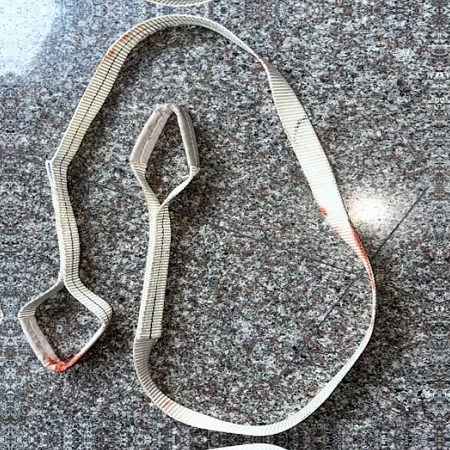
After the lift: pran retrèt li, do not store it
A single-trip band that comes home to a rack will be issued again, and its marking will then be stating something that is no longer true — that this article is the one specified for that lift. The end of the lift is the end of the article: cut it, or put it where the site sends industrial textiles, and record the quantity against the lift file.
Where the same bands will be needed next month, the answer is not to keep these; it is to buy a returnable set with an inspection regime, which is a different article and a different page. Where the band has to be kept for a short second stage of the same project, it is kept as equipment: inspected again before the second lift, and treated as an article with a history rather than as a consumable with none.
Where single-use slings are bought for one lift
| The lift | Ki sa ki deside fistibal la | What to send |
|---|---|---|
| Installation onto a foundation — machine, skid, tank, transformer | Mass per pick, the four-leg derating, ak headroom a anba zen an | Mass, pick positions and spacing, hook height, the fittings at the eyes |
| Like-for-like replacement — a failed unit out, a new one in | The same sling has to do both lifts, so it is specified for the heavier of the two | Both masses, and whether the two lifts use the same pick points |
| Plant relocation — a works moving once | Quantity and marking: many items, one plan, and no store at the far end | The item list, pick points per item, and the references to print |
| One-off placement — a fabrication, a precast unit, a roof plant | Length and geometry, and the surface that must not be marked | Drawing with pick points, fini sifas, and any spreader above |
| Removal and demolition — a unit that is being cut out | Abrasion and cut edges, and a band that will not be recovered | Mass, bor, and whether the band can be left with the scrap |
| Export break-bulk — slings fitted before the pack is closed | Pre-slung bands, marked so the receiving end needs no plan | Pack list, pick points, and the reference to print per pack |
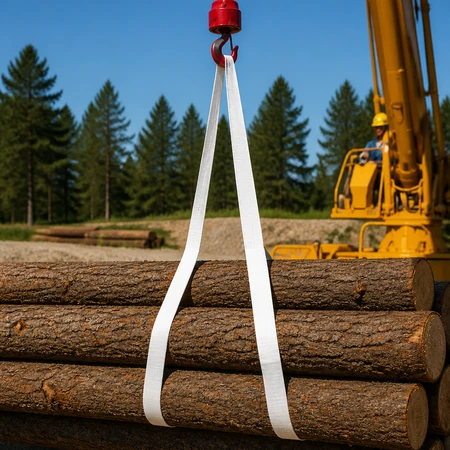
Send the lift plan, get the sling drawing
Mass per pick, the hitch and the angle, the geometry between hook and pick, the fittings at the eyes and the reference to print. Nou tounen ak lajè a, longè a, the factor and the marking — on a drawing, before the bands are cut.
Send your one-trip lift details · Telephone / WeChat +86 180 6600 2268 · 702461526@qq.com
Lifute Endistriyèl Park, Taizhou City, Pwovens Jiangsu, China · HS code 630790
Kesyon yo poze souvan
What is a single-use lifting sling for a one-trip lift?
A rated flat woven polyester band bought for a lift that will not be repeated, and not recovered afterwards. It is made to the lift plan, make ak limit chaj travay li yo, longè ak pakèt, inspected once at issue and retired at the end of the lift.
How do I choose the working load limit for one lift?
From the load carried by one leg, not from the total mass. Divide the load by the assembly mode factor of the hitch actually used, then take the next size up. A four-leg assembly is rated at 2.1 times a single leg, because the standard assumes only three legs carry.
Is a single-use sling weaker than a returnable one?
Non. Width follows the working load limit and the safety factor in exactly the same way, ak figi yo enprime sou gwoup la se figi ki aplike nan asansè a. The difference is commercial: the band is not recovered, so its print and the packing list carry the whole record.
Can a one-trip sling be used again if it looks perfect?
It looks perfect because a single lift does not visibly age a webbing band. The article was specified, marked and priced for one lift; a second lift is an uninspected sling doing a job nobody rated. Retire it at the end of the lift.
How much capacity is lost in a choker hitch?
Twenty per cent: the choke factor is 0.8 nan figi vètikal la, konsa yon 5 t fistibal toufe 4 t. A basket hitch doubles the figure with parallel legs and reduces it by the angle as the legs open.
Why does the leg angle change the sling I need?
Leg tension rises as the legs move away from vertical: at 45° each leg carries 1.41 times its share, at 60° twice its share. A band pulled tight between two picks is the usual reason a lift that looked within capacity is not.
Can the bands be printed with our lift reference?
Wi. Limit chaj travay la, longè, faktè, batch and your own lift, order or pack reference can be printed before despatch, in the exact string you send, so the band can be matched to the lift plan after the lift is finished.