

Lift sling rigging company produce Endless Webbing Sling for Steel Pipe Lifting,Grommet Continuous Loop Sling,Endless Slings for Pipe Lifting,Endless hoisting slings and straps,Endless Web Sling.
Endless Lifting Sling · Pipe Lifting
Endless Webbing Sling for Steel Pipe Lifting
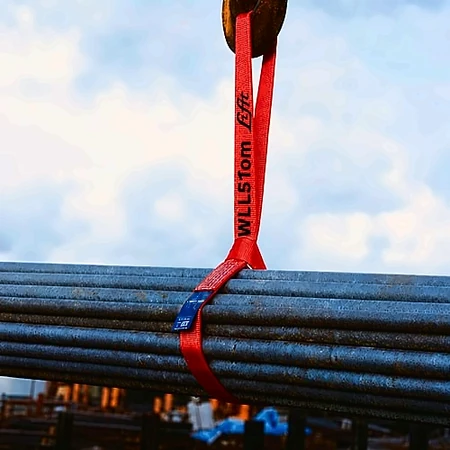
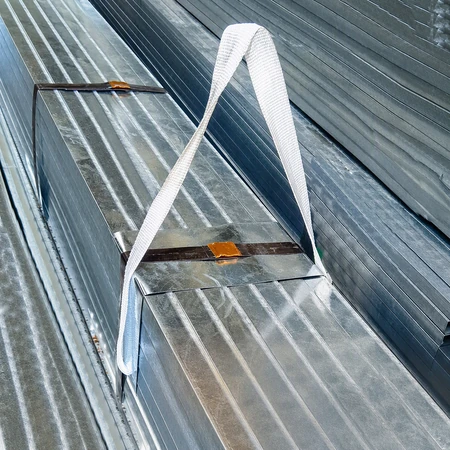
Steel pipe is the load that shows whether a sling was chosen or just fetched. It rolls, li se wonn, it is usually already coated, and it arrives in bundles longer than the hook is wide. An endless webbing sling answers all four: one continuous loop of flat woven polyester passes under the bundle and comes straight back to the hook, with no eyes to thread and no fittings to swing against the pipe wall. Rated 1 t pou 24 t limit chaj k ap travay, built to NAN 1492-1 ak yon 7:1 design factor, and the loop can be turned after every lift so the wear, the hook contact point and the stitched joint keep moving around the circumference instead of staying in one place.
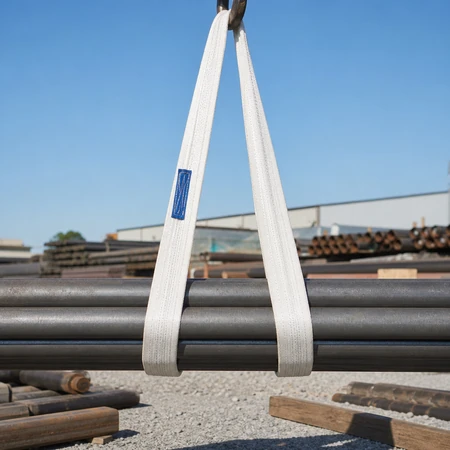
Three things pipe does to a sling
Pipe is not a difficult load because it is heavy. It is difficult because of what it does while it is being lifted.
- It rolls. A single length of pipe on a flat band will walk sideways if the hook is off-centre or the legs are uneven. Two pick points and a level hook block stop that; one sling in the middle of a 12 m length never does.
- It is finished before it is lifted. Galvanising, 3LPE, FBE, epoxy and shop paint are all softer than a wire rope and easier to mark than steel. A flat polyester band distributes contact pressure over its full width; a wire rope puts the whole load on one line and leaves a witness mark at best, a chip at worst.
- It cuts. Echèl Mill, tiyo fini, threaded couplings and flange faces will abrade a webbing band far faster than a smooth steel plate will. That is a sleeve question, not a capacity question, and it is the reason pipe slings are so often specified with protection.
Why endless, and not eye-and-eye
On pipe, the endless form wins for three practical reasons. Premye, there is nothing to damage the load: pa gen kouto, pa gen zen, no eye reinforcement sitting against the pipe wall when the bundle is set down. Dezyèmman, one sling covers every hitch you are likely to use on pipe — a basket under a bundle, a choker round a single length, a double wrap where the pipe is slippery. Twazyèm, the loop rotates. A pipe yard that lifts the same bundle profile all day wears one spot on an eye-and-eye sling until it is condemned; on an endless sling you turn the loop a quarter turn between lifts and the wear spreads around the whole circumference.
The trade-off is length control. An eye-and-eye sling has two fixed pick-up points, so the distance between them is the lift. Yon bouk pa gen okenn pwent pou mezire ant, and it is quoted either by circumference or by effective working length — the two differ by roughly a factor of two. If you order by the wrong one, the sling arrives at the wrong height. Both conventions are accepted here; say which one your figure is in, or simply give the hook height above the bundle and we size the loop to it. NAN 1492-1 holds the effective working length to within ±3% of nominal, measured with the sling laid flat.
The hitches that work on pipe
The label on the sling gives one number: the working load limit in a straight lift. Everything a pipe crew actually does is a reduction from that number, and the reduction is applied before the sling is picked, pa apre.
| Hitch on pipe | Faktè | Ki sa li fè, and where it is used |
|---|---|---|
| Vètikal, loop over the hook | 1.0 | Figi etikèt la. Rarely used on pipe — a loop hung vertically lifts nothing unless it is passed under something. |
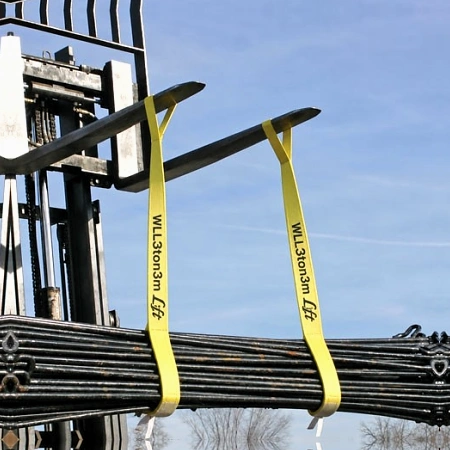
| Panyen, legs parallel | 2.0 | Both parts of the loop share the load and run vertically to the hook. The standard bundle lift when the hook can sit directly above the bundle. |
| Panyen, legs opened to 45° | 1.4 | Legs slope out to the bundle edges. Tension climbs as the legs open, which is why a wider bundle needs a bigger sling, not a longer one. |
| Panyen, legs opened to 60° | 1.0 | The limit of normal practice: at 60° a basket carries no more than a straight lift. |
| Choker, single pipe | 0.8 | The loop passes round the pipe and back through itself. Correct for one length; the choke point also compresses the band, so keep the stitched joint out of it. |
| Double-wrap choker | 0.8 | Two turns round the pipe before the choke. More friction on smooth or galvanised surfaces, and the band is less likely to slide along the pipe. |
| Angled choker, 45° / 60° | 0.7 / 0.5 | The most heavily reduced arrangements in common use. If a pipe will not sit under the hook, correct the rigging rather than accept 0.5. |
Basket capacity can also be written as 2.0 × WLL × cos θ, where θ is the angle of the legs away from vertical. At 30° that is 1.73, at 45° 1.41, nan 60° 1.00. The number on the label never changes; the number you are allowed to use does.
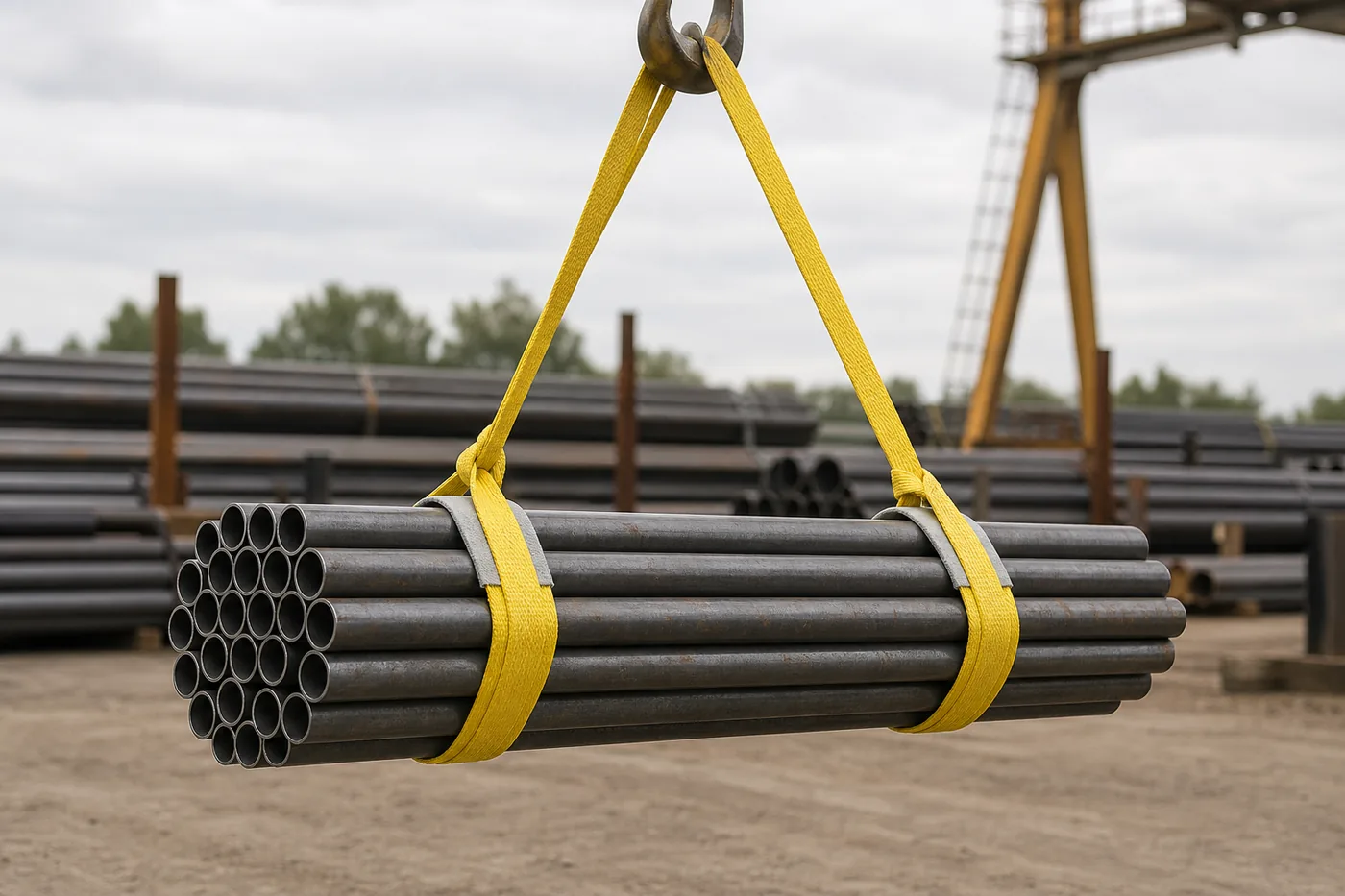
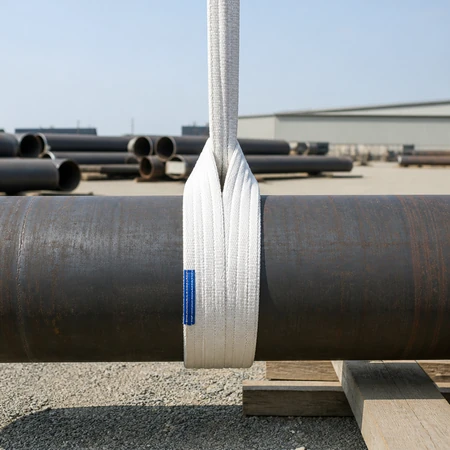
Sizing a pipe lift in four steps
Most wrong sling orders on pipe come from sizing the pipe and not the bundle, or sizing the bundle and forgetting the hitch. Four steps, nan lòd sa a, get it right.
- Weigh one length, not the pipe size. Mass per metre depends on outside diameter and wall thickness:
(OD − t) × t × 0.02466kg/m for steel. A nominal 8″ Schedule 40 pipe is 219.1 mm outside and 8.18 mm wall, konsa 42.55 kg/m — 511 kg pou yon 12 m longè. Schedule 80 of the same size is roughly a third heavier. - Multiply by the number of lengths and add the bundling. Strapping, dunnage and end caps are small but they are not zero; add 2–3% and round up.
- Divide by the number of slings, then apply the hitch factor. Two basket slings on a 4 t bundle means 2 t each before the angle, epi 1.16 t of required vertical WLL at 30°.
- Check width and protection against the pipe, pa sèlman tonnaj la. A 60 mm band on a 219 mm pipe bears on a narrow strip; sleeves and a wider band are what keep the coating intact.
| Nominal size | OF (mm) | Mi (mm) | kg/m | 12 m longè | 8 × 12 m bundle |
|---|---|---|---|---|---|
| 2″ | 60.3 | 3.91 | 5.44 | 0.065 t | 0.52 t |
| 3″ | 88.9 | 5.49 | 11.29 | 0.136 t | 1.08 t |
| 4″ | 114.3 | 6.02 | 16.07 | 0.193 t | 1.54 t |
| 6″ | 168.3 | 7.11 | 28.26 | 0.339 t | 2.71 t |
| 8″ | 219.1 | 8.18 | 42.55 | 0.511 t | 4.08 t |
| 10″ | 273.0 | 9.27 | 60.29 | 0.723 t | 5.79 t |
| 12″ | 323.9 | 10.31 | 79.73 | 0.957 t | 7.65 t |
| 16″ | 406.4 | 12.70 | 123.30 | 1.480 t | 11.84 t |
Egzanp travay
Uit 12 m lengths of 8″ Schedule 40: 4.08 t. Two endless webbing slings in a basket under the bundle, legs 30° from vertical → 4.08 ÷ 2 = 2.04 t pou chak fistibal, ÷ 1.73 = 1.18 t required → EWS-2T, 2 t, 60 mm bann. Open the legs to 60° and the same bundle asks for 2.04 t → one model up, EWS-3T. The load did not change; gréement la te fè.
Gwosè estanda
Pick by the vertical WLL you need, then read across for the width you get on the pipe and the minimum length the loop can be made in. Single ply is 7.5 mm Polyester twal metalik; double ply is two plies sewn into a 15 mm konpoze, which buys capacity at the same width and a band that resists cutting better.
| Modèl | Pli | Koulè | WLL vètikal | WLL choker | WLL panyen | Lajè | Min length |
|---|---|---|---|---|---|---|---|
| EWS-1T | Selibatè | Vyolèt | 1,000 kg | 800 kg | 2,000 kg | 30 mm | 1.1 m |
| EWS-2T | Selibatè | Vèt | 2,000 kg | 1,600 kg | 4,000 kg | 60 mm | 1.2 m |
| EWS-3T | Selibatè | Jòn | 3,000 kg | 2,400 kg | 6,000 kg | 90 mm | 1.3 m |
| EWS-4T | Selibatè | Gri | 4,000 kg | 3,200 kg | 8,000 kg | 120 mm | 1.4 m |
| EWS-5T | Selibatè | Wouj | 5,000 kg | 4,000 kg | 10,000 kg | 150 mm | 2 m |
| EWS-6T | Selibatè | Brown | 6,000 kg | 4,800 kg | 12,000 kg | 180 mm | 2 m |
| EWS-8T | Selibatè | Ble | 8,000 kg | 6,400 kg | 16,000 kg | 240 mm | 2 m |
| EWS-10T | Selibatè | Orange | 10,000 kg | 8,000 kg | 20,000 kg | 300 mm | 3 m |
| EWS-12T | Selibatè | — | 12,000 kg | 9,600 kg | 24,000 kg | 300 mm | 3 m |
| EWSD-2T | Double | Vèt | 2,000 kg | 1,600 kg | 4,000 kg | 30 mm | 1.5 m |
| EWSD-4T | Double | Gri | 4,000 kg | 3,200 kg | 8,000 kg | 60 mm | 1.5 m |
| EWSD-6T | Double | Brown | 6,000 kg | 4,800 kg | 12,000 kg | 90 mm | 1.5 m |
| EWSD-8T | Double | Ble | 8,000 kg | 6,400 kg | 16,000 kg | 120 mm | 2 m |
| EWSD-10T | Double | Orange | 10,000 kg | 8,000 kg | 20,000 kg | 150 mm | 2 m |
| EWSD-12T | Double | — | 12,000 kg | 9,600 kg | 24,000 kg | 180 mm | 3 m |
| EWSD-16T | Double | — | 16,000 kg | 12,800 kg | 32,000 kg | 240 mm | 3 m |
| EWSD-20T | Double | — | 20,000 kg | 16,000 kg | 40,000 kg | 300 mm | 3 m |
| EWSD-24T | Double | — | 24,000 kg | 19,200 kg | 48,000 kg | 300 mm | 3 m |
Anwo 10 t la EN 1492-1 colour code no longer applies — the sewn label and the black stripes (youn pou chak tòn) govern. Longè a 12 m are standard and built to order up to 200 m; multi-ply constructions up to 50 t are quoted on request. Detail on the form itself, including single versus double ply and how the lap joint is made, sits on the kontinuèl kalite fistibal sangle paj.
Coated pipe: what a sleeve actually protects
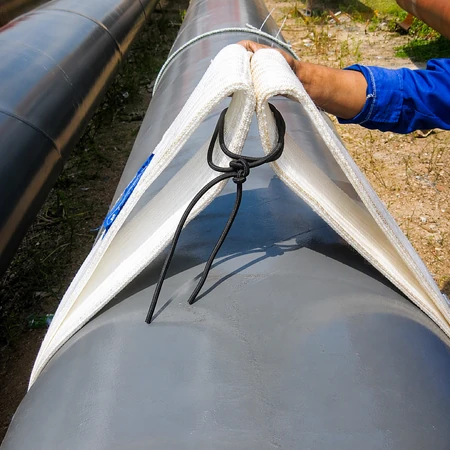
A protective sleeve does not add capacity. It adds a sacrificial layer between the load and the load-bearing webbing, so the abrasion that mill scale, pipe ends and bundling straps cause is taken by a replaceable sleeve instead of the band. On coated pipe it changes what the lift costs: no chip, no touch-up, no rejected length at the coating inspection.
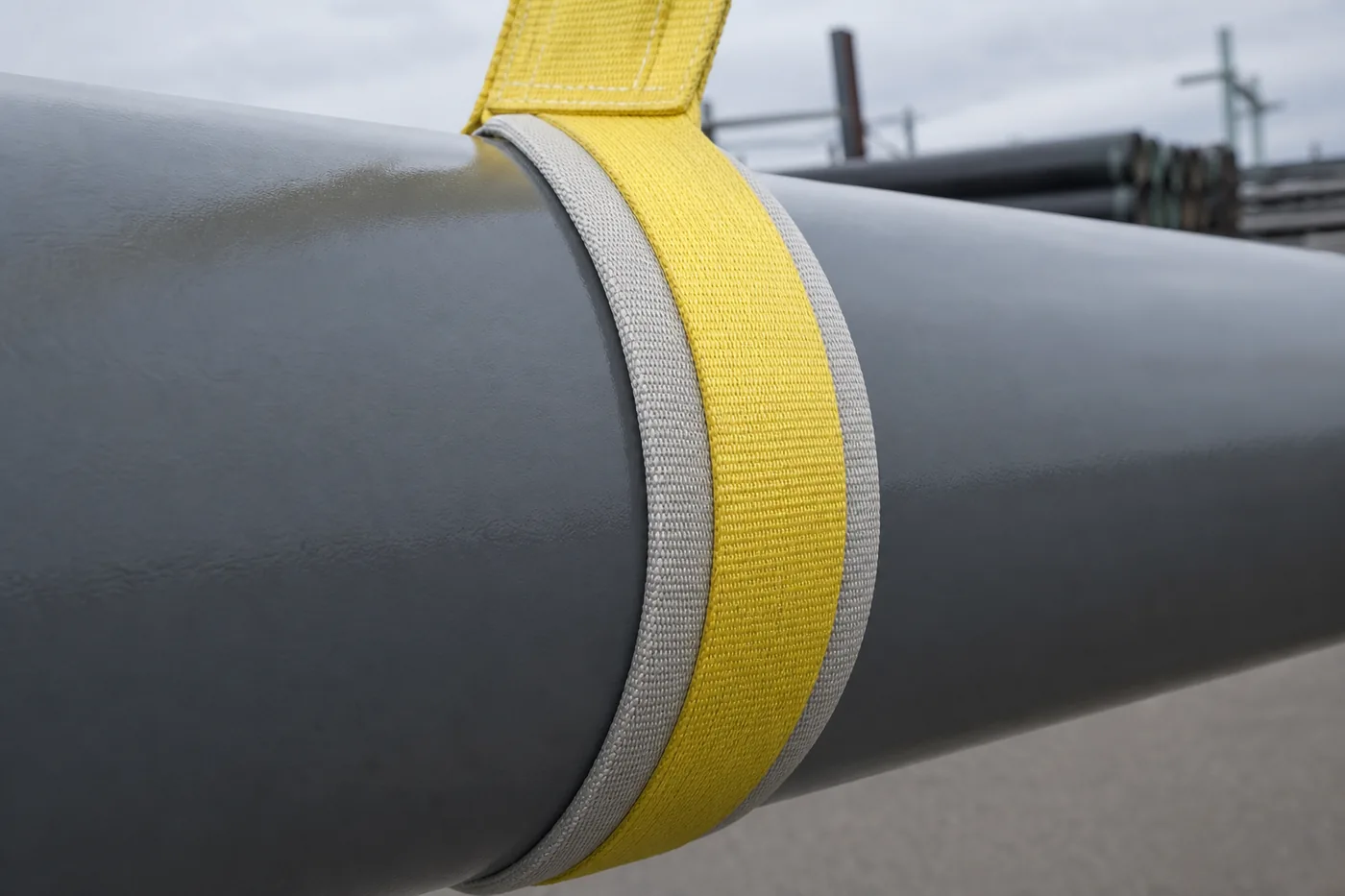
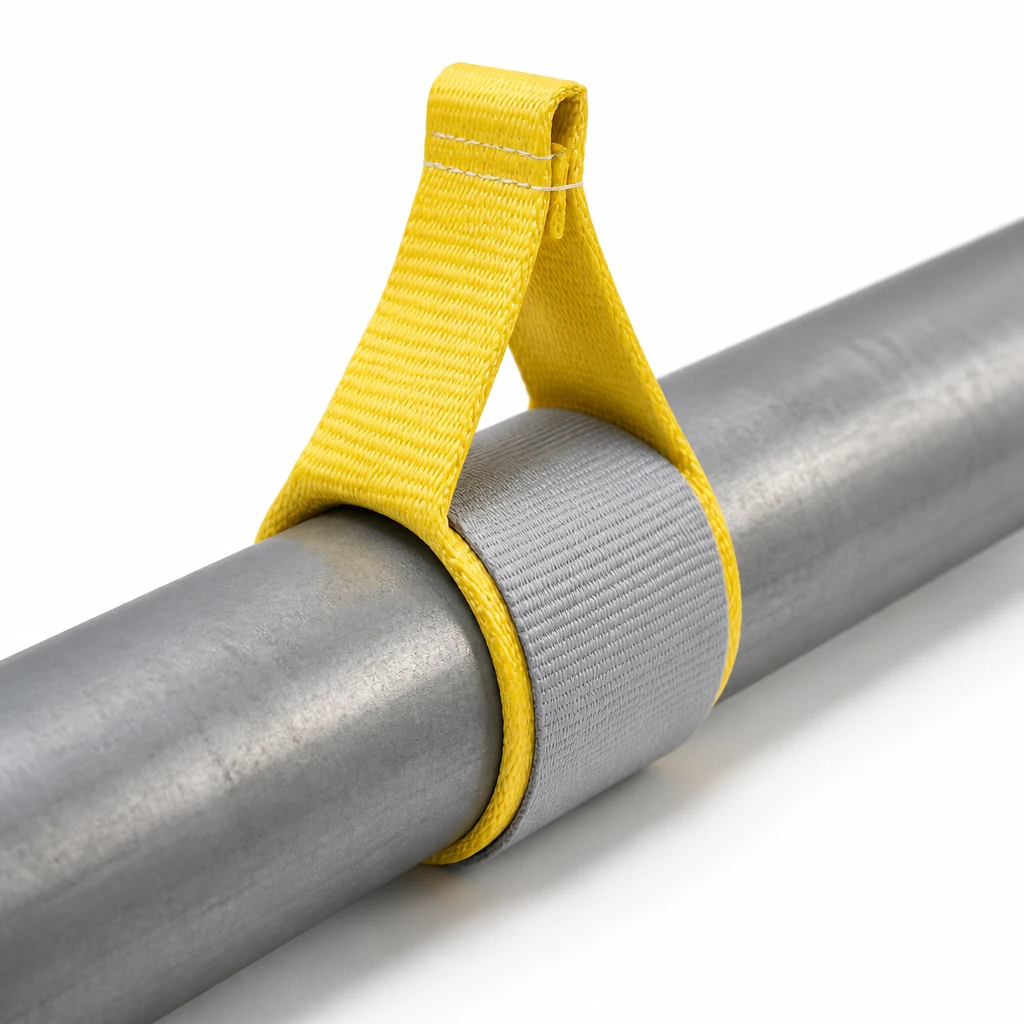
Where the pipe is delicate, heavily coated or has a soft lining, a fistibal wonn is sometimes the better article: its round body conforms to the pipe and leaves no stitch-line pressure mark. The flat band still has two advantages — a wider bearing strip for the same capacity, and damage that is visible on both faces at inspection. Most pipe yards keep both and choose per coating specification.
Long pipe: two pick points, or a spreader beam
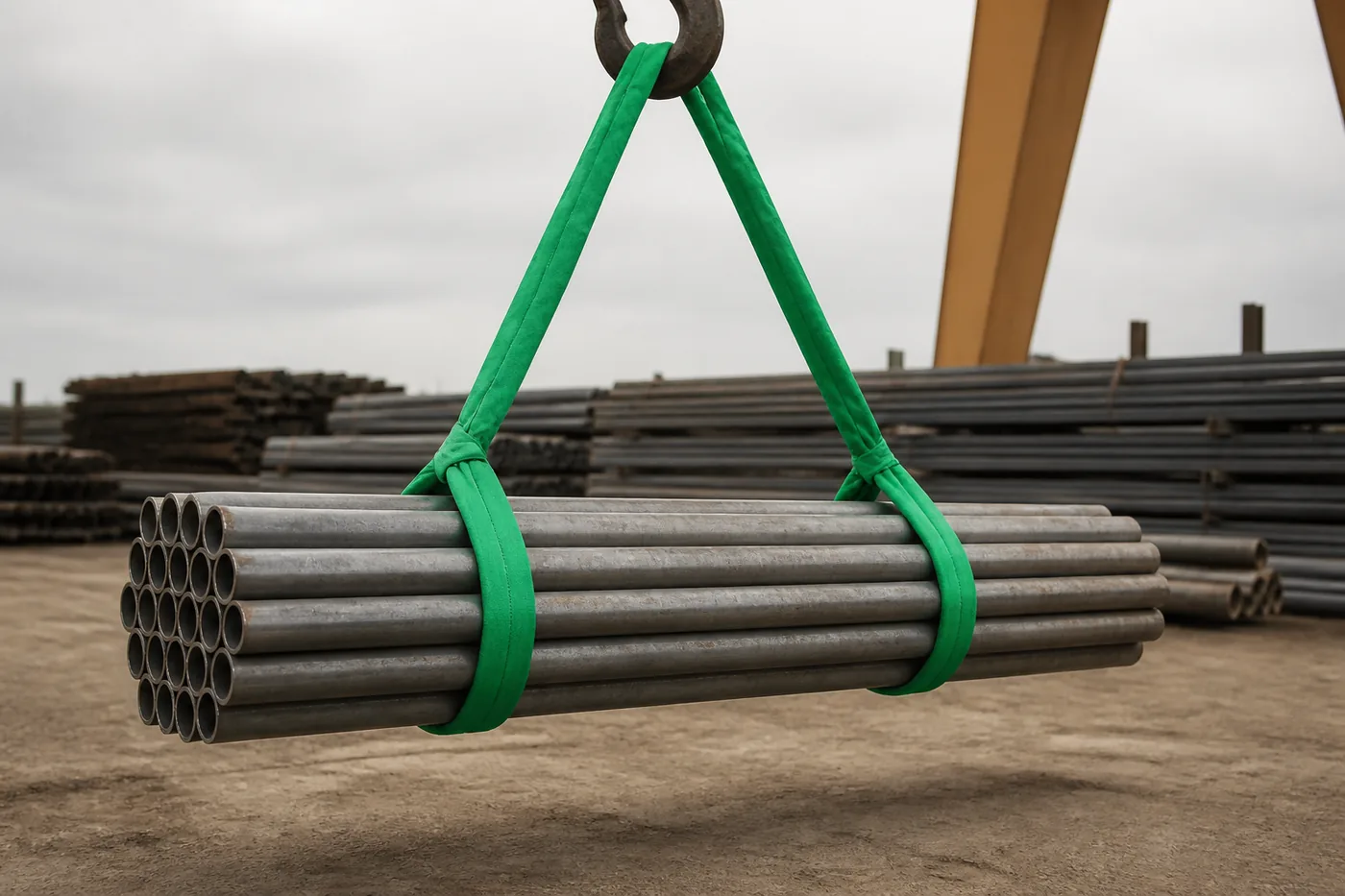
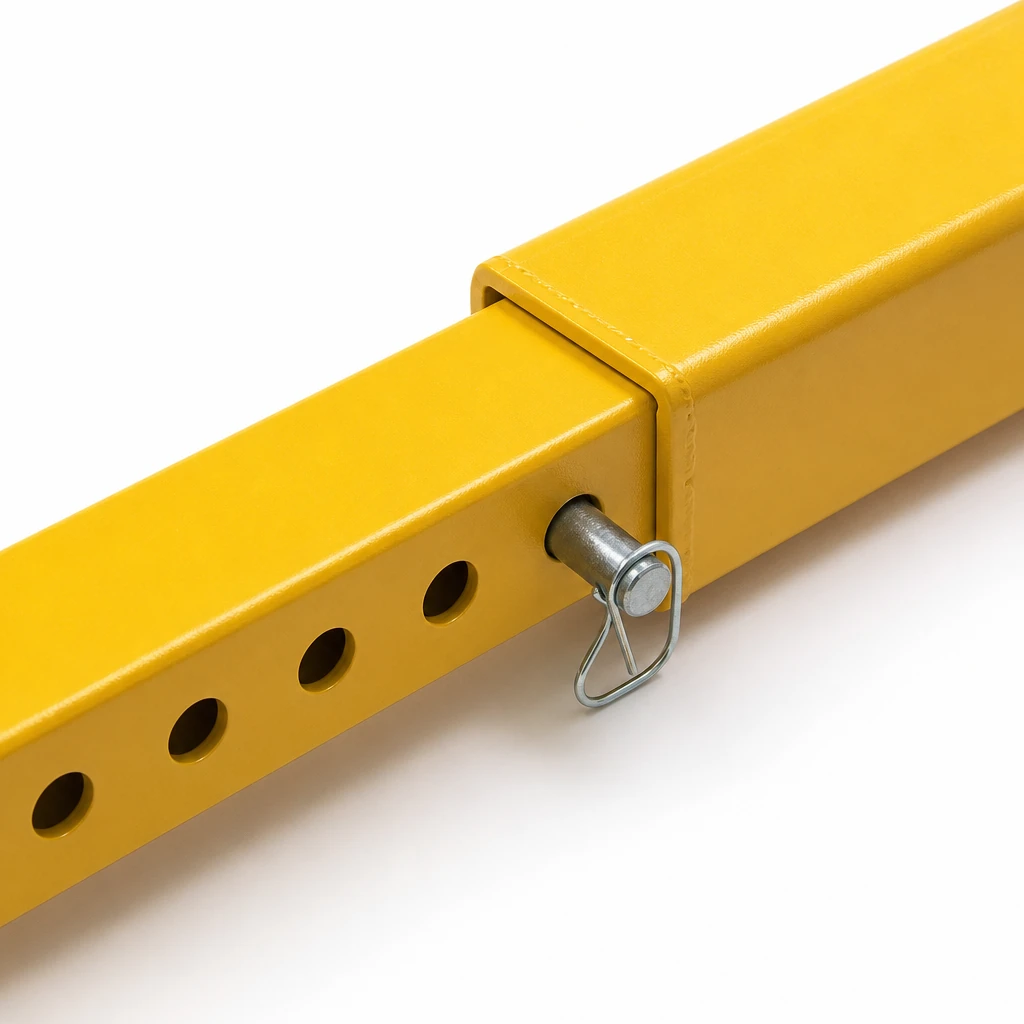
A bundle picked in the middle bows; picked too close to the ends it whips. For a uniformly loaded length, pick points at roughly the quarter points of the span give a near-balanced moment and the bundle arrives level. Beyond about 12 m, or where the pipe must stay dead level for a coating or alignment check, put the slings on a leve gwo bout bwa epandeuz: the beam takes the horizontal component out of the upper legs, so the lower slings stay vertical and the capacity is not eaten by a shallow angle.

Spesifikasyon
| Paramèt | Spesifikasyon |
|---|---|
| Pwodwi | Endless webbing sling for steel pipe lifting — endless type A flat woven webbing sling, circular webbing sling |
| Estanda | NAN 1492-1, 7:1 seri; AS 1353 referenced for Australian supply |
| Materyèl | 100% Polyester segondè-tenasite (PES); poliamid ak polypropylène sou demann |
| WLL ranje | 1 t - 12 t single ply standard; 2 t - 24 t double ply; multi-ply up to 50 t sou demann |
| Faktè konsepsyon | 7:1 de YON 1492-1; 6:1 epi 8:1 engineered to specification |
| Webbing | 7.5 mm yon sèl pli; 2 × 7.5 mm (15 mm) doub pli; lajè 25 – 300 mm |
| Longè | By circumference or effective working length; standard to 12 m, custom to 200 m; EWL tolerance ±3% |
| Elongasyon | Max 3% nan WLL; max 10% at breaking load |
| Tanperati | -40 °C pou +100 °C (polyestè) |
| Pipe protection | Reinforced PU or woven sleeves at bearing points; optional full-length sleeve; edge and end protection sets |
| Marking | NAN 1492-1 koulè kapasite, one black stripe per tonne, etikèt koud ak WLL, materyèl, estanda, maker, longè ak pakèt |
| Dokimantasyon | Pakèt MTC, type-test reports and Declaration of Conformity; CE to 2006/42/EC on the 7:1 seri |
| Anbalaj | PE bag, katon, palèt; wooden cases for multi-leg and heavy sets; private label on request |
Enspeksyon: jwenti a, bann lan, the pipe
An endless sling is endless in use but it is not seamless: the two ends are lapped and closed across the full width by dense rows of stitching. That lap is the one place where the load passes through a made connection, so it gets the first thirty seconds of every inspection — every stitch row, the step at each end of the lap, and whether the plies still lie flat and parallel.
- Joint: broken or pulled stitching, a lap that has started to open at the edge, or plies that no longer lie flat. Withdraw the sling.
- Bann: koupe, fwotman, lustraj, or a band that has narrowed at one point. The whole width carries the load, so a cut edge is a capacity loss, not a cosmetic one.
- Hook contact zone: the part of the loop that folds in the hook throat takes concentrated pressure. Rotate it out of service before it becomes the worn spot.
- Pipe debris: mill scale and coating dust embed in the weave and then abrade it from the inside. Brush the sling down after coated or scaly pipe.
- Heat and chemicals: lustraj, stiffness or discolouration means the band has met something outside −40 to +100 °C, or a solvent. Retire it.
Thorne kòm politik, pa kòm reparasyon: a quarter turn of the loop between lifts keeps the bearing point, the hook point and the joint moving. Keep the band flat and untwisted — a flat sling twisted into a rope concentrates the whole load on one edge and loses the contact area that was the reason for choosing it.
Kesyon yo poze souvan
Can I lift steel pipe with an endless webbing sling?
Wi, and it is one of the best-matched loads for the form. The flat band bears on the pipe wall over its full width, there are no fittings to strike the coating, and the loop can be rotated between lifts. Use a basket under a bundle, or a choker (0.8 nan etikèt la) on a single length.
Basket or choker hitch on pipe?
Basket for bundles and for anything you can get under — it keeps 2.0 of the WLL with the legs parallel, and it does not compress the pipe. Choker for a single length or where there is no room under the load; it drops to 0.8 and adds a choke point that must be inspected.
Will a webbing sling damage galvanised or coated pipe?
Less than wire rope, and less than chain, but not never. Mill scale and pipe ends abrade the band, and a band loaded against a sharp flange edge can mark the coating. Specify sleeves at the bearing points; where the coating is the critical feature, a round sling leaves a softer contact still.
Konbyen fistibal fè a 12 m pipe need?
De, at roughly the quarter points, for a single length or a short bundle — one sling in the middle lets the pipe roll and tip. Pi wo pase sou 12 m, or where the bundle must stay level, use a spreader beam so the lower slings stay vertical.
What length do I order for a pipe bundle?
Circumference must cover the arc under the bundle plus twice the leg length up to the hook, plus a short allowance at the hook. Or give us the hook height above the bundle and the bundle diameter and we will size the loop. State whether your figure is a circumference or an effective working length — they differ by about a factor of two.
Can I lift hot pipe?
Polyester is rated −40 to +100 °C. Warm pipe off a coating line is usually fine; glowing or heat-treated pipe is not — use a heat-resistant sling or a wire rope sling, and never let weld spatter reach the band.
Do you supply the sleeves separately?
Wi. Sleeves are sewn in at build, or supplied as separate slip-on sleeves for slings already in service. Send the band width and the length of the wear zone.
What we need to quote a pipe sling
- Pipe outside diameter and wall thickness or schedule; length of each length
- Number of lengths per bundle, and the bundle weight if you have it
- Hitch you intend to use — basket, choker, double wrap — and the number of slings
- Hook height above the bundle, and whether the length is a circumference or a working length
- Coating type, so the sleeve is specified rather than guessed
- Estanda, destination market, marking and documentation requirements
Send your pipe lift details for a quotation
Telefòn / WeChat: +86 180 6600 2268 | Imèl: 702461526@qq.com
Adrès: Lifute Endistriyèl Park, Taizhou City, Pwovens Jiangsu, Lachin