

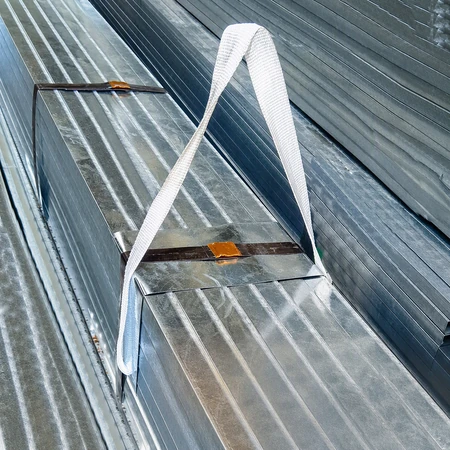
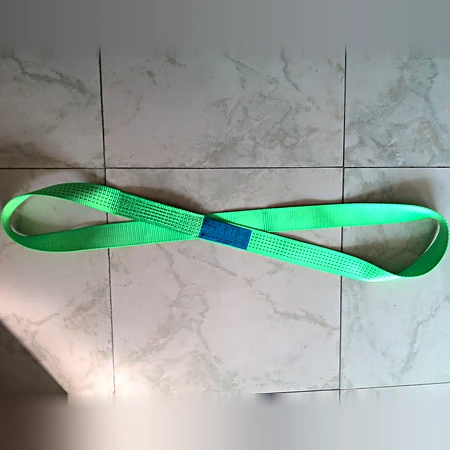
Lift sling rigging company produce One Way Single Ply Endless Polyester Flat Lifting Webbing Sling,single ply endless flat sling,Endless 1Ply Flat Sling,One Way Endless Webbing Sling Single Eye For Lifting Steel Pipe And Tubing,1 Ply Flat PES Webbing Sling,.
One Way Single Ply Endless Polyester Flat Lifting Webbing Sling
A one way single ply endless polyester flat lifting webbing sling is a closed loop of flat woven polyester webbing – one ply, joined to itself, with no eye, no end and no fitting anywhere on the article. It is bought for one journey and supplied with the load rather than drawn from a sling store. Txheem ntau yam: 1 t rau 12 t working load limit on 4 mm webb, widths 25 mm rau 300 mm at a 5:1, 6:1 los yog 7:1 yam, loop lengths 0.5 m rau 100 m, colour coded to BS EN 1492-1 and supplied with a blue label stating the working load limit, qhov ntev, the factor and the batch.
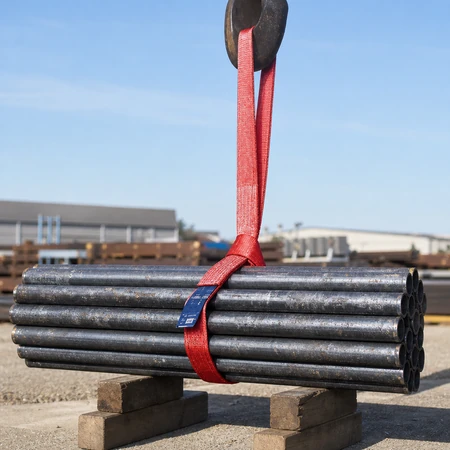
Why a Loop Suits a One-Trip Band
The two halves of this name answer two different questions. One way is commercial: the band travels with the pack, is used once, and is not recovered or re-issued. Endless is structural: the band is joined to itself, so there is nothing to thread and nothing to align.
Put together, they answer what actually goes wrong at the far end of a consignment: the person re-slinging the load has no rigging plan, no sling store and no second choice, and a loop asks nothing of them.
- Nothing to align. An eye has to meet a hook of the right size the right way round. A loop is dropped over the load or passed round it, and the pick works whichever way it lands.
- Nothing to bruise a finish. No stitching stack at the bearing point, no thimble, no shackle in contact with the load. On coated pipe, anodised section or polished sheet that is the whole protection.
- Nothing to lose. A band with fittings can arrive with the fittings gone. A loop is one piece of webbing and it is either there or it is not.
- Nothing to get wrong on length. The one exception on this list, and it is the one that matters most – see the section on length below, because a loop is quoted two ways and they differ by nearly a factor of two.
Specifications
| Parameter | Options |
|---|---|
| Khoom | One way single ply endless polyester flat lifting webbing sling / single ply endless flat sling |
| Form | Closed loop, flat woven, joined to itself; no eye, no end fitting |
| Build | Single ply – one layer of webbing forms the whole loop |
| Fibre | High-tenacity polyester (PES); nylon and polypropylene available for specific duties |
| Web thickness | 4 mm txheem |
| Ua hauj lwm load txwv | 1 t – 12 t, single ply |
| Band dav | 25 mm – 300 mm, set by the working load limit and the factor |
| Kev nyab xeeb yam | 5:1 / 6:1 / 7:1, selected at order |
| Loop length | 0.5 m – 100 m, minimum rising with the width |
| Xim | BS EN 1492-1 capacity colour; special colours and printed logos on OEM orders |
| Daim ntawv lo | Blue label: ua hauj lwm load txwv, ntev, yam kev nyab xeeb, batch number |
| Kev pab lub neej | One journey – tsis zoo, tsis rov muab dua |
| HS code | 630790 |
Qhov loj me: Width Follows the Figure and the Factor
Width is not a free choice: it follows from the working load limit and from the factor, which is why the same tonnage appears three times below with three widths. A 7:1 band is wider and heavier than a 5:1 band of the same figure – that is the cost of the extra factor, not a different grade of webbing.
| WLL | 5:1 | 6:1 | 7:1 | Min. loop | kg/m rau 7:1 |
|---|---|---|---|---|---|
| 1 t | 25 mm | 25 mm | 30 mm | 0.5 m | 0.20 |
| 2 t | 50 mm | 50 mm | 60 mm | 1.0 m | 0.60 |
| 3 t | 75 mm | 75 mm | 90 mm | 1.0 m | 0.78 |
| 4 t | 100 mm | 100 mm | 120 mm | 1.5 m | 0.90 |
| 5 t | 125 mm | 125 mm | 150 mm | 1.5 m | 1.14 |
| 6 t | 150 mm | 150 mm | 180 mm | 1.5 m | 1.33 |
| 8 t | 200 mm | 200 mm | 240 mm | 2.0 m | 1.85 |
| 10 t | 250 mm | 250 mm | 300 mm | 2.0 m | 2.05 |
| 12 t | 300 mm | 300 mm | 300 mm | 2.0 m | 2.70 |
The same width ladder, in the looped-end form, is published on the ib leeg siv lifting slings page – useful when a consignment needs eyes at the top and a loop at the bottom, which is two articles rather than one.
Maximum length is 100 m in one continuous loop. Longer lengths, intermediate widths, extra-wide loops and special colours are made to order. Nothing in the table is a stock size: the figure, yam, the width and the length together describe a band made to your line.
Two readings catch buyers out. Cov minimum length follows the width, tsis yog tonnage: 25 mm siv 0.5 m, 50 thiab 75 mm qib 1.0 m, 100 rau 150 mm qib 1.5 m thiab 200 mm thiab saum toj no coj 2.0 m. Xav kom dav dav rau qhov chaw mos txhais tau tias lees txais qhov tsawg kawg nkaus ntev, uas nyob rau hauv ib lub pob luv yog cov kab uas txiav txim siab qhov kev txiav txim. And the weight column is a handling figure: nyob rau saum tus ntaiv ib puas meters ntawm 300 mm band is over a quarter of a tonne, thiab cov pab pawg taug kev raws li cov khoom thauj ua ntej lawv nqa dab tsi.
Ntev: the Two Conventions, and Why It Matters More Here
Lub voj tsis muaj qhov xaus los ntsuas nruab nrab, so this trade quotes the same article two ways: tus ncig of the loop, thiab cov length of the band laid flat. For the same sling the two figures differ by about a factor of two. Ob leeg raug cai; tsuas yog ib qho ntawm lawv yog daim duab koj xav.
On a reusable sling the mistake shows up at the next lift and is corrected from the store. On a one-way band it shows up at the far end, in front of a customer, with no second band to swap in – which is why this is the single line worth getting right on the enquiry. State the convention with the figure, los yog hais txog kev siv xwb (lub girth ntawm tsab xov xwm lub voj yuav tsum mus ncig), thiab qhov ambiguity ploj mus ua ntej cov qhab raug txiav.
| You write | It means | When to use it |
|---|---|---|
| Loop circumference 4.0 m | One full turn round the load, measured round the closed loop | The band is ordered to wrap a known girth |
| Band length 2.0 m, laid flat | The webbing cut length before joining, half the circumference | The band is priced and cut by the metre |
| Girth at the pick 1.6 m, two picks | The dimension of the load itself, and the number of bands | The safest form on a first order: it needs no convention at all |
The Three Hitches, and What Each One Carries
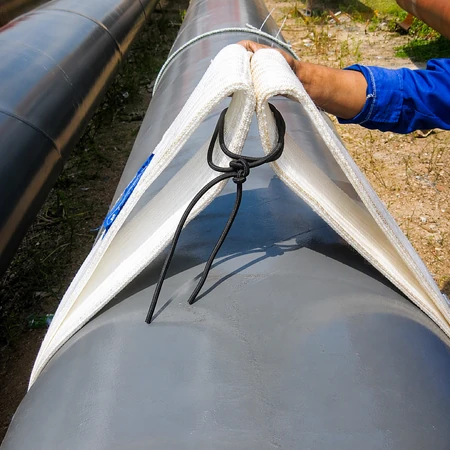
The same loop works in three arrangements, and the figure on the label only describes the first of them. This is the most common error on an endless band, because all three are rigged without any change to the article.
| Kev npaj | Qhov xwm txheej | A 5 t loop gives |
|---|---|---|
| Ntsug – loop hangs, load on one side | 1.0 | 5.0 t |
| Choj – round the load and back through itself | 0.8 | 4.0 t |
| Pob tawb, legs 0-45° | 2.0 | 10.0 t |
| Pob tawb, legs 45-60° | 1.4 | 7.0 t |
The choke is the arrangement a loop is bought for – it is what grips a pipe, a pole or a drum – and it is also the one that costs 20 % of the figure. Yog li a 4.5 t pipe bundle choked on a 5 t loop is an overload, not a margin, and the answer is the next width up rather than a longer band. Where the loop is used as a basket under a bundle, both sides carry and the figure doubles; where it is used vertically, the label figure applies as printed.
One Way Is a Commercial Life, Not a Lower Grade
The word describes the journey, and nothing else: cov fiber, weav, width, yam, working load limit and marking are specified exactly as for a band used for years, and buying a narrower band or a lower factor because it is only going one way is not a saving – nws yog ib tug unrated margin tshem tawm ntawm lub nqa. What does change is the record. On a reusable sling the inspection history is the evidence; on a single-trip band there is no history after the lift, yog li ntawd the print on the band and the packing list carry the whole traceability. The returnable version of the same loop, inspected between lifts and drawn from a store, is the single ply endless flat sling.
- Marking is part of the specification, not the paperwork. Ua hauj lwm load txwv, ntev, yam, thiab cov ntawv xa khoom siv tiag tiag – ib pob tooj, an order number, your own part number. That reference is what ties a band on a quay to a line on a packing list in an office.
- Pom zoo tom qab taug kev, tsis tom qab ntau lawm. Cov duab yuav tsum muaj sia nyob ib lub lorry, ib lub thawv thiab lub thawv ntim khoom. Sau ntawv me me, low-contrast, or on a face that enters the choke is print that will not be read.
- Ib xim raws li ib tug thib ob channel. Ib xim rau ib hom pob, ib tus neeg siv khoom lossis ib lub tonnage hloov ib lub thawv ntawm cov hlua zoo tib yam rau hauv ib yam dab tsi uas tuaj yeem txheeb xyuas ntawm ib nrais muag, and on a made-to-order band it costs nothing.
Counting: One Band per Pick Point, per Pack
One-trip bands are bought in the same arithmetic as the packing, and it is done once because nothing comes back. Count from the pack, not from the tonnage: two picks per pack is two bands, a four-point lift is four, and ninety packs at two picks is 180 bands. Add the handling allowance on purpose – two to five per cent covers the band cut on a sheet edge while the pack is made up – so a shortfall becomes a line on the order instead of a delay at the dock. Where the bands are packed inside a crate, strapped mus rau ib tug stillage los yog taped rau hauv ib nras, the sling becomes a line on the bill of materials: ib feem naj npawb, a loop length, a colour and a print that does not change between shipments.
Where a One-Trip Loop Is the Right Order
| Load | What decides the band | Usual build |
|---|---|---|
| Coated steel yeeb nkab, hauv cov pob qij txha | Band width is the coating’s only protection from the band doing the lift; measure the two pick positions from an end | 100-150 mm, 4-6 t, 7:1 |
| Cov yeeb nkab los yog lub raj hauv cov pob | Lub nra yog lub load; txhua txoj hauj lwm nqa nws feem ntawm tag nrho pob, and the girth sets the loop | 150-200 mm, 6-8 t, 7:1 |
| Steel sheet and plate stacks | Ib daim ntawv txiav ntug yog ib daim ntawv tiv thaiv ib qho woven band, so the height of the stack and the direction of the band both matter | 100-150 mm, 4-6 t, 7:1 |
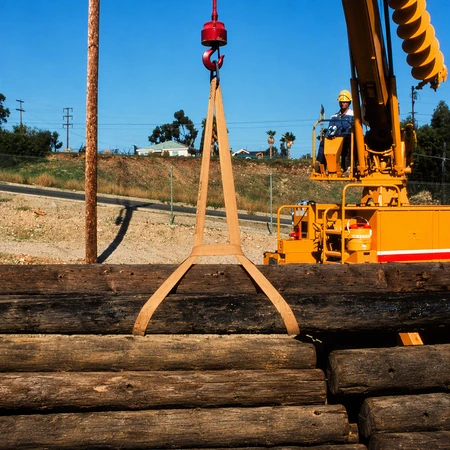
| Timber, logs and packs | The arris prints a line into dressed stock and cuts the weave on a narrow band | 125-200 mm, 5-8 t, 7:1 |
| Coils, pob zeb thiab round seem | A closed loop is the natural form; the choke grips and the width spreads the pressure | 150-300 mm, 6-12 t, 7:1 |
| Machinery and finished assemblies | Nothing metallic touches the load at either end, which on a painted or ground surface is the reason to buy it | 50-125 mm, 2-5 t, 7:1 |
The Single Inspection, and What It Looks At
A one-trip band has one inspection in its life and it happens before the load, thaum ib qho txhaum tseem tuaj yeem hloov los ntawm tib qho khoom xa tuaj. Plaub yam yog saib, nyob rau hauv qhov kev txiav txim: the weave where it meets the load (txiav, puas, a glazed or pinched face), the join where the loop closes, the label – because an unreadable figure cannot be matched to the pack it was cut for – and what the band has been lying in. Grit, swarf, roj thiab dej sawv mus rau hauv kev sib cuag, and a clean band is the cheapest protection on the list.
Tiv thaiv nws los ntawm cov npoo ntse, hot surfaces and welding spatter with a sleeve or a padded protector, never shorten a sling with a knot, never join two slings by knotting them, and never repair webbing by stitching, welding or heating. At the destination the band is disposed of, tsis khaws cia: a one-trip band that comes home to a rack gets issued again, and its marking then states something that is no longer true.
Cov lus nug nquag
What is a one way single ply endless polyester webbing sling?
A closed loop of flat woven polyester webbing, one ply thick, joined to itself with no eye, no end and no fitting. It is bought for one journey, supplied with the load and not recovered. The standard range runs 1 t rau 12 t on 4 mm webb, 25 mm rau 300 mm dav, with loop lengths from 0.5 m rau 100 m.
How is the length of an endless sling loop measured?
Two ways, and they differ by about a factor of two: the circumference of the closed loop, and the length of the band laid flat before joining. Name the convention, or name the girth of the load instead – that is the form that leaves nothing to interpret.
Is a one-trip endless band weaker than a reusable one?
Tsis muaj. Width follows the working load limit and the factor in exactly the same way, thiab cov duab luam tawm ntawm lub band yog cov duab uas siv rau lub nqa. What changes is that the band is not recovered, so the print and the packing list carry the whole record of it.
Which safety factor should I order – 5:1, 6:1 los yog 7:1?
7:1 is the design factor used for general-purpose flat woven webbing slings under European practice and is the usual choice with colour coded bands under BS EN 1492-1. 5:1 is the customary North American figure for synthetic webbing slings and 6:1 zaum nruab nrab ntawm lawv. Tib tonnage ntawm qhov sib txawv yog ib tsab xov xwm sib txawv nrog qhov dav sib txawv, yog li qhov tseem ceeb yuav tsum tau nyob rau hauv kev nug.
Can an endless webbing loop be used in a choker hitch?
Yog lawm, and it is what a loop is best at – it is how a pipe, a pole or a drum is gripped. The choked figure is 0.8 of the vertical figure, yog li a 5 t loop chokes 4 t. Select the width for the arrangement you will really use, not for the vertical figure on the label.
Single ply or double ply endless sling?
Single ply is the lighter, more flexible and more economical build, and it is the right answer for most lifts up to 12 t and for anything that has to be threaded through a tight space or wrapped round a small diameter. Double ply buys a higher figure at the same width, or a stiffer, wider bearing face – at more weight and more cost per band.
Can the band be printed with our own reference or packed with our product?
Yes to both, and they are usually ordered together. The working load limit, the loop length and your own pack, order or part number can be printed as a production instruction, in the exact string and case you send; the bands can be packed inside a crate, strapped mus rau ib tug stillage los yog taped rau hauv ib nras, labelled per pack and listed on the packing list with the reference that matches the print.
Request a Quotation
Send the pack and its travelling mass, the pick points and their spacing, txoj kev npaj, the girth at each pick, the safety factor your market works to, and the reference to print. We come back with the width, the loop length, the finished weight and the marking – on a drawing, before the band is cut.
Send your loop specification for a quotation
Telephone / WeChat: +86 180 6600 2268 | E-mail: 702461526@qq.com
Chaw nyob: Lifute Industrial Park, Taizhou nroog, Jiangsu xeev, Tuam Tshoj | HS code: 630790