

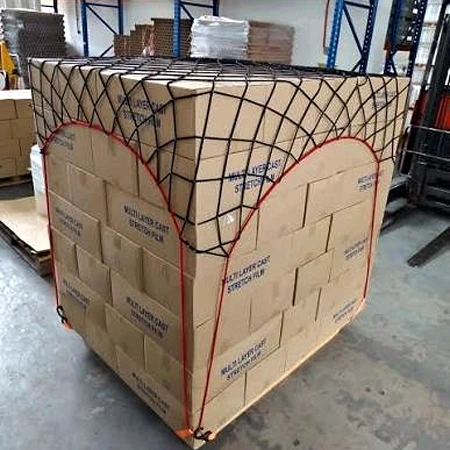
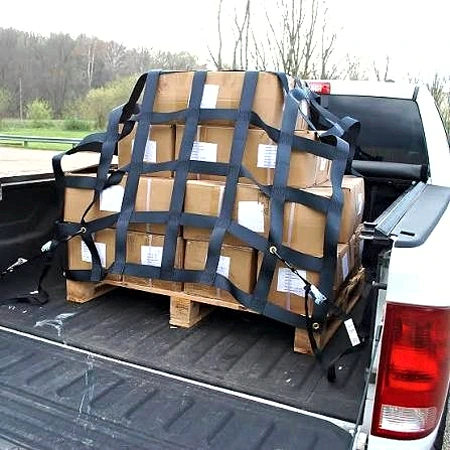
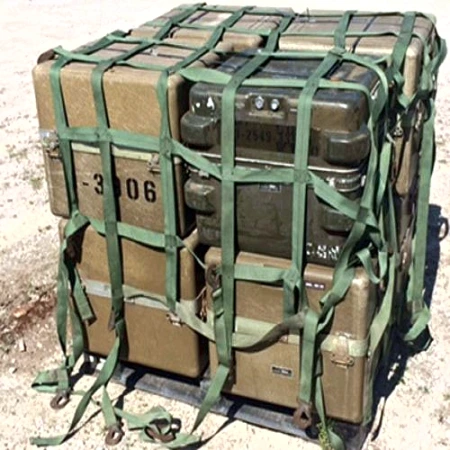
Lift sling rigging company produce Cargo Securing Net,Load Securing Net,Small mesh cargo securing net,Container securing net,Cargo ruaj ntseg webbing net.
Cargo Securing Net
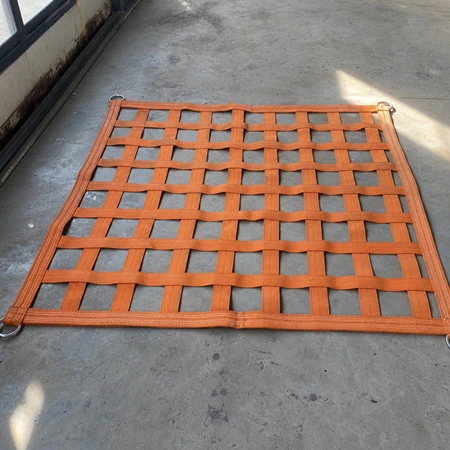
A cargo securing net is a flat-belt restraint net laid over a load and tensioned down to the deck, so that the cargo cannot slide, rock or topple on the way. The belts are woven from high-tenacity polyester into an open lattice, the border is folded and double-stitched, and the edge carries rated attachment points that are pulled down with ratchet tensioners until the load is pressed onto the vehicle or container floor.
The distinction that matters on this product is duty, not appearance. A cargo securing net restrains; it does not lift. Its label carries a lashing capacity (LC) and a standard tension force (STF) in daN, the arrangement is calculated to EN 12195-1 and the belts are type-tested to EN 12195-2 – not to a lifting working load limit. We weave the belts in our own mill in Taizhou, so net size, mesh, belt width, fittings and markings are set to your load, your vehicle and your anchor points.
- Restraint rating, tsis yog lifting rating – LC and STF marked in daN, calculated to EN 12195-1, belts type-tested to EN 12195-2.
- Flat high-tenacity polyester belts – 25 mm rau 100 mm, single or duplex, UV stabilised and rot-proof.
- Sized to the load or the aperture – cover nets, container doorway nets, partition nets and bag form, all made to order.
- Rated fittings and tensioners – ratchets, nuv, D-rings and lashing points, with anti-slip mats where the deck friction is low.
- CE thiab GS tau ntawv pov thawj – woven, xaws, marked and tested in one plant, nrog ISO 9001, CNAS and DNV behind it.
Restraint is not lifting – and the label says which one you have
The two products look alike, are made from the same belt and are often bought by the same fleet. Lawv tsis yog interchangeable, and the difference is not a formality: one is sized so a load cannot move, the other is sized so a load cannot fall. Using a restraint net on a crane hook, or a lifting net as a tensioned tie-down, is a safety failure rather than a paperwork problem.
Rooj 1 – Why a securing rating and a lifting rating are not interchangeable.
| Point of comparison | Cargo securing net (nplooj ntawv no) | Lifting net |
|---|---|---|
| Nws ua li cas | Restrains a load that stays on the vehicle | Carries the full weight of a load in the air |
| Governed by | IN 12195-1 (calculation of securing forces) and EN 12195-2 (webbing lashings) | Lifting standards, with webbing rated on the EN 1492-1 hauv paus |
| Rated nyob rau hauv | lashing muaj peev xwm (LC) and standard tension force (STF), in daN | Ua hauj lwm load txwv (WLL), in tonnes |
| How it is sized | Sized to resist the acceleration and friction case for the journey | Sized with a 5:1, 6:1 los yog 7:1 factor and proof-tested per sling |
| How it is tested | Belt and tensioner type-tested to EN 12195-2 | Every sling break-tested on our own 1000 t tshuab |
| Yuav ua li cas ua tsis tau | The load moves – a road accident | The sling breaks – a dropped load |
If the requirement is to lift – a pallet onto a roof, a bag into a hold – the right product is a lifting net: tus crane pallet cargo net, tus polyester nqa hoisting net lub hnyav luag nylon cargo net sling. If the requirement is to keep a load still from the loading bay to the delivery point, this page is the right one.
The forces the net has to answer for
A load on a moving vehicle is pushed in three directions, and each one is a design case rather than an accident. The accelerations below are the ones EN 12195-1 uses for road transport; other modes and national rules differ, which is why we ask where the load is travelling before we size the net.
Rooj 2 – Design accelerations for road transport and what resists each one.
| Direction | Design acceleration | What resists it |
|---|---|---|
| Forward (braking) | 0.8 g | Blocking or a headboard first, then direct lashings to the front; friction contributes |
| Rearward (acceleration) | 0.5 g | Rear lashings and a tailboard; the net’s rear edge lines |
| Sideways (cornering) | 0.5 g | Side lashings, containment by the lattice, and friction from the pre-tension |
| Ntsug | Not a road design case | Held down by pre-tension and containment; a net reduces bounce but is not a substitute for blocking |
The practical consequence is that a net alone rarely carries the whole case. Blocking against a headboard does more for the braking case than any strap, and a net laid over the top does the rest. A good securing arrangement is a combination, and we will say so when a net is the wrong answer for your load.
How a flat-belt net holds a load
A securing net works through three mechanisms at once. Which one dominates depends on how the net is fitted, and that is decided at the vehicle rather than at the factory.
Rooj 3 – The three mechanisms a securing net uses.
| Mechanism | Nws ua haujlwm li cas | What it depends on |
|---|---|---|
| Kev sib txhuam (tie-down) | The tensioned net presses the load onto the deck, and friction between load and deck resists sliding. This is the main effect of a cover net | A clean, dry deck or anti-slip mats. Without friction the same net restrains far less |
| Containment | The lattice physically stops the load spreading, rocking, or throwing individual items out | A mesh fine enough for the smallest item, and a net fitted tight rather than draped |
| Direct lashing | Where the edge belts run down to rated points on the vehicle, the belt itself carries the restraint force | Certified anchor points on the vehicle – never a random protrusion or a load’s own packaging |
Two numbers decide whether the arrangement works, and both are usually ignored. The first is the angle: a tie-down belt is most effective between 75 thiab 90 degree rau lub lawj, and its effective capacity follows LC_eff = LC × sin α. Ntawm 30 degrees you keep roughly half the belt’s rating, so a net pulled down almost flat looks tidy and holds very little. The second is friction: the coefficient between a steel load and a steel deck is about 0.1 rau 0.2, steel on timber about 0.2 rau 0.3, timber on timber about 0.3 rau 0.4, and a good anti-slip mat takes a pallet on a deck to about 0.5 rau 0.6. ntub, oily or icy surfaces take all of these figures down, which is why the same net restrains very different loads on two different days.
Technical parameters
The figures below cover the standard securing range. Siv, mesh, net loj, edge fittings and tensioners are all made to order, yog li kho cov lus no raws li qhov pib taw qhia rau cov lus hais es tsis yog cov ntawv teev tseg.
Rooj 4 – Cargo securing net: technical parameters.
| Parameter | Specification |
|---|---|
| Yam khoom | Cargo securing net (load restraint net) – cover net, partition net, container doorway net or bag form. Not a lifting device |
| Belt material | 100 % high-tenacity polyester (PET); high-tenacity nylon ntawm kev thov |
| Siv dav | 25 / 35 / 50 / 75 / 100 mm |
| Belt construction | Ib txheej los yog duplex, woven selvedge, not a cut edge |
| Belt thickness | 1.8 mm – 4.0 mm nyob ntawm qhov dav thiab txheej suav |
| Mesh qhib | 100 × 100 mm txheem; 50 mm – 300 mm ua order |
| Net loj | Made to the load footprint, the vehicle bed, or the container or doorway aperture |
| lashing muaj peev xwm (LC) | Txog 750 daN on a 25 mm belt to about 5,000 daN on a 100 mm duplex belt, marked per net |
| Ua ntej nro (STF) | 250 – 500 daN depending on the tensioner supplied; cim rau ntawm daim ntawv lo |
| Txuj hauv paus | IN 12195-1 for the securing calculation; IN 12195-2 for the webbing lashing |
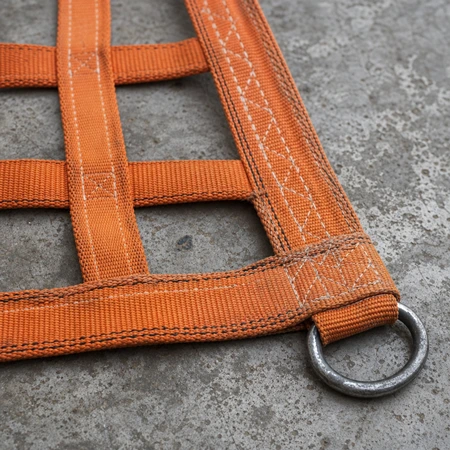
| Ciam teb | Folded and double-stitched; reinforced at every attachment point |
| Fittings | Ratchet tensioners, nuv, D-rings, cam buckles and lashing points, qib 80 steel where steel is used |
| Xim | Orange for high visibility as standard; xiav, ntsuab, black or a custom colour |
| Kev kho mob | UV ruaj khov, anti-aging, abrasion and tear resistant, rot-proof |
| Ua haujlwm kub | -40 °C rau +100 °C |
| Daim ntawv pov thawj | CE, GS, ISO 9001, JIS on request; CNAS Laboratory; DNV |
| Kev kho kom haum | OEM / ODM loj, xim, printed belt, daim ntawv lo, logo and packing |
| HS code | 6307.90 – nets and netting of textile materials |
Standard sizes, mesh and lashing capacity
A securing net is sized to the load it covers or the aperture it closes, never to a tonnage. The load has to be fully covered, and the border has to land on the deck or on the anchor points instead of hanging in mid-air, because an unsupported edge is an edge that can be pulled sideways.
Rooj 5 – Standard securing net sizes, with the belt and capacity that normally go with them.
| Net loj (L × W) | Mesh | Siv | LC per edge line | Hom kev siv |
|---|---|---|---|---|
| 1.2 × 1.2 m (4 × 4 ft) | 100 mm | 35 – 50 mm | 1,000 – 2,000 Thiab | Single pallet in a van or light truck |
| 2.5 × 1.2 m (8 × 4 ft) | 100 mm | 50 mm | 2,000 Thiab | Two pallets abreast in a van or curtain-sider |
| 2.5 × 2.5 m | 100 mm | 50 mm | 2,000 Thiab | Flatbed loads, tshuab, mixed cargo |
| 5.0 × 2.5 m | 100 – 150 mm | 50 – 75 mm | 2,000 – 3,500 Thiab | Full-length flatbed and trailer loads |
| 2.4 × 2.6 m (thawv) | 100 mm | 75 mm | 3,500 Thiab | Container doorway net, load held back from the doors |
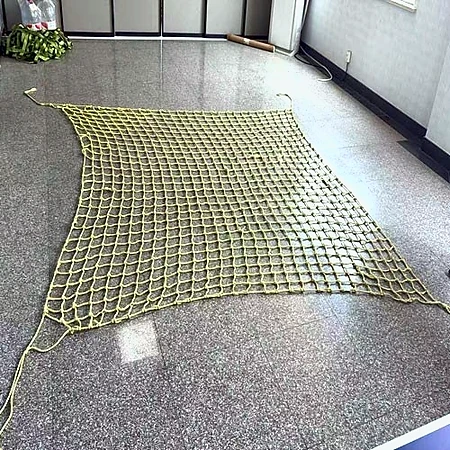
| 1.5 × 1.5 m bag form | 50 – 100 mm | 50 mm | 2,000 Thiab | Loose or bagged goods that would spread on the deck |
| Ua rau kev kos duab | 50 – 300 mm | 25 – 100 mm | To calculation | Tej ko taw, aperture or vehicle bed |
The capacity column is the restraint available per edge line, not a lifting limit. The number of edge lines, their angle and the friction under the load decide what the arrangement actually restrains.
Four forms of securing net
The same lattice is supplied in four arrangements, and choosing the right one is most of the job. The fittings differ between them; the restraint principle does not.
Rooj 6 – Npog, partition, container and bag forms.
| Daim ntawv | How it is fitted | Siv thaum |
|---|---|---|
| Cover net | Spread over the load and tensioned down to the deck or to the vehicle’s rated points | Flatbed, curtain-sider and container loads that must not move in any direction – the most common arrangement |
| Partition net | Fixed upright across the vehicle body and tensioned against its own frame | Separating two loads in one vehicle, or holding cargo away from a bulkhead |
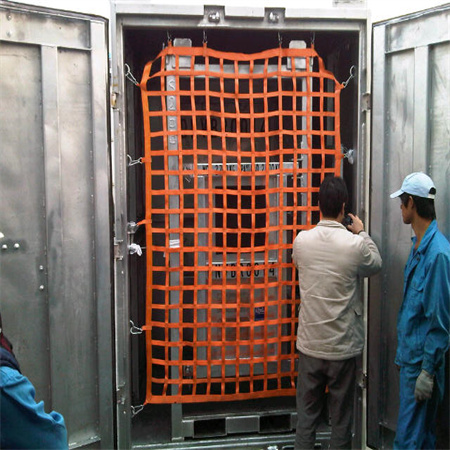
| Container doorway net | Fitted across the door aperture and hooked to the container’s own rings | Stopping cargo migrating to the doors during the journey, so the container is safe to open |
| Hnab daim ntawv | Closed at the bottom, with the cargo sitting inside the lattice | Loose or bagged goods that would otherwise spread across the deck |
Fittings, tensioners and anti-slip
A securing net is only as good as the tensioner that pre-tensions it and the anchor point it pulls against. These are the parts that get specified last and fail first.
Rooj 7 – Fittings and tensioners.
| Haum | Siv nrog | Nco tseg |
|---|---|---|
| Ratchet tensions | Cover net, bag form | Sets the pre-tension (STF). A ratchet that cannot reach the marked STF makes the net ineffective, whatever its LC |
| Cam buckle | Lub luag haujlwm | Faster than a ratchet but reaches a much lower pre-tension – for light loads only |
| Hooks and D-rings | Any arrangement | The link between net and anchor point; qib 80 steel where a steel fitting is used |
| Lashing points | Cover net | Rated anchor points in the vehicle structure – the restraint force has to go somewhere rated |
| Anti-slip lev | Frictional restraint | Raises the friction coefficient under the load; usually the single most effective addition on a smooth deck |
| Lub tes tsho tiv thaiv | Sharp-edged loads | Fits over the belt at the contact point; qhov pheej yig tshaj txoj kev mus cuag net life |
| Kho cov khoom siv | Fleet maintenance | Matching belt, stitching thread and a spare tensioner |
Kos npe, colour and identification
A securing net is checked by the driver before every trip and by an inspector at the roadside, so the marking has to be readable at a distance and has to survive being dragged over a deck.
- Lashing capacity and standard tension force printed along the belt in daN – the units load securing is actually calculated in.
- Net size and date of manufacture printed as well, so the net can be matched to the vehicle and its age judged on the spot.
- A sewn capacity label in addition to the print, so the net and its paperwork always agree.
- Orange as the standard high-visibility colour, with blue, ntsuab, black or a house colour for fleet identification.
- OEM orders can carry your brand, warning text or certificate number printed on the belt.
- Nets ship folded into a bag or a crate – a fleet order takes a fraction of the space of the same number of loose straps.
Kev sim, certification and traceability
- Forty years of lifting equipment manufacturing – nrhiav tau hauv 1985 hauv Taizhou, Jiangsu, nrog ntau dua 200 cov neeg ua haujlwm.
- Belts woven in our own mill, yog li dav, layer count and colour are under our control rather than bought in.
- Webbing strength-tested on our own 1000 t horizontal machine before it is cut into nets.
- Belts supplied to the EN 12195-2 material requirements for securing duty, with the securing calculation following EN 12195-1.
- CE declaration of conformity and GS certification, with JIS on export orders; ISO 9001, CNAS laboratory accreditation and DNV certification behind the plant.
- Every net marked with its lashing capacity, pre-tension, loj thiab mesh ua ntej packing, and supplied with a material test report on request.
Certificates and test reports are available as PDFs for a tender file or a customs check – see the full ntawv pov thawj teeb.
Where cargo securing nets are used
The same net covers a road trailer, a container, a rail wagon and a barge. What changes is the number of anchor points, the mesh and how the net is tensioned – not the product itself.
Rooj 8 – Applications by transport mode.
| Mode or sector | What the net restrains | Why a flat-belt net suits it |
|---|---|---|
| Road – flatbed | Tshuab, hlau, ntoo, pallets, drums and mixed cargo | Covers the whole load in one action and combines friction with containment |
| Road – curtain-sider | Palletised and boxed goods that shift against a soft curtain | Contains the load where the curtain itself carries no restraint |
| Container transport | Cargo behind the doors, and cargo that must not migrate in transit | A doorway net makes the container safe to open and stops the load moving forward |
| Rail freight | Palletised and loose cargo in wagons and on flat wagons | Long nets cover a wagon bed and can be tensioned at regular intervals |
| Sea and inland waterway | Deck cargo, and cargo inside barges and holds | Rot pov thawj, UV stabilised and unaffected by salt water |
| Heavy haulage and project cargo | Hloov pauv, plant and out-of-gauge loads | Combined with direct lashings and blocking for indivisible loads |
| Waste, recycling and agriculture | Bales, refuse, compost and bulk loads on open vehicles | Containment stops loose material leaving the vehicle in transit |
| Military and relief transport | Palletised and loose cargo in trucks and aircraft | One net per load, quick to apply and reusable over many trips |
Saib xyuas, tshuaj xyuas thiab nyiaj laus
- Check the net before every trip and record the check: the tensioner first, then the stitching at every attachment point, then the belts.
- Reject any belt with cuts, edge damage, tawg stitching, tshuaj staining, kub glazing, or the colour and gloss change that signals UV degradation.
- Check the vehicle’s anchor points as carefully as the net. A perfect net on a corroded lashing point restrains nothing.
- Keep the deck clean and dry, and fit anti-slip mats wherever load-to-deck friction is low. That is a securing measure, not a refinement.
- Never use a securing net to lift, and never use a lifting net as a tensioned tie-down unless its label carries both ratings.
- Khaws kom huv si thiab qhuav, tawm hauv av thiab tawm ntawm lub hnub ncaj qha; never repair a webbing belt by knotting, vuam los yog cua sov nws.
- Withdraw the net if a belt, a stitch line or a tensioner is damaged, and have nets inspected by a competent person at the interval your fleet requires.
Cov lus nug uas nquag nug
Can a cargo securing net be used to lift a load?
Tsis muaj. It is rated for restraint, tsis nqa, and the two are calculated on completely different bases. If the load has to go onto a hook, use a lifting net with a working load limit and a per-sling proof test – the crane pallet cargo net or the polyester lifting hoisting net, both linked earlier on this page.
What is the difference between LC and STF?
LC (lashing muaj peev xwm) is the restraint force the belt is rated to carry. STF (txheem nro quab yuam) is how hard the ratchet tensioner can pre-tension the belt. Both are marked in daN. LC matters most in direct lashing, where the belt itself holds the load; STF matters most in tie-down lashing, where the pre-tension creates the friction that does the holding.
How tight should the net be?
Tight enough to reach the pre-tension marked on the label, with the belts running as steeply to the deck as the load allows – 75 rau 90 degrees is where a tie-down belt works best. A belt laid almost flat keeps only about half its capacity, so a net that looks neatly covered can be holding very little.
Do I need anti-slip mats?
If the restraint relies on friction – which is what a cover net does – then usually yes. On steel, aluminium or plastic surfaces the friction coefficient is low, and a mat often adds more restraint than an extra strap does. A clean, dry deck is the other half of the same measure.
How many lashings or anchor points do I need?
It follows from the load, the deck friction, the vehicle and the journey rather than from a rule of thumb. Direct lashing normally needs at least four anchor lines, two per side and crossed, with the vertical and plan-view angles between 30 thiab 60 qib. Send us the load and vehicle details and we will work the arrangement through with you.
Will a net stop cargo moving inside a container?
A doorway or partition net stops the load migrating towards the doors and makes the container safe to open. For the journey itself the load still has to be restrained as a whole, so a container is usually secured with a partition net plus blocking or dunnage rather than with a net alone.
What mesh opening should I choose?
Fine enough that the smallest item in the load cannot pass through. 100 mm is our standard and holds pallets, thawv, hnab thiab nruas; loose or small items need a tighter mesh, and large indivisible loads can take a wider one.
What else do you make for load handling?
The same belts go into our webbing swb thiab endless round slings, the wire rope range is under hlau hlua slings, the rope itself under nylon hlua, and RoRo and breakbulk work is covered by the tsheb nqa nqa. The lifting side of the net range starts at cargo lifting nets.
Thov ib daim ntawv hais
Send the transport mode, the load weight and dimensions, whether it can spread or topple, the deck material, the net or aperture size, the belt width and the anchor points you have – or a drawing of the load and the vehicle. Our engineers will confirm the net, the fittings, the number of lashing lines and the packing, thiab hais nws hauv ib teb. Mus tham ua ntej, tiv tauj peb cov engineers.
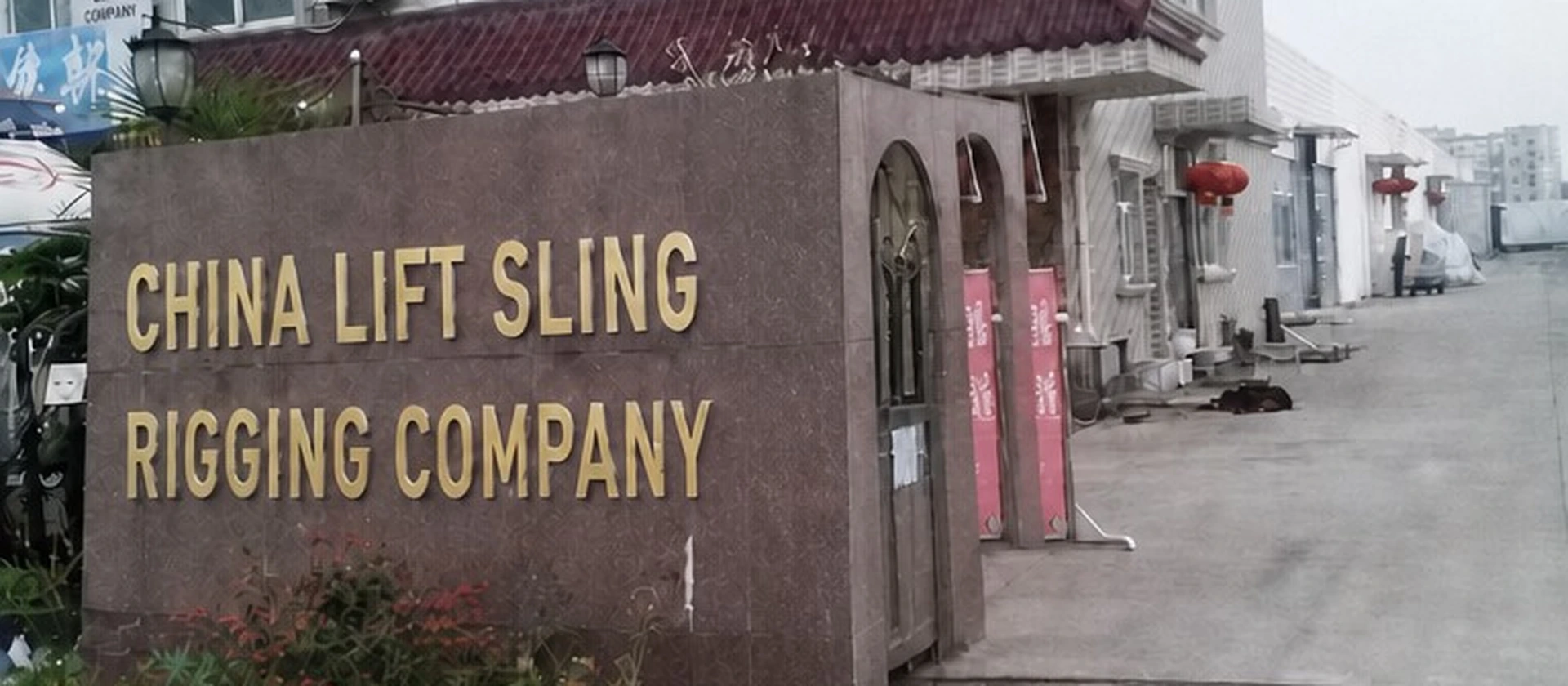
Lift Sling Rigging Company – Lifute Industrial Park, Taizhou nroog, Jiangsu xeev, Tuam Tshoj
Tel: +86 523 8693 5818 | WhatsApp: +86 180 6600 2268 | E-mail: ib 98@jslift.com