

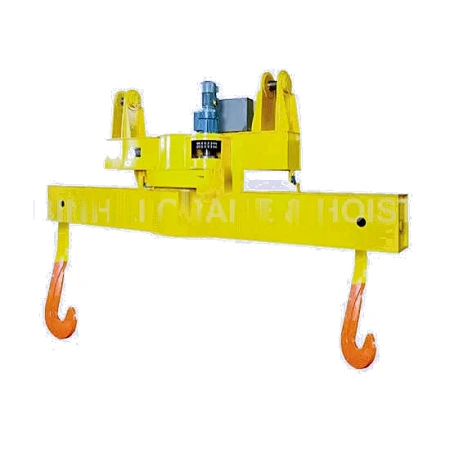
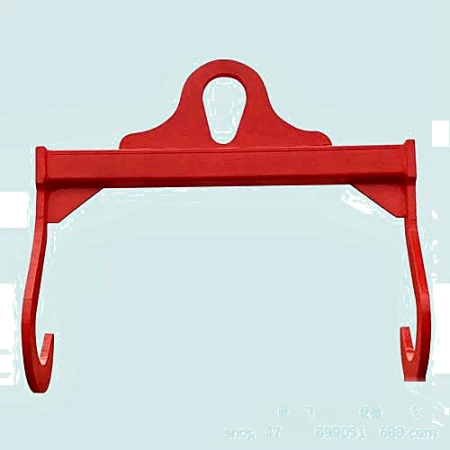
Lift sling rigging company produce Roll Lifting Beams,Roll Handling Beam,Paper Roll Lifting Equipment,Horizontal Roll Lifting Beams,Fixed Roll Lifting Beams,Paper Roll Lifting Beam,
Roll Lifting Beams
A roll has no lifting point: no lug, no edge you dare mark, and a face that is usually the product itself. ए roll lifting beam solves that by ignoring the face altogether. Two arms hang from the beam, drop into the core from both ends, and the roll hangs on its bore – the surface is never touched, never squeezed and never banded.
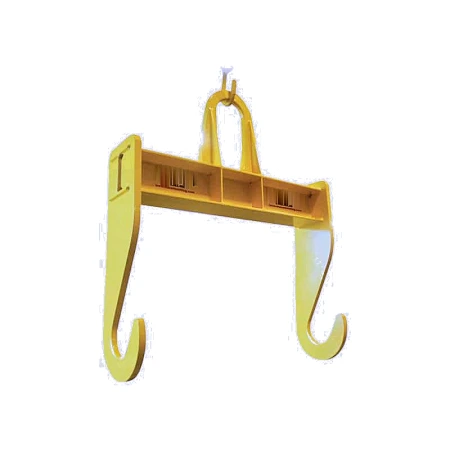
What the Beam Actually Does
The beam is a spreader with two rigid arms hanging from its ends, spaced to match the roll. Each arm ends in a hook or a mandrel stub that enters the bore. Lower the beam, let the arms take the core, उठाना: the roll is now a suspended body carried on two points inside its own core.
- The core carries the roll. That is the whole idea, and also the whole limit – see the next section.
- The arms set the span, the beam sets the reach. A beam for a 600 mm face will not take a 1,500 mm roll, even if both weigh the same.
- Nothing is clamped. No squeeze, no pad pressure, no banding marks on coated or printed stock.
Why Lift a Roll by Its Core
Three reasons, and the third is the one that decides it for print and film work:
| Reason | What it protects |
|---|---|
| No contact with the face | Printed, coated or polished stock – the surface is the product |
| No squeezing | Soft or layered rolls that would oval under a clamp |
| No banding, no sling | Cut-free handling; nothing to remove afterwards |
| Repeatable position | The roll hangs level, which matters when it has to enter a machine |
The trade-off is honesty about cores. The core must be strong enough to carry the roll, and it must stick out far enough for the arms to bite. A steel or aluminium core takes this easily; a cardboard core on a heavy paper roll may crush at the bore, and that roll needs an outside-diameter handler instead.
What Decides the Model
A roll beam is built around the roll, not around a tonnage. Four figures set the whole frame, and two more decide whether the tool can be used at all.
| पैरामीटर | What it decides | How to state it |
|---|---|---|
| Roll weight | किरण अनुभाग, arm size, hook section | Heaviest single roll in the run |
| Roll diameter (OD) | Arm length and how far the hooks must drop | Largest roll, measured |
| Face width | Arm spacing and beam span | Widest and narrowest face, both |
| Core diameter (ID) | Hook or mandrel stub size | 76 मिमी और 150 mm are common paper cores; state the actual |
| Core protrusion | Whether the arms can enter at all | How far the core stands proud of each face |
| Core material and wall | Whether core lifting is safe | इस्पात, aluminium, or cardboard and its thickness |
| Roll axis at pick-up | Fixed beam or adjustable span | Horizontal in a rack, or standing on end |
| Headroom under the hook | Beam depth plus arm length | Measured at the lowest pick-up point |
The Core Protrusion Rule
This is the single most common reason a roll beam cannot be used on a site that has already bought one. The arms need bare core to sit on; if the roll’s face runs flush to the end of the core, there is nothing to hook.
| Core situation | Can a core-entry beam take it? | What to do |
|---|---|---|
| Core protrudes at both ends | हाँ – ideal | Quote on the protrusion length, not just the roll |
| Core flush with one face | Only one arm can bite | Roll must be turned, or use an OD handler |
| Core flush at both ends | नहीं | Use a roll clamp or a sling cradle instead |
| Core plugged or sleeved | Depends on the plug | State the plug; a soft plug will not take a hook load |
| No core – solid roll | नहीं | Different tool entirely |
तय, Horizontal and Adjustable Builds
The catalogue names on this page describe the same geometry at three levels of flexibility:
| निर्माण | इसका क्या मतलब है | Right for |
|---|---|---|
| Fixed roll lifting beam | Arm spacing welded to one roll width | One press, one roll size, steady production |
| Horizontal roll lifting beam | Built for a roll lying on its side in a rack | Warehouse and reel-stand work |
| Adjustable span | Arms move on a slotted or pin-located beam | Mixed face widths on one line |
Fixed is stiffer and cheaper per unit; adjustable pays for itself the first time two roll widths have to be handled in the same shift. If the yard runs one width, do not buy the adjustment.
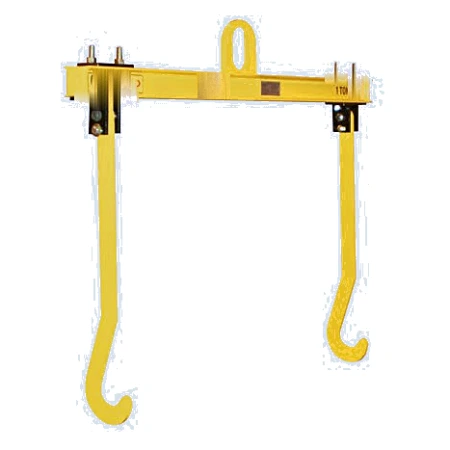
क्षमता, and the Beam It Is Built On
Roll beams are built on the same spreader range as the rest of this section: welded box and H sections in Q235B or Q345B, spans from about half a metre to 25 m on the beam side, and rated capacities from around 100 किलो से 180 t for the parent beam. A roll beam rarely uses the top of that range – the limit is nearly always the core, not the steel.
Two consequences follow. पहला, the rated capacity on the plate refers to the beam and arms; the core still has to be checked by the user. दूसरा, a roll beam is proof-load tested as a complete assembly, because the arms and hooks are part of the load path – unlike a plain spreader, where the sling does the work.
Safe Use, and What Wears Out
| Point | यह क्यों मायने रखती है |
|---|---|
| Check the core before every lift | A split or crushed core releases the roll |
| Both arms must seat fully | One arm short means the roll hangs skewed and can walk off |
| Hook throat wear | The throat is the load path; measure it, do not eyeball it |
| No side pull | The arms grip vertically; dragging unloads one side |
| One roll per lift | Two rolls on two arms is a balance, not a hold |
| Arm straightness | A bent arm changes the span and the seat angle |
What to Send With the Inquiry
- Roll weight, and the heaviest single roll rather than the average.
- Roll diameter and face width, at both ends of the range.
- Core diameter and core protrusion at each face.
- Core material and wall thickness, with a photo of the core end if possible.
- Roll axis at pick-up, and a photo of the roll as it sits in the rack.
- Headroom under the hook at the lowest pick-up point.
अक्सर पूछे जाने वाले प्रश्नों
What is a roll lifting beam?
A spreader beam with two rigid arms spaced to the roll, each ending in a hook or mandrel stub that enters the roll’s core. The roll is carried on its bore, so the face is never contacted and nothing is clamped or banded.
Why use a beam instead of a sling?
A sling has to pass around the roll, which means contact with the face and a load path over the edge. A core-entry beam keeps the load inside the roll’s own bore and leaves the surface untouched – the difference between a saleable roll of printed stock and a marked one.
Can it lift any roll?
नहीं. The core has to be strong enough and has to stand proud at both ends. A roll whose core is flush with the face, or whose cardboard core would crush under the roll’s weight, needs an outside-diameter handler instead.
What is the most common reason a roll beam cannot be used?
Core protrusion. The arms need bare core to seat on; if the roll is wound right to the end of the core at both faces, there is nothing for the hooks to take. Measure the protrusion before ordering.
Fixed or adjustable span?
Fixed is stiffer and cheaper, and is the right choice when the yard runs one face width. Adjustable earns its cost when two or more widths are handled in the same shift, at the price of a heavier beam and an extra check on the pin or slot before each lift.
Is the rated capacity the capacity of the whole lift?
It is the capacity of the beam and arms. The core is not part of the certificate – the user has to confirm the core can take the roll. That division of responsibility is normal for roll handling but is worth stating in writing.
How is the beam tested?
As a complete assembly, beam and arms together, because the arms are part of the load path. The proof load and the serial number are recorded, and the plate carries the rated capacity, धड़ा वजन, the roll size range and the year.
Send the roll range – वज़न, व्यास, face width, core diameter and core protrusion – and the frame size comes back as a calculation rather than a guess. Send roll dimensions