

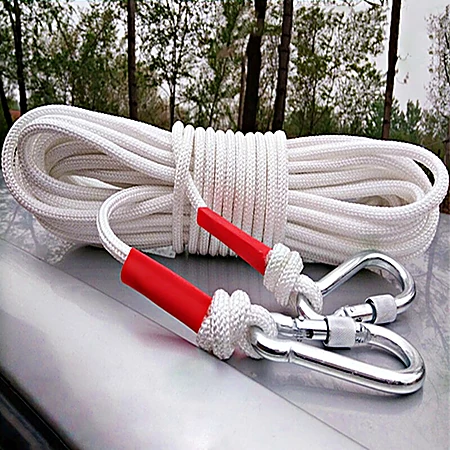
Lift sling rigging company manufacture Safety Lifeline Rope,Fireproof Safety Rope Lifeline,Nylon Safety Lifeline Rope,Vertical Lifeline Rope,Fall Protection Lifeline Rope,Fall Protection Vertical Lifeline Assembly with Rope Grab.
Safety Lifeline Rope
Low-stretch kernmantle lifeline rope for vertical systems, rope access and fall protection — 10.5 mm to 14 mm, with rope grab and fireproof options
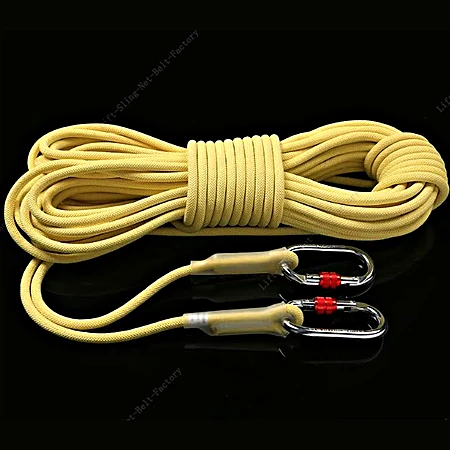
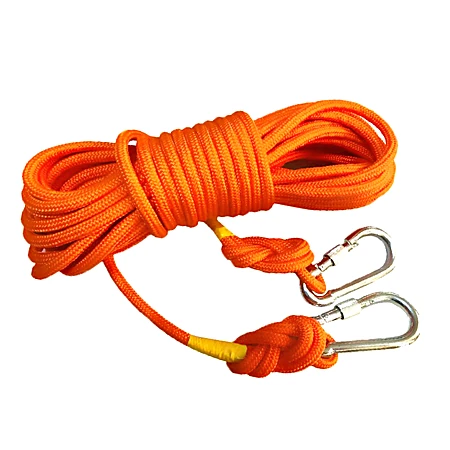
A safety lifeline rope is bought for one job: to hold a person when nothing else will. That duty decides the rope. It has to be low-stretch, because a line that stretches drops the user further and moves the working position every time they lean on it. It has to keep its sheath, because it runs over roof edges, ladder rungs, scaffold tubes and steel profiles. And it has to be identifiable and traceable, because a lifeline that cannot be shown to be the right type and the right age is not one anyone can rely on. We build it as a kernmantle construction — a braided sheath over a twisted core — in 10.5 mm, 11 mm, 12 mm and 14 mm, finished with spliced eyes and supplied with the connectors and rope grabs that make it up into a working system.
- Low stretch — static elongation below 5 % at 150 kg, so the working position stays where it was set
- Sheath that lasts — a 32 or 48 strand braid takes the abrasion while the core carries the load
- Traceable — manufacturer, year, diameter, type and a unique identification number marked at the rope
- Fireproof option — aramid-core lifeline rope for fire service and hot work duty
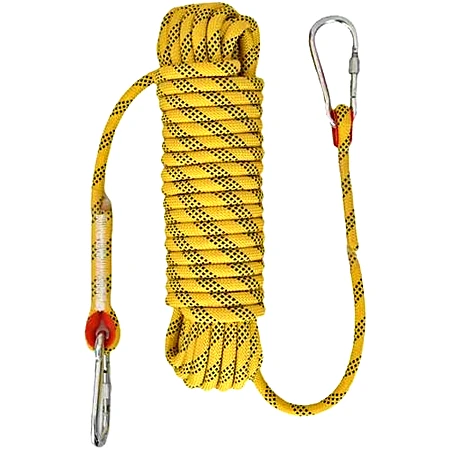
Key Features of Our Safety Lifeline Rope
Low Stretch, Because the User Has to Stay Where They Are
A lifeline is not a climbing line and should not behave like one. Static elongation stays below 5 % at 150 kg, so a person working at height is held at the height they set and the rope grab is not chasing slack the rope created. Rope meant for falls is a different article — see our climbing rope.
A Sheath Built for Edges
Most lifelines are retired because the sheath is cut or glazed, not because the core broke. A dense 32 or 48 strand braid spreads that wear across many yarns, and the sheath is the first inspection point precisely because it is the early warning the core never gives.
A Predictable Core
The core is twisted high-tenacity polyamide (nylon) — chosen for strength, wear and consistent behaviour under load. Polyester core is used where a firmer hand and less water uptake are wanted. Both are nylon rope constructions, but built to a lifeline specification rather than a general-purpose one.
Technical Specifications
| Item | Specification range |
|---|---|
| Product name | Safety lifeline rope / vertical lifeline rope / fall protection lifeline rope / low stretch kernmantle rope |
| Construction | Kernmantle — braided sheath over a twisted multifilament core |
| Core | High-tenacity polyamide (nylon); high-tenacity polyester and aramid cores on request |
| Sheath | 32 or 48 strand braid, high-tenacity polyamide (nylon) |
| Standard diameters | 10.5 mm · 11 mm · 12 mm · 14 mm (custom range 8.5–16 mm) |
| Standard lengths | 10 m · 20 m · 30 m · 50 m · 100 m; any cut length to order |
| Elongation | Static elongation below 5 % at 150 kg (the low-stretch behaviour a lifeline needs) |
| Sheath proportion | Typically 35–40 % of the rope’s mass; a higher proportion gives more abrasion resistance |
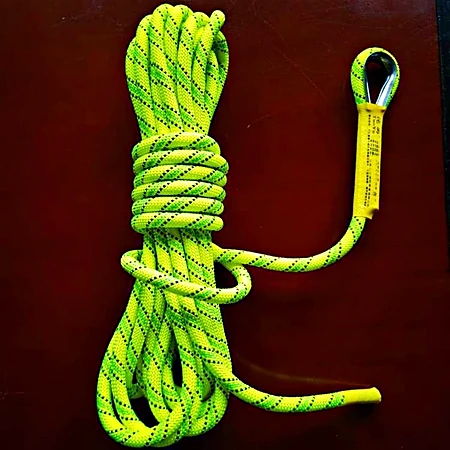
| Colour | Yellow · orange · green · neon yellow-green · black · white · custom colours |
| End finishing | Spliced eye · spliced eye with thimble · sewn and welded eye · whipped or heat-sealed ends |
| Connectors | Screw-gate and twist-lock carabiners, hooks, rope grabs and shock absorbers supplied with the line |
| Marking | Manufacturer, year of manufacture, diameter, rope type, standard reference, batch and unique identification number |
| Fireproof option | Aramid-core construction for hot work and fire service duty (see the fireproof section below) |
| Packing | Coil, rope bag or kit bag; custom label, barcode and instruction sheet available |
| MOQ & OEM | Low MOQ for trial orders; full OEM — diameter, colour, sheath construction, length, splicing, printed logo and packaging |
Standard specification range — other diameters, sheath constructions and lengths are produced to order.
Diameter and Breaking Strength
A vertical lifeline is normally sized by the rope grab and the connectors it has to work with, then checked against the load and the fall the system has to arrest.
| Diameter | Approx. weight (g/m) | Typical breaking strength | Static elongation at 150 kg | Rope type |
|---|---|---|---|---|
| 10.5 mm | ≈ 68 | ≈ 25 kN | < 5 % | A (≥ 10.5 mm) |
| 11 mm | ≈ 75 | ≈ 28 kN | < 5 % | A (≥ 10.5 mm) |
| 12 mm | ≈ 90 | ≈ 33 kN | < 5 % | A (10.5–12.0 mm) |
| 14 mm | ≈ 120 | ≈ 42 kN | < 5 % | Above the standard range — confirmed per order |
Typical reference values for our standard kernmantle constructions — the test certificate issued for your batch is the authoritative figure. Rope type refers to the size bands used in EN 1891.
What EN 1891 Asks of a Low-Stretch Kernmantle Rope
Where a lifeline is sold into a market that asks for a certified article, the European standard for this construction is EN 1891. The requirements below are what it sets for the rope itself; the assembly it goes into is governed by separate standards for the harness, the connector and the fall arrester.
| Requirement | What the standard asks |
|---|---|
| Standard | EN 1891:1998 — personal protective equipment for the prevention of falls from a height; low stretch kernmantel ropes |
| Rope types | Type A: ≥ 10.5 mm and ≤ 12.0 mm, main working lines; Type B: ≥ 8.5 mm and < 10.5 mm, light duty |
| Static strength | Type A: minimum 22 kN unaged; Type B: minimum 18 kN |
| Static elongation | Below 5 % at a 150 kg load |
| Sheath slippage | Not more than 1 % of the test length (20 mm on the test specimen) |
| Shrinkage in water | Below 5 % length shrinkage after immersion |
| Impact force test | Type A: five arrests with 100 kg; Type B: five arrests with 80 kg |
| Mandatory marking | Manufacturer, year of manufacture, type A or B, diameter, standard reference, CE mark where applicable, unique identification number |
Summarised from published information on EN 1891:1998 and given as guidance on the standard, not as a statement of certification. Confirm the current edition and the certification route for your market before ordering.
The Lifeline Is One Part of a System
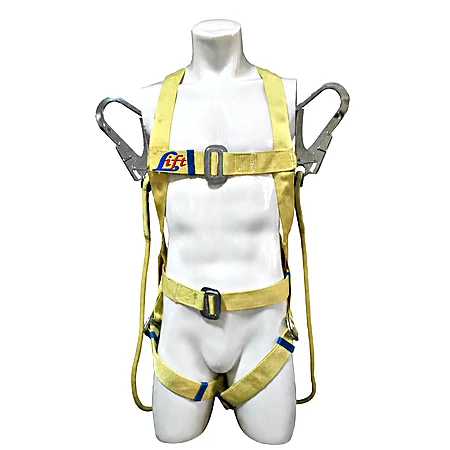
Rope only becomes fall protection when it is assembled with the rest of the system: a certified anchor, the lifeline, a rope grab or fall arrester that grips it, an energy absorber that limits the arrest force, and a full body harness that spreads that force across the body. The parts have to be compatible and the assembly checked by a competent person. Tell us how the system is arranged and we will supply the rope and connectors that suit it, including the safety harness that completes the set.
Spliced Ends and Connectors
A knot costs a lifeline a large part of its strength, so the end is spliced and not knotted. We finish the rope with hand-spliced eyes, spliced eyes fitted with a thimble where the eye meets a pin or a shackle, and sewn and welded eyes where a compact termination is wanted. Connectors are matched to the eye and supplied with the line. A finished end shortens the usable length, so order the finished length you need.
Marking, Inspection and Retirement
- Marked where it is used — manufacturer, year, diameter, rope type, batch and a unique identification number, so the line can be logged and traced
- Inspected before every use — look for cuts, glazing, sheath damage, flat spots, soft or stiff sections and core protrusion
- Retired after damage or a fall — a sheath opened to the core, contact with chemicals or heat, or an arrested fall, ends the rope’s life
- Recorded — a log of first use, the work done and any impacts is the most reliable retirement guide there is
Fireproof and Heat-Resistant Options
Where the line has to survive flame, molten splash or radiant heat as well as hold a person, the core is built in aramid rather than nylon. Aramid does not melt, holds about 75 % of its tenacity after 100 hours at 200 °C, and reaches zero strength only near 455 °C. The same fibre is described on our aramid braided rope page, and it is the construction used in our fire rescue rope and fire escape rope.
Where a Safety Lifeline Rope Is Used
- Vertical lifelines and ladder safety systems on towers, masts and rooftops
- Rope access, work positioning and restraint at height
- Confined space entry and retrieval lines
- Rescue kits, escape lines and fire service duty (aramid version)
- Window cleaning, façade access and industrial maintenance platforms
- Related protective and pulling items: safety rope net, pulling rope and utility winch line
Customisation and OEM Service
- Diameter — 10.5, 11, 12 and 14 mm standard; 8.5–16 mm on request
- Sheath — 32 or 48 strand braid, proportion tuned to how abrasive the duty is
- Colour — yellow, orange, green, neon, black, white and custom colours for site identification
- Length — any cut length with both ends finished; coils and kit bags
- System supply — rope with connectors, rope grabs, absorbers and harness as a matched set
- Marking and paperwork — printed label, barcode, batch number and instruction sheet
Frequently Asked Questions
What diameter safety lifeline rope do I need?
For a vertical lifeline rope system, 11 mm and 12 mm are the usual sizes because most rope grabs and connectors are made for that band. Choose what the device is rated for, then confirm it against the load and the fall to be arrested.
Can I use any strong rope as a lifeline?
No. A general-purpose rope, however strong, is not a fall-protection article. It has to be the right type, marked and traceable, and used in an assembly put together and checked by a competent person. Tell us at the enquiry stage if a rope will be used where a person could fall.
Will the rope work with my rope grab?
It depends on the diameter and how firm the sheath is. Rope grabs are made for a diameter band and a rope stiffness, so send the device make and model and we will confirm whether our 11 mm or 12 mm construction suits it. Where the device is known, we have matched rope to it before.
How long does a safety lifeline rope last?
There is no calendar life. A line used daily on a rough façade ages far faster than one kept in a rescue kit, so retirement is decided by inspection and use — cuts, glazing, sheath damage, chemical or heat contact, or any arrested fall.
Request a Quote for Safety Lifeline Rope
Send us the diameter, the finished length, the system it goes into and the connectors or rope grab it must work with, plus any marking or certification your market requires. You will get back a construction, a finished length, a sample line to inspect and a price from the factory.
Safety notice: a safety lifeline rope is a component of a fall-protection system and must be used as part of a system specified and checked by a competent person, with the correct anchor, connector, absorber and harness. Rope of any strength is not a fall-protection device unless it has been made and certified for that duty.
Contact: Lift Sling Rigging Co., Ltd — telephone and WeChat 18066002268, e-mail 702461526@qq.com, Lifute Industrial Park, Taizhou City, Jiangsu Province, China. HS code 630790.