

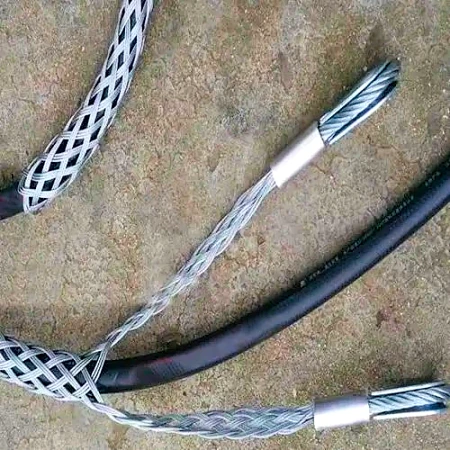
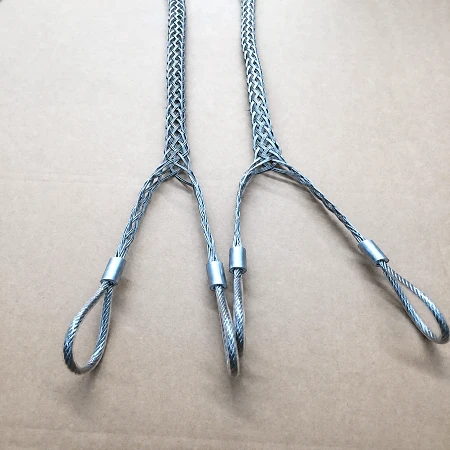
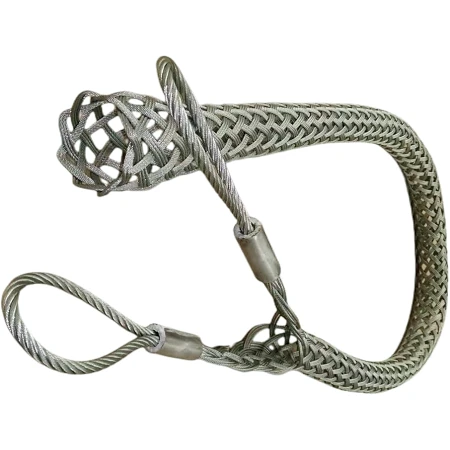
Lift sling rigging company produce Double Eye Cable Grips,Empuñaduras para tirar de cables de dobre ollo,Double Eye Cable Socks,Cable pulling grips with two eyes,Double Eye Stainless Steel Cable Grips,Double Eye Threaded Support Cable Grips,Double Eye Cable Grip for Balanced Heavy Pulling Tasks.
Empuñaduras para tirar de cables de dobre ollo
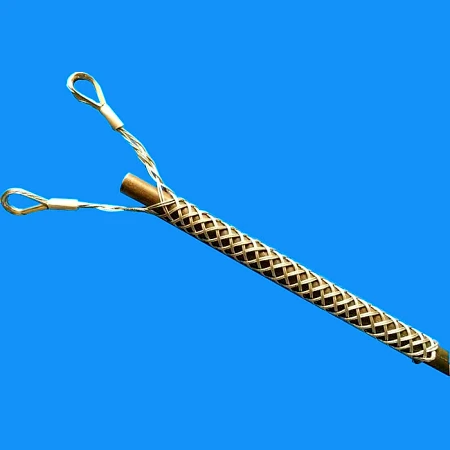
Double eye cable pulling grips are wire mesh cable socks with two braided eyes at the head, so the pull is shared between two attachment points instead of one. The double-layer galvanised steel mesh tightens on the cable as tension rises and grips by friction alone – no clamps, no bolts, no crushed insulation. Standard models cover cable diameters from 9 mm a 160 mm, with 304/316 stainless steel and PVC-coated mesh available for corrosive or surface-critical work.
What Makes a Double Eye Grip Different?
A single eye grip gives you one loop for one pulling line. A double eye grip gives you two, and that changes what the grip can do on site:
- Balanced two-point pull. Two eyes load the head symmetrically, so the mesh stays square on the cable and the weave does not roll to one side during a long pull.
- Pass-through pulling. The cable can be threaded through the grip and pulled in either direction – useful where a cable has already been laid and must be pulled further without repositioning the winch.
- Two-leg and bridle rigging. Each eye takes its own line, so one grip can be used in a two-leg arrangement or with a spreader where a single eye cannot be centred.
- Support duty. Hanging the load from both eyes halves the load per eye and keeps the cable axis vertical – the same mesh can serve as a support grip after installation.
- Redundancy. If one eye or one line is damaged, the second eye still carries the pull while the cable is brought down safely.
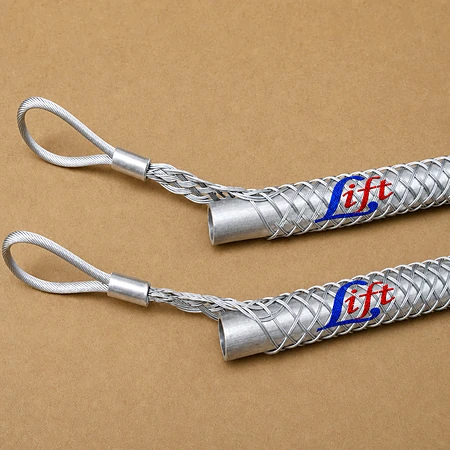
Empuñaduras para tirar de cables de dobre ollo – Especificacións
The table below is the standard build. Cable range, lonxitude da malla, wire diameter, eye type and coating are all fixed at order – tell us the cable outside diameter and the pulling load, and we match the model.
| Parámetro | Especificación |
|---|---|
| Nome do produto | Double eye cable pulling grip / double eye cable sock / double eye wire mesh grip |
| Material | Fío de aceiro galvanizado de alta resistencia; AISI 304 ou 316 aceiro inoxidable opcional |
| Estrutura | Double-layer cross-woven tubular mesh, closed head with two braided eyes |
| Diámetro de malla de arame | 1.5 mm / 2.0 mm / 2.5 mm / 3.0 mm |
| Rango de diámetros de cable | 9-16 mm up to 130-160 mm in standard models; tamaños maiores feitos por encargo |
| Malla (calcetín) lonxitude | 300 / 450 / 600 / 700 / 900 / 1200 / 1500 mm; personalizado ata 3000 mm |
| Ollo / tipo de cabeza | Two braided eyes (standard double eye); swaged ferrule eyes, ollos de dedal, offset eyes on request |
| Factor de seguridade | 5:1 sobre a forza de rotura nominal |
| Opcións de revestimento | Galvanizado liso; PVC or rubber coated mesh; colour coding |
| Temperatura de traballo | -40 °C to +120 °C (versións recubertas para +70 °C) |
| Personalización | Lonxitude de malla personalizada, ollo personalizado, impresión de logotipo, embalaxe de marca privada |
| Orixe | Lift Sling Rigging Co., Ltd – Taizhou, Jiangsu, China |
Model Selection Chart
Choose the model by the measured cable outside diameter first, then confirm the mesh length against the pulling load. Capacities below are the standard ratings for the same mesh body used across our cable sock range; confirm the final rating for your cable surface and pull length with our engineers before the first lift.
| Modelo | Rango de Ø de cable (mm) | Lonxitude da malla (mm) | Ø de malla de arame (mm) | Capacidade de tracción (kg) | Ollo |
|---|---|---|---|---|---|
| DEPS-16 | 9-16 | 300 | 1.5 | 750 | Double |
| DEPS-25 | 16-25 | 450 | 2.0 | 1,300 | Double |
| DEPS-38 | 25-38 | 600 | 2.0 | 1,800 | Double |
| DEPS-50 | 38-50 | 700 | 2.5 | 2,500 | Double |
| DEPS-75 | 50-75 | 900 | 2.5 | 3,500 | Double |
| DEPS-100 | 75-100 | 1200 | 3.0 | 5,000 | Double |
| DEPS-160 | 130-160 | 1500 | 3.0 | 8,000 | Double |
Capacity applies to a straight, axial pull on a clean cable at 20 °C. Side loading, sharp bends at the duct mouth, wet or oily cable jackets and short mesh engagement all reduce the usable pull. Order one size above the measured diameter when the cable is within 1 mm of a range limit.
How to Choose the Right Model
- Measure the outside diameter at the point the mesh will grip – not the nominal cable size. For a bundle, use the overall diameter including the ties.
- Pick the range, not the number. The mesh must be expanded to grip: too large slips, too small will not slide over the jacket.
- Size the mesh length to the load. Use at least 4-5 times the cable diameter of mesh engagement; go longer for high pulls, soft jackets or long duct runs.
- Choose the eye arrangement. Double eye where the line must be balanced, shared between two points, or passed through; a cable pulling socks grip with a single eye is enough for a straight one-line pull.
- Match the material to the environment. Galvanised for general site work, 304/316 stainless for marine, tunnel, offshore and humid duty, PVC or rubber coated mesh where painted, stainless or plastic surfaces must not be marked.
- State the pulling load and we confirm the mesh wire diameter – the wire gauge, not the mesh length alone, sets the breaking strength.
Materials and Options
- Galvanised steel mesh – estándar, zinc coated high-tensile wire, general pulling and support duty.
- AISI 304 / 316 stainless steel – for salt spray, chemical exposure and offshore or tunnel work; 316 where chlorides are present.
- PVC or rubber coated mesh – protects painted pipe, stainless tube, fibre optic jackets and finished surfaces from marking.
- Eye variants – two braided rope eyes as standard; swaged aluminium ferrule eyes for a low-profile head, thimble eyes for abrasion resistance at the winch hook, offset eyes for support runs.
- Marcado – model, cable range and capacity on a tag; your logo braided into the mesh or printed on the eye on request.
Aplicacións típicas
- Tirando LV, MV and HV power cable through ducts, trenches and cable trays
- Fibre optic and control cable installation where the jacket must not be crushed
- Tirando de feixes de cables, wire rope, rods and conduit with a winch or cable puller
- Two-leg bridle pulls and pass-through pulls where the cable is already laid
- Supporting or lowering smooth cylindrical loads – steel pipe, PE/PVC pipe, hose, ducting
- Mariña, tunnel, utility and substation work, including stainless and coated versions
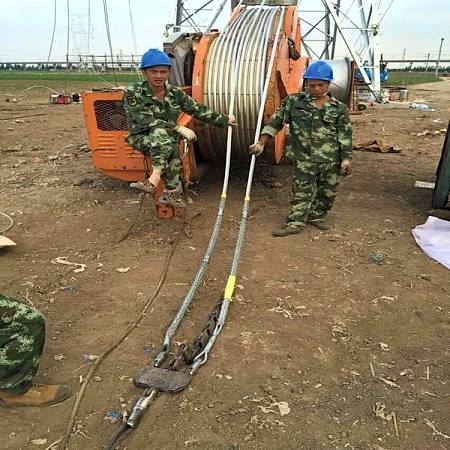
Installation and Safe Use
- Inspeccionar a malla, eyes and ferrules before every pull; discard any grip with broken wires, un ollo deformado ou unha virola escorregada.
- Expand the mesh fully and slide it on until the cable end reaches the head – never pull with the cable only half inserted.
- Load both eyes evenly. A single loaded eye on a double eye grip puts the head in bending and reduces capacity.
- Keep the pull axial; side loading at a duct mouth is the most common cause of mesh damage. Use a snatch block or roller where the line changes direction.
- Nunca exceda a capacidade de tracción nominal, and do not use a pulling grip for overhead lifting unless the model is rated and marked for lifting duty.
- Almacenar seco e limpo; rinse and re-check galvanised grips after use in wet or salty conditions.
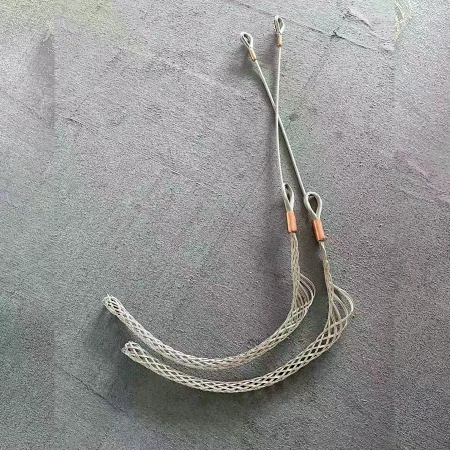
Control de calidade
Lift Sling Rigging Co., Ltd has manufactured wire rope and mesh rigging in Taizhou, Jiangsu since 1985. Mesh is braided from wire we select, eyes are braided or swaged to a controlled length, and samples are proof-loaded before despatch in our own laboratory. Os informes de inspección previos ao envío e as probas de terceiros pódense organizar baixo petición.
Preguntas frecuentes
What is a double eye cable pulling grip used for?
Agarra un cable, pipe or rod so it can be pulled by a winch or by hand, with the pull shared between two eyes. That suits balanced pulls, two-leg bridle rigs, pass-through pulls and support duty where a single eye would sit off-centre.
Single eye or double eye – which should I order?
For a straight pull on one line, a single eye grip is lighter and cheaper. Order double eye when the load must be balanced, when two lines share the pull, when the cable has to pass through the grip, or when the same grip will later support the cable.
How do I pick the size?
Measure the true outside diameter of the cable and choose the model whose range covers it – the chart above runs from 9 mm a 160 mm. Then set the mesh length from the pulling load, using at least 4-5 times the cable diameter of engagement for heavy pulls.
Can you supply stainless steel or coated mesh?
Si. O fío galvanizado é estándar; AISI 304 e 316 stainless are available for corrosive duty, and PVC or rubber coating is available where the cable or pipe surface must not be marked.
What is the safety factor and the lead time?
Standard grips are rated at 5:1 on the breaking strength. Tell us the required pulling load and we specify the wire diameter and mesh length to suit. Despatch dates for standard sizes and for custom lengths, eyes and marking are confirmed on the quotation.
Request a Quotation
Send the cable outside diameter, lonxitude da malla, eye type, coating and required pulling load – or a photo of the cable end and the duct – and our engineers will confirm the model, the rating and the price. Custom lengths, private label and OEM marking are standard business for us.
Send your cable details for a quotation
Teléfono / WhatsApp: +86 180 6600 2268 | Correo electrónico: 702461526@qq.com
Enderezo: Parque Industrial Lifute, Cidade de Taizhou, Provincia de Jiangsu, China