

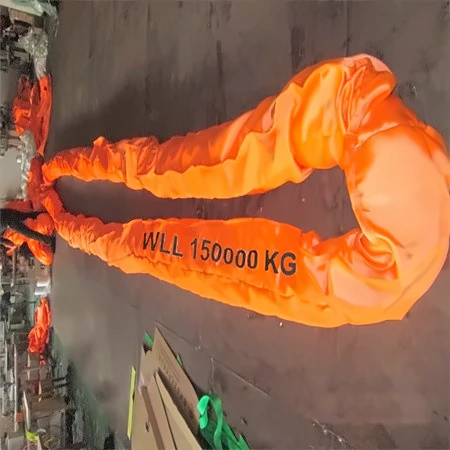
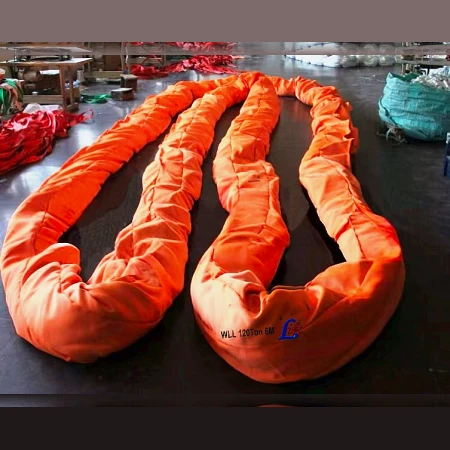
Lift sling rigging company produce WLL 250T Polyester Heavy Duty Round Slings for Lifting,250Tonne Round Sling,250Eslinga de elevación de toneladas.
WLL 250T Polyester Heavy Duty Round Slings for Lifting
A WLL 250T polyester heavy duty round sling carries 250,000 kg (about 551,000 lb) on a single vertical leg. The load path is a continuous loop of high-tenacity polyester yarn held inside a heavy duty woven sleeve — no metal, no splice and no sewn joint carrying the load. At this capacity the sling is not a catalogue item: it is built to an approval drawing, proof loaded to 500,000 kg and shipped with the test record that belongs to its serial number.

What the 250 Tonne Size Is For
Tonnage steps above 200 t exist for one reason: a lift that lands between two catalogue sizes. A 500 t module on four legs at 30° asks for roughly 238 t per leg once the assembly factor is applied. A 200 tonne sling is short of that figure, and a 300 tonne sling answers it with capacity the lift never uses — paid for in sleeve bulk, coil diameter and freight. O 250 t sling is the size that fits, and it is normally ordered against a lift plan rather than from stock.
| Load to be lifted | 500 t, symmetrical |
|---|---|
| Configuration | 4 legs at 30° to vertical |
| Assembly factor, 4 legs at 0–45° | 2.1 |
| Required capacity per leg | 500 ÷ 2.1 = 238 t |
| Sling selected | WLL 250T, working at about 95% of its vertical rating |
The assembly factor assumes the load is shared equally. An off-centre centre of gravity, a short leg or a two-leg pick-up changes the figure, so calculate per leg rather than dividing by the number of legs.
Capacity in Each Arrangement
The figure on the sleeve is the vertical rating. Every other arrangement is that figure multiplied by a mode factor, and the spread between them is wide enough that the configuration, not the headline capacity, usually decides the lift.
| Arrangement | Mode factor | Límite de carga de traballo |
|---|---|---|
| Vertical | 1.0 | 250 t (250,000 kg) |
| Sufocado | 0.8 | 200 t (200,000 kg) |
| Cesta, 0–7° | 2.0 | 500 t (500,000 kg) |
| Cesta, 7-45° | 1.4 | 350 t (350,000 kg) |
| Cesta, 45-60° | 1.0 | 250 t (250,000 kg) |
Multi-leg assembly factors: 2 legs 1.4 (0-45°) e 1.0 (45-60°); 3 e 4 legs 2.1 (0-45°) e 1.5 (45-60°). A basket rating is only usable if the hook, shackle or beam above it is rated for the same figure — a 500 t basket under a 300 t hook is a 300 t lift.
Especificacións técnicas
| Product | WLL 250T polyester heavy duty round sling / 250 tonne round sling / 250,000 kg heavy duty round lifting sling |
|---|---|
| Estándar | AS 4497:2018; EN 1492-2 and ISO 4878 a petición |
| Límite de carga de traballo (vertical) | 250,000 kg (250 t / about 551,000 lb) |
| Minimum breaking load | 1,750,000 kg (7 × WLL) |
| Proof load | 500,000 kg (2 × WLL), applied to every sling |
| Factor de seguridade | 7:1 |
| Configuration | Endless loop as standard; two stitched eyes on request |
| Core | High-tenacity polyester parallel yarn, continuous loop |
| Sleeve | Heavy duty woven polyester, double layer as standard at this size; wear pads at the choke point on request |
| Elongation at WLL | Aprox. 2–3% |
| Temperatura de traballo | -40 °C a +100 °C with a polyester core; an aramid round sling for higher temperatures |
| Effective length | Made to order — state lay-flat length or full circumference; 20 m body shown above |
| Marcado | Sewn label: WLL in kg, lonxitude efectiva, estándar, fabricante, serial or batch |
| Embalaxe | Coiled and strapped, poly-wrapped, labelled crate or pallet for export |
| Código HS | 630790 |
Sizing the Connection Above the Sling
A 250 t body is thick and does not bend tightly. Forced around a pin that is too small, the sleeve wrinkles, the core bunches on the inside of the bend and the load stops being shared evenly across the yarn. Two checks settle most of it: the bowl of the hook or bow shackle should take the body without pinching it, and the pin should present a generous radius, not a sharp edge.
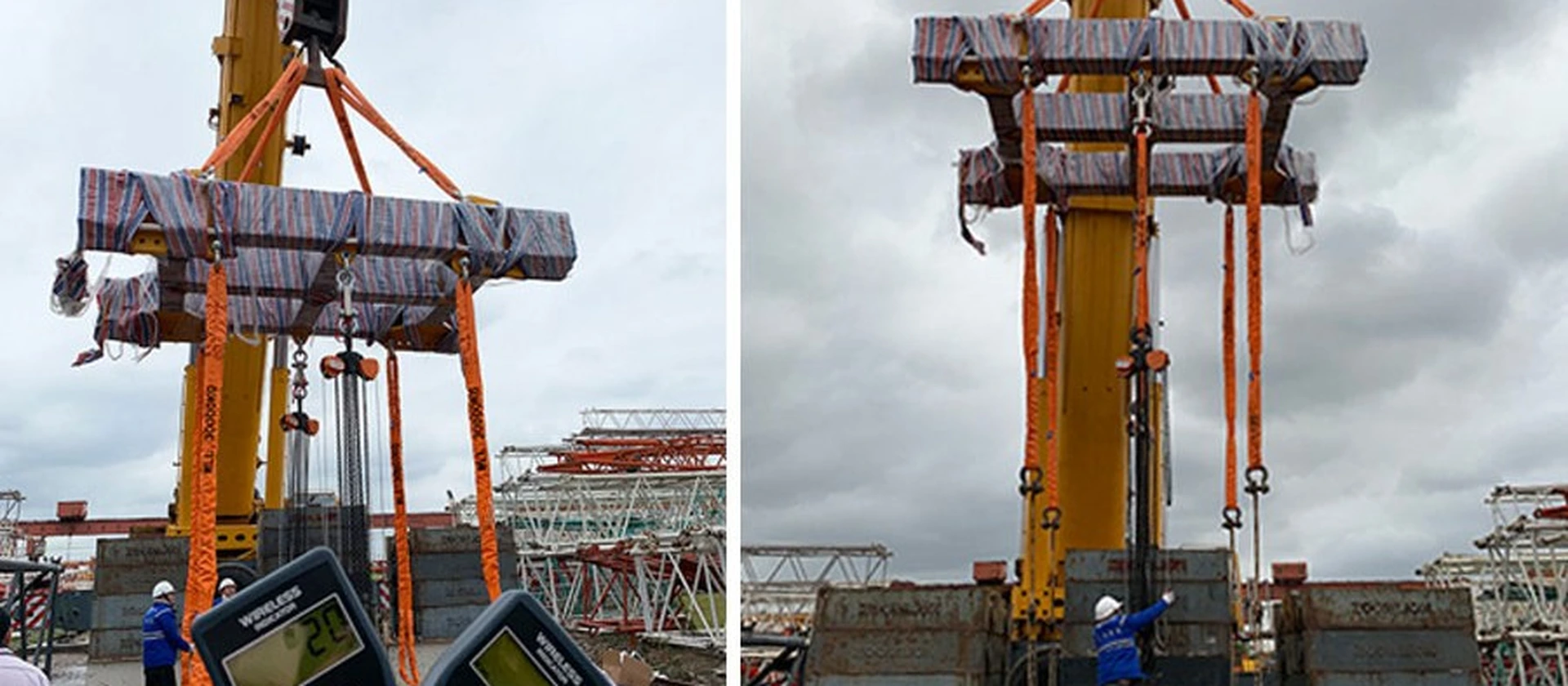
Where the pick-up points are close together or the legs would otherwise splay wide, a spreader beam keeps the legs near vertical, takes the horizontal component out of the sling and lowers the load in each leg. It is often the cheaper answer than the next size up.
Sleeve and Core at 250 Tonnes
The construction does not change with capacity; the proportions do. The core is a continuous loop of parallel polyester yarn — thousands of ends sharing the load, with no twist and no stitch in the load path — and the sleeve is a woven tube that takes the abrasion, holds the core in shape and carries the marking. At 250 t the sleeve is built as a double layer as standard, because a single layer that wears through on a rough edge exposes the core long before the sling is due for retirement.
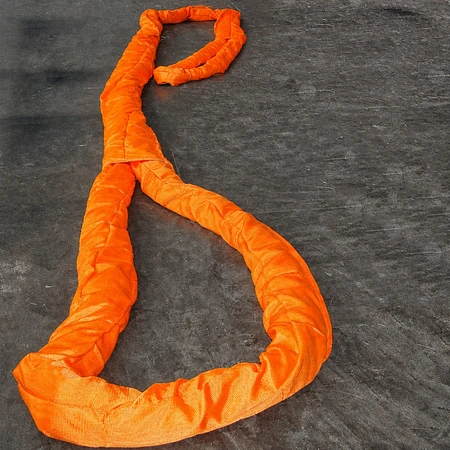
Polyester brings three things to a lift this size: low stretch (roughly 2–3% at WLL, so the load does not creep as it comes off the ground), no metal in the load path, and a soft face that will not bruise a machined, painted or coated surface. It is not an insulated tool, though: a standard round sling is not rated for live electrical work. If the lift is near energised equipment, specify the rating rather than assume it.
Length, Coil and Freight
An endless sling is quoted one of two ways — as the lay-flat length, or as the full circumference of the loop — and the difference is a factor of two. State which convention you are using in the enquiry, and measure from it. Getting this wrong is the most common and most expensive mistake on a high-capacity order, because the sling cannot be shortened afterwards.
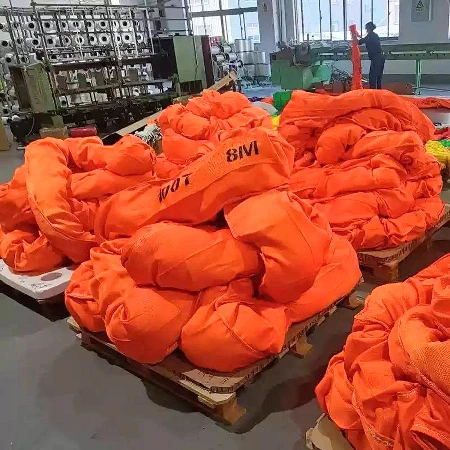
Length also drives handling. O 20 m body shown above is moved with a crane or forklift assist, not carried up a ladder, and a longer body coils larger again. Confirm the coil diameter, the packed weight and the access at the receiving end before the length is fixed.
Proof Load, Marking and Paperwork
Every 250 t sling is proof loaded to 500,000 kg before dispatch, and the figure is recorded against its serial number. The sewn label carries the WLL in kilograms, the effective length, the standard it was built to, the manufacturer and the serial or batch. That label is the sling’s identity: colour coding is a small-capacity convention and does not extend to 250 t, so at this size the label is the only thing that tells a rigger what he is holding.
If the project requires third-party witness of the proof load, or a certificate pack in a particular format, raise it at enquiry. It is built into the inspection plan before the sling goes on the bed — not added afterwards.
Inspection and Retirement
Inspect a high-capacity sling before every lift, and formally at the intervals set by your site regime. Withdraw it from service on any of the following — and do not return it to a lift because the damage looks cosmetic:
- A cut or burn in the sleeve deep enough to expose the core, or any visible broken or fused yarn.
- Chemical contamination, hardening, glazing or a change of colour that suggests heat or solvent damage.
- A label that can no longer be read — WLL, length or serial — because the sling can no longer be identified.
- Missing proof record or a serial number that does not match the certificate.
- Distortion of the loop, or a body that has been loaded in a way that has permanently flattened or kinked it.
Options and OEM
Polyester is the standard core. An aramid core suits hot loads and a UHMWPE (Dyneema) core suits situations where the weight of the sling itself matters — both are made to order at this capacity. Beyond the core, the variables are configuration (endless loop or round sling with eyes), sleeve colour, wear pads, lonxitude efectiva, label layout and packing. Trial quantities are accepted, and the same build can be repeated against the approval drawing for follow-on orders.
If the load is a flat or a bundle rather than a single body, a heavy-duty webbing sling may sit better; the case for the round sling is capacity in a soft, sleeved body. O 40-tonne steel pipe lift is a recent example of that trade-off — a sling that had to wrap a curve without marking it.
Frequently Asked Questions
What is the breaking strength of a 250 t round sling?
1,750,000 kg at a 7:1 factor de seguridade, calculated from the 250,000 kg vertical working load limit, con a 500,000 kg proof load applied to every sling before dispatch.
Is a 250 tonne round sling colour coded?
Non. Colour coding is a small-capacity convention that does not extend to 250 t. The sleeve colour is a customer choice and the sewn label identifies the capacity.
How much can it lift in a choke or a basket?
200,000 kg choked (0.8 × WLL); 500,000 kg in a basket at 0–7°, 350,000 kg at 7–45° and 250,000 kg at 45–60°.
Can the 250 t sling be supplied with eyes?
Yes — the same core and sleeve, gathered and stitched into two reinforced eyes to give a defined eye-to-eye length. That is the usual choice where the same lift repeats at the same geometry.
What do you need to quote one?
The load and its centre of gravity, the number of legs and their angle, the hook or shackle the sling will sit in, the length as lay-flat length or circumference, and the delivery port. Capacity and length are confirmed together, because the minimum length rises with capacity.
Request a Quote for a 250 Tonne Round Sling
Send the lift plan or the five figures above and we will come back with the configuration, the effective length and the proof load record for the size you need. For the sizes either side of this one, see the 150 tonne round sling e, where the lift needs eyes, o 100 tonne heavy duty round slings with eyes.
lift98@jslift.com · WhatsApp +86 180 6600 2268