

A empresa de aparellos de eslinga de elevación produce Heavy Duty 20 Ton Polyester Cargo Lifting Net,10Ton Cargo Lifting Net,30T Cargo Net,50Tonne Lifting Net,20Tonne Cargo Net,
Pesado 20 Ton Polyester Cargo Lifting Net
A 20 t working load limit at 7:1: wide duplex polyester bands, eight lifting points and a rating that comes off the test bed, not off a table.
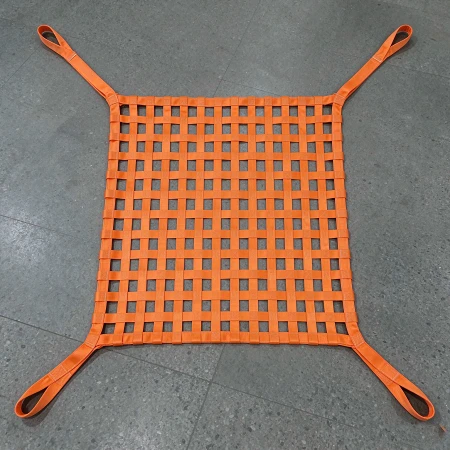
We build these nets to order in Taizhou: band width and layer, malla, tamaño neto, lifting points and printing are set from the load, and each net is proof tested on our own bed before it leaves with its capacity label and material test report.
Why polyester at this rating
Ás 20 t the net is under load for a long time and usually lifted many times a week, so stretch matters more than it does on a one-off lift. That is what decides the fibre.
| Poliéster (PET) | Nylon (PA) | |
|---|---|---|
| Stretch under a steady load | Low — the net stays square and the load stays level | Markedly higher; the net settles and the load can tilt |
| Absorción de choque | Moderado | Best in the family; 18–22 % alongamento en rotura |
| Absorción de auga | Moi baixo, dries quickly | Sobre 4 %, with some strength loss when saturated |
| Repetitive crane cycles | The usual choice | Better where pickups are rough |
| Temperatura de traballo | -40 °C a +100 °C | Lower at the top end |
| Best fit for a 20 t carga | Ensacado, palletised, bundled or stacked cargo lifted on a cycle | Irregular or shocky loads that must settle into the mesh |
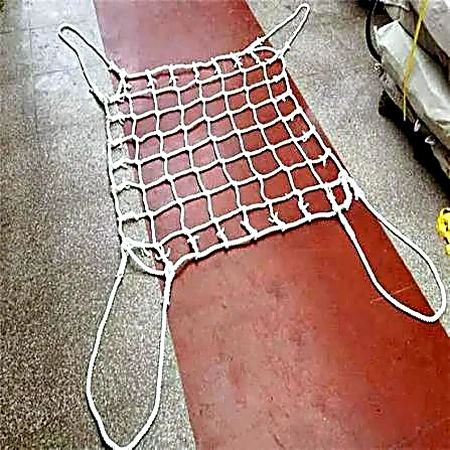
What changes when the rating goes to 20 t
Capacity is not a property of the net’s size. It comes from four things moving together: a banda, the number of load-bearing bands under the load, the corner points, and the hardware the points gather onto.
| Load band | Band and build | Malla | Puntos de elevación | What else changes |
|---|---|---|---|---|
| 2 – 5 t | 50 mm single layer | 100 mm | 4 corners | Standard warehouse net |
| 5 – 10 t | 50 – 75 mm, duplex on the load run | 100 mm | 4 corners, 8 a petición | Heavier border, reinforced loops |
| 10 – 20 t | 75 – 100 mm dúplex | 100 – 150 mm | 8 points | Master ring or spreader beam; net built to drawing |
| 20 – 30 t | 100 mm dúplex, band count from the load face | 150 mm | 8 points | Spreader beam in the assembly; proof test per net |
| Arriba 30 t | 100 mm multi-layer or wider pitch | 150 – 200 mm | 8 points or more | Engineered and tested to the lift, not to a catalogue |
Build steps above 10 t are our standard practice; the rating of any individual net is fixed by its own proof test and quoted from that certificate.
Seguen dúas consecuencias. Primeiro, the corner loops and the master link or spreader have to be rated for the same 20 t — a net rated 20 t en a 10 t ring is a 10 t montaxe. Segundo, the same net can be rated differently for four points and eight: the label states the arrangement it was tested in, and lifting it another way changes what it may carry.
Sizing the net to a 20 t carga
A lifting net must be bigger than the load, or the cargo sits on the border instead of inside the mesh and the corner loops pull straight up through it.
- Flat form: allow at least 100–150 mm of net beyond the load on every side, and more where the sides are vertical or the load is loose. A 2.0 × 2.0 m load therefore takes a net of about 2.3 × 2.3 m or larger.
- Forma de bolsa: the flat width has to wrap up the sides and close over the top, así flat width = footprint + 2 × bag depth. A 1.2 m footprint in a 0.6 m deep bag needs about 2.4 m across.
- Corner legs: the four or eight legs have to reach the hook or master ring without lifting the border off the cargo — a common reason a net that fits the load is still too small for the lift.
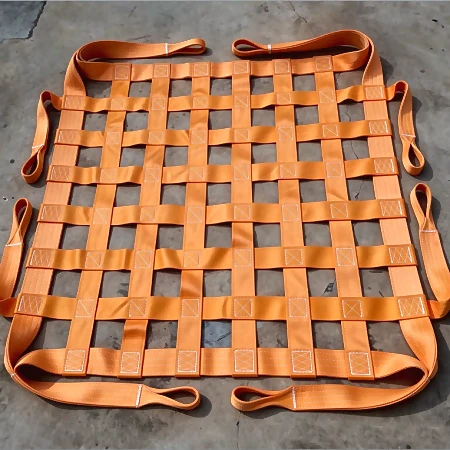
Malla: tamaño da carga, non a tonelaxe
Mesh decides what cannot escape the net; tonnage decides how strong the bands are. A heavy net with too open a mesh spills small items whatever its rating.
| Dimensión de carga máis pequena | Typical cargo at 20 t | Malla para especificar |
|---|---|---|
| Baixo 75 mm | Small castings, compoñentes a granel, drummed goods | 100 mm diamond, or a closed bag net |
| 75 – 150 mm | Ladrillos, bagged goods, pedra partida | 100 – 150 mm |
| 150 – 250 mm | Sawn packs, bundled tube, caixas de cartón, chatarra | 150 – 200 mm |
| Acabado 250 mm | Bloques, large stone, restos de demolición | 200 – 300 mm |
Especificación
| Parámetro | Especificación |
|---|---|
| Tipo | Open flat webbing lattice, four or eight lifting points |
| Material da banda | 100 % poliéster de alta tenacidade (PET); nylon or UHMWPE on request |
| Ancho de banda | 75 – 100 mm for this class |
| Band build | Dúplex (dobre capa) on the load-bearing run, single layer elsewhere |
| Abertura de malla | 100 – 150 mm; square standard, diamond on request |
| Tamaño neto | Normalmente 4.0 × 4.0 m a 6.0 × 6.0 m, or to the load footprint |
| Límite de carga de traballo | 20,000 kg in the rated arrangement |
| Factor de seguridade | 7:1 - Carga de rotura mínima 140,000 kg |
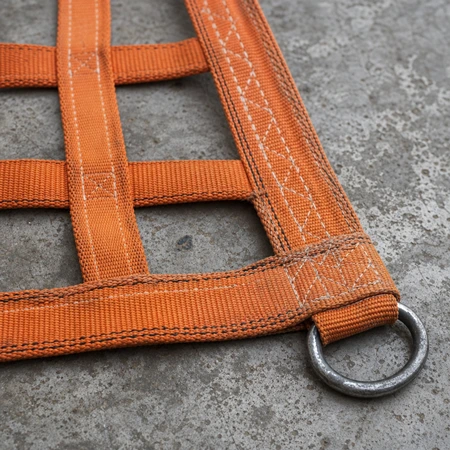
| Borde e esquinas | Doubled border, empalmado nas esquinas; reinforced loops, four or eight |
| Accesorios | Master ring or grade 80 grilletes; spreader beam for eight-point lifts |
| Tratamento | UV estabilizado, anti-envellecemento, abrasion-resistant finish |
| Temperatura de traballo | -40 °C a +100 °C |
| Marcado | WLL, arrangement, net size and identification on a sewn label; band printing on request |
| Documentación | Capacity label, material test report, Marcado CE; tested on our own 1000 t bed |
| Código HS | 630790 |
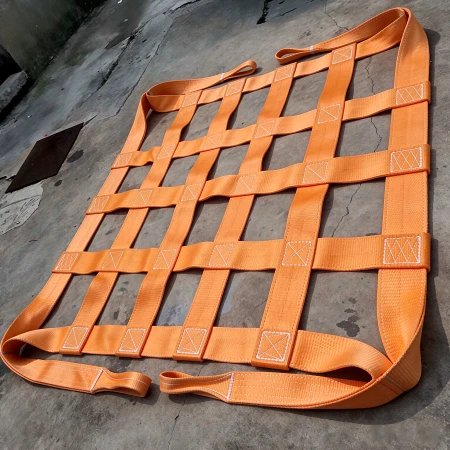
Eight points, non catro, once the load is long
Twenty tonnes gathered onto four corner loops means each loop carries about 5 t before any angle is taken into account; from eight points it is 2.5 t each, and the load face stays square instead of bowing in the middle. That is why an eight-point net is paired with a spreader beam or a master link rather than hung from a single hook.
- Four points suit square, compact loads where the net is only holding the cargo together;
- Eight points suit long or wide loads, and any lift where the net must stay flat under load;
- The spreader or master link, the slings above it and the hook must each be rated at least 20 t;
- Never lift from fewer points than the net was rated for, and never knot or shorten a leg to take up slack.
The leg sees more than the share: ás 45 deg from the vertical, a 2.5 t share becomes about 3.5 t along the leg (2.5 / cos 45), which is why the slings above the net are sized from the angle, not from the load divided by eight.
Inspection and retirement
| Comproba | Retire or repair if |
|---|---|
| Corner loops and their stitching | A loop is deformed, the stitching is broken, or the band is cut at the throat |
| Borde | The border is cut, flattened, or has pulled out of a corner |
| Load-bearing bands | Any band is cut, profundamente desgastado, heat glazed or chemically stained |
| Mesh geometry | The lattice is distorted from an overload — the net no longer sits square |
| Costura | Stitch lines are broken or pulled at a crossover |
| Label and printing | The WLL or the arrangement is illegible — an unlabelled net cannot be rated |
Inspect before each lift and have the net examined by a competent person at the interval your site sets. Gárdao limpo e seco, fóra do chan e fóra do sol directo; never knot, weld or heat-repair a webbing net.
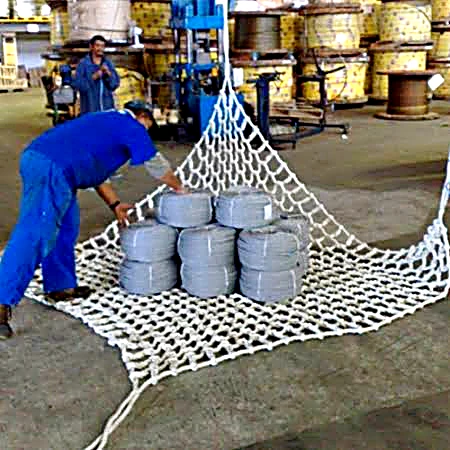
Como se constrúe, and how the rating is proven
- Bands woven, not cut from sheet. The webbing is woven to width and stitched into the lattice at the crossover points, with the stitch pattern set so the thread takes shear rather than peel.
- Lattice laid square. The mesh is set out from the drawing before stitching, so the bands under the load line up with the load face instead of running diagonally.
- Border spliced into the corners. The doubled border carries the load from corner to corner, so no single stitch line carries the lift; the loops are formed out of the border.
- Proof tested, then labelled. Each net is loaded on our own bed and fitted with a label stating the working load limit, the arrangement it was tested in and the net number.
The same works weaves webbing and presses wire rope ferrules, which is why a net, a cabestrillo de correas e a eslinga de cable de arame on the same lift can be matched in rating rather than bought from three suppliers.
Onde a 20 t net does the work
| Sector | O que levanta a rede | Construción habitual |
|---|---|---|
| Aceiro e fabricación | Paquetes, seccións, stillage loads | Rede plana, 100 mm dúplex, eight points |
| Stone and quarry | Bloques, pedra partida, cobbles | Forma de bolsa, 150 malla mm, corner patches |
| Portos e terminais | Bagged and unitised cargo, quay work | Flat net on a spreader, WLL impreso |
| Madeira | Sawn packs, polos, sleepers | Flat or bag, 150 – 200 malla mm |
| Scrap and recycling | Chatarra mixta e abrasiva | Large mesh, wear bands at the corners |
| Precast concrete | Units, aneis, paneis | Flat net with edge sleeves, eight points |
Preguntas frecuentes
É o 20 t rating for the net or for the whole assembly?
The net is rated 20 t in the arrangement it was tested in — four or eight points, on the fittings supplied. The assembly as lifted is limited by its weakest part, so the master link, grilletes, spreader and slings above must be rated at least 20 t as well.
Why is the safety factor 7:1 e non 5:1?
7:1 is the factor we build to for this class, which gives a 140 t Carga de rotura mínima para a 20 valoración t. Where a site works to 5:1, say so at enquiry and the net is built to that factor instead — the rating on the label always states what it was made to.
Polyester or nylon for a 20 t levantar?
Polyester where the load is lifted on a cycle and must stay level — its lower stretch keeps the net square. Nylon where the pickup is shocky or the cargo is irregular and has to settle into the mesh; it stretches far more, which absorbs the jolt but lets the load tilt.
How big a net do I need for a 2 × 2 m load?
At least 2.3 × 2.3 m to give 150 mm of overhang on every side, plus enough corner leg to reach the hook without pulling the border up over the cargo. Send the footprint and the hook height and the leg length is worked out from those two.
Can it be lifted by a single hook?
Yes on four points, where the four loops gather on a master ring under the hook. On eight points a single hook would pull the net into a cone, so a spreader beam or a two-leg arrangement is used instead.
Can you print our brand and the WLL on the net?
Yes — WLL, arrangement, tamaño neto, fleet number and your own brand can be printed along the band, with a sewn label as well. Yards running a fleet of nets usually ask for it.
Solicita cotización
Send the load and how it is presented
The cargo — what it is, como está embalado, and the weight as presented for the lift;
The footprint — length × width, plus height if a bag form is needed;
The lift — four or eight points, altura do gancho, and whether a spreader beam is available;
The duty — how many lifts a week, indoors or on a quay, and the temperature range;
The paperwork — CE marking, test report and own-brand printing if you need them.
Onde ir a continuación
- Red de elevación de carga con correas — the standard 2–10 t range;
- Heavy duty nylon flat webbing net — the same lattice in nylon;
- Rede de carga de corda de nailon — rope construction to 50 t;
- Heavy duty cargo net sling — closed bottom for loose cargo;
- Elevación de vigas esparcidoras for eight-point lifts;
- The whole cargo lifting net range e contact.