

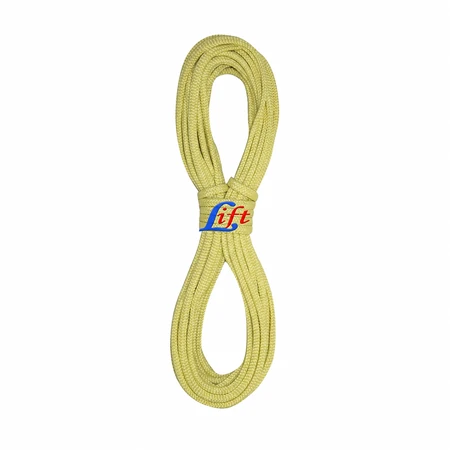
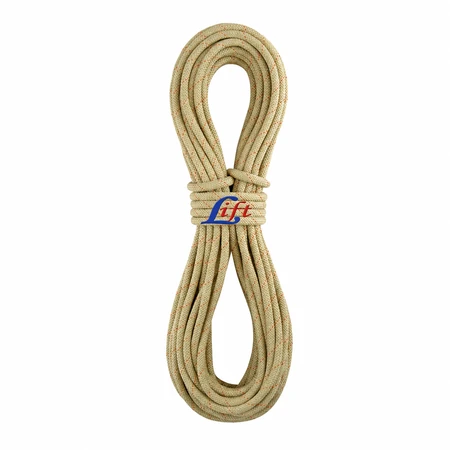
Lift sling rigging company produce Fire Escape Rope.
Fire Escape Rope for Buildings – Braided Emergency Descent Rope
A rópa éalaithe dóiteáin is a fixed or portable descent rope kept ready at a window, balcony or roof access point so that people can leave a building when the normal exits are blocked. Lifute manufactures braided fire escape ropes in high-tenacity nylon, polyester and heat-resistant aramid, in diameters from 8 mm chuig 16 mm, supplied with thimble eyes, storage bags and wall-mount anchor plates. The rope is low stretch, easy to grip even when wet, and is woven with an optional reflective tracer so it can be found in a smoke-filled or unlit room.
Fógra sábháilteachta. Fire escape and emergency descent equipment is life-safety equipment. This product is supplied as a rope component, not as a complete escape system. It must be used only with a certified descender device and a full-body harness, only by people trained in its use, and only after the anchor point has been checked by a competent person. Confirm the standard that applies in your market before you place an order.
Product Highlights
- Braided low-stretch construction– holds its shape under load, does not kink or spin, and stays easy to grip with gloves.
- Three builds– standard braided nylon or polyester, heat-resistant aramid, and a steel-wire-core version for cut resistance.
- 8 mm chuig 16 mm– from single-person domestic escape to multi-person and rescue duty.
- Optional reflective tracer– a reflective yarn woven into the sheath makes the rope visible in low light and smoke.
- Ready-to-install kits– súil thimble, storage bag and wall-mount anchor plate supplied as a set.
- Lengths from 10 m chuig 50 m– matched to the escape height of the building.
- Heat and abrasion resistant options– for kitchen areas, plant rooms and industrial sites.
- OEM / ODM réidh– dath saincheaptha, printed label and branded storage bag.
Types of Fire Escape Rope
There is no single correct fire escape rope. The right build depends on the escape height, the surrounding environment and the descent device you intend to use. These are the three builds we produce most often.
| Cineál | Tógáil | Is fearr le haghaidh | Nótaí |
| Braided nylon / poileistear | 16-strand braided sheath over a parallel core | Domestic buildings, hotels, schools, offices | The standard choice. Stráice íseal, lámh bog, saol abrasion maith, easy to store. |
| Heat-resistant aramid | Braided aramid sheath, croí aramid | Kitchens, seomraí plandaí, industrial and marine sites | Withstands much higher temperatures than nylon or polyester ★. Higher cost per metre. |
| Steel-wire-core | Braided synthetic sheath over a galvanised steel wire core | Higher cut and theft resistance, industrial duty | Heavier and stiffer. Also available as a separate product in the same escape range. |
Product Specifications of the Fire Escape Rope
The table below covers the standard range. Trastomhas, fad, dath, termination and accessories are all configurable, and we produce to your drawing or sample for OEM orders.
| Paraiméadar | Sonraíocht |
| Ainm an táirge | Téad éalaithe dóiteáin (braided emergency descent rope) |
| Múnla | LF-ER-16S (cóid mhúnla saincheaptha ar fáil le haghaidh orduithe OEM) |
| Tógáil | 16-strand braided sheath over a parallel core; 12-strand and steel-wire-core versions available |
| Roghanna snáithíní | poileistir ard-tionachta (PES), níolón (PA), heat-resistant aramid |
| Diameter range | 8 mm – 16 mm |
| Trastomhais chaighdeánacha | 8 mm, 10 mm, 12 mm, 14 mm, 16 mm |
| Minimum breaking
strength ★ |
8 mm approx. 12 kN (1,200 kg)
10 mm approx. 18 kN (1,800 kg) 12 mm approx. 26 kN (2,650 kg) 14 mm approx. 34 kN (3,470 kg) 16 mm approx. 44 kN (4,490 kg) |
| Elongation ★ | Stráice íseal, thart 3-5% ag 50% of the breaking load |
| Sheath | Braided, resistant abrasion; heat-resistant sheath in the aramid version |
| Reflective tracer | Optional reflective yarn woven into the sheath for low-light and smoke visibility |
| Heat resistance ★ | Standard nylon / poileistear: continuous use to approximately 80 °C
Aramid version: short-term exposure to approximately 200 °C |
| Roghanna datha | Oráiste (caighdeánach), buí, dearg, bán, dubh; dathanna saincheaptha ar iarratas |
| Faid caighdeánach | 10 m, 15 m, 20 m, 25 m, 30 m agus 50 m; custom lengths to order |
| Foirceann | Súil spliced, spliced eye with steel thimble, crúca, or plain end with a stopper knot |
| Gabhálais | Storage bag, wall-mount anchor plate, descender device (roghnach, supplied separately) |
| Pacáil | Coil in a storage bag, ansin cartán a onnmhairiú |
| MOQ ★ | Ó 200 pcs per diameter and colour; lower trial quantity negotiable |
| OEM / ODM | Dath saincheaptha, lipéad clóite, branded storage bag and header card |
| Tagairt
standards ★ |
IN 1891, IN 341 (descender devices), NFPA 1983 – certificate and test report to be confirmed for your market |
| Áit tionscnaimh | Jiangsu, tSín |
The figures above are given for reference. The certified values for a specific fibre, diameter and construction are confirmed on the order and can be supported by a test report.
Construction and Key Features
The rope is built as a braided sheath over a parallel core. The sheath takes the abrasion where the rope crosses a window sill or parapet, and the core carries the load. Because the braid is balanced, the rope does not spin or hockle while it is being paid out, which matters when someone is descending with limited visibility and limited time.
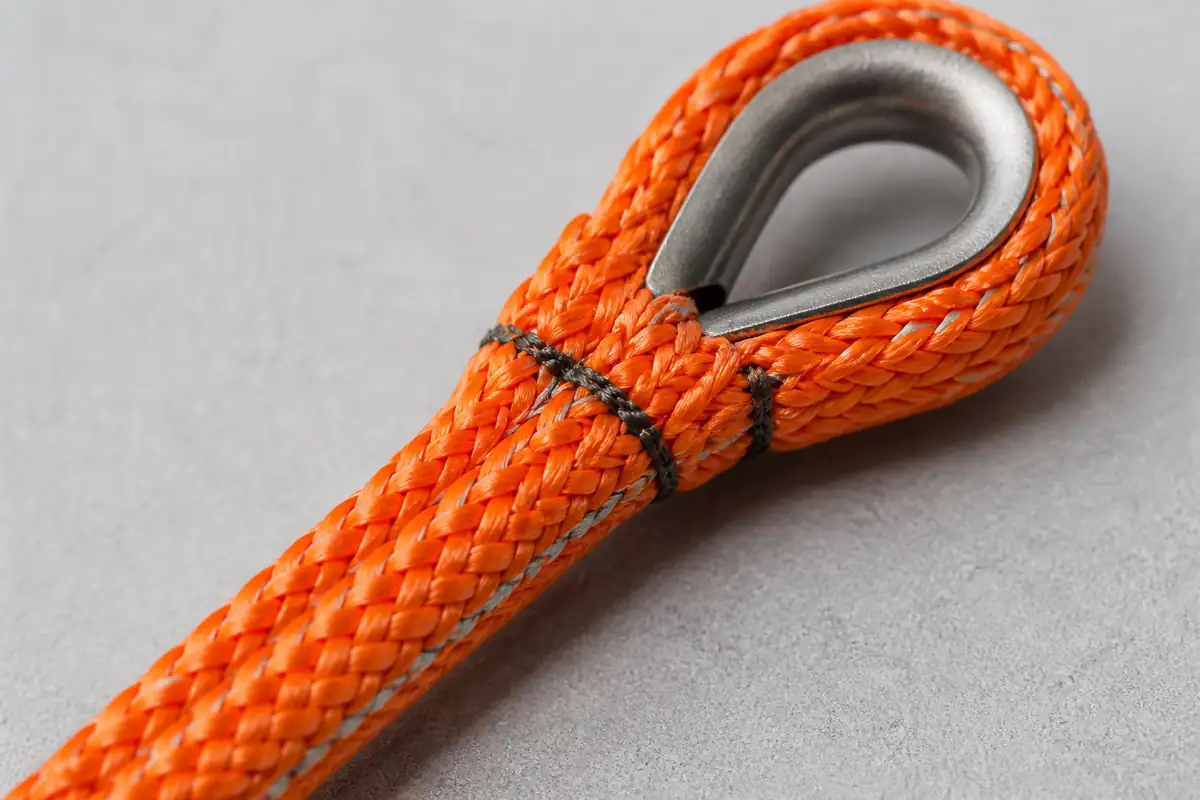
The braided sheath and its spliced thimble eye. The steel liner protects the eye where it bears on an anchor ring or hook, which is the point that wears first on a stored escape rope.
- 16-strand braided sheath– distributed wear, no core-to-sheath slippage, and a soft hand that grips well even when wet.
- Parallel load-bearing core– low stretch under load, so the rope does not surge while someone is descending.
- Spliced thimble eye– a steel thimble at the anchor end, which is where a stored rope wears fastest.
- Optional reflective tracer– woven reflective yarn keeps the rope findable in smoke and low light.
- Heat-resistant aramid option– for locations where the rope may be exposed to heat or flame.
- Heat-sealed and whipped ends– the braid will not unravel in storage or after repeated deployment drills.
- Batch-labelled– each rope is labelled with fibre, trastomhas, fad, production batch and a next-inspection date, which is what an auditor will ask for.
Fire Escape Rope vs. Rope Ladder vs. Descender System
These three products are often specified together rather than instead of each other. The right answer depends on who is expected to use it: a trained responder, or an untrained occupant trying to leave a smoke-filled flat.
| Gné | Cluiche Líne Téad Éalú Dóiteáin | Rope Ladder | Descender Escape System |
| Descent method | Controlled descent using a descender, gloves or a friction hitch | Climbing down fixed rungs | Hands-free, speed controlled by the device |
| Skill required | Níos airde – requires training and practice | Low to moderate | Íseal – the device governs the descent speed |
| Suitable for | Trained staff, rescue teams, a second escape route | All occupants, including children and older people | All occupants, high-rise, hotels and public buildings |
| Stóráil | Coil in a bag or a wall-mounted box | Rolled or folded on a hook | Wall cabinet at each escape point |
| Height suitability | Any height, given the correct rope length | Typically up to 3-4 floors | Multi-storey, with a braking mechanism |
| Relative cost | Ísle | Íseal | is airde |
How to Choose the Right Fire Escape Rope
- Measure the escape height, not the building height.Work from the height of the escape window down to the ground or to the first safe landing, then add 15-20% for the anchor and for the person landing.
- Match the diameter to the duty.8-10 mm suits a single person with a descender, 12 mm is the usual general-purpose size, agus 14-16 mm is for rescue teams, repeated use and higher loads.
- Decide whether heat resistance is needed.Standard nylon or polyester is right for an ordinary residential or office escape point. Choose the aramid version where the rope is stored or deployed near heat, plant rooms or cooking areas.
- Decide whether cut resistance is needed.Where the rope may run over a sharp parapet, glass or a broken edge, specify the steel-wire-core version or pair the rope with a protective edge sleeve.
- Choose the anchor arrangement.A wall-mount anchor plate beside the escape point keeps the rope ready and the anchor verifiable, and it is the arrangement most likely to satisfy a fire inspection.
- Order the full kit.Rópa, súil thimble, mála stórála, anchor plate and – where the descent is controlled – a certified descender and harness. A rope on its own is not an escape system.
| Building height | Escape height (thart.) | Recommended rope length |
| 3 floors | suas go dtí 10 m | 15 m |
| 5 floors | suas go dtí 15 m | 20 m |
| 8 floors | suas go dtí 25 m | 30 m |
| 12 floors | suas go dtí 40 m | 50 m |
Indicative only. Confirm the escape height on site and allow 15-20% extra rope for the anchor point and the landing.
Suiteáil, Cigireacht agus Cothabháil
A fire escape rope is only useful if it is still fit for use on the day it is needed. That means storage discipline and a recorded inspection routine.
- Fix the anchor point properly.The anchor and its fixing must be installed and checked by a competent person, in a position that lets the user reach the rope from the escape opening without leaning out.
- Store it dry and out of sunlight.Use the storage bag or a wall box. Damp rope in a sealed bag is where mildew starts.
- Inspect at least every six months and after every deployment drill.Check for chafed or glazed sheath, stiff or flattened sections, gearrthacha, grit leabaithe, and any damage near the thimble eye.
- Record the inspection.Note the date, the inspector and the result on the rope label or in the building safety log. Fire inspections ask for this.
- Clean with fresh water only.No detergents, solvents or bleach, which attack synthetic fibre.
- Replace, do not repair.A life-safety rope that has taken a shock load, has a damaged sheath or has passed its service interval should be retired rather than patched.
- Train and practise.A rope and a descender that have never been handled before an emergency are a liability. Schedule practical drills.
Feidhmchláir
We supply fire escape ropes to building owners and facility managers, fire-protection contractors, hotels, schools, industrial plants and marine operators, as well as to distributors who resell them under their own brand.
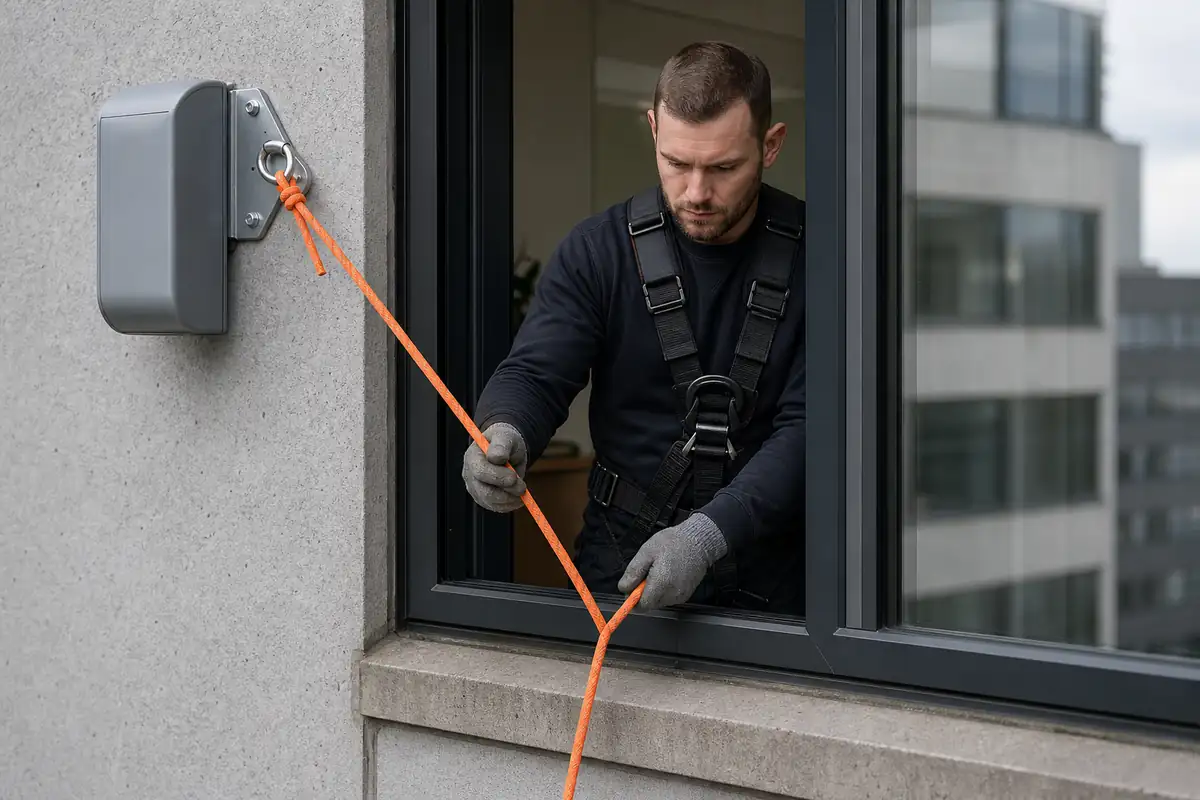
A fire escape rope stored at a window escape point. The wall-mounted box and anchor plate keep the rope ready and the anchor verifiable during a fire inspection.
- High-rise residential and apartment buildings
- Hotels, hostels and serviced apartments
- Offices, schools, hospitals and public buildings
- Construction sites and temporary accommodation blocks
- Industrial plants, warehouses and plant rooms
- Confined space access and rescue standby
- Facade access, window cleaning and maintenance backup
- Marine and offshore escape routes
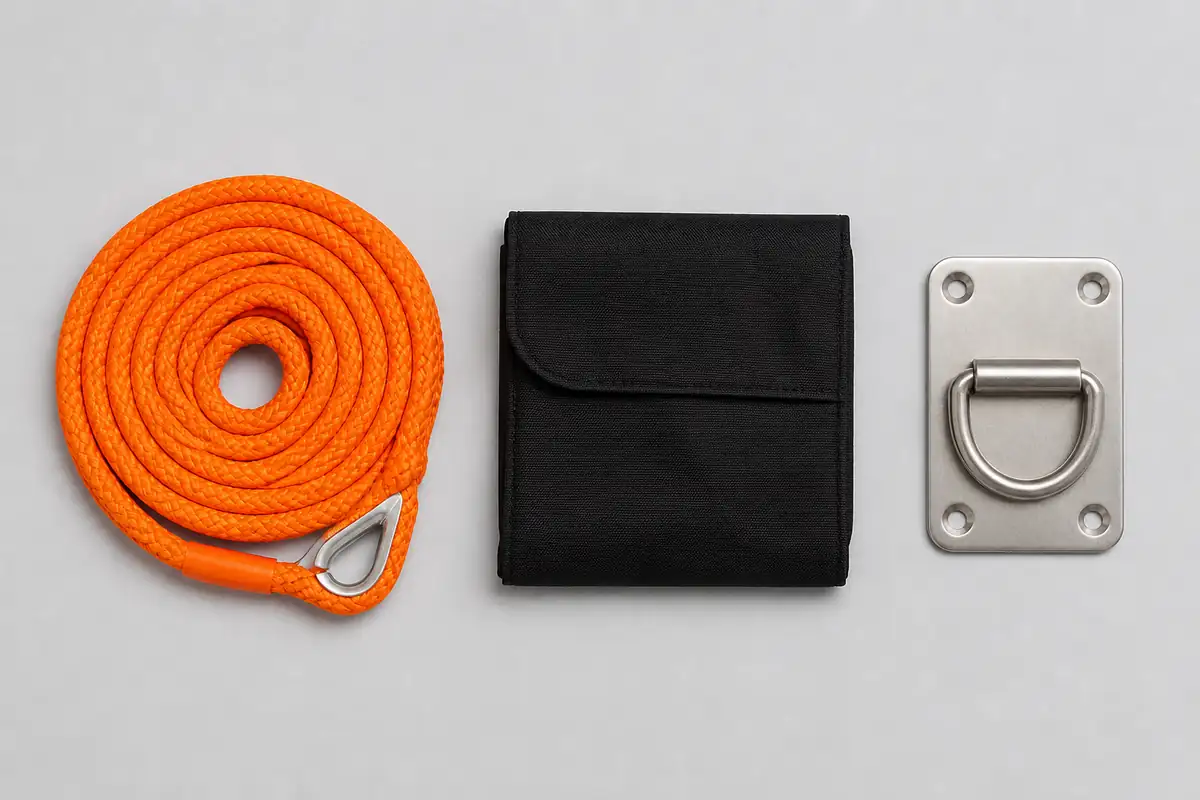
A standard escape kit: braided rope with a thimble eye, a storage bag and a steel wall-mount anchor plate. Descender devices and harnesses are supplied separately on request.
Why Buy Fire Escape Ropes From Lifute
Ardaitheoir Sling Rigging Co., Teo. has manufactured rope, rigging and safety products in Taizhou, Jiangsu Cúige ar feadh beagnach tríocha bliain. We already supply the escape and rope-ladder range to building-safety and fire-protection contractors, so this rope is made on the same lines, with the same braid construction and the same batch labelling on every order – which is what matters when the rope has to pass an inspection years after it was bought.
- Praghsanna monarcha-dhíreachon trial orders and full container loads.
- Tacaíocht OEM agus ODM– dath saincheaptha, printed labels, branded storage bags and header cards.
- Kits assembled in house– téad, meirleach, bag and anchor plate shipped as a matched set.
- Related escape products from the same factory– rope ladders, steel-wire-core fire rope and static safety ropes can ship together.
Ceisteanna Coitianta
C1. What is a fire escape rope used for?
A fire escape rope is a descent rope kept ready at a window, balcony or roof access point so that people can leave a building when the stairs or corridors are blocked by fire or smoke. It is used with a descender device and a harness by trained people, or as a second escape route alongside a rope ladder or a fixed escape system.
C2. What length of fire escape rope do I need?
Measure the escape height – the height from the escape opening down to the ground or to the first safe landing – and add 15-20% for the anchor point and for the person landing. Mar threoir, a 3-floor escape point takes about 15 m, a 5-floor point about 20 m, an 8-floor point about 30 m and a 12-floor point about 50 m.
C3. What is the load capacity of the fire escape rope?
Minimum breaking strength ranges from approximately 12 kN (faoi 1,200 kg) ag 8 mm to approximately 44 kN (faoi 4,490 kg) ag 16 mm, depending on the fibre and construction. Breaking strength is not a working load: with a descender system, always work to the safe working load stated by the descender manufacturer, which will be far lower. The certified value for your specific rope is confirmed on the order.
C4. What is the difference between a fire escape rope, a rope ladder and a descender system?
A fire escape rope is a descent line that the user controls with a descender or a friction hitch, so it needs training. A rope ladder is fixed rungs that anyone can climb down, but it is usually limited to about three or four floors. A descender escape system provides a device that controls the descent speed automatically, which makes it suitable for untrained occupants in high-rise buildings. Many buildings specify more than one of the three.
Q5. Is a fire escape rope heat resistant?
The standard nylon and polyester versions suit ordinary residential and office escape points and should be kept away from direct heat. For kitchens, seomraí plandaí, industrial sites and marine applications we supply a heat-resistant aramid version that withstands much higher short-term temperatures. Tell us the environment and we will recommend the right build.
Q6. Can you supply storage bags and wall-mount anchor plates?
Tá. The rope is normally supplied as a kit with a storage bag and a steel wall-mount anchor plate with a thimble eye, so it is ready to fit at the escape point. Descender devices and harnesses can be quoted separately – they are not part of the rope product.
Q7. How often should a fire escape rope be inspected and replaced?
Inspect it at least every six months and immediately after any deployment drill or suspected damage. Replace it if the sheath is chafed, gloinithe, cut or flattened, if the rope has taken a shock load, or if it has reached the service interval set by your fire-safety regime. Record every inspection on the rope label or in the building safety log.
Q8. Cad é an MOQ agus an t-am seachadta?
The standard minimum order quantity starts from 200 pieces per diameter and colour, and lower trial quantities can be discussed for a first order. Production time depends on the fibre, trastomhas, fad, thimble and whether OEM labels or branded bags are involved; confirm your quantity, length and destination port and we will quote a schedule with the price.
Request a Quote for Fire Escape Ropes (CTA block)
Tell us the escape height, the diameter and length you need, whether heat or cut resistance is required, and whether you want the kit with a storage bag and anchor plate. We will reply with pricing, sonraí pacála agus sceideal táirgeachta. Samples and spliced thimble eyes can be arranged before mass production.
Ardaitheoir Sling Rigging Co., Teo. (Lámhaigh é) – Páirc Tionscail Lifute, Cathair Taizhou, Cúige Jiangsu, tSín | Teil / WhatsApp: 18066002268 | R-phost: 702461526@qq.com
Related Products in the Escape and Rope Range
- Emergency escape lifeline and steel-wire-core fire escape rope (/product/yj.html) – for higher cut resistance at industrial escape points.
- Life safety rope (/product/life-safety-rope.html) – for rescue teams and technical rope work.
- Fire safety rope and static safety rope (/product/dlfdfdd.html) – low-stretch rope for fixed installations.
- Rope ladder (/rope-ladder/) – for occupants who cannot use a descender.
- All nylon ropes (/nylon-rope/) – the full rope range from the same factory.
- Nylon safety nets (/nylon-safety-net/) – for fall protection and catch-net installations.