

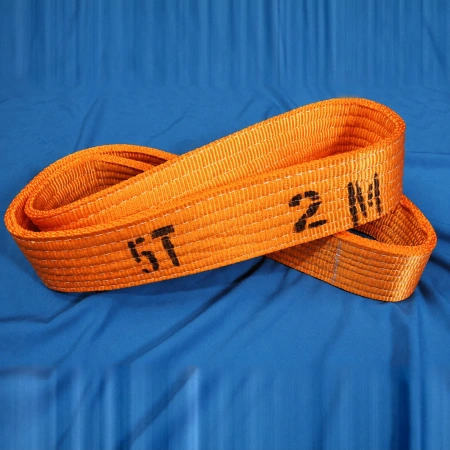
Lift sling rigging bedriuw produsearje 2 Ply Webbing Sling,2-ply web sling,2-Ply Web Lifting Sling,2-ply Flat Web Sling with a Twisted Eye,Double Ply Polyester Web Sling,2-Ply Lifting Sling Strap,2-Ply Nylon Eye & Eye Web Sling,2-Ply Web Lifting Sling,Double ply webbing sling.
2 Ply Webbing Sling
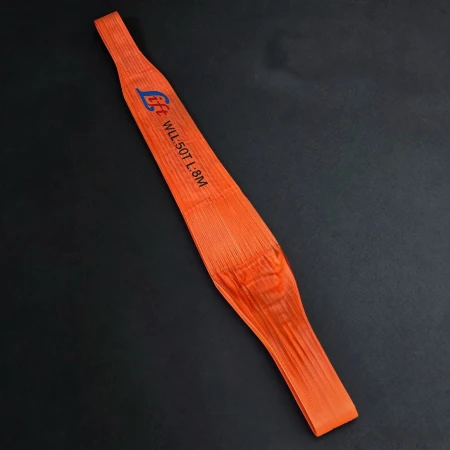
Two layers in the one band, an eye at each end. The same width as a single ply sling with twice the section — more capacity where the width is capped, and a softer face on finished work.
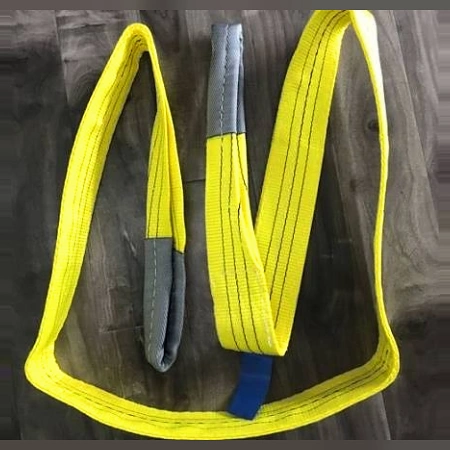
The number in front of the word ply answers one question only: how many layers of webbing are in the band the sling is made from. It does not mean two slings, and it does not mean a band doubled over on the hook. Everything else follows from it — the thickness, it gewicht, the capacity a given width can be marked at, how softly the band beds onto the load, and how much material an edge has to work through.
What the second layer buys on an eye-and-eye sling
Op in slinger mei eagen, the band does two jobs: it carries the load between the eyes, and it presents a face to the load. The second layer changes both, and a third thing besides:
- Capacity at a fixed width. A wide band is not always available — the hook is small, the gap is tight, the load is narrow. Ply is what is left to raise the figure without widening the band.
- A softer bearing face. Two layers make a thicker, more compliant stack between the load and the load-bearing core, so contact pressure spreads and a machined or coated surface is less likely to be marked.
- Abrasion reserve. Where the band works over a rough but not sharp edge, there is a second layer behind the first: wear has further to travel before the load path is affected.
- A stiffer band. It lies down across a plate or a machined face instead of curling at the edges, which keeps the contact full width — and it also means the eye sits flatter on the hook.
Wêr 2 ply sits in the family
The same construction is made in one, twa, trije, four and more layers. The table is qualitative on purpose: the builds are sold as builds, and the figure that applies to a particular sling is the one proof tested and printed on it, not a number copied off a web page.
| Single ply | 2 ply | 3 ply | 4 ply | |
|---|---|---|---|---|
| Layers in the band | Ien | Twa | Trije | Fjouwer |
| Ôfdieling | Thinnest | Roughly twice the single-ply section | Thicker again | Thickest build |
| Capacity at the same width | Baseline | Heger | Higher again | Heechste |
| Bearing gesicht | Firm, wiid | Sachter, thicker stack | Softer again | Most forgiving |
| Behanneling | Folds small, tight radius | Stiver, sits flat on the hook | Stiffer again | Least supple |
| Usual duty | General yard work, light to medium | High figure in a capped width, finished surfaces | Swiere plicht, precast and machined work | Heaviest duty, maximum cushioning |
Two of those neighbours have their own pages: de 3 ply webbing sling en de 4 ply webbing sling, with the whole 2/3/4/6/8 ply family collected in one place.
De eintsjes: flat each, fold each, ferdraaid each
On an eye-and-eye sling the ends are a specification line, gjin detail. They decide how the band sits on a hook, whether the sling can be used in a choker at all, and how the last of the fibres at the end are protected — and the end is where a band wears out first.
| Ein | Hoe sit it | Wêr is it foar |
|---|---|---|
| Flat loop | The band turns back on itself and is closed flat; the loop hangs in the plane of the band | Lichte plicht, soft loads, the cheapest end and the easiest to inspect |
| Folded eye | The end is folded and closed so the eye presents a thicker, rounder bearing on the hook | Where the hook is small and the band must not crease at the eye |
| Fersterke each | Extra material and stitching at the eye | Heavy duty and repeated choker work — the eye is the wear point |
| Ferdraaid each | The eye is turned through ninety degrees to the band | Ferstik: the band lies in the plane of the hook, so the wrap beds down instead of standing off |
If the sling will be choked, say so at the enquiry. A twisted eye costs very little on the order and cannot be added afterwards, and a choked figure is 0.8 of the vertical one either way — so the eye decides whether the choke works, not what it is rated at.
Ien band, ferskate sifers: the hitch decides the rating
In singelband hat net ien kapasiteit. It has one in vertical, in oare yn koer en in legere stikken, en it label stiet elk fan harren. Buying on “the tonnage” alone is the most common error in this category. The factors below are the standard ones this site publishes; the angle is the leg angle to the vertical, and the label on the article overrides the table.
| Arrangement | Mode faktor | Wat it betsjut op 'e flier |
|---|---|---|
| Fertikaal | 1.0 | Ien skonk, rjocht op. De band hinget en draacht. |
| Fersmoarge | 0.8 | Band round the load and back through its own eye; de omslach grypt en de bân wurdt tsjin himsels laden. |
| Koer, 0–45° | 2.0 | Band ûnder de lading, beide eagen op 'e heak, skonken near fertikale. |
| Koer, 45–60° | 1.4 | Deselde koer mei de skonken ferspraat; de ferspriedingskosten kapasiteit. |
| Twa skonken, 0–45° | 1.4 | Twa slingers oan ien heak, load dield. |
| Twa skonken, 45–60° | 1.0 | The same pair, spread. |
| Trije en fjouwer poaten, 0–45° | 2.1 | Not three or four times the figure — the load rarely shares evenly. |
| Trije en fjouwer poaten, 45–60° | 1.5 | Deselde regeling ferspraat. Kontrolearje earder as oannimme. |
Twa konsekwinsjes binne it wurdich om dúdlik te sizzen. In fersmoarge slinger is swakker as deselde slinger dy't fertikaal brûkt wurdt, dus in lading dy't fersmoarge wurde moat, hat in gruttere band nedich as in langere. And as the legs spread the capacity falls — a geometric fact, answered by a different arrangement, a spreader or a bigger sling, en troch neat oars.
Colour tells you the figure; it label is it antwurd
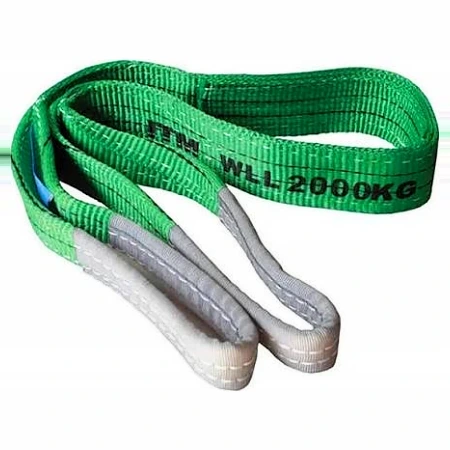
Flat webbing slings are colour-coded by working load limit under the convention most of the market uses, and this site follows it:
| Kleur | Working load limyt | Where it helps |
|---|---|---|
| Fiolet | 1 t | Separating the light bands in a mixed pile |
| Grien | 2 t | The most common general-purpose band in a yard |
| Giel | 3 t | Fast identification on a busy site |
| Griis | 4 t | Mid-range duty |
| Read | 5 t | The step where handling starts to need two hands |
| Brún | 6 t | Heavy general duty |
| Blau | 8 t | Structural and plant work |
| Oranje | 10 t | Top of the coded range |
It is a fast check and nothing more. Wat de kleur kin net dwaan is ferfange it label, because the figure that applies is the one printed and affixed to that individual sling — and beyond the top of the coded range there is no colour to read at all. Where the two disagree, or the label cannot be read, de slinger is bûten tsjinst.
Width is the other half of the specification
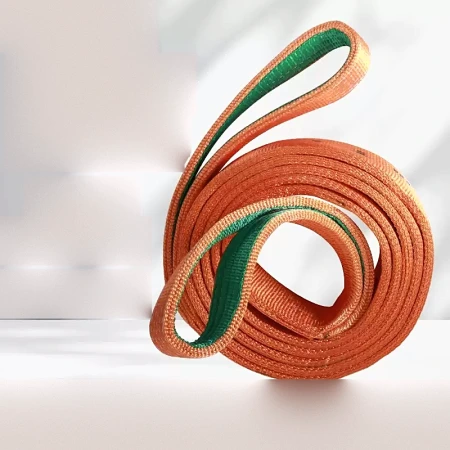
Width sets the pressure on the load and the figure the band can be marked at, and it sets what the band can be folded into. A narrow band concentrates the load and is right on a light, stive artikel; a wide band spreads it and is right on anything soft, coated of klear. The practical rule is the narrowest width that carries the figure without crushing the load — or the widest the load’s geometry will accept.
The range runs 25 mm oan 300 mm en breder, finished slings 0.5 m oan 100 m, by 7:1 as standard with 5:1, 6:1 en 8:1 te bestellen. The final width, ply and weight of a given sling are confirmed on the order acknowledgement, with the proof-test certificate behind them.
Against a wire rope, and against an endless loop
Two comparisons decide most enquiries. The first is the swap from steel, which is never about strength but about contact and handling; the second is the choice between an eye sling and a closed loop.
| Condition | 2 ply webbing sling | Wire tou sling |
|---|---|---|
| Finished of skildere oerflak | Wide soft contact, no marking — the reason to choose it | Marks and scuffs; hat padding nedich om te konkurrearjen |
| Gewicht te behanneljen | In fraksje fan in tou fan deselde figuer | Swier, stiff and awkward above a certain size |
| Skerpe rânen en burrs | Needs an edge protector or a sleeve, sûnder útsûndering | Omgean mei folle mear |
| Hot surfaces | Rûnom 100 °C wurkje limyt; fails by melting | Folle mear tolerant, hoewol net ûnbeheind |
| Abrasion and grit | Draacht fluch; the doubled band buys time, net immuniteit | The better answer where the environment is the attack |
| Reach along the load | The eyes fix where the band meets the load; a long load needs a long sling or two | Same constraint |
Against the endless form the difference is the eyes. An eye-and-eye sling presents two defined bearing points, which is what you want when the pick positions are fixed by lugs or a spreader; a closed loop can be wrapped anywhere along its length, which is what you want on a round section with no natural pick point. De double ply endless lifting sling is the same two layers in the other form — same band, different way of meeting the load.
Edges and sleeves: part of the specification
In band snije troch in râne begjint as in lytse notch en einiget as in mislearring, sadat râne beskerming is in spesifikaasje line yn stee fan in accessoire beslút. Dêr't de lading hat in skerpe hoeke, in machined lip, in burch, weld spatter or a rough casting skin, of de bân is sleeved en de sleeve is diel fan it artikel, of de hoeke wurdt beskerme mei in pad dat reizget mei de slinger. Ask at the enquiry stage: in mouw kin net retro-fitted oan in band al woven.
Ynspeksje, and what ends a sling’s life
Kontrolearje foar elk gebrûk, en formeel op it ynterval de site regels set. The conditions that remove a webbing sling from service are specific:
- soere of bytende brânwûnen, smelten of charring;
- snags, punctures, tears or cuts — on a 2 ply band, look for a cut that has gone through the outer layer;
- brutsen of droegen stiksels, particularly at the eyes and the joins;
- distortion of the eyes or of the band’s lay;
- a label that can no longer be read.
A sling with any of those is out of service because the damage is in the load path, net om't it der untidy útsjocht. Bewarje skjin en droech, út sinneljocht, en hâld it rekord mei it artikel.
Faak frege
Wat docht 2 ply mean on a webbing sling?
Two layers of webbing woven into the one band the sling is made from — not two slings and not a band doubled over on the hook. It gives a thicker section, more capacity at a given width and a softer bearing face than the single-ply build.
Does 2 ply double the capacity of a single ply sling?
Not literally. Two layers add substantial capacity at the same width, but the figure that applies is the one the sling is proof tested and marked at — it is not a multiplication of another sling’s number. Read the label on the article, per hitch.
Hokker each moat ik spesifisearje?
Twisted eyes if the sling will be choked, because the band then lies in the plane of the hook and the wrap beds down. Folded or reinforced eyes where the eye takes the wear, and flat loops for light duty where the cheapest inspectable end is enough.
Can I use it in a choker if it has flat eyes?
It can be done, but a flat eye stands off the load and the wrap beds unevenly, which is why the choked figure is 0.8 of vertical either way. On repeated choke work, specify the twisted eye and size to the choked figure rather than the vertical one.
Polyester or nylon for a 2 ply sling?
Polyester is the default: it stretches little, tolerates sunlight and keeps the hook height predictable. Nylon takes shock and abrasion better and is the right choice where the load lands rather than rises. De synthetic fibre comparison covers the rest of the range, including the temperature limits.
How is the sling marked?
Capacity colour in the weave, the working load limit and length printed on the band where the order calls for it, and a sewn label with the figure, materiaal, standard and traceability code. Own-brand labels and packing are available; HS koade 630790.
In offerte oanfreegje
Five lines and the sling is settled
The load — what it is, its surface, and where the eyes have to sit;
The figure per hitch — vertical, basket of choked, with the leg angle;
The width the hook and the load will accept;
De lingte, each yn each, and the eye type (flet, fold, fersterke, twisted);
The environment — edges, hjitte, chemicals — and the marking you need printed.
Wêr te gean neist
- Webbing slingers — the whole category, from the band to the end configuration;
- De 2/3/4/6/8 ply family, de 3 ply webbing sling en de 4 ply webbing sling;
- Synthetic fibre lifting belt slings - polyester, nylon, polypropylene, aramid and UHMWPE compared;
- Double ply endless lifting sling for the closed-loop form of the same band;
- Stiel piip lifting strap foar pipe plicht, wire tou slingers where the environment wins, en de flat webbing sling factory side;
- Kontakt with the load, the figure and the hitch.