


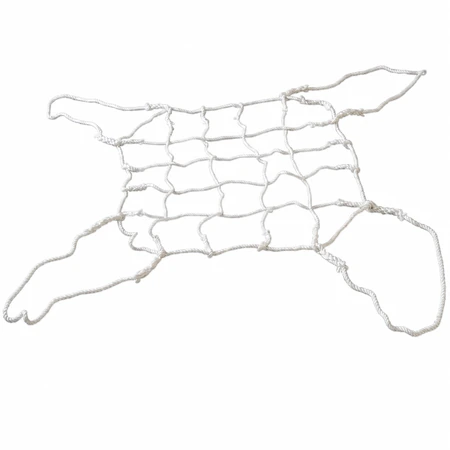
Lift sling rigging bedriuw produsearret Polyester Lifting Hoisting Net,Polyester Cargo Net,Safety Lifting Net Strap,Bungee Cargo Net,Polyester Cargo Lifting Net,Lifting Sling Net,Rope Lifting Net,Pallet Cargo Net,Garden Climbing Net.
Polyester Lifting Hoisting Net
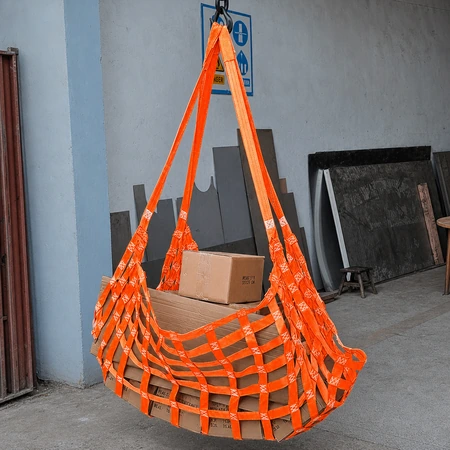
A polyester lifting hoisting net is a soft bag woven from high-tenacity polyester webbing, built to move bagged goods and bulk material in a single crane lift. The load is tipped into the bag, or the bag is laid flat and drawn up around a stack, and four corner loops carry the whole consignment to the hook. There is no pallet to return, no strapping to cut, and nothing to re-handle at the far end.
Because we weave the webbing in our own mill in Taizhou, Jiangsu, de gaas iepening, bag footprint, djipte, bottom construction and working load limit are all set to the cargo rather than to a fixed catalogue. Standard nets cover 0.5 t oan 20 t en 0.6 m³ oer 10 m³, every net is proof-load tested before packing, and each shipment travels with a material test report. Nets are CE and GS certified, with webbing rated to the EN 1492-1 basis.
- Fully custom build – mesh, tas grutte, djipte, colour and safety factor (5:1, 6:1 of 7:1) set to your specification.
- High-tenacity polyester webbing – 25 mm oan 100 mm bands, inkel, duplex or triplex, UV stabilised and rot-proof.
- Wear and heat resistant – working range -40 °C oan +100 °C, with a reinforced bottom for abrasive loads.
- Sêft, fleksibel en ljocht – the flat band contacts the load over a wide area, so bags, cartons and finished surfaces are neither crushed nor marked.
- CE en GS sertifisearre – op ús eigen testen 1000 t masine, with an ISO 9001 quality system and a CNAS-accredited laboratory behind it.
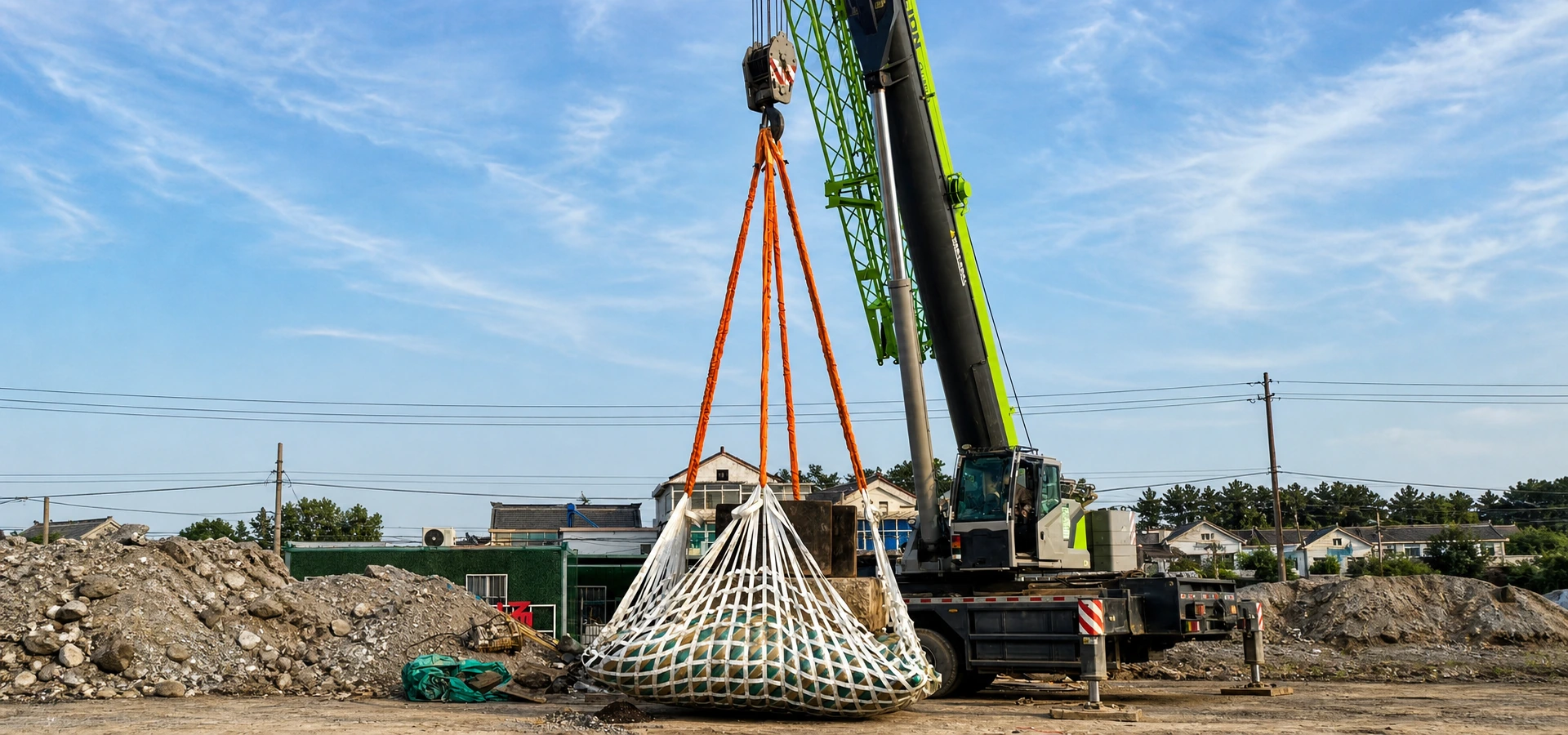
Why a webbing net bag, and not a rope net or a big bag
Three products are sold for the same job and they behave very differently once the load is in the air. A rope net concentrates the load on a few contact points. A big bag carries one free-flowing product and is itself the package. A webbing net bag spreads the pressure across flat bands, holds a stacked or mixed load together, and goes back to the store empty.
Tafel 1 – How the four common ways of lifting loose cargo compare.
| Opsje | Konstruksje | Kontakt mei de lading | Best cargo | Limitation |
|---|---|---|---|---|
| Polyester webbing net bag | Flat woven bands, 25-100 mm, 25-300 mm mesh | Wide flat bands, low pressure per cm² | Bagged, steapele, mixed and bulk cargo | Needs a crane or hook; not a sealed package for powder |
| Nylon touw net | Knotted or braided rope, 8-24 mm | Line contact at every rope | Irregular and heavy single items | Ropes mark soft cargo; a tight mesh adds weight |
| FIBC / big bag | Woven PP fabric with a liner | Full surface, sealed | One free-flowing product per bag | Single product only; the bag is the packaging |
| Pallet and strapping | Timber or plastic pallet plus bands | Rigid base | Unitised cartons | Pallet returned or lost; bands cut and discarded; no drainage |
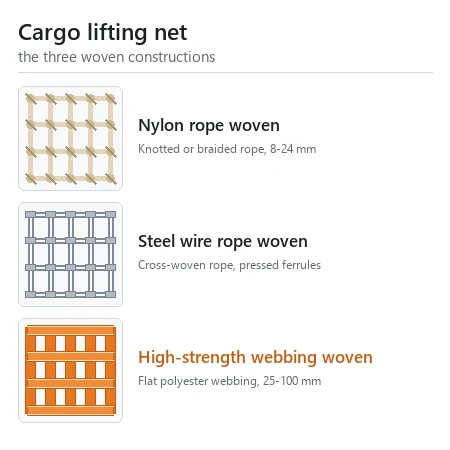
Five decisions that set the specification
A polyester lifting hoisting net is quoted from five numbers. Get them right and the net arrives right; get the mesh wrong and no amount of extra tonnage will fix it later.
Tafel 2 – What we need to know, and why each answer changes the net.
| Beslút | Wat it reparearret | What to tell us |
|---|---|---|
| 1. Cargo form | Whether the net is a bag or a flat sheet, and how the bottom is built | How the cargo arrives: sekken, grutte bags, balen, or loose material |
| 2. Weight per lift | Band width and layer count, and therefore the rated capacity | It bruto gewicht dat jo fan doel binne op te heffen, not the weight of the net |
| 3. Folle folume | Footprint and depth of the bag | Bulk tichtens (t/m³) for loose material, or the height of the stack for bagged goods |
| 4. Mesh iepening | The largest gap the cargo can pass through | The smallest unit in the load: in 25 kg bag, nôt, aggregate or scrap |
| 5. Discharge metoade | Sletten, laced, chute of lined boaiem | Whether the bag is tipped, untied over a hopper, or emptied by hand |
Weight and volume are two separate limits, and for light bulk the volume arrives first. Grain op likernôch 0.7 t/m³ en houtsnippers op likernôch 0.3 t/m³ beide folje a 3.6 m³ bag, but one lift weighs about 2.5 t and the other about 1 t. Send the bulk density with the tonnage and we will size the bag so that a full bag is also a legal bag.
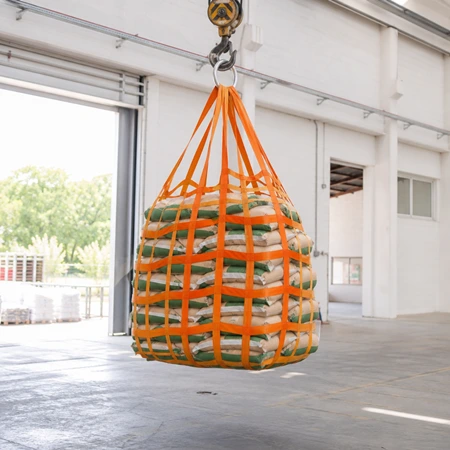
Technyske parameters
De sifers hjirûnder dekke de standert bagged en bulk berik. Mesh, fuotprint, djipte, bottom, loops and capacity are made to order, so treat this as the starting point for a quotation rather than a fixed catalogue.
Tafel 3 – Polyester lifting hoisting net: technyske parameters.
| Parameter | Spesifikaasje |
|---|---|
| Produkt namme | Polyester lifting hoisting net (polyester webbing net tas) |
| Konfiguraasjes | Closed bag, release-bottom bag, or flat lifting net |
| Webbing materiaal | 100 % hege sterkte polyester (HÚSDIER); hege-sterkte nylon op oanfraach |
| Band breedte | 25 / 38 / 50 / 75 / 100 mm (50 mm standert) |
| Band construction | Single laach, duplex or triplex; woven selvedge, not a cut edge |
| Band dikte | 1.8 mm – 4.5 mm ôfhinklik fan breedte en laach count |
| Mesh iepening | 100 × 100 mm standert; 25 – 300 mm op bestelling makke |
| Netto grutte | Makke oan 'e lading foetôfdruk, truck bed or receiving hopper; see Table 4 |
| Bag djipte | 0.8 m – 2.5 m, of oan tekenjen |
| Folle folume | Oer 0.6 m³ oer 10 m³, set by footprint and depth |
| Grins | Folde en dûbele stitched, reinforced at every lifting point |
| Opheffen punten | Fjouwer hoeke loops standert; acht foar in spreader beam; loops boppe en ûnder op oanfraach |
| Rated kapasiteit (WLL) | 0.5 t – 20 t, ynsteld troch band, laach count en lift arrangement |
| Feiligens faktor | 5:1 / 6:1 / 7:1 |
| De wiziging yn' e WLL | 7 % of minder |
| Kleur | Kleurkoade troch limyt fan wurklast, of in oanpaste hûskleur |
| Wurktemperatuer | -40 °C oan +100 °C |
| Weather and chemical | UV stabilisearre, rot-proof, unaffected by rain, sea water and wash-down |
| Markearje | WLL, mesh and batch printed on the belt, plus in sewn kapasiteit label |
| Standert basis | Webbing rated nei EN 1492-1 |
| Sertifisearring | CE, GS, ISO 9001, JIS on request; CNAS laboratoarium; DNV |
| Oanpassing | OEM / ODM grutte, kleur, printe logo, label en ferpakking |
| HS koade | 6307.90 – nets and netting of textile materials |
Standert maten, volumes and working load limits
These six lines cover the great majority of bagged and bulk work. Filled volume is calculated from the footprint and the depth with an allowance for the rounded shape a loaded bag takes, so a material that settles well will carry slightly more and one that bridges will carry less.
Tafel 4 – Standard net sizes at four corner loops gathered on one hook.
| Netto grutte (L × W) | Depth | Folle folume | Mesh | Band | WLL | Typyske lading |
|---|---|---|---|---|---|---|
| 1.0 × 1.0 m | 1.0 m | 0.6 m³ | 50-100 mm | 50 mm ien | 0.5-1.5 t | 25 kg tas, lytse sekken, balen |
| 1.5 × 1.5 m | 1.2 m | 1.6 m³ | 50-100 mm | 50 mm duplex | 1-2.5 t | Bagged nôt, fertilizer, produsearje |
| 2.0 × 2.0 m | 1.5 m | 3.6 m³ | 50-100 mm | 50 mm duplex | 2-4 t | Bulk nôt, sân, gemalen stien |
| 2.5 × 2.5 m | 1.8 m | 6.8 m³ | 50-150 mm | 75 mm duplex | 3-6 t | Bulk fertilizer, stienkoal, skrap, fisk |
| 3.0 × 3.0 m | 2.0 m | 10.8 m³ | 100-150 mm | 75 mm duplex | 4-8 t | Grutte bulk loads, kade en hâld wurk |
| To drawing | 0.8-2.5 m | Te bestellen | 25-300 mm | 25-100 mm | 0.5-20 t | Elke footprint, djipte en lading |
The working load limits above assume a four-loop lift. A two-loop basket de-rates the net – ask for the derated figure rather than reading across from this table.
Mesh iepening, chosen from the cargo
Mesh is the one dimension that cannot be adjusted after the net is sewn, so it is sized from the smallest unit in the load rather than from the total weight.
Tafel 5 – Mesh opening by cargo.
| Lading | Oanrikkemandearre mesh | Reden |
|---|---|---|
| 50 kg soks, grutte bags, balen | 100 mm | The sacks are far larger than the opening; the mesh only has to keep the stack together |
| 25 kg tas, lytse sekken | 50-75 mm | Small bags can squeeze through 100 mm once the load settles in the air |
| Nôt, sied, droege produkten | 25-50 mm, of in sletten liner | Fine material must not sift out on the hook or in transit |
| Fertilizer, prills, poeders | 25-50 mm, of in sletten liner | Fine and moisture-sensitive: a liner keeps the product in and the weather out |
| Sân, grint, gemalen stien | 50-100 mm | Fijn genôch om de bulk te hâlden, open enough for rainwater to drain |
| Koal, coke | 100-150 mm | Large lumps; in bredere gaas hâldt it net ljocht en drain goed |
| Skrot metaal, ôfslach | 100-150 mm | Open mesh with a reinforced bottom and wear pads at the contact points |
| Fisk, skulpdieren, wiete produkten | 25-50 mm | Holds the catch, drains freely, keeps the weight honest |
| Logs, brânhout, grutte ôfstannen | 150-300 mm | Indivisible pieces: a wide mesh saves weight without losing the load |
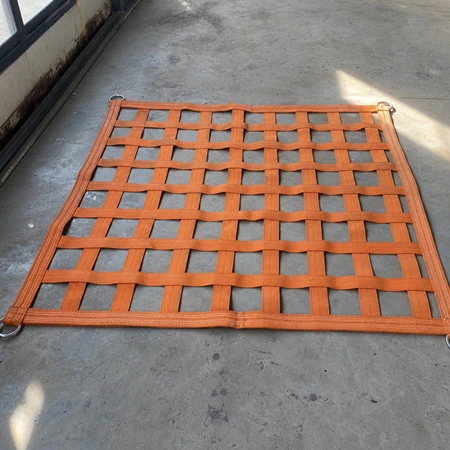
Bottom construction and discharge
How the load comes out is a design decision in its own right. For bagged cargo the answer is usually a person with a knife; for bulk it is usually gravity.
Tafel 6 – Bottom options and how each one is emptied.
| Boaiem | Hoe't it wurket | Chosen when |
|---|---|---|
| Sletten, folslein genaaid | The bag holds the cargo permanently and is emptied by tipping or by hand | Bagged lading, and bulk tipped over a hopper or onto a pile |
| Release bottom, laced | In laced naad oer de boaiem wurdt losmakke op it ôffier punt en de lading falt út | Free-flowing bulk – sân, nôt, aggregaat – discharged without tipping the bag |
| Slach ûnder | The bag narrows to a chute opened over the receiving hopper | Controlled discharge into a hopper, in barge of in transportband |
| Closed with a liner | In stof liner sit binnen it net | Dusty or moisture-sensitive bulk: nôt, fertilizer, poeders |
| Fersterke ûnderste paniel | An extra layer of webbing is stitched across the base | Abrasive and heavy bulk: aggregaat, erts, skrap |
| Loops top and bottom | Loops at both ends, so the bag can be lifted either way up | Loading at height, en leegje troch inverting de tas op 'e heak |
Lifting arrangements and fittings
Hoe't de tas wurdt hong bepaalt hoefolle fan 'e lading it echt draacht, en bulk is ûnferbidlik, om't de lading yn 'e tas bliuwt bewege wylst it yn' e loft is.
- Four loops on the hook – the standard for bagged and bulk work; the loops gather on the hook or a master ring and the bag closes around the cargo as the crane takes up the slack.
- Eight loops on a spreader beam – de tas bliuwt fjouwerkant, de lading bliuwt nivo, en elke loop draacht in foarsisber oandiel; the right arrangement for large bags and high tonnage, sjo ús lifting spreader beam berik.
- Two-loop basket – faster to rig, mar it de-rates it net; ask for the derated capacity instead of reading across from the four-loop figure.
- Loops top and bottom – lets the bag be lifted either way up, dat is hoe't in sletten tas wurdt lege troch it omkearjen oer in hopper.
Fittings supplied or fitted on request: sewn webbing loops, master ring or master link, klasse 80 boeien, laced release bottoms, chutes and discharge sleeves, inner liners, wear pads and protection sleeves for scrap and aggregate, and repair kits for fleets that maintain their own equipment.
Materiaal, stitching and finish
The belt is the product. We weave it on needle looms from high-tenacity polyester yarn, with a woven selvedge rather than a cut edge, so the band does not fray from the outside in.
- 100 % hege sterkte polyester, lege ferlinging (7 % of minder by WLL), UV stabilisearre, rot-proof and unaffected by moisture.
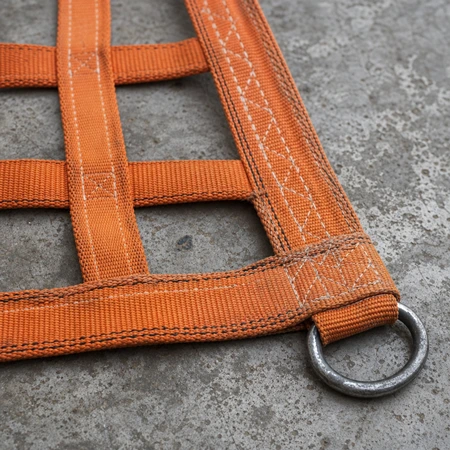
- Locked stitching in high-tenacity polyester thread, run in multiple rows along the border and box-X at every loop – on a cheap net it is the stitch line, not the belt, that fails first.
- Folde en dûbelstikte râne, so the edge of the mesh cannot unravel under load.
- Galvanised or stainless steel rings and master links on request.
- Polyester holds its strength from -40 °C oan +100 °C; above that, or in chemical exposure, tell us and we will quote nylon or another construction.
Testen, certification and traceability
- Forty years of lifting equipment manufacturing – oprjochte yn 1985 yn Taizhou, Jiangsu, mei mear as 200 meiwurkers en ien fan Sina grutste lifting slinger en netto produksje bases.
- Every net is proof-load tested on our own 1000 t horizontale test masine – hifke, not sampled.
- A material test report travels with each shipment, quoting the belt batch and the test load.
- CE declaration of conformity and GS certification, mei JIS-sertifikaasje op eksportoarders.
- ISO 9001 quality management system, a CNAS-accredited laboratory and DNV certification behind the plant.
- Every net is marked with its working load limit, mesh, rated volume and batch number before packing, sadat de tas en syn papierwurk altyd iens binne.
Certificates and test reports are available as PDFs for your tender or customs file – see the full sertifisearring set.
Where these nets work
A polyester lifting hoisting net is used wherever loose cargo has to travel between a stack and a hook – quay, mûne, quarry, yard or hold. The sectors below are the ones where the bagged and bulk version earns its place.
Tafel 7 – Applikaasjes per sektor.
| Sektor | Wat it net behannelet | Wêrom in polyester net past it |
|---|---|---|
| Ports, kaaien en terminals | Bagged lading, nôt, fertilizer and bulk between quay, barge and hold | Ien tas per lift, gjin pallet, en de lading drain as it reizget |
| Lânbou en feed molens | Sied, nôt, feed, meststof en bagged produkt | In strakke gaas of in liner hâldt it produkt yn en it waar út |
| Bouwmaterialen | Sân, grint, smoarge stien en bagged cement | Fijn genôch om de bulk te hâlden, open enough for rainwater to drain |
| Mining en steengroeven | Aggregate, erts en minerale bulk | In fersterke boaiem nimt de skuorre dy't in net draacht út |
| Fiskerij en itenferwurking | Wiete fisk, shellfish en produsearje | Iepen gaas drains frij, which keeps the weight honest |
| Recycling en ôffal | Los plestik, glês, metaal en mingd materiaal | Contains loose material that would otherwise blow or fall |
| Biomass and power | Houtsnippers, blaffe, pellets en brânstof bulk | In grutte tas foar in beskieden tonnage, oerienkomt mei de folume limyt |
| Construction sites and relief work | Bagged materials raised to upper floors, field cargo | No pallet, gjin banding, en it kin direkt op 'e grûn lege wurde |
Customisation and branding
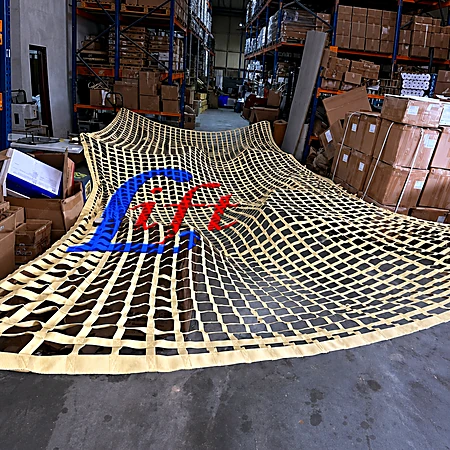
A net that moves between quays, holds and yards has to be identifiable from a distance and has to keep its marking. Kleur, printe logo, working load limit and cargo type are all applied in our own plant, so the marking cannot be washed off or pulled away with a label.
- Kleurkoade troch limyt fan wurklast, or a custom house colour to separate your fleet from a competitor’s.
- Logo, brand name, warning text or certificate number printed on the belt, or woven in on larger orders.
- Cargo type printed on the bag, which stops a fine-mesh grain net being sent out for scrap.
- Sewn capacity label in addition to the print, so the net and its paperwork agree at every inspection.
- Packing folded into a bag or a crate – a set of ten net bags takes the space of one pallet.
Soarch, ynspeksje en pensjoen
- Inspect the loops and their stitching first, dan de grins, then the bottom closure – on a bulk net the bottom and the corners wear before the mesh does.
- Leeg de tas folslein foar opslach; material left inside holds moisture, foeget gewicht en ferberget skea.
- Sjoch foar besunigings, abrasion, brutsen stiksels, gemyske kleuring, waarmte glazing en de kleur of glans feroaring dat sinjalearret UV degradaasje.
- Weigh a wet bag before lifting it. Rein, sea water and wet bulk can add far more than the cargo was rated at, en in net wit it ferskil net.
- Nea boppe de rated kapasiteit, lift nea op minder dan de folsleine set lussen, en sleep nea in laden tas sideways mei de kraan.
- Bewarje skjin en droech, út 'e grûn en út direkte sinne; never repair webbing by knotting, welding of ferwaarming it.
Faak stelde fragen
What is the difference between a polyester lifting hoisting net and a cargo net?
A lifting net is rated, marked and tested to carry a load on a crane hook. A cargo net is a restraint: it holds a load down in transit and is not designed to be lifted. If the net is going onto a hook, it must be the rated version – sjo ús lading befeiliging net for the tie-down case.
How do I choose the mesh opening?
From the smallest unit in the load, net út de tonnage. IN 25 kg bag needs 50-75 mm; grain or fertilizer needs 25-50 mm or a closed liner; scrap and coal can take 100-150 mm. Once the net is sewn the mesh cannot be changed, so this is the one number worth checking twice.
Why does the volume matter as much as the weight?
Omdat ljocht bulk follet de tas foardat it berikt de rated gewicht. A bag that is full at half its rating doubles the number of lifts and the crane time. Give us the bulk density with the tonnage and we will size the bag so a full bag is also a legal bag.
Kin de tas leech wurde sûnder it te tippen?
Ja. A laced release bottom or a chute bottom lets a free-flowing load be discharged straight into a hopper, in barge of in transportband. Bagged cargo is normally emptied by hand or with a forklift at the far end.
Sil it net wiete lading hâlde?
The net itself is unaffected – polyester does not absorb water and does not rot, so rain, sea water and wash-down do no harm. Twa warskôgings: wet cargo is heavier, and fine wet material can clog the mesh, dy't foeget gewicht en stopet it draining.
How is the working load limit proved?
De riem is beoardiele oan de EN 1492-1 basis en netten wurde levere by 5:1, 6:1 of 7:1 lykas oantsjutte. Every net is proof-load tested on our own 1000 t masine, a material test report travels with the order, en de produkten drage CE- en GS-sertifikaasje.
Do you make a flat version for palletised cargo?
Ja – the flat lifting net is the kraan pallet lading net, and the material-led range is covered by the polyester webbing net foar opheffen. The rope constructions sit alongside as the nylon lading opheffen net en de swiere plicht nylon lading net sling.
What else do you make from the same webbing?
The same belt goes into our singels slingers en einleaze rûne slingers, and the wider cargo range is listed under lading opheffen netten – ynklusyf de singel lading opheffen net for flat work.
In offerte oanfreegje
Send the cargo and whether it is bagged or bulk, de bulkdichte as jo it witte, it gewicht dat jo wolle per lift, de gaas iepening, the discharge method and the environment the net will work in – or a sketch of the bag you have in mind. Us yngenieurs sille de netto grutte befêstigje, djipte, boaiem konstruksje, band and packing and quote it in one reply. Om it earst troch te praten, kontakt opnimme mei ús yngenieurs.
Lift Sling Rigging Company – Lifute Industrial Park, Taizhou City, Jiangsu Provinsje, Sina
Tel: +86 523 8693 5818 | WhatsApp: +86 180 6600 2268 | E-post: lift98@jslift.com