

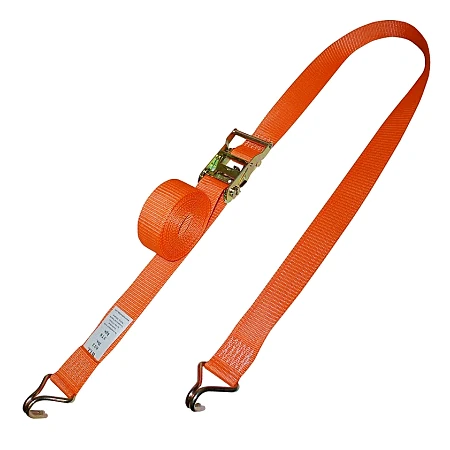
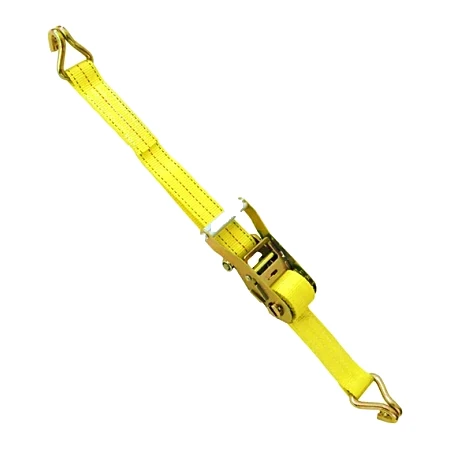
L'entreprise de gréage d'élingues de levage produit 5 Ton Heavy Duty Ratchet Straps,10 Sangle à cliquet de tonne,5-Ton Heavy Duty Ratchet Tie Down Strap,5.000daN Lashing strap,5000kg Truck ratchet strap,5 Tonne Ratchet Strap with Chassis Rave Hook,5000kg Ratchet Strap Claw Hook,5000kg Ratchet Strap D Ring,5000kg Ratchet Strap Flat Snap Hook,Ratchet Strap Looped Ends,Ratchet Strap S Hooks.
5 Ton Heavy Duty Ratchet Straps
50 sangle en polyester de 1,5 mm, a forged ratchet and 2,500 daN of lashing capacity — plus a stainless build for salt and an aramid build for heat.
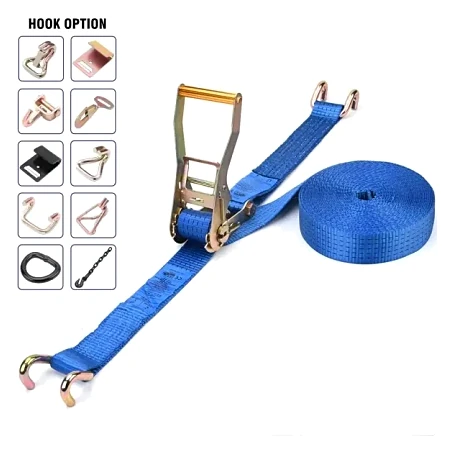
The standard build is 50 mm high-tenacity polyester webbing, a forged ratchet tensioner with a 300 mm handle, and the end fitting your anchor point needs — chassis rave hook, claw hook, D ring, flat snap hook, S hook, sewn loop or no fitting at all. Lengths run 3 à 10 m en standard, LC 2,500 Et, STF 350 et N à 50 et la force de la main. Two special builds sit alongside it for the jobs polyester cannot take: a stainless ratchet on the same webbing for salt and wash-down duty, and para-aramid webbing for steel that is still hot.
Part of the élingue en sangle and lashing range. Le 50 mm specification in isolation sits on the 50 mm 5000 kg de ceinture d'arrimage à cliquet page.
What “5 Ton” Actually Means on a Ratchet Strap
Three figures appear on a lashing strap and only one of them describes what the strap is allowed to do in service. Sous EN 12195-2 la sangle d'une sangle d'arrimage doit atteindre au moins deux fois sa capacité d'arrimage, which is where the familiar 2:1 relationship comes from — and where the confusion starts, because “5,000 kg” is the failure figure, not the working figure.
| Chiffre | Value on the 50 mm assembly | Ce qu'il décrit | How it gets misread |
|---|---|---|---|
| Résistance à la rupture minimale | 5,000 Et (5,000 kilos) | La charge à laquelle l'assemblage échoue lors d'un test de traction | Read as the working figure — the mistake that overloads a trailer |
| Capacité d'arrimage (LC) | 2,500 Et (2.5 t) | La retenue que l'ensemble est censé contenir, printed on the label | Par rapport à la CMU d’une élingue de levage, which is a different duty altogether |
| Force de tension standard (STF) | 350 et N à 50 et la force de la main | The tension one person reaches with the ratchet handle | Confus avec LC, pour que l'opérateur continue de remonter au-delà du point utile |
Pourquoi le 50 mm Build Is the Heavy-Duty Default
Width is a compromise between strength, handling and what the anchor will accept. Narrow bands are cheap but concentrate the load and run out of capacity above a van; the widest belts carry twice as much and are twice as awkward to throw over a load bed. Le 50 mm sits where the strength covers a flatbed, a container or a plant trailer while the band can still be handled in gloves.
| Largeur de la bande | Typical LC | Force de rupture | Pourquoi il est acheté |
|---|---|---|---|
| 25 mm (1 dans) | 400–500 daN | 800–1,000 daN | Tool boxes, light restraint, tight anchor eyes |
| 35 mm (1-3/8 dans) | 750 Et | 1,500 Et | Van and trailer decks, general cargo |
| 38 mm (1-1/2 dans) | 1,000–1,500 daN | 2,000–3,000 daN | Plaque d'acier, faisceaux de tuyaux, plant |
| 50 mm (2 dans) | 2,500 Et | 5,000 Et | Heavy cargo restraint, bobines, machinerie, conteneurs |
| 75–100 mm | 5,000 daN and up | 10,000 daN and up | Abnormal loads, where the bed allows the width |
The hardware matters as much as the band. The ratchet is forged steel with a case-hardened pawl and gear, and the handle is dimensioned so the standard tension force is reached inside the 250 N manual limit of EN 12195-2 — no extension bars and no cheater pipes, which is how handles get bent and operators get hurt.
Standard Specification of the 5 Ton Assembly
| Article | Spécification |
|---|---|
| Sangles | 100% polyester haute ténacité, armure sergée, Stabilisé aux UV, 50 mm ± 2% |
| Épaisseur de la bande / masse | 1.8 mm nominal / 88 g per metre |
| Capacité d'arrimage (LC) | 2,500 et par assemblage |
| Résistance à la rupture minimale | 5,000 Et (2:1 against LC) |
| Force de tension standard (STF) | 350 et N à 50 et la force de la main |
| Tendeur | Forged steel ratchet, black electrophoretic coating, case-hardened pawl, 300 mm handle |
| Allongement à LC | 7% ou moins |
| Température de service | −40 °C à +100 °C (sangle en polyester) |
| Longueur standard | 3–10 m; 1–30 m to order |
| Marquage | Etiquette tissée: LC, STF, longueur, numéro de lot, standard reference |
| Standard | Designed, tested and marked to EN 12195-2 |
| Code HS | 630790 |
The End Fitting Decides Whether the Strap Fits the Job
The webbing is the easy half. The fitting has to reach the anchor the vehicle actually has, seat on the crown of the eye rather than the point of another hook, and stay seated when the load shifts.
| Convenable | Anchors to | Notes before ordering |
|---|---|---|
| Chassis rave hook | Flatbed side rail, chassis lip | Check rail thickness and that the hook throat clears it |
| Claw hook | Anchor rings, D rings, recessed eyes | Opening must clear the ring; load on the crown only |
| D ring / delta ring | Welded or bolted anchor points | Ring bore at least as wide as the webbing |
| Flat snap hook | E-piste, slotted rail, trous | Confirm slot width; snap gate must close fully |
| S hook | Tuyaux, rails, frame members | Both ends must seat without point loading on a weld |
| Sewn loop / looped ends | Around the load or through a bore | Nothing metal at the load; ideal for finished surfaces |
| Sans fin, pas de montage | Girth only — hulls, bobines, paquets | See the endless loop build below |
Le 5 Ton Strap in Two Special Builds
Polyester covers most freight, and it fails predictably when it is out of its depth: ça adoucit autour 150 °C and melts at about 255 °C, and it corrodes nothing but is let down by plated hardware in salt. The two builds below exist for exactly those two failure modes, and they are ordered by customers who have already had the failure once.
Stainless steel ratchet tie downs — for salt, wash-down and finished surfaces
The stainless build keeps the same 50 mm polyester webbing and replaces the hardware with AISI 304 ou 316: ratchet frame, rivets, spring and, where an anchor exists, stainless wire hooks. LC runs from 400 et N à 25 mm à 2,500 et N à 50 mm, still at 2:1 against webbing break. Most orders are the endless form, where the strap closes on itself through the ratchet and the buckle is the only metal part in the whole assembly — and it sits outside the loop, so a hull, a mast section or a coil sees webbing only.
The grade decision is about chloride, ne pas charger. 304 (1.4301) handles rain, eau douce, condensation and indoor wash-down; 316 (1.4401/1.4404) adds molybdenum for salt spray, marina air, de-icing salt and food plants. Both are annealed to a comparable strength, so paying for 316 croire qu'il est plus fort, c'est payer pour la mauvaise propriété. Lorsque l'application est liée à la sécurité, confirmer la qualité sur le certificat de l'usine plutôt que sur la description de la facture.
Two shop-floor notes worth passing on. Fils inoxydables fiel, so a dry 316 l'écrou coule fort sur un 316 stud can seize — the ratchet is assembled lubricated and should be re-lubricated rather than forced with a bar. Et l'inox boulonné à l'aluminium dans l'eau salée forme une paire galvanique, so where the strap anchors to an alloy frame, isoler le contact.
Full range and grade comparison: sangle à cliquet sans fin en acier inoxydable.
Aramide (Kevlar) ratchet straps — for heat, sparks and cut edges
Para-aramid webbing behaves differently from polyester at temperature. It has no practical melting point: at about 427 °C it chars and carbonises instead of melting and dripping, its limiting oxygen index is 28 or above so it self-extinguishes once the ignition source is removed, and it holds 200 °C continuously with short-term peaks to 400 °C. On a steel coil that is still warm from the mill, a polyester strap of the same width would already have lost its tension; the aramid band is still doing its job.
The second property is mechanical. Para-aramid has roughly three times the tenacity of polyester at equal thickness, with the cut and abrasion resistance that coil edges, slab corners, galvanised strip and scaffolding demand, and a denser weave so damage stays local instead of unravelling across the width. Elongation at break is only 2.4–3.5%, which is what a static restraint wants — the strap does not creep, and it does not need re-tensioning when the load cools.
Widths 25–50 mm, LC 500–2,500 daN, standard lengths 1–10 m: aramid flame retardant ratchet straps.
How Many Straps Does the Load Actually Need?
Lashing capacity is not the same thing as restraint delivered. A strap tensioned at an angle gives a horizontal component that is smaller than its LC, and the angle is the operator’s choice, not the supplier’s. At 45° a strap delivers roughly 0.7 of its lashing capacity; bring the legs closer to vertical and the figure rises towards the full LC, lay them flatter and it falls away.
| Straps used | Angle to the deck | Restraint per strap | Total restraint |
|---|---|---|---|
| 2 | 45° | environ. 1,750 Et | environ. 3,500 Et |
| 4 | 30° | environ. 1,250 Et | environ. 5,000 Et |
| 4 | 45° | environ. 1,750 Et | environ. 7,000 Et |
| 4 | 60° | environ. 2,165 Et | environ. 8,660 Et |
| 6 | 45° | environ. 1,750 Et | environ. 10,500 Et |
The arithmetic is an illustration, not a lashing plan: DANS 12195-2 also brings friction between load and deck into the calculation, and a low-friction load on a steel bed needs anti-slip matting before extra straps. Send us the cargo weight, the deck, the anchor points and the route, and we will state the number of straps and the angle rather than leave it to the yard.
Où le 5 Ton Ratchet Strap Earns Its Keep
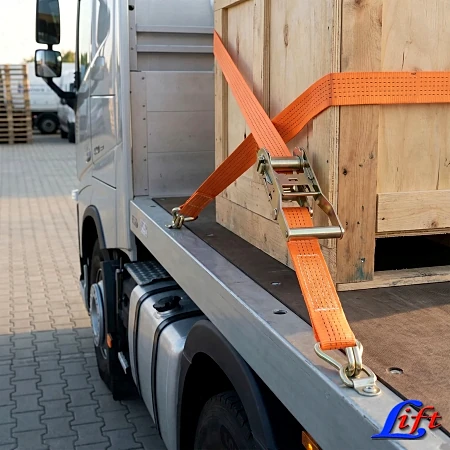
- À plat, container and plant trailer restraint — the volume application for the 50 mm build.
- Bobine d'acier, dalle, billet and pipe bundles, with edge protection at the contact points.
- Machinerie, moulds and skid-mounted plant, où un 25 mm strap has neither the width nor the tension.
- Packs de bois, caisses et supports, including the endless form that simply closes round the pack.
- Vehicle transport and recovery decks, holding cars and plant to the bed rather than to a hook.
- Marin, marina and wash-down duty in 304 ou 316 where plated hardware would be a maintenance item.
- Steel mills, foundries and glass plants in aramid, where polyester would melt before the shift ended.
Couleur, Printing and Private Label
Band colour is a customer choice rather than a rating, which is why the same 50 mm assembly ships in blue, orange, jaune, noir, rouge, olive or a matched shade. Brand, LC and a batch number can be printed directly on the webbing so the strap is identifiable after years in a warehouse, and the sewn label carries LC, STF, longueur, standard and traceability code. Cartons of 10 à 20 pièces, palletised for export, with neutral or own-brand packaging as required.
Essai, Traceability and the Paperwork Buyers Ask For
Every production batch is sampled for breaking strength at the 2:1 ratio the standard requires, and each assembly carries a batch number that traces back to the webbing roll and the hardware lot. Rapports de tests, material declarations, mill certificates for stainless grades and lashing capacity calculations are available for tender packages and safety audits.
One point worth being blunt about: any claim of EN 12195-2 conformity, CE marking or a third-party test mark has to match the documents actually held for that product and that factory. We state the standard the assembly is built and tested to, and we send the report with the shipment, because a claim that cannot be produced costs more than the order it wins.
Foire aux questions
Est-ce qu'un 5 ton ratchet strap rated to lift 5 tonnes?
Non, and it is not rated to lift at all. A lashing strap carries a lashing capacity — 2,500 daN on the 50 mm build — for restraint in transit. Lifting needs a sling with the correct safety factor and its own marking. A strap bought for restraint and used as a sling is the most common and most serious misuse in this category.
Why does the same strap get called 5 tonne et 2.5 tonne?
Because two different figures are being quoted. 5,000 daN is the minimum breaking strength; 2,500 daN is the lashing capacity the assembly is rated to hold, at the 2:1 ratio EN 12195-2 requires. Always ask which figure a quotation is against.
50 mm ou 38 mm for a flatbed?
50 mm, unless the anchor points are small. Le 38 mm is a genuine 1,000–1,500 daN strap and suits plate and pipe; le 50 mm gives 2,500 daN with a longer handle and a heavier ratchet, and it is the size most flatbed and container work ends up with.
Do I need 304 ou 316 inoxydable?
316 where chloride is present — sea air, brouillard salin, sel de déneigement, boatyards, plantes alimentaires. 304 is enough for rain, eau douce, condensation and indoor wash-down. The difference is corrosion resistance, pas de force.
At what temperature does polyester fail, and what does aramid do instead?
Polyester softens around 150 °C and melts at about 255 °C, and it drips burning polymer as it goes. Para-aramid holds 200 °C continuously, takes short peaks to 400 °C, and chars at about 427 °C instead of melting. Au-dessus de 400 °C, or against molten metal, both need a heat shield.
Can the strap be supplied with a printed brand and a custom length?
Oui. Largeurs, longueurs à 30 m, band colour, webbing print, label layout and packaging are all made to order, and the rating applies to the finished assembly rather than to the roll of webbing.
Demander un devis
Five lines are enough for an accurate price and an accurate rating: the cargo weight and shape, the deck and anchor points, l'environnement (salt, chaleur, lavage), the length and the end fitting. We reply with the assembly, the LC and STF figures, the standard it is built to and the lead time.
Entreprise de gréage d'élingues de levage
Parc industriel de Lifute, Ville de Taizhou, Province du Jiangsu, Chine
Tél: +86 523 8693 5818 · WhatsApp: +86 180 6600 2268
E-mail: 702461526@qq.com · HS code 630790
Produits connexes
- Ratchet straps — the full lashing range, 25 mm à 100 mm.
- 50 mm 5000 kg de ceinture d'arrimage à cliquet — this specification in detail.
- Endless loop ratchet strap — closed loop, pas de crochet, for girth-only loads.
- Endless stainless steel ratchet strap — 304 ou 316 for salt and wash-down.
- Aramid flame retardant ratchet straps — 200 °C en continu, 400 Pic °C.
- Élingue en sangle en polyester — when the job is lifting rather than lashing.