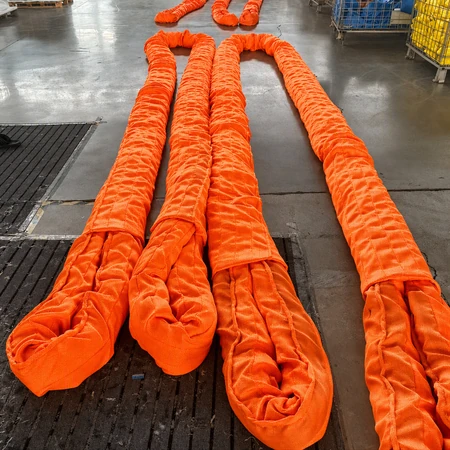
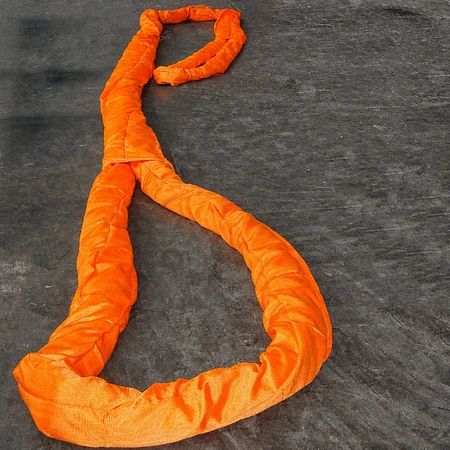
Lift sling rigging company produce Eye-Eye Round Sling,Œil & Eye Round Sling,Eye and Eye Polyester Round Sling,double-eye round sling.
Eye-Eye Round Sling — Double Eye Sling, 1–1000 tonnes
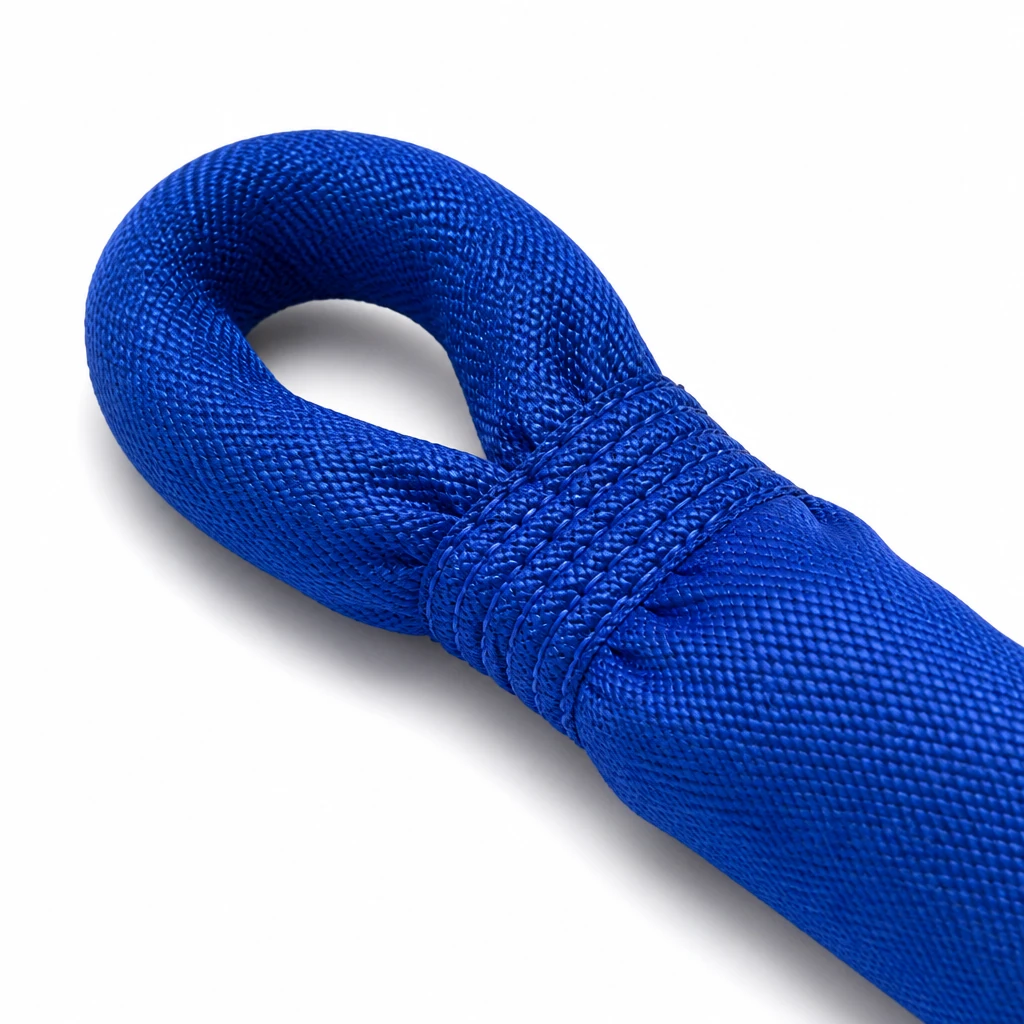
Un écharpe ronde œil-œil is a round sling terminated at each end: the woven sleeve is gathered and stitched into two reinforced eyes, so the sling has a fixed length et two known pick-up points instead of an endless loop. It is made in high-tenacity polyester across 27 LFTERS articles, depuis 1,000 kg à 1,000,000 kilos, in eye-to-eye lengths from 0.5 m à 80 m. The table below gives the article, la limite de charge de travail, the body thickness and width, the length range and the weight per metre — enough to pick the model before you send the enquiry.
- Limite de charge de travail1,000 kg à 1,000,000 kilos
- Article rangeLFTERS-1 to LFTERS-1000, 27 sizes
- Body dimensions6 × 40 mm jusqu'à 320 × 1,050 mm
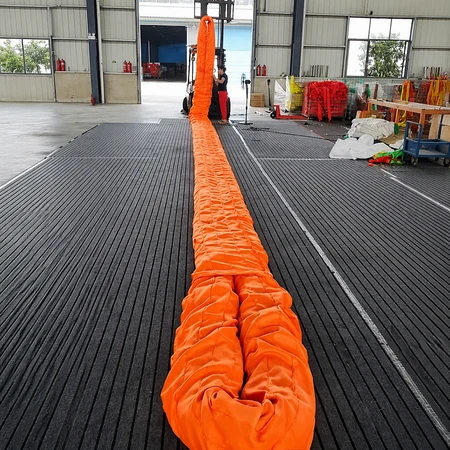
- Longueur0.5–80 m eye-to-eye
- Poids unitaire0.4 à 222 kg/m
- Facteur de sécurité7:1 deux UN 1492-2 pratique
Why specify an eye-eye round sling rather than an endless one
An endless round sling goes round anything and spreads its own wear. Un écharpe ronde œil et œil gives up a little of that freedom for something a rigging team values more on a repeated lift: certainty. The length you ordered is the length you get, the eyes land in the same place every time, and the hook or shackle takes a formed eye instead of a bunch of sleeve.
- A length that repeats. The eye-to-eye distance is a specification, not a result, so a lift carried out next month matches the one carried out today.
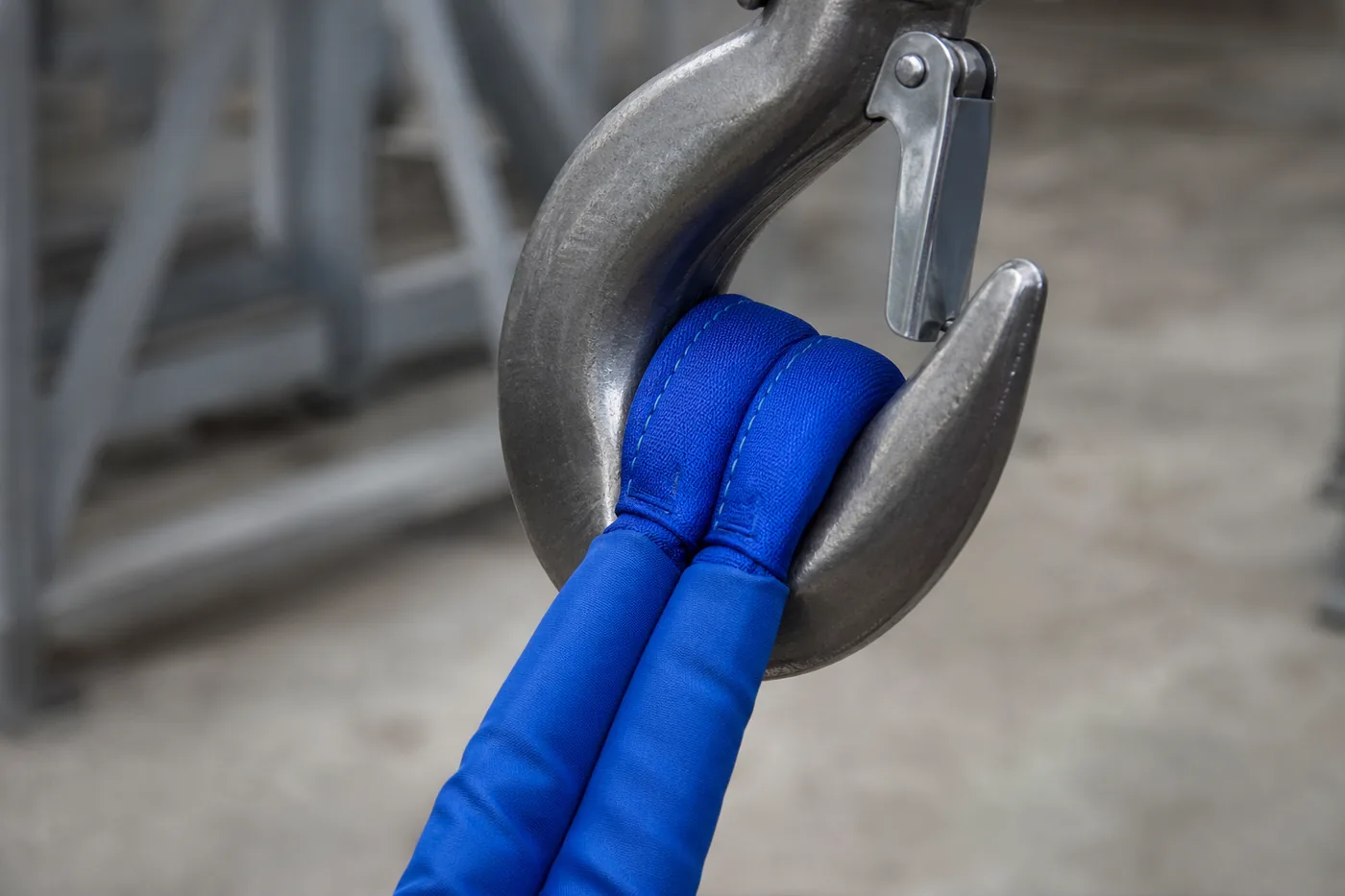
- Two defined pick-up points. The eye sits in the hook bowl or the shackle pin as a unit — quick to rig, quick to check, easy to hand over between shifts.
- The round body is unchanged. Under the load the sleeve still conforms to a roll, a pipe, a trunnion or a machined face, so nothing is marked and nothing is point-loaded.
- One place to look first. Load transfers through the two stitched eyes, so inspection starts and usually ends there.
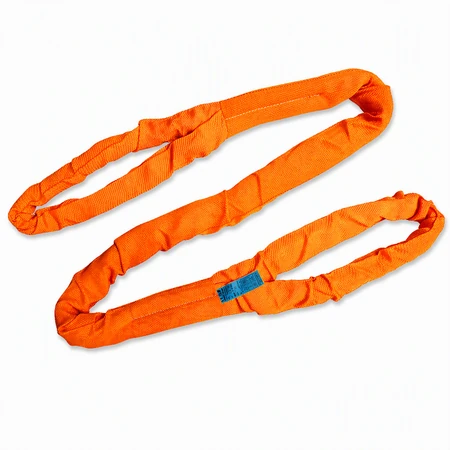
Eye-Eye Round Sling specifications
| Nom du produit | Écharpe ronde œil-œil / écharpe ronde œil et œil / écharpe ronde œil à œil / double eye round sling |
|---|---|
| Construction | Noyau parallèle continu à l'intérieur d'un manchon tubulaire tissé, gathered and stitched at both ends into two reinforced eyes |
| Cœur | Fil parallèle en polyester haute ténacité, standard; UHMWPE and aramid cores on request |
| Manche | Polyester tissé haute ténacité, simple ou double couche; heat-resistant sleeve to order |
| Limite de charge de travail | 1,000 kg à 1,000,000 kg across 27 articles — LFTERS-1 · -2 · -3 · -4 · -5 · -6 · -8 · -10 · -12 · -15 · -20 · -25 · -30 · -40 · -50 · -60 · -80 · -100 · -200 · -300 · -400 · -500 · -600 · -700 · -800 · -900 · -1000 |
| Corps | Thickness 6–320 mm, width 40–1,050 mm; see the article table for the exact figure of each size |
| Longueur | Eye-to-eye, 0.5 m à 80 m; the minimum rises with the article — 0.5 m at LFTERS-1, 9.0 m at LFTERS-1000 |
| Poids unitaire | 0.4 kg/m at LFTERS-1 to 222 kg/m at LFTERS-1000, used for shipping and for crane load calculations |
| Facteur de sécurité | 7:1 deux UN 1492-2 pratique; other factors to order where the market requires |
| Type d'oeil | Flat stitched eye standard; reinforced eye and wear pad optional |
| Couleur | Stock orange or blue; DANS 1492-2 capacity colour applied when the order asks for the standard code |
| Marquage | Etiquette cousue: article number, limite de charge de travail, eye-to-eye length, numéro de lot |
| Emballage | Coil in poly bag or carry bag, carton étiqueté, emballage d'exportation |
| Quantité minimale de commande / OEM | Faible MOQ pour les commandes à l'essai; full OEM on article, longueur, couleur des manches, mise en page et emballage des étiquettes |
Article range: choose the model
The article number carries the capacity — LFTERS-10 is the 10,000 écharpe en kg, LFTERS-100 the 100,000 kg one. Thickness and width describe the body; the last columns give the shortest and longest eye-to-eye length made in that article, and what the sling weighs per metre so it can be added to the crane load.
| Numéro d'article. | WLL (kilos) | WLL (t) | Épaisseur (mm) | Largeur (mm) | Min. (m) | Max. (m) | Poids (kg/m) |
|---|---|---|---|---|---|---|---|
| LFTERS-1 | 1,000 | 1 | 6 | 40 | 0.5 | 80 | 0.40 |
| LFTERS-2 | 2,000 | 2 | 7 | 50 | 0.5 | 80 | 0.61 |
| LFTERS-3 | 3,000 | 3 | 8 | 60 | 0.5 | 80 | 0.75 |
| LFTERS-4 | 4,000 | 4 | 9 | 70 | 0.5 | 80 | 0.80 |
| LFTERS-5 | 5,000 | 5 | 11 | 75 | 0.5 | 80 | 0.84 |
| LFTERS-6 | 6,000 | 6 | 12 | 80 | 1.0 | 80 | 0.98 |
| LFTERS-8 | 8,000 | 8 | 13 | 90 | 1.0 | 80 | 1.10 |
| LFTERS-10 | 10,000 | 10 | 15 | 100 | 2.0 | 80 | 2.20 |
| LFTERS-12 | 12,000 | 12 | 16 | 110 | 2.0 | 80 | 3.20 |
| LFTERS-15 | 15,000 | 15 | 18 | 125 | 2.0 | 80 | 3.80 |
| LFTERS-20 | 20,000 | 20 | 20 | 150 | 2.5 | 80 | 5.20 |
| LFTERS-25 | 25,000 | 25 | 24 | 180 | 2.5 | 80 | 6.50 |
| LFTERS-30 | 30,000 | 30 | 32 | 200 | 2.5 | 80 | 7.80 |
| LFTERS-40 | 40,000 | 40 | 40 | 200 | 2.5 | 80 | 10.4 |
| LFTERS-50 | 50,000 | 50 | 45 | 220 | 2.5 | 80 | 13.0 |
| LFTERS-60 | 60,000 | 60 | 65 | 220 | 4.0 | 80 | 15.6 |
| LFTERS-80 | 80,000 | 80 | 70 | 260 | 4.0 | 80 | 20.8 |
| LFTERS-100 | 100,000 | 100 | 80 | 290 | 4.0 | 80 | 25.0 |
| LFTERS-200 | 200,000 | 200 | 120 | 450 | 5.0 | 80 | 64.0 |
| LFTERS-300 | 300,000 | 300 | 160 | 525 | 5.0 | 80 | 79.0 |
| LFTERS-400 | 400,000 | 400 | 200 | 670 | 5.0 | 80 | 95.5 |
| LFTERS-500 | 500,000 | 500 | 220 | 750 | 8.0 | 80 | 113.4 |
| LFTERS-600 | 600,000 | 600 | 240 | 820 | 8.0 | 80 | 136.0 |
| LFTERS-700 | 700,000 | 700 | 260 | 870 | 8.0 | 80 | 152.0 |
| LFTERS-800 | 800,000 | 800 | 280 | 930 | 9.0 | 80 | 175.0 |
| LFTERS-900 | 900,000 | 900 | 300 | 990 | 9.0 | 80 | 199.0 |
| LFTERS-1000 | 1,000,000 | 1,000 | 320 | 1,050* | 9.0 | 80 | 222.0 |
* LFTERS-1000 body width is 1,050 mm. The width column steps up by roughly 60 mm per 100 t from LFTERS-900 (990 mm), et 1,050 mm is the figure consistent with the listed 222 kg/m; the source sheet carries one zero too many. Maximum length is 80 m in every article, and the minimum is the shortest eye-to-eye distance the body can be gathered and stitched into.
What the sling lifts in each arrangement
The working load limit in the article table is the verticale figure. Choking or basketing the same sling changes what it may lift, and the multipliers below are applied to that figure — they are not added to it. Three articles are worked out; the same factors apply to all 27.
| Arrangement | Facteur | LFTERS-10 | LFTERS-50 | LFTERS-100 |
|---|---|---|---|---|
| Verticale | × 1.0 | 10,000 kilos | 50,000 kilos | 100,000 kilos |
| Étouffé | × 0.8 | 8,000 kilos | 40,000 kilos | 80,000 kilos |
| Panier, 0–7° | × 2.0 | 20,000 kilos | 100,000 kilos | 200,000 kilos |
| Panier, 7–45° | × 1.4 | 14,000 kilos | 70,000 kilos | 140,000 kilos |
| Panier, 45–60° | × 1.0 | 10,000 kilos | 50,000 kilos | 100,000 kilos |
Comment commander
- The article. Take the load at each leg, divide by the arrangement factor above, and choose the first article whose working load limit covers the result.
- The eye-to-eye length. Measure inside eye to inside eye, then add headroom so the legs do not splay into a wide angle that costs capacity. It has to sit between the Min and Max columns of that article.
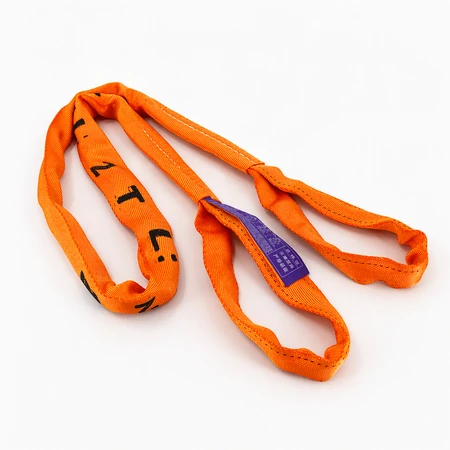
- The eye type. Flat stitched eyes for normal service; reinforced eyes or wear pads where the hook bowl is worn or the sling is repeated on the same edge.
- The environment and the marking. Température, produits chimiques, eau, lumière du jour, and the identification or certificate the receiving site has to read.
Quote it as article, length and option — for example LFTERS-10, 6 m eye-to-eye, flat stitched eye, single polyester sleeve. Any article can be built in any length inside its range, and the weight per metre lets you confirm the total before the crane is booked.
Construction: what carries the load, and what protects it
Three parts decide the service life of an écharpe ronde œil à œil. Le cœur is a bundle of parallel polyester yarn running unbroken from eye to eye; it carries the entire load and elongates very little. Le manche is a woven tube over the core that takes abrasion, dirt and daylight, and carries the colour, the printed working load limit and the label. Le yeux are the two places where the sleeve is gathered and the stitching takes the load path.
That hierarchy explains most retirements: a sleeve cut through so the core is visible retires the sling even when the core still looks sound, and stitching that is broken, slack or pulled retires it even when the sleeve is intact. On an endless sling the load passes continuously round the loop; here it has to cross two stitched terminations, and those terminations are where it will fail first.
Oeil-oeil, endless or flat webbing: which one for the lift
| Propriété | Écharpe ronde œil-œil | Élingue ronde sans fin | Élingue en sangle plate |
|---|---|---|---|
| Se termine | Deux yeux cousus | None — closed ring | Deux yeux, flat body |
| Longueur | Defined, yeux dans les yeux | Circonférence de la boucle | Defined, yeux dans les yeux |
| Wear point | Fixed at the eyes | Rotatable round the loop | Fixed along the band |
| Contact avec la charge | Round body conforms | Round body conforms | Wide flat face |
| Capacity in a slim profile | High — parallel core | High — parallel core | Needs width and plies |
| Idéal pour | Repeat lifts, accrochage et enchaînage, géométrie fixe | Awkward shapes, usure étalée, très grandes capacités | Narrow openings, visible load path |
Both round sling forms are made on the same line from the same core and sleeve, so the choice between them is a rigging decision, pas de capacité. For the endless form see our élingue ronde sans fin gamme; for the flat form see élingues en sangle plate.
Where an eye-eye sling earns its place
- Repeated lifts of the same machine or mould, where the geometry must not change between shifts.
- Rigging eye-to-eye onto a hook, a shackle or a palonnier de levage that keeps the legs vertical.
- Nacelles élévatrices sous rouleaux, tuyaux, tubes and machined shafts, where the round body wraps the curve.
- Plaque d'acier, sheet and coil packs that need soft bearing and high capacity in one slim sling.
- Peint, coated or polished plant where a chain or a élingue en câble métallique would mark the surface.
- Very heavy work at the top of the range — the WLL 30T polyester round slings et le 1100 Élingue ronde UHMWPE d'une tonne take the same construction further.
Inspection, care and limits
- Eyes first, then sleeve, then body — dans cet ordre, before every use.
- Retire on broken or pulled stitching, une manche usée fine au niveau de l'œil, core visible through the sleeve, vitrage thermique, or chemical staining.
- Protect the edge. The sleeve is abrasion protection, pas d'armure; use an edge protector wherever the body crosses a cut edge.
- Do not choke on the eye. The eyes are rated terminations, pas un endroit pour faire passer le corps.
- Ne traînez jamais une élingue chargée, and store it dry, off the floor and out of daylight.
- Record the lifts and any damage, and follow the practice of your national governing body and the training you have received.
Questions fréquemment posées
What is an eye-eye round sling?
A round sling whose sleeve is gathered and stitched into a reinforced eye at each end, instead of being closed into an endless ring. The core and the sleeve-over-core construction are the same as any élingue ronde; the difference is two defined ends, a defined length and two defined pick-up points.
What do the LFTERS article numbers mean?
The number is the working load limit in tonnes on the 1-2-3-4-5-6-8-10-12-15-20-25-30-40-50-60-80-100-200-300-400-500-600-700-800-900-1000 échelle. LFTERS-10 is rated 10,000 kg verticale, LFTERS-100 is 100,000 kg and LFTERS-1000 is 1,000,000 kilos. There is no article for 7 t, 9 t ou 11 t — the range steps in the sequence shown.
Comment la longueur est-elle mesurée sur une écharpe à œil et à œil rond?
Entre les yeux – de l’intérieur d’un œil à l’intérieur de l’autre. The eyes add to the overall measurement but are not part of the working length. Each article has its own minimum, depuis 0.5 m at LFTERS-1 to 9.0 m at LFTERS-1000, et 80 m is the maximum in every size.
How much does the sling weigh?
The last column of the article table is the weight per metre: 0.40 kg/m at LFTERS-1, 2.20 kg/m at LFTERS-10 and 222 kg/m at LFTERS-1000. Multiply by the eye-to-eye length and add the eyes and fittings to get the figure to put against the crane’s capacity.
What can a 10,000 kg eye-eye round sling lift in a basket?
20,000 kg at a basket angle of 0–7°, 14,000 kg between 7° and 45°, et 10,000 kg between 45° and 60°. Étouffé, the same sling is rated 8,000 kilos. Le 10,000 kg figure printed on the sleeve is the vertical rating only.
Can the capacity be identified from the sleeve colour?
Where the EN 1492-2 code is specified on the order, Oui: violet 1 t, vert 2 t, jaune 3 t, gris 4 t, rouge 5 t, brun 6 t, bleu 8 t and orange from 10 vers le haut. Stock slings are orange or blue regardless of capacity, with the working load limit and article number printed on the sleeve — so read the printed figure, pas la couleur.
Do you make custom lengths, eye types and sleeve colours?
Oui. Any eye-to-eye length inside the Min–Max range of the article, flat stitched eyes as standard with reinforced eyes and wear pads optional, aramid or UHMWPE cores, heat-resistant sleeves, and your own label layout, language and packing. Envoyez la charge, les points de retrait, the headroom and the environment for a sized quotation.
Request a quote for eye-eye round slings
Send the article number or the load, la distance entre vos points de retrait, the arrangement you will rig, la hauteur sous plafond, and any marking or certification your market requires. On reviendra avec la manche, la longueur, un échantillon et un prix direct usine. Related specifications: double sleeve heavy duty round sling for hard service, et UHMWPE round slings where weight matters more than cost. For the termination on its own, without the ordering detail, see the shorter écharpe ronde avec yeux overview.
Obtenez un devis et un échantillon gratuits