

Lift sling rigging company produce Steel Pipe Lifting One Way Webbing Sling,Lifting Slings For Steel and Steel Tube.
Steel Pipe Lifting One Way Webbing Sling
Deux yeux, deux choix, one journey — a flat woven band cut to the pick spacing of the lift and printed with the tonnage it will carry.
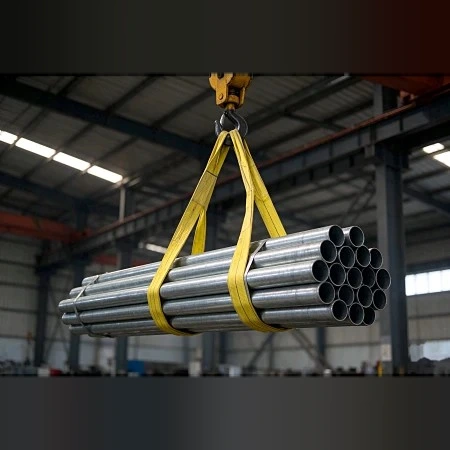
Deux yeux, deux choix, and what that decides
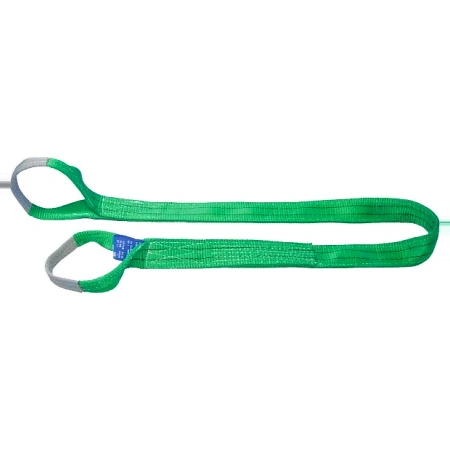
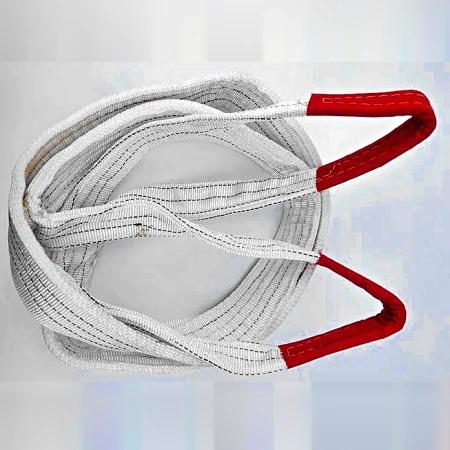
The same one-way discipline is sold in three shapes, and the shape is decided by what is at each end of the band. On pipe work the eye-and-eye form is the general answer because a pipe is usually picked at two points along its length, with something to hook to above each one.
| Shape | What is at each end | How the pipe is held | When it is the right buy |
|---|---|---|---|
| Eye and eye — this page | A formed flat eye, stitched and bar-tacked | One eye on each hook, band under the pipe or round the bundle | Two picks along the length, with a hook, pin or shackle above each |
| Boucle sans fin | Nothing — a closed ring | Wrapped round the pipe and back through itself, or doubled as a basket | Where there is no fitting to thread and the band must close on itself |
| Un seul oeil | One eye and a plain tail | Étouffé: the tail passes back through the eye and the noose closes | Where the pipe must be gripped rather than hung, or left slung on arrival |
The single-eye version is written up separately, because a choke changes both the arithmetic and the length: voir élingues de levage sans fin à sens unique, un seul oeil, for steel pipe and tubing. The endless loop is for the same loads with no hardware at either end — la forme en anneau fermé is on its own page as well. Nothing prevents a consignment using more than one shape, but each has to be specified and counted separately.
The figure on the band is per leg — the angle decides what a pair will carry
A two-leg lift is never twice one sling. The legs lean towards each other, so each leg carries more than half the load and the pair carries less than two bands’ worth. The design factor table used for synthetic webbing slings states it plainly, and the reference angle is measured from the vertical, not between the legs.
| Arrangement | Angle | Facteur | Capacité |
|---|---|---|---|
| Une seule jambe, verticale | — | × 1.0 | 5,000 kilos |
| Deux jambes | 0–45° de la verticale | × 1.4 | 7,000 kg per pair |
| Deux jambes | 45–60° de la verticale | × 1.0 | 5,000 kg per pair |
| Deux jambes | beyond 60° | not permitted | — |
| Panier, both parts vertical | 0° | × 2.0 | 10,000 kilos |
| Panier, parts at 45–60° | — | × 1.4 | 7,000 kilos |
| Étouffé | — | × 0.8 | 4,000 kilos |
Worked case. UN 9 t joint of 508 mm pipe, picked at two points, crochet 4 m above the pipe, pick spacing 6 m. Each leg is √(3² + 4²) = 5.0 m long and makes 36.9° with the vertical, so the pair is worth 1.4 × WLL. To carry 9 t the slings must be rated 9 ÷ 1.4 = 6.4 t each, et un 7 t band is the answer. Halve the hook height and the same pipe needs 9 t bands — the pipe did not change, the geometry did.
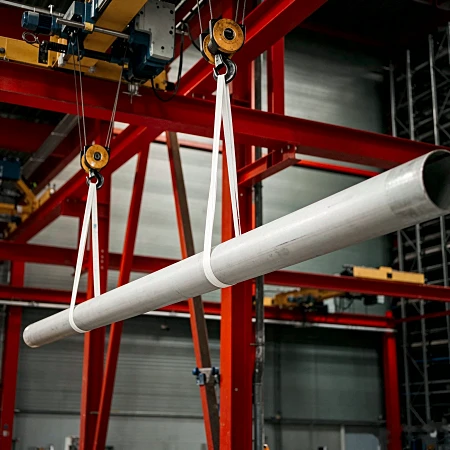
Where the picks go on a pipe
Un tuyau est une poutre, and where it is supported decides whether it sags, whips or bends at the overhang. The classical layout for a uniform span puts the supports at about 0.21 L from each end, which makes the sag in the middle equal to the overhang at the ends; many yards simply use the quarter points, which is close enough on a stiff wall and easier to measure. Neither figure is a rule from a standard — it is a layout, and the layout is what the sling length is cut to.
| Pipe length | Pick position from each end | Span between picks | Remarques |
|---|---|---|---|
| Jusqu'à 6 m | 1.5 m (quarter points) | 3 m | Deux choix, one hook or two |
| 6 – 12 m | 0.21 L, ou 2 m minimum | 0.58 L | The usual range for line pipe |
| 12 – 18 m | 0.21 L | 0.58 L | Four picks or a spreader above |
| Sur 18 m | Two pick groups | — | Spreader beam rather than a long V |
| Forfaits | One pick per sling position | Set by the pack | Girth, not length, sets the band |
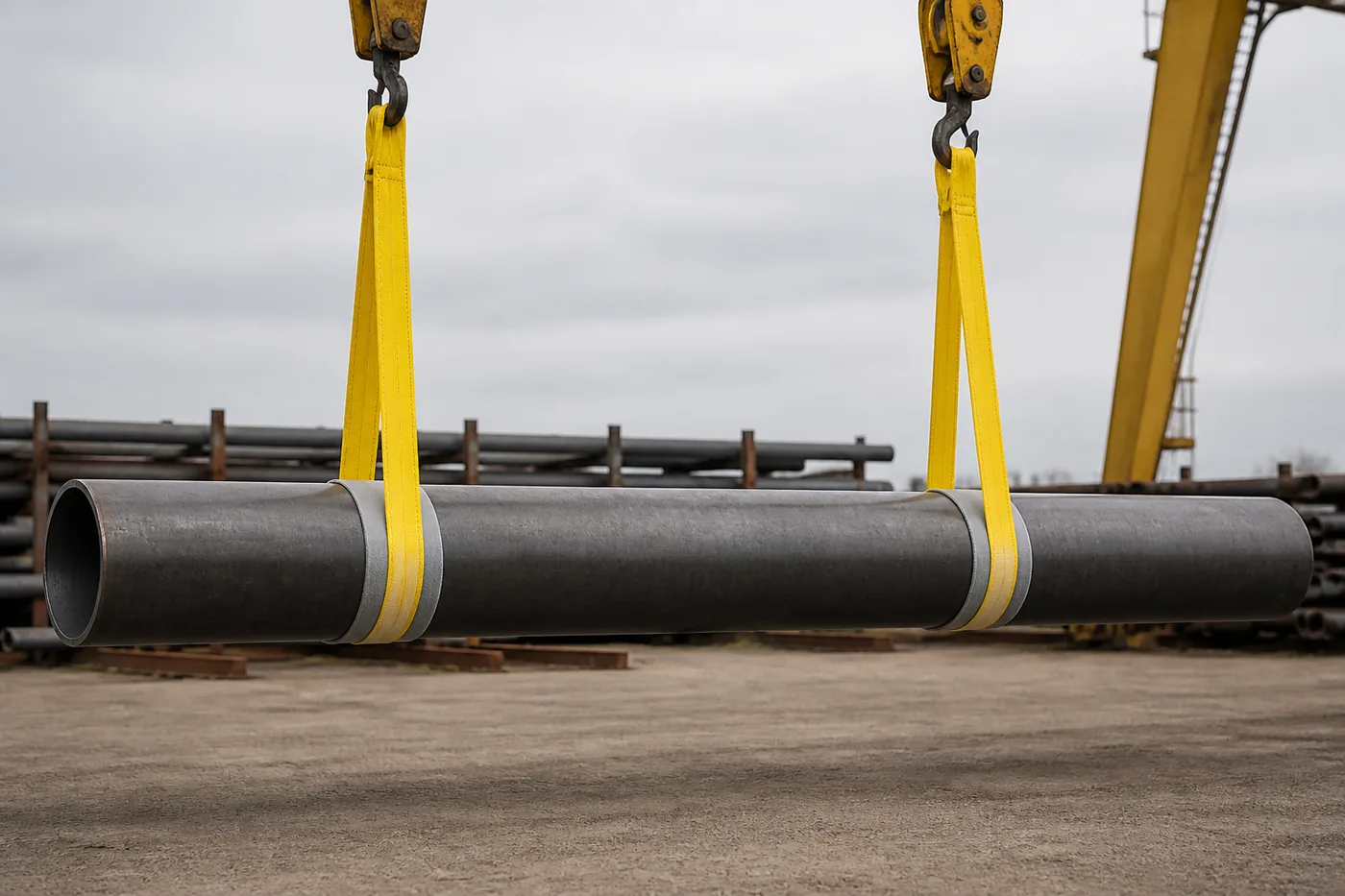
Two practical points that decide more lifts than the table does. A pick must not sit on a weld seam or a coating repair, and it must clear the end collar: an end that is thicker than the barrel will take the band on its shoulder and cut it. On a joint with a bevelled or sheared end, the band goes behind the bevel, never on it.
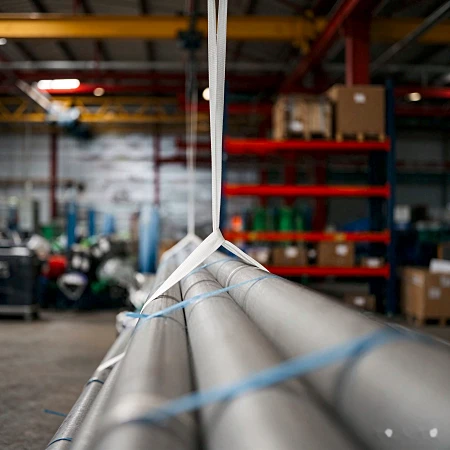
Length from pick spacing and hook height
On a two-leg lift the band is not a height, it is a hypotenuse. Given the spacing between the picks and the height of the hook above the pipe, the leg length and the angle follow directly — and the angle, pas le tonnage, is what changes the capacity of the pair.
Leg length = √((spacing ÷ 2)² + hook height²), et angle from vertical = arctan((spacing ÷ 2) ÷ hook height). Add the eye take-up at both ends — roughly the eye clear length — and order to the next half metre. A sewn article holds ±2 % on length.
| Pick spacing | Hook height | Longueur de jambe | Angle from vertical | Pair capacity |
|---|---|---|---|---|
| 4 m | 4 m | 4.47 m | 26.6° | 7,000 kilos |
| 6 m | 4 m | 5.00 m | 36.9° | 7,000 kilos |
| 8 m | 5 m | 6.40 m | 38.7° | 7,000 kilos |
| 10 m | 4 m | 6.40 m | 51.3° | 5,000 kilos |
| 12 m | 5 m | 7.81 m | 50.2° | 5,000 kilos |
| 12 m | 7 m | 9.22 m | 40.6° | 7,000 kilos |
| 16 m | 6 m | 10.00 m | 53.1° | 5,000 kilos |
| 16 m | 9 m | 12.04 m | 41.6° | 7,000 kilos |
The capacity column is the pair, not the leg, and it already includes the mode factor. Beyond 60° from vertical the arrangement is outside the factor table: raise the hook or shorten the spacing rather than adding tonnage.
This is why the same pipe can need two very different bands on two sites. A yard with a high gantry picks a 12 m joint with 5 jambes; a shed with low headroom, picking the same joint at the same spacing, needs 7 t legs or a spreader to lift the pick points clear of the hook. The sling is the same length in both cases and a different article.
What the band bears on: mur, coating and the end
The width of the band is chosen by the surface it touches, pas par le tonnage. A pipe is a line contact with a curved, sometimes thin, sometimes coated face — and the failure on pipe work is nearly always local: a cut, a scuff or an ovalised wall at the pick, not a band that broke in the middle.
| Tuyau | Largeur de bande | Protection at the pick | Qu'est-ce qui ne va pas sans ça |
|---|---|---|---|
| Bare black pipe, mur 6 mm and up | 75 – 100 mm | None normally needed | Cosmetic scuffing only |
| Bare pipe, wall under 4 mm | 100 – 150 mm | Large bande, pick behind the collar | Ovalisation at the pick |
| Recouvert, painted or lined | 150 mm, 7.5 bande mm | Porter une manche, soft contact | Coating damage becomes a rejection |
| Galvanised tube | 100 – 150 mm | Sleeve where the band turns | Bright witness marks on the zinc |
| Bundled tube | 150 – 200 mm | Sleeve at the arris, if square-cut | Band cut on a tube end |
| Stainless or aluminium | 150 mm, sleeve as standard | Manche, and a band that has never been used on steel | Iron transfer, then corrosion |
Two details cost almost nothing at the order and are impossible to add later: un wear sleeve over the contact point, which is replaced with the band instead of the band being replaced, et un oeil renforcé where a hook or shackle pin bears. On a one-trip article both are thrown away with the band, which is exactly why they are cheap.
Spécification
| Paramètre | Construction standard | Remarques |
|---|---|---|
| Sangles | Flat woven high-tenacity polyester, 25–300 mm | 4 mm ou 7.5 bande mm |
| Limite de charge de travail | 1 t – 24 t par élingue | Verticale, une seule jambe |
| Facteur de conception | 5:1 / 6:1 / 7:1 | Same WLL needs a wider band at 7:1 |
| Se termine | Formed flat eye at each end | Stitched and bar-tacked; sleeved on request |
| Eye clear length | 250 mm à 1 t à 650 mm à 15 t | Hook bowl or pin plus about 10 mm |
| Longueur | 0.5 m- 100 m | Cut to the pick spacing; ±2 % |
| Couleur | Pour commander; DANS 1492-1 code up to 10 t | A second channel for sorting |
| Température | −40 °C à +100 °C | Polyester; not for molten metal |
| Marquage | WLL, longueur, fibre, lot, votre référence | Printed on the band and on a sewn label |
| Emballage | Enroulé, baled or cartoned | Can travel inside the consignment |
| Code HS | 630790 | Packing list line |
The standard range
The works weaves nine tonnages on a 4 bande mm et neuf sur un 7.5 bande mm. Width follows the tonnage and the factor, and the minimum length steps up with the width rather than with the tonnage — which is the line that decides a short order.
| WLL | Groupe | 5:1 | 6:1 | 7:1 | Min.. longueur |
|---|---|---|---|---|---|
| 1 t | 4 mm | 25 mm | 50 mm | 30 mm | 0.5 m |
| 2 t | 4 mm | 50 mm | 100 mm | 60 mm | 1.0 m |
| 3 t | 4 mm | 75 mm | 150 mm | 90 mm | 1.0 m |
| 4 t | 4 mm | 100 mm | 200 mm | 120 mm | 1.5 m |
| 5 t | 4 mm | 125 mm | 250 mm | 150 mm | 1.5 m |
| 6 t | 4 mm | 150 mm | 300 mm | 180 mm | 1.5 m |
| 8 t | 4 mm | 200 mm | 200 mm | 240 mm | 2.0 m |
| 10 t | 4 mm | 250 mm | 250 mm | 300 mm | 2.0 m |
| 12 t | 4 mm | 300 mm | 300 mm | 300 mm | 2.0 m |
| 2 t | 7.5 mm | 25 mm | 50 mm | 30 mm | 0.5 m |
| 4 t | 7.5 mm | 50 mm | 100 mm | 60 mm | 1.0 m |
| 6 t | 7.5 mm | 75 mm | 150 mm | 90 mm | 1.0 m |
| 8 t | 7.5 mm | 100 mm | 200 mm | 120 mm | 1.5 m |
| 10 t | 7.5 mm | 125 mm | 250 mm | 150 mm | 1.5 m |
| 12 t | 7.5 mm | 150 mm | 300 mm | 180 mm | 1.5 m |
| 16 t | 7.5 mm | 200 mm | 200 mm | 240 mm | 2.0 m |
| 20 t | 7.5 mm | 250 mm | 250 mm | 300 mm | 2.0 m |
| 24 t | 7.5 mm | 300 mm | 300 mm | 300 mm | 2.0 m |
Two lines of reading are worth doing before the table is used. The two blocks share the same width ladder, so a band bought thicker for a delicate surface buys nothing if the width column was already right — thickness is for tonnage and wear, width is for the surface. And at 8 t and above the 6:1 column runs out of width: from that point the band is already at 300 mm, and the answer to more tonnage is a heavier block or two slings, not a wider band.
Sens Unique, and what that adds to the order
The band travels with the pipe, is inspected once at issue, and is not recovered. That changes three things about how it is ordered, and none of them about how it is made.
- Counted per pick, par paquet. A bundle on two picks is two bands; a long joint on four picks is four. Add 2–5 % for the band that gets cut while the pack is made up, and put the number on the order rather than in someone’s head.
- Marked to the consignment. Limite de charge de travail, length and your reference printed on the band — pack number, order number or part number — because that print is the only record the receiving site will have. Le one way sling category sets out the discipline in full.
- Packed to arrive with the goods. Coiled and baled, cartoned, or packed into the crate beside the pipe so the bands land at the same time as the consignment instead of a week earlier.
L'inspection en cause
There is one inspection in the life of a one-way band and it happens before the lift. Four places, dans cet ordre:
- The eyes. Piqûre, bar-tacks and the mouth of each eye — a broken stitch at an eye gives no warning at the load.
- The band where it will bear. Coupes, chicots, vitrage à cause de la chaleur, and any thin patch that shows daylight through the weave.
- L'impression. If the WLL or the length cannot be read, the band cannot be matched to the pipe it was cut for.
- Dans quoi il s'est couché. Grincer, les copeaux et l'huile pénètrent dans le contact; a clean band is the only protection on the list that costs nothing.
Foire aux questions
How many slings does a 12 m joint of pipe need?
Deux, at about 0.21 L from each end — 2.5 m in from either end, leaving a 7 m span — provided the wall carries the overhang. Ci-dessus à propos 18 m, or where the overhang whips, four picks or a spreader beam is the honest answer and the band count goes up with it.
Can one sling lift one end of a pipe?
Only for a short, stiff, light joint, and then it is a single vertical leg at 1.0 × WLL with the pipe hanging at an angle. On anything long the pipe rotates about the pick and the load walks; two picks are the arrangement, and the second sling is cheaper than the first accident.
Oeil et oeil, endless loop or single eye for pipe?
Eye and eye where there is a hook or a pin at each pick — the usual case. The endless loop where nothing must be threaded and the band closes on itself, which is also the kindest to a coated surface. The single eye where the pipe must be gripped in a choke and left slung on arrival. The three are separate articles and are counted separately.
How flat is too flat?
Beyond 60° from the vertical the two-leg arrangement leaves the factor table entirely, and the tension in each leg climbs steeply for very little gain in height. If the pick spacing is fixed and the headroom is not there, the answer is a spreader beam that lifts the pick points instead of a heavier pair of slings.
Will the sling mark galvanised or coated pipe?
A used band can: grit embedded in the weave polishes the zinc, and a band that has carried black steel leaves iron behind that shows up as rust later. A sleeve at the contact point, a band kept for coated work only, et 150 mm of width instead of 75 mm are the three measures that prevent it.
Can the length be cut to my pick spacing exactly?
Yes — that is what the length on the order means. Send the spacing between picks and the height of the hook above the pipe, and the leg length comes out of the arithmetic in Table 4; add the eye take-up and round to the next half metre. The finished length is confirmed in writing before the bands are cut, to ±2 %.
Send the lift, pas seulement le tonnage
Six lines and the band can be cut
Le tuyau: diamètre extérieur, épaisseur de paroi, coating or finish, and whether it travels as a joint or a bundle;
The mass of one lift, and how many picks you intend to use;
The spacing between picks, and the height of the hook above the pipe;
The fittings at each pick — hook, shackle or pin — with their sizes;
The factor your market expects: 5:1, 6:1 ou 7:1;
La référence à imprimer, la couleur, et la quantité par paquet.
Ascenseur Sling Rigging Co., Ltd · Parc industriel de Lifute, Ville de Taizhou, Province du Jiangsu, Chine · Code SH 630790 · Tel / WeChat +86 180 6600 2268 · 702461526@qq.com
Où aller ensuite
- Élingue à sens unique — the category and the buying discipline;
- Élingues à usage unique — the whole ladder and the four forms;
- Single eye for steel pipe and tube — the choker version of this page;
- Écharpe jetable à sens unique — the flat band and its loads;
- Single-use endless loop — the closed ring, pas de raccords;
- Looped end single use sling — eye and eye in detail;
- Élingue en sangle — the returnable version of the same band;
- Palonnier de levage — where the picks hang from a beam, pas le crochet;
- Appareils de levage — the hooks and shackles the eyes must clear.