Catégories de produits

Polyester Lifting Hoisting Net

Brève description:

Lift sling rigging company produce Polyester Lifting Hoisting Net,Polyester Cargo Net,Safety Lifting Net Strap,Bungee Cargo Net,Polyester Cargo Lifting Net,Lifting Sling Net,Rope Lifting Net,Filet de chargement pour palettes,Garden Climbing Net.

Polyester Lifting Hoisting Net

A polyester lifting hoisting net is a soft bag woven from high-tenacity polyester webbing, built to move bagged goods and bulk material in a single crane lift. The load is tipped into the bag, or the bag is laid flat and drawn up around a stack, and four corner loops carry the whole consignment to the hook. There is no pallet to return, no strapping to cut, and nothing to re-handle at the far end.

Because we weave the webbing in our own mill in Taizhou, Jiangsu, l'ouverture du grillage, bag footprint, depth, bottom construction and working load limit are all set to the cargo rather than to a fixed catalogue. Standard nets cover 0.5 t à 20 t et 0.6 m³ to over 10 m³, every net is proof-load tested before packing, and each shipment travels with a material test report. Nets are CE and GS certified, with webbing rated to the EN 1492-1 base.

  • Fully custom build – engrener, bag size, depth, colour and safety factor (5:1, 6:1 ou 7:1) set to your specification.
  • High-tenacity polyester webbing – 25 mm à 100 bandes mm, célibataire, duplex or triplex, Stabilisé aux UV et imputrescible.
  • Wear and heat resistant – working range -40 °C à +100 °C, with a reinforced bottom for abrasive loads.
  • Doux, flexible and light – the flat band contacts the load over a wide area, so bags, cartons and finished surfaces are neither crushed nor marked.
  • Certifié CE et GS – testé par nous-mêmes 1000 machine, with an ISO 9001 quality system and a CNAS-accredited laboratory behind it.
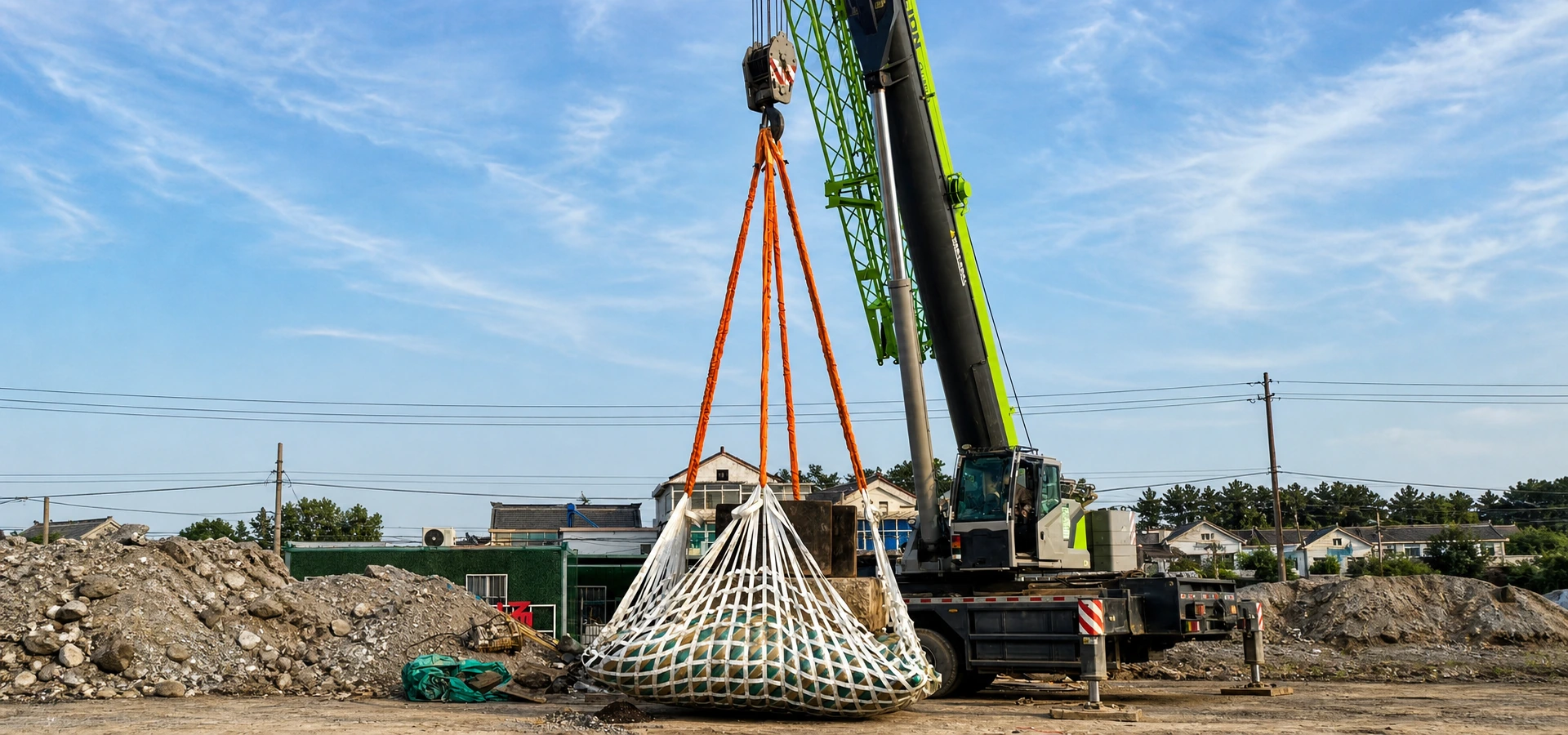
Polyester lifting hoisting net under a mobile crane carrying broken stone
A polyester lifting hoisting net in bulk service – the bag is filled with broken stone and lifted from its four loops by a mobile crane.

Why a webbing net bag, and not a rope net or a big bag

Three products are sold for the same job and they behave very differently once the load is in the air. A rope net concentrates the load on a few contact points. A big bag carries one free-flowing product and is itself the package. A webbing net bag spreads the pressure across flat bands, holds a stacked or mixed load together, and goes back to the store empty.

Tableau 1 – How the four common ways of lifting loose cargo compare.

Option Construction Contact avec la charge Best cargo Limitation
Polyester webbing net bag Flat woven bands, 25-100 mm, 25-300 maille mm Wide flat bands, low pressure per cm² Bagged, stacked, mixed and bulk cargo Needs a crane or hook; not a sealed package for powder
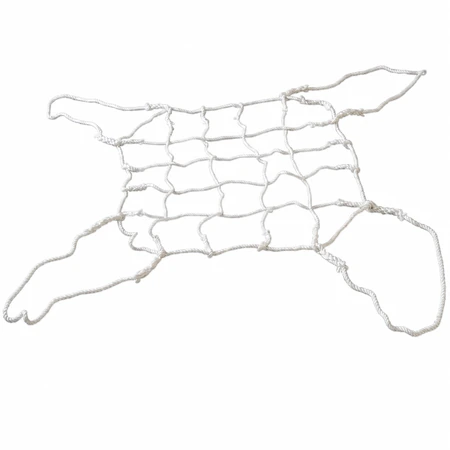
Filet en corde de nylon Knotted or braided rope, 8-24 mm Line contact at every rope Irregular and heavy single items Ropes mark soft cargo; a tight mesh adds weight
FIBC / big bag Woven PP fabric with a liner Full surface, sealed One free-flowing product per bag Single product only; the bag is the packaging
Pallet and strapping Timber or plastic pallet plus bands Rigid base Unitised cartons Pallet returned or lost; bands cut and discarded; no drainage
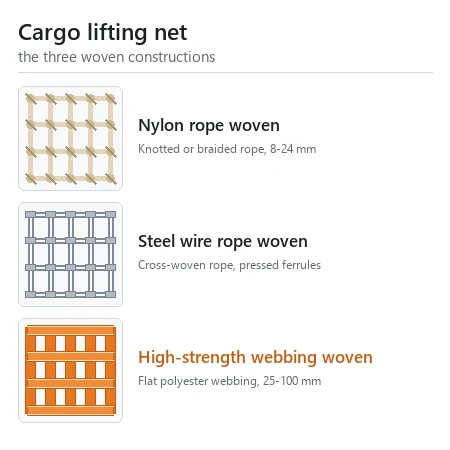
Diagram comparing nylon rope, steel wire rope and polyester webbing net constructions
Three woven constructions for cargo nets: corde en nylon, steel wire rope and high-strength polyester webbing.

Five decisions that set the specification

A polyester lifting hoisting net is quoted from five numbers. Get them right and the net arrives right; get the mesh wrong and no amount of extra tonnage will fix it later.

Tableau 2 – What we need to know, and why each answer changes the net.

Décision Ce que ça corrige What to tell us
1. Cargo form Whether the net is a bag or a flat sheet, and how the bottom is built How the cargo arrives: sacs, big bags, bales, or loose material
2. Weight per lift Band width and layer count, and therefore the rated capacity The gross weight you intend to lift, not the weight of the net
3. Filled volume Footprint and depth of the bag Bulk density (t/m³) for loose material, or the height of the stack for bagged goods
4. Ouverture en maille The largest gap the cargo can pass through The smallest unit in the load: un 25 kg bag, grain, aggregate or scrap
5. Discharge method Closed, laced, chute or lined bottom Whether the bag is tipped, untied over a hopper, or emptied by hand

Weight and volume are two separate limits, and for light bulk the volume arrives first. Grain at about 0.7 t/m³ and wood chips at about 0.3 t/m³ both fill a 3.6 m³ bag, but one lift weighs about 2.5 t and the other about 1 t. Send the bulk density with the tonnage and we will size the bag so that a full bag is also a legal bag.
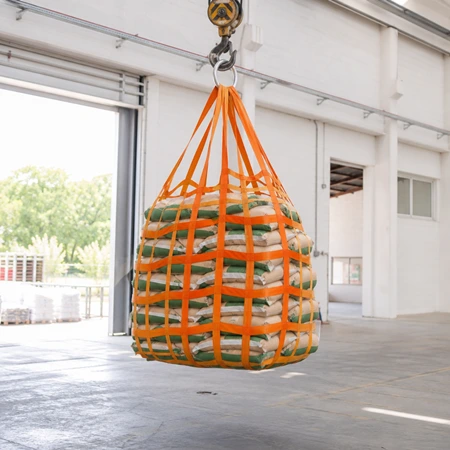
Polyester net bag lifting stacked 25 kg sacks in one crane lift
Bagged cargo in a polyester net bag – a stack of 25 kg sacks is closed in by the mesh and lifted as a single load.

Paramètres techniques

The figures below cover the standard bagged and bulk range. Engrener, footprint, depth, bottom, loops and capacity are made to order, alors considérez cela comme le point de départ d'un devis plutôt que d'un catalogue fixe.

Tableau 3 – Polyester lifting hoisting net: paramètres techniques.

Paramètre Spécification
Nom du produit Polyester lifting hoisting net (polyester webbing net bag)
Configurations Closed bag, release-bottom bag, or flat lifting net
Matériau de la sangle 100 % polyester haute ténacité (ANIMAL DE COMPAGNIE); nylon haute ténacité sur demande
Largeur de bande 25 / 38 / 50 / 75 / 100 mm (50 mm norme)
Construction de bandes Couche unique, duplex or triplex; lisière tissée, pas un bord coupé
Épaisseur de la bande 1.8 mm – 4.5 mm en fonction de la largeur et du nombre de couches
Ouverture en maille 100 × 100 mm norme; 25 – 300 mm sur commande
Taille nette Adapté à l'empreinte de charge, truck bed or receiving hopper; see Table 4
Profondeur du sac 0.8 m – 2.5 m, or to drawing
Filled volume À propos 0.6 m³ to over 10 m³, set by footprint and depth
Frontière Plié et double couture, reinforced at every lifting point
Points de levage Quatre boucles de coin standard; huit pour un palonnier; loops top and bottom on request
Capacité nominale (WLL) 0.5 t – 20 t, set by band, nombre de couches et disposition de levage
Facteur de sécurité 5:1 / 6:1 / 7:1
Allongement à WLL 7 % ou moins
Couleur Code couleur par limite de charge de travail, ou une couleur maison personnalisée
Température de travail -40 °C à +100 °C
Weather and chemical Stabilisé aux UV, imputrescible, unaffected by rain, sea water and wash-down
Marquage WLL, mesh and batch printed on the belt, plus a sewn capacity label
Base standard Webbing rated to EN 1492-1
Attestation CE, GS, OIN 9001, JIS sur demande; Laboratoire CNAS; DNV
Personnalisation OEM / Taille d'ODM, couleur, logo imprimé, étiquette et emballage
Code HS 6307.90 – filets et filets en matières textiles

Tailles standards, volumes and working load limits

These six lines cover the great majority of bagged and bulk work. Filled volume is calculated from the footprint and the depth with an allowance for the rounded shape a loaded bag takes, so a material that settles well will carry slightly more and one that bridges will carry less.

Tableau 4 – Standard net sizes at four corner loops gathered on one hook.

Taille nette (L × L) Depth Filled volume Engrener Groupe WLL Cargaison typique
1.0 × 1.0 m 1.0 m 0.6 m³ 50-100 mm 50 mm simple 0.5-1.5 t 25 kg bags, small sacks, bales
1.5 × 1.5 m 1.2 m 1.6 m³ 50-100 mm 50 mm recto-verso 1-2.5 t Bagged grain, fertilizer, produire
2.0 × 2.0 m 1.5 m 3.6 m³ 50-100 mm 50 mm recto-verso 2-4 t Bulk grain, sand, crushed stone
2.5 × 2.5 m 1.8 m 6.8 m³ 50-150 mm 75 mm recto-verso 3-6 t Bulk fertilizer, coal, ferraille, fish
3.0 × 3.0 m 2.0 m 10.8 m³ 100-150 mm 75 mm recto-verso 4-8 t Large bulk loads, travaux de quai et de cale
To drawing 0.8-2.5 m Pour commander 25-300 mm 25-100 mm 0.5-20 t N'importe quelle empreinte, depth and cargo

The working load limits above assume a four-loop lift. A two-loop basket de-rates the net – demandez le chiffre déclassé plutôt que de lire ce tableau.

Ouverture en maille, chosen from the cargo

Mesh is the one dimension that cannot be adjusted after the net is sewn, so it is sized from the smallest unit in the load rather than from the total weight.

Tableau 5 – Mesh opening by cargo.

Cargaison Maille recommandée Reason
50 kg sacks, big bags, bales 100 mm The sacks are far larger than the opening; the mesh only has to keep the stack together
25 kg bags, small sacks 50-75 mm Small bags can squeeze through 100 mm once the load settles in the air
Grain, graine, dried produce 25-50 mm, or a closed liner Fine material must not sift out on the hook or in transit
Fertilizer, prills, powders 25-50 mm, or a closed liner Fine and moisture-sensitive: a liner keeps the product in and the weather out
Sable, gravier, crushed stone 50-100 mm Fine enough to hold the bulk, open enough for rainwater to drain
Coal, coke 100-150 mm Large lumps; a wider mesh keeps the net light and drains well
Ferraille, chutes 100-150 mm Open mesh with a reinforced bottom and wear pads at the contact points
Fish, shellfish, wet produce 25-50 mm Holds the catch, drains freely, keeps the weight honest
Journaux, firewood, large offcuts 150-300 mm Indivisible pieces: a wide mesh saves weight without losing the load
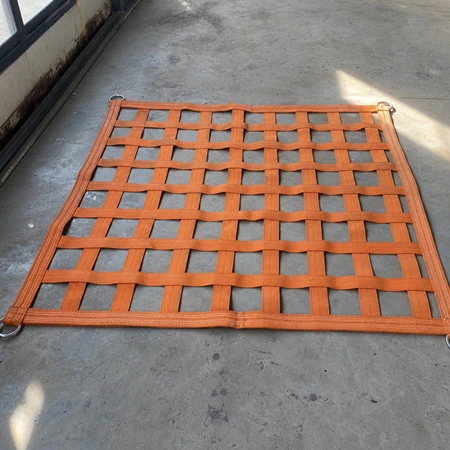
Orange polyester webbing lifting net laid flat with steel corner rings
A square polyester webbing net laid out flat: 100 maille mm, 50 bandes mm, reinforced border and a steel ring at each corner.

Bottom construction and discharge

How the load comes out is a design decision in its own right. For bagged cargo the answer is usually a person with a knife; for bulk it is usually gravity.

Tableau 6 – Bottom options and how each one is emptied.

Bas Comment ça marche Chosen when
Closed, fully sewn The bag holds the cargo permanently and is emptied by tipping or by hand Cargaison en sac, and bulk tipped over a hopper or onto a pile
Release bottom, laced A laced seam across the bottom is untied at the discharge point and the load falls out Free-flowing bulk – sand, grain, agrégat – discharged without tipping the bag
Chute bottom The bag narrows to a chute opened over the receiving hopper Controlled discharge into a hopper, a barge or a conveyor
Closed with a liner A fabric liner sits inside the net Dusty or moisture-sensitive bulk: grain, fertilizer, powders
Reinforced bottom panel An extra layer of webbing is stitched across the base Abrasive and heavy bulk: agrégat, ore, ferraille
Loops top and bottom Loops at both ends, so the bag can be lifted either way up Loading at height, and emptying by inverting the bag on the hook

Lifting arrangements and fittings

How the bag is hung decides how much of the load it really carries, and bulk is unforgiving because the load keeps moving inside the bag while it is in the air.

  • Quatre boucles sur le crochet – the standard for bagged and bulk work; the loops gather on the hook or a master ring and the bag closes around the cargo as the crane takes up the slack.
  • Huit boucles sur un palonnier – the bag stays square, the load stays level, and each loop carries a predictable share; the right arrangement for large bags and high tonnage, voir notre palonnier de levage gamme.
  • Two-loop basket – faster to rig, mais ça dévalorise le net; ask for the derated capacity instead of reading across from the four-loop figure.
  • Loops top and bottom – lets the bag be lifted either way up, which is how a closed bag is emptied by inverting it over a hopper.

Fittings supplied or fitted on request: sewn webbing loops, master ring or master link, grade 80 chaînes, laced release bottoms, chutes and discharge sleeves, inner liners, wear pads and protection sleeves for scrap and aggregate, and repair kits for fleets that maintain their own equipment.

Matériel, stitching and finish

The belt is the product. We weave it on needle looms from high-tenacity polyester yarn, with a woven selvedge rather than a cut edge, so the band does not fray from the outside in.

  • 100 % polyester haute ténacité, faible allongement (7 % or less at WLL), Stabilisé aux UV, rot-proof and unaffected by moisture.
  • Locked stitching in high-tenacity polyester thread, run in multiple rows along the border and box-X at every loop – on a cheap net it is the stitch line, pas la ceinture, that fails first.
  • Folded and double-stitched border, so the edge of the mesh cannot unravel under load.
  • Galvanised or stainless steel rings and master links on request.
  • Polyester holds its strength from -40 °C à +100 °C; above that, or in chemical exposure, tell us and we will quote nylon or another construction.
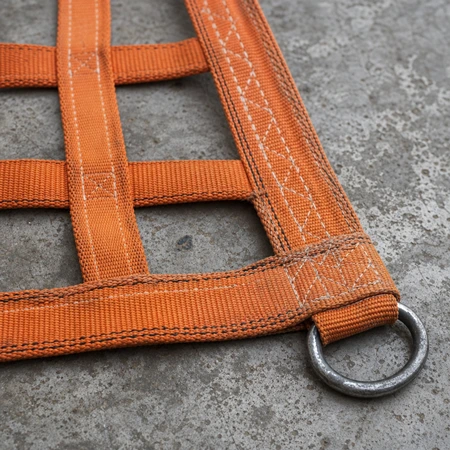
Close-up of webbing net border stitching and a galvanised D-ring
Border stitching and a galvanised D-ring at the corner – the two places a webbing net bag is most often overloaded.

Essai, certification et traçabilité

  • Quarante ans de fabrication d'équipements de levage – fondée en 1985 à Taizhou, Jiangsu, avec plus de 200 employees and one of China’s largest lifting sling and net production bases.
  • Every net is proof-load tested on our own 1000 t machine d'essai horizontale – testé, non échantillonné.
  • A material test report travels with each shipment, quoting the belt batch and the test load.
  • Déclaration de conformité CE et certification GS, avec certification JIS sur les commandes à l'exportation.
  • OIN 9001 système de gestion de la qualité, un laboratoire accrédité CNAS et une certification DNV derrière l'usine.
  • Every net is marked with its working load limit, engrener, rated volume and batch number before packing, so the bag and its paperwork always agree.

Certificates and test reports are available as PDFs for your tender or customs file – voir le complet attestation ensemble.

Where these nets work

A polyester lifting hoisting net is used wherever loose cargo has to travel between a stack and a hook – quay, moulin, quarry, yard or hold. The sectors below are the ones where the bagged and bulk version earns its place.

Tableau 7 – Candidatures par secteur.

Secteur What the net handles Why a polyester net suits it
Ports, quays and terminals Cargaison en sac, grain, fertilizer and bulk between quay, barge and hold One bag per lift, no pallet, and the load drains as it travels
Agriculture and feed mills Seed, grain, alimentation, fertilizer and bagged product A tight mesh or a liner keeps the product in and the weather out
Building materials Sable, gravier, crushed stone and bagged cement Fine enough to hold the bulk, open enough for rainwater to drain
Mining and quarrying Aggregate, ore and mineral bulk A reinforced bottom takes the abrasion that wears a net out
Fisheries and food processing Wet fish, shellfish and produce Open mesh drains freely, which keeps the weight honest
Recycling and waste Loose plastics, glass, metal and mixed material Contains loose material that would otherwise blow or fall
Biomass and power Wood chips, bark, pellets and fuel bulk A large bag for a modest tonnage, matched to the volume limit
Construction sites and relief work Bagged materials raised to upper floors, field cargo No pallet, no banding, and it can be emptied straight onto the ground
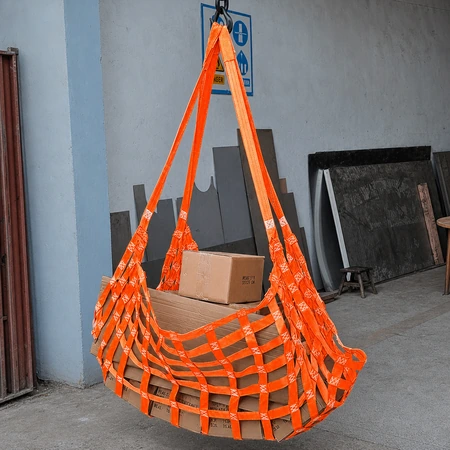
Orange webbing net bag lifting a carton with soft wide bands
Mixed cargo on site: a net bag takes a carton as readily as a stack of sacks, and the flat webbing spreads the load rather than cutting into it.

Customisation and branding

A net that moves between quays, holds and yards has to be identifiable from a distance and has to keep its marking. Couleur, logo imprimé, working load limit and cargo type are all applied in our own plant, so the marking cannot be washed off or pulled away with a label.

  • Code couleur par limite de charge de travail, or a custom house colour to separate your fleet from a competitor’s.
  • Logo, brand name, texte d'avertissement ou numéro de certificat imprimé sur la ceinture, or woven in on larger orders.
  • Cargo type printed on the bag, which stops a fine-mesh grain net being sent out for scrap.
  • Sewn capacity label in addition to the print, so the net and its paperwork agree at every inspection.
  • Packing folded into a bag or a crate – a set of ten net bags takes the space of one pallet.
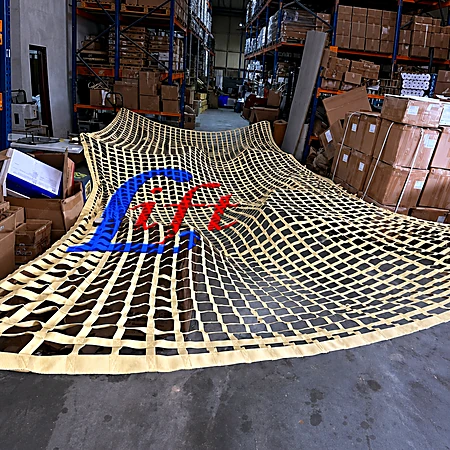
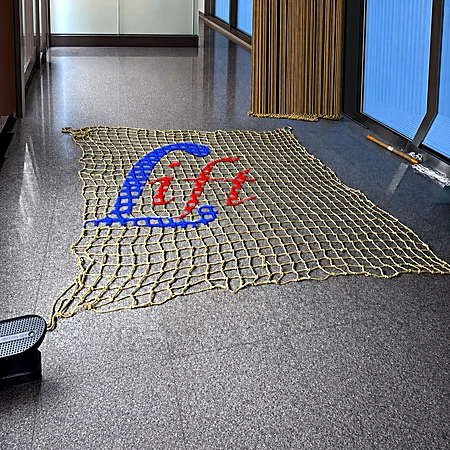
Polyester webbing cargo net printed with a customer logo in a warehouse
Buyer branding applied at the mill: the customer mark is printed directly on the webbing bands, not on a tag.
Beige polyester webbing net with printed logo laid out for inspection
Final inspection before packing – couleur, logo imprimé, mesh and working load limit are checked on the finished net.

Soins, inspection et mise à la retraite

  • Inspect the loops and their stitching first, puis la frontière, then the bottom closure – on a bulk net the bottom and the corners wear before the mesh does.
  • Empty the bag completely before storage; material left inside holds moisture, adds weight and hides damage.
  • Recherchez des coupures, abrasion, couture cassée, coloration chimique, heat glazing and the colour or gloss change that signals UV degradation.
  • Weigh a wet bag before lifting it. Pluie, sea water and wet bulk can add far more than the cargo was rated at, and a net does not know the difference.
  • Ne dépassez jamais la capacité nominale, ne soulevez jamais moins que l’ensemble complet des boucles, and never drag a loaded bag sideways with the crane.
  • Conserver propre et sec, hors du sol et à l'abri du soleil direct; ne réparez jamais la sangle en la nouant, le souder ou le chauffer.

Questions fréquemment posées

What is the difference between a polyester lifting hoisting net and a cargo net?

A lifting net is rated, marked and tested to carry a load on a crane hook. A cargo net is a restraint: it holds a load down in transit and is not designed to be lifted. If the net is going onto a hook, it must be the rated version – voir notre cargo securing net for the tie-down case.

How do I choose the mesh opening?

From the smallest unit in the load, pas du tonnage. UN 25 kg bag needs 50-75 mm; grain or fertilizer needs 25-50 mm or a closed liner; scrap and coal can take 100-150 mm. Once the net is sewn the mesh cannot be changed, so this is the one number worth checking twice.

Why does the volume matter as much as the weight?

Because light bulk fills the bag before it reaches the rated weight. A bag that is full at half its rating doubles the number of lifts and the crane time. Give us the bulk density with the tonnage and we will size the bag so a full bag is also a legal bag.

Can the bag be emptied without tipping it?

Oui. A laced release bottom or a chute bottom lets a free-flowing load be discharged straight into a hopper, a barge or a conveyor. Bagged cargo is normally emptied by hand or with a forklift at the far end.

Will the net hold wet cargo?

The net itself is unaffected – polyester does not absorb water and does not rot, so rain, sea water and wash-down do no harm. Deux mises en garde: wet cargo is heavier, and fine wet material can clog the mesh, which adds weight and stops it draining.

How is the working load limit proved?

The webbing is rated to the EN 1492-1 basis and nets are supplied at 5:1, 6:1 ou 7:1 as specified. Every net is proof-load tested on our own 1000 machine, a material test report travels with the order, and the products carry CE and GS certification.

Do you make a flat version for palletised cargo?

Oui – the flat lifting net is the filet de chargement de palette de grue, and the material-led range is covered by the filet en sangle de polyester pour le levage. The rope constructions sit alongside as the filet de levage de cargaison en nylon et le élingue de filet de chargement en nylon robuste.

What else do you make from the same webbing?

The same belt goes into our élingues en sangle et élingues rondes sans fin, and the wider cargo range is listed under filets de levage de marchandises – including the filet de levage de cargaison en sangle for flat work.

Demander un devis

Send the cargo and whether it is bagged or bulk, the bulk density if you know it, the weight you want per lift, l'ouverture du grillage, the discharge method and the environment the net will work in – or a sketch of the bag you have in mind. Our engineers will confirm the net size, depth, bottom construction, band and packing and quote it in one reply. Pour en parler d'abord, contactez nos ingénieurs.

Entreprise de gréage d'élingues de levage – Parc industriel de Lifute, Ville de Taizhou, Province du Jiangsu, Chine
Tél: +86 523 8693 5818 | WhatsApp: +86 180 6600 2268 | E-mail: lift98@jslift.com

Détail du produit

Lift sling rigging company produce Polyester Lifting Hoisting Net,Polyester Cargo Net,Safety Lifting Net Strap,Bungee Cargo Net,Polyester Cargo Lifting Net,Lifting Sling Net,Rope Lifting Net,Filet de chargement pour palettes,Garden Climbing Net.

Polyester Lifting Hoisting Net

A polyester lifting hoisting net is a soft bag woven from high-tenacity polyester webbing, built to move bagged goods and bulk material in a single crane lift. The load is tipped into the bag, or the bag is laid flat and drawn up around a stack, and four corner loops carry the whole consignment to the hook. There is no pallet to return, no strapping to cut, and nothing to re-handle at the far end.

Because we weave the webbing in our own mill in Taizhou, Jiangsu, l'ouverture du grillage, bag footprint, depth, bottom construction and working load limit are all set to the cargo rather than to a fixed catalogue. Standard nets cover 0.5 t à 20 t et 0.6 m³ to over 10 m³, every net is proof-load tested before packing, and each shipment travels with a material test report. Nets are CE and GS certified, with webbing rated to the EN 1492-1 base.

  • Fully custom build – engrener, bag size, depth, colour and safety factor (5:1, 6:1 ou 7:1) set to your specification.
  • High-tenacity polyester webbing – 25 mm à 100 bandes mm, célibataire, duplex or triplex, Stabilisé aux UV et imputrescible.
  • Wear and heat resistant – working range -40 °C à +100 °C, with a reinforced bottom for abrasive loads.
  • Doux, flexible and light – the flat band contacts the load over a wide area, so bags, cartons and finished surfaces are neither crushed nor marked.
  • Certifié CE et GS – testé par nous-mêmes 1000 machine, with an ISO 9001 quality system and a CNAS-accredited laboratory behind it.
Polyester lifting hoisting net under a mobile crane carrying broken stone
A polyester lifting hoisting net in bulk service – the bag is filled with broken stone and lifted from its four loops by a mobile crane.

Why a webbing net bag, and not a rope net or a big bag

Three products are sold for the same job and they behave very differently once the load is in the air. A rope net concentrates the load on a few contact points. A big bag carries one free-flowing product and is itself the package. A webbing net bag spreads the pressure across flat bands, holds a stacked or mixed load together, and goes back to the store empty.

Tableau 1 – How the four common ways of lifting loose cargo compare.

Option Construction Contact avec la charge Best cargo Limitation
Polyester webbing net bag Flat woven bands, 25-100 mm, 25-300 maille mm Wide flat bands, low pressure per cm² Bagged, stacked, mixed and bulk cargo Needs a crane or hook; not a sealed package for powder
Filet en corde de nylon Knotted or braided rope, 8-24 mm Line contact at every rope Irregular and heavy single items Ropes mark soft cargo; a tight mesh adds weight
FIBC / big bag Woven PP fabric with a liner Full surface, sealed One free-flowing product per bag Single product only; the bag is the packaging
Pallet and strapping Timber or plastic pallet plus bands Rigid base Unitised cartons Pallet returned or lost; bands cut and discarded; no drainage
Diagram comparing nylon rope, steel wire rope and polyester webbing net constructions
Three woven constructions for cargo nets: corde en nylon, steel wire rope and high-strength polyester webbing.

Five decisions that set the specification

A polyester lifting hoisting net is quoted from five numbers. Get them right and the net arrives right; get the mesh wrong and no amount of extra tonnage will fix it later.

Tableau 2 – What we need to know, and why each answer changes the net.

Décision Ce que ça corrige What to tell us
1. Cargo form Whether the net is a bag or a flat sheet, and how the bottom is built How the cargo arrives: sacs, big bags, bales, or loose material
2. Weight per lift Band width and layer count, and therefore the rated capacity The gross weight you intend to lift, not the weight of the net
3. Filled volume Footprint and depth of the bag Bulk density (t/m³) for loose material, or the height of the stack for bagged goods
4. Ouverture en maille The largest gap the cargo can pass through The smallest unit in the load: un 25 kg bag, grain, aggregate or scrap
5. Discharge method Closed, laced, chute or lined bottom Whether the bag is tipped, untied over a hopper, or emptied by hand

Weight and volume are two separate limits, and for light bulk the volume arrives first. Grain at about 0.7 t/m³ and wood chips at about 0.3 t/m³ both fill a 3.6 m³ bag, but one lift weighs about 2.5 t and the other about 1 t. Send the bulk density with the tonnage and we will size the bag so that a full bag is also a legal bag.

Polyester net bag lifting stacked 25 kg sacks in one crane lift
Bagged cargo in a polyester net bag – a stack of 25 kg sacks is closed in by the mesh and lifted as a single load.

Paramètres techniques

The figures below cover the standard bagged and bulk range. Engrener, footprint, depth, bottom, loops and capacity are made to order, alors considérez cela comme le point de départ d'un devis plutôt que d'un catalogue fixe.

Tableau 3 – Polyester lifting hoisting net: paramètres techniques.

Paramètre Spécification
Nom du produit Polyester lifting hoisting net (polyester webbing net bag)
Configurations Closed bag, release-bottom bag, or flat lifting net
Matériau de la sangle 100 % polyester haute ténacité (ANIMAL DE COMPAGNIE); nylon haute ténacité sur demande
Largeur de bande 25 / 38 / 50 / 75 / 100 mm (50 mm norme)
Construction de bandes Couche unique, duplex or triplex; lisière tissée, pas un bord coupé
Épaisseur de la bande 1.8 mm – 4.5 mm en fonction de la largeur et du nombre de couches
Ouverture en maille 100 × 100 mm norme; 25 – 300 mm sur commande
Taille nette Adapté à l'empreinte de charge, truck bed or receiving hopper; see Table 4
Profondeur du sac 0.8 m – 2.5 m, or to drawing
Filled volume À propos 0.6 m³ to over 10 m³, set by footprint and depth
Frontière Plié et double couture, reinforced at every lifting point
Points de levage Quatre boucles de coin standard; huit pour un palonnier; loops top and bottom on request
Capacité nominale (WLL) 0.5 t – 20 t, set by band, nombre de couches et disposition de levage
Facteur de sécurité 5:1 / 6:1 / 7:1
Allongement à WLL 7 % ou moins
Couleur Code couleur par limite de charge de travail, ou une couleur maison personnalisée
Température de travail -40 °C à +100 °C
Weather and chemical Stabilisé aux UV, imputrescible, unaffected by rain, sea water and wash-down
Marquage WLL, mesh and batch printed on the belt, plus a sewn capacity label
Base standard Webbing rated to EN 1492-1
Attestation CE, GS, OIN 9001, JIS sur demande; Laboratoire CNAS; DNV
Personnalisation OEM / Taille d'ODM, couleur, logo imprimé, étiquette et emballage
Code HS 6307.90 – filets et filets en matières textiles

Tailles standards, volumes and working load limits

These six lines cover the great majority of bagged and bulk work. Filled volume is calculated from the footprint and the depth with an allowance for the rounded shape a loaded bag takes, so a material that settles well will carry slightly more and one that bridges will carry less.

Tableau 4 – Standard net sizes at four corner loops gathered on one hook.

Taille nette (L × L) Depth Filled volume Engrener Groupe WLL Cargaison typique
1.0 × 1.0 m 1.0 m 0.6 m³ 50-100 mm 50 mm simple 0.5-1.5 t 25 kg bags, small sacks, bales
1.5 × 1.5 m 1.2 m 1.6 m³ 50-100 mm 50 mm recto-verso 1-2.5 t Bagged grain, fertilizer, produire
2.0 × 2.0 m 1.5 m 3.6 m³ 50-100 mm 50 mm recto-verso 2-4 t Bulk grain, sand, crushed stone
2.5 × 2.5 m 1.8 m 6.8 m³ 50-150 mm 75 mm recto-verso 3-6 t Bulk fertilizer, coal, ferraille, fish
3.0 × 3.0 m 2.0 m 10.8 m³ 100-150 mm 75 mm recto-verso 4-8 t Large bulk loads, travaux de quai et de cale
To drawing 0.8-2.5 m Pour commander 25-300 mm 25-100 mm 0.5-20 t N'importe quelle empreinte, depth and cargo

The working load limits above assume a four-loop lift. A two-loop basket de-rates the net – demandez le chiffre déclassé plutôt que de lire ce tableau.

Ouverture en maille, chosen from the cargo

Mesh is the one dimension that cannot be adjusted after the net is sewn, so it is sized from the smallest unit in the load rather than from the total weight.

Tableau 5 – Mesh opening by cargo.

Cargaison Maille recommandée Reason
50 kg sacks, big bags, bales 100 mm The sacks are far larger than the opening; the mesh only has to keep the stack together
25 kg bags, small sacks 50-75 mm Small bags can squeeze through 100 mm once the load settles in the air
Grain, graine, dried produce 25-50 mm, or a closed liner Fine material must not sift out on the hook or in transit
Fertilizer, prills, powders 25-50 mm, or a closed liner Fine and moisture-sensitive: a liner keeps the product in and the weather out
Sable, gravier, crushed stone 50-100 mm Fine enough to hold the bulk, open enough for rainwater to drain
Coal, coke 100-150 mm Large lumps; a wider mesh keeps the net light and drains well
Ferraille, chutes 100-150 mm Open mesh with a reinforced bottom and wear pads at the contact points
Fish, shellfish, wet produce 25-50 mm Holds the catch, drains freely, keeps the weight honest
Journaux, firewood, large offcuts 150-300 mm Indivisible pieces: a wide mesh saves weight without losing the load
Orange polyester webbing lifting net laid flat with steel corner rings
A square polyester webbing net laid out flat: 100 maille mm, 50 bandes mm, reinforced border and a steel ring at each corner.

Bottom construction and discharge

How the load comes out is a design decision in its own right. For bagged cargo the answer is usually a person with a knife; for bulk it is usually gravity.

Tableau 6 – Bottom options and how each one is emptied.

Bas Comment ça marche Chosen when
Closed, fully sewn The bag holds the cargo permanently and is emptied by tipping or by hand Cargaison en sac, and bulk tipped over a hopper or onto a pile
Release bottom, laced A laced seam across the bottom is untied at the discharge point and the load falls out Free-flowing bulk – sand, grain, agrégat – discharged without tipping the bag
Chute bottom The bag narrows to a chute opened over the receiving hopper Controlled discharge into a hopper, a barge or a conveyor
Closed with a liner A fabric liner sits inside the net Dusty or moisture-sensitive bulk: grain, fertilizer, powders
Reinforced bottom panel An extra layer of webbing is stitched across the base Abrasive and heavy bulk: agrégat, ore, ferraille
Loops top and bottom Loops at both ends, so the bag can be lifted either way up Loading at height, and emptying by inverting the bag on the hook

Lifting arrangements and fittings

How the bag is hung decides how much of the load it really carries, and bulk is unforgiving because the load keeps moving inside the bag while it is in the air.

  • Quatre boucles sur le crochet – the standard for bagged and bulk work; the loops gather on the hook or a master ring and the bag closes around the cargo as the crane takes up the slack.
  • Huit boucles sur un palonnier – the bag stays square, the load stays level, and each loop carries a predictable share; the right arrangement for large bags and high tonnage, voir notre palonnier de levage gamme.
  • Two-loop basket – faster to rig, mais ça dévalorise le net; ask for the derated capacity instead of reading across from the four-loop figure.
  • Loops top and bottom – lets the bag be lifted either way up, which is how a closed bag is emptied by inverting it over a hopper.

Fittings supplied or fitted on request: sewn webbing loops, master ring or master link, grade 80 chaînes, laced release bottoms, chutes and discharge sleeves, inner liners, wear pads and protection sleeves for scrap and aggregate, and repair kits for fleets that maintain their own equipment.

Matériel, stitching and finish

The belt is the product. We weave it on needle looms from high-tenacity polyester yarn, with a woven selvedge rather than a cut edge, so the band does not fray from the outside in.

  • 100 % polyester haute ténacité, faible allongement (7 % or less at WLL), Stabilisé aux UV, rot-proof and unaffected by moisture.
  • Locked stitching in high-tenacity polyester thread, run in multiple rows along the border and box-X at every loop – on a cheap net it is the stitch line, pas la ceinture, that fails first.
  • Folded and double-stitched border, so the edge of the mesh cannot unravel under load.
  • Galvanised or stainless steel rings and master links on request.
  • Polyester holds its strength from -40 °C à +100 °C; above that, or in chemical exposure, tell us and we will quote nylon or another construction.
Close-up of webbing net border stitching and a galvanised D-ring
Border stitching and a galvanised D-ring at the corner – the two places a webbing net bag is most often overloaded.

Essai, certification et traçabilité

  • Quarante ans de fabrication d'équipements de levage – fondée en 1985 à Taizhou, Jiangsu, avec plus de 200 employees and one of China’s largest lifting sling and net production bases.
  • Every net is proof-load tested on our own 1000 t machine d'essai horizontale – testé, non échantillonné.
  • A material test report travels with each shipment, quoting the belt batch and the test load.
  • Déclaration de conformité CE et certification GS, avec certification JIS sur les commandes à l'exportation.
  • OIN 9001 système de gestion de la qualité, un laboratoire accrédité CNAS et une certification DNV derrière l'usine.
  • Every net is marked with its working load limit, engrener, rated volume and batch number before packing, so the bag and its paperwork always agree.

Certificates and test reports are available as PDFs for your tender or customs file – voir le complet attestation ensemble.

Where these nets work

A polyester lifting hoisting net is used wherever loose cargo has to travel between a stack and a hook – quay, moulin, quarry, yard or hold. The sectors below are the ones where the bagged and bulk version earns its place.

Tableau 7 – Candidatures par secteur.

Secteur What the net handles Why a polyester net suits it
Ports, quays and terminals Cargaison en sac, grain, fertilizer and bulk between quay, barge and hold One bag per lift, no pallet, and the load drains as it travels
Agriculture and feed mills Seed, grain, alimentation, fertilizer and bagged product A tight mesh or a liner keeps the product in and the weather out
Building materials Sable, gravier, crushed stone and bagged cement Fine enough to hold the bulk, open enough for rainwater to drain
Mining and quarrying Aggregate, ore and mineral bulk A reinforced bottom takes the abrasion that wears a net out
Fisheries and food processing Wet fish, shellfish and produce Open mesh drains freely, which keeps the weight honest
Recycling and waste Loose plastics, glass, metal and mixed material Contains loose material that would otherwise blow or fall
Biomass and power Wood chips, bark, pellets and fuel bulk A large bag for a modest tonnage, matched to the volume limit
Construction sites and relief work Bagged materials raised to upper floors, field cargo No pallet, no banding, and it can be emptied straight onto the ground
Orange webbing net bag lifting a carton with soft wide bands
Mixed cargo on site: a net bag takes a carton as readily as a stack of sacks, and the flat webbing spreads the load rather than cutting into it.

Customisation and branding

A net that moves between quays, holds and yards has to be identifiable from a distance and has to keep its marking. Couleur, logo imprimé, working load limit and cargo type are all applied in our own plant, so the marking cannot be washed off or pulled away with a label.

  • Code couleur par limite de charge de travail, or a custom house colour to separate your fleet from a competitor’s.
  • Logo, brand name, texte d'avertissement ou numéro de certificat imprimé sur la ceinture, or woven in on larger orders.
  • Cargo type printed on the bag, which stops a fine-mesh grain net being sent out for scrap.
  • Sewn capacity label in addition to the print, so the net and its paperwork agree at every inspection.
  • Packing folded into a bag or a crate – a set of ten net bags takes the space of one pallet.
Polyester webbing cargo net printed with a customer logo in a warehouse
Buyer branding applied at the mill: the customer mark is printed directly on the webbing bands, not on a tag.
Beige polyester webbing net with printed logo laid out for inspection
Final inspection before packing – couleur, logo imprimé, mesh and working load limit are checked on the finished net.

Soins, inspection et mise à la retraite

  • Inspect the loops and their stitching first, puis la frontière, then the bottom closure – on a bulk net the bottom and the corners wear before the mesh does.
  • Empty the bag completely before storage; material left inside holds moisture, adds weight and hides damage.
  • Recherchez des coupures, abrasion, couture cassée, coloration chimique, heat glazing and the colour or gloss change that signals UV degradation.
  • Weigh a wet bag before lifting it. Pluie, sea water and wet bulk can add far more than the cargo was rated at, and a net does not know the difference.
  • Ne dépassez jamais la capacité nominale, ne soulevez jamais moins que l’ensemble complet des boucles, and never drag a loaded bag sideways with the crane.
  • Conserver propre et sec, hors du sol et à l'abri du soleil direct; ne réparez jamais la sangle en la nouant, le souder ou le chauffer.

Questions fréquemment posées

What is the difference between a polyester lifting hoisting net and a cargo net?

A lifting net is rated, marked and tested to carry a load on a crane hook. A cargo net is a restraint: it holds a load down in transit and is not designed to be lifted. If the net is going onto a hook, it must be the rated version – voir notre cargo securing net for the tie-down case.

How do I choose the mesh opening?

From the smallest unit in the load, pas du tonnage. UN 25 kg bag needs 50-75 mm; grain or fertilizer needs 25-50 mm or a closed liner; scrap and coal can take 100-150 mm. Once the net is sewn the mesh cannot be changed, so this is the one number worth checking twice.

Why does the volume matter as much as the weight?

Because light bulk fills the bag before it reaches the rated weight. A bag that is full at half its rating doubles the number of lifts and the crane time. Give us the bulk density with the tonnage and we will size the bag so a full bag is also a legal bag.

Can the bag be emptied without tipping it?

Oui. A laced release bottom or a chute bottom lets a free-flowing load be discharged straight into a hopper, a barge or a conveyor. Bagged cargo is normally emptied by hand or with a forklift at the far end.

Will the net hold wet cargo?

The net itself is unaffected – polyester does not absorb water and does not rot, so rain, sea water and wash-down do no harm. Deux mises en garde: wet cargo is heavier, and fine wet material can clog the mesh, which adds weight and stops it draining.

How is the working load limit proved?

The webbing is rated to the EN 1492-1 basis and nets are supplied at 5:1, 6:1 ou 7:1 as specified. Every net is proof-load tested on our own 1000 machine, a material test report travels with the order, and the products carry CE and GS certification.

Do you make a flat version for palletised cargo?

Oui – the flat lifting net is the filet de chargement de palette de grue, and the material-led range is covered by the filet en sangle de polyester pour le levage. The rope constructions sit alongside as the filet de levage de cargaison en nylon et le élingue de filet de chargement en nylon robuste.

What else do you make from the same webbing?

The same belt goes into our élingues en sangle et élingues rondes sans fin, and the wider cargo range is listed under filets de levage de marchandises – including the filet de levage de cargaison en sangle for flat work.

Demander un devis

Send the cargo and whether it is bagged or bulk, the bulk density if you know it, the weight you want per lift, l'ouverture du grillage, the discharge method and the environment the net will work in – or a sketch of the bag you have in mind. Our engineers will confirm the net size, depth, bottom construction, band and packing and quote it in one reply. Pour en parler d'abord, contactez nos ingénieurs.

Entreprise de gréage d'élingues de levage – Parc industriel de Lifute, Ville de Taizhou, Province du Jiangsu, Chine
Tél: +86 523 8693 5818 | WhatsApp: +86 180 6600 2268 | E-mail: lift98@jslift.com

Laissez votre message

Faire défiler vers le haut