

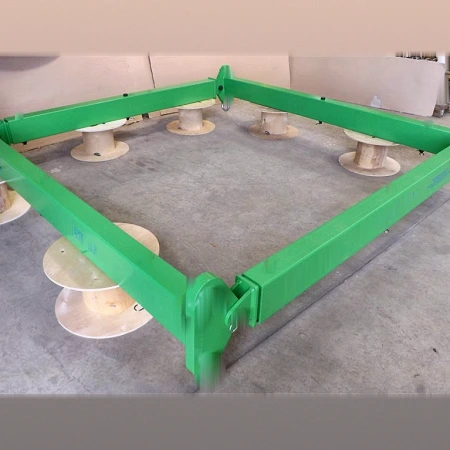
Lift sling rigging company produce Four-Point Lifting Beam,Mabigat na Tungkulin 4 Point Lifting Spreader Beams,Container Four Point Lifting Beams,Adjustable Four Point Lifting Beam,Adjustable 4 Point Lifting Beam,HLC Four Points Side Grip Lifting Beam.
Four-Point Lifting Beam
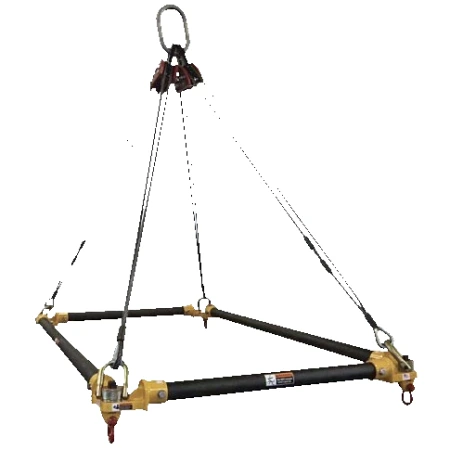
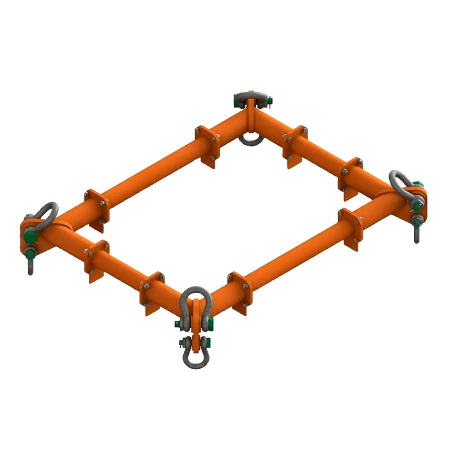
A four-point lifting beam carries the load on four pick points instead of two, so a long, wide or flat load is picked at four corners and hangs without racking, tipping or squeezing. It is built as a rigid frame – a beam with two cross members, a rectangular frame, or a container frame with four twistlocks – with one hook above and four legs below, or in the container case four top points as well. Rated from 0.5 t sa 100 t, in box, H-section or truss construction, proof load tested to 125 % before dispatch. There is one thing about four points that decides everything else on this page, and it is not the fourth sling.
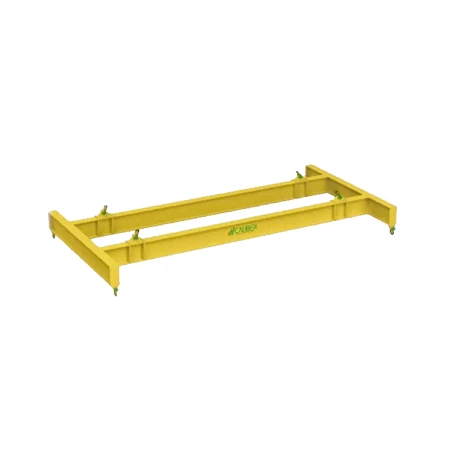
The Four-Point Problem Nobody Warns You About
Two pick points are statically determinate: with the centre of gravity known, the share on each is fixed arithmetic. Four points on a rigid frame are not. The frame takes the load through four legs whose lengths, angles and stiffness are never identical, and the share settles where the geometry and the elasticity put it – not where the drawing says. If the centre of gravity sits off the middle, two diagonally opposite legs can end up carrying most of the load while the other two go slack.
That has a direct consequence for a four-point beam: it has to be rated for the load it will actually see, which is usually two legs taking the lot, not four legs taking a quarter each. A beam designed on “25 % per leg” is a beam designed for the drawing, not for the yard.
| Centre of gravity | What the four legs share | What the frame must be rated for |
|---|---|---|
| Dead centre, all four legs equal length | Close to 25 % each | The nominal case – rarely what happens in practice |
| Slightly off centre | One diagonal pair takes more, the other goes light | An unequal share, not a quarter each |
| Well off centre, or one leg slack | Two diagonal legs carry nearly everything | The full load on two points – the figure the frame is designed to |
| Frame with pivoting or equalizing points | Share evens out on its own | The load, with far less sensitivity to where the CoG sits |
Practical rule: if the centre of gravity cannot be measured and held under the middle of the frame, ask for equalizing or pivoting pick points. They are what turns four points from a guess into a share you can plan with.
Two Different Products Share the Name
“Four point” is used for two arrangements, and the difference is where the four points are.
| Pag-aayos | Top | Bottom | What it is for |
|---|---|---|---|
| Four-point spreader frame(本页主推) | One hook, one or two top lugs | Apat | Containers, mga panel, mga papag, long fabricated sections – anything that needs four corners picked |
| Four-point lifting beam, four top points | Apat | One to four | Two cranes, each on two hooks, or a four-hook gantry – a tandem arrangement with more pick points |
The first is what most enquiries mean, and it is what this page covers. The second is a tandem lift with extra points; if you have two crane hooks we have a page for that arrangement rather than for the frame (锚文本 → /lifting-spreader-beam/dual-crane-lifting-beam/).
Container Four-Point Frames
A container frame is a four-point beam whose four bottom points are twistlocks that land in the ISO corner castings. Two things distinguish it from a general frame: the corner spacing is fixed by the container, and the frame usually has to work at both 20 ft and 40 ft, which means adjustable cross members or telescopic longitudinal beams.
The corner casting centres are standard, so a container frame is one of the few beams whose geometry is not a negotiation – only the structure and the capacity are.
| Container size | Corner casting centres, haba | Corner casting centres, lapad | Frame arrangement |
|---|---|---|---|
| 20 ft ISO | 5,853 mm | 2,259 mm | Fixed or adjustable frame |
| 40 ft ISO | 11,985 mm | 2,259 mm | Adjustable or telescopic frame |
| 20 ft and 40 ft from one frame | Both, by adjustment | 2,259 mm | Sliding cross members with pinned positions |
Dimensions above are the ISO 668 corner fitting centres, given as a reference for frame design. Confirm the standard your market works to before the frame is built – a frame made to the wrong spacing will not lock onto the box.
Adjustable Four-Point Beams
Adjustability on a four-point frame usually means one of two things: the spacing between the two long beams, so the same frame takes a narrow pallet and a wide panel; or the length of the frame, so it takes a 20 ft and a 40 ft container. Both are pinned or clamped positions, and both change what the frame is rated at.
The derating logic is the same as on any adjustable beam: the rated capacity is quoted at the position the frame was designed for, normally the widest or longest setting, and that figure governs the whole frame. Extending also flattens the upper slings unless they are lengthened with it, and a flatter V raises the compression in the frame quickly. If you need the full working range explained, our adjustable beam page covers the geometry (锚文本 → /lifting-spreader-beam/adjustable-lifting-beam/).
Side-Grip and HLC Frames
Some containers and tanks cannot be picked from above at all – the top is occupied, damaged, or simply not accessible where the load sits. A side-grip frame replaces the four twistlocks with four hydraulic or mechanical clamps that grip the corner castings or the side walls from outside. It is a different machine, with its own hydraulic or manual actuation to inspect, and it is normally a dedicated purchase rather than a variant of a standard frame. Tell us the container type, the access available and whether the frame will be used with a laden or empty box.
Mga pagtutukoy
| Parameter | Options |
|---|---|
| produkto | Four-point lifting beam / heavy duty 4 point lifting spreader beam / container four point lifting beam / adjustable four point lifting beam / HLC four points side grip lifting beam |
| Na-rate na kapasidad (WLL) | 0.5 t sa 100 t standard range; larger custom designs quoted on request |
| Configuration | One top lug with four lower points · two top lugs with four lower points · four top points (tandem) |
| Frame size | Made to the load: 0.5 m sa 25 m in one direction, cross members to suit the load width |
| Pick points | Fixed lugs · pin holes · sliding brackets · pivoting / equalizing points · container twistlocks |
| Adjustment | Sliding cross members · telescopic longitudinal beams · pinned positions at 20 ft and 40 ft container spacing |
| Beam section | Welded box section · welded H-section · lattice truss for long spans and high capacities |
| Materyal | Q235B / Q345B (S235JR / S355JR); high-strength steel for large-tonnage designs |
| Top sling angle | Normally set between 45° and 60° from the horizontal – confirmed against your headroom and load |
| Salik ng disenyo | Applied against the rated capacity per the applicable standard and service class – karaniwan 3:1 sa 5:1, confirmed per project |
| Proof load test | 125 % of rated capacity before dispatch, with a load test certificate |
| Surface finish | Shot blast to Sa 2.5 + epoxy primer + polyurethane topcoat (safety yellow); optional hot-dip galvanising |
| Pagmamarka | Na-rate na kapasidad (WLL), tare weight, serial number and year of manufacture on the frame |
| Dokumentasyon | General arrangement drawing, material certificate, weld record, proof load test certificate |
| Mga pamantayan ng sanggunian | ASME B30.20 / ASME BTH-1 and EN 13155 pagsasanay; ISO 668 for container corner fittings – confirm what your market requires |
| HS code | 842890 |
Capacity and Span Bands
| Na-rate na kapasidad (WLL) | Typical frame size | Pick points | Typical section | Karaniwang gamit |
|---|---|---|---|---|
| 0.5 t | 1.0 × 1.0 m | 4 | Box | Mga papag, maliliit na panel |
| 1 t | 1.5 × 1.2 m | 4 | Box | Mga panel, crates |
| 3 t | 2.5 × 1.5 m | 4 | Box | Sheet packs, fabricated parts |
| 5 t | 3.0 × 2.0 m | 4 | Box / welded H | Long sections, stone slabs |
| 10 t | 6.0 × 2.4 m | 4 | Welded H | 20 ft container, wide panels |
| 16 t | 6.0 × 2.4 m | 4 | Welded H | 20 ft container, heavy packs |
| 20 t | 12.2 × 2.4 m | 4 | Welded H / truss | 40 ft container |
| 32 t | 12.2 × 2.4 m | 4 | Truss | 40 ft laden container |
| 50 t | 12.2 × 3.0 m | 4 | Truss | Heavy container and tank frames |
| 100 t | Made to the load | 4 or more | Custom truss | Oversize and project frames |
The final frame size, section and tare weight are confirmed against your load case. On a container frame the length is fixed by ISO 668 and only the structure is designed; on a general four-point frame both are.
What to Send for a Quotation
| Pigura | Why the frame needs it |
|---|---|
| Load mass, plus frame and rigging mass | Sets the rated capacity; the frame’s own weight comes off the crane’s |
| Load footprint and where it may be picked | Sets the frame size and the position of the four points |
| Centre of gravity, or a drawing that shows it | Decides whether fixed points are enough or the points have to equalize |
| Container size, if a container frame | 20 ft or 40 ft, and whether one frame has to do both |
| Capacity of the crane at the working radius | The binding limit before any derating for the rig |
| Headroom above the load | Decides the top sling angle, and whether the frame will fit the lift |
| Access at the load | Top pick, side grip, or twistlock – this decides the type of frame |
Pagsubok, Marking and Records
Every four-point frame is proof load tested to 125 % of its rated capacity before dispatch and issued with a test certificate; rated capacity, tare weight, serial number and year are marked on the frame. A frame that adjusts – sliding cross members, telescopic beams, 20/40 ft positions – should have its test record state the configuration tested, and any setting outside that record needs confirmation before the frame goes back into service. Where a particular standard or market certification is required, say so before the order.
Mga Madalas Itanong
What is a four-point lifting beam?
A rigid frame with four lower pick points, hung from one crane hook, used when a load has to be picked at four corners – mga lalagyan, mga panel, mga papag, long fabricated sections – so it hangs without racking or tipping. Some versions have four top points as well, for a tandem or four-hook lift.
How is the load shared between four points?
It is not a simple quarter each. On a rigid frame the share is statically indeterminate: leg lengths, angles and stiffness decide it, and a centre of gravity off the middle can leave two diagonal legs carrying nearly the whole load. That is why a four-point frame is designed for the two-leg case, and why equalizing or pivoting points are worth having when the centre of gravity cannot be held under the middle.
What is the difference between a four-point beam and a two-point spreader beam?
The number of pick points and what that does to the frame. Two points are determinate – each share is arithmetic – and the beam is a single member. Four points need a frame, and the share between the four is not fixed, so the frame is heavier and the design has to allow for an unequal share.
Can one frame handle both 20 ft and 40 ft containers?
Oo, with sliding cross members or telescopic longitudinal beams pinned at the two spacings. The frame is then rated at the position it was designed for, normally the longer one, so check the marking before using the shorter setting at full load.
What is a side-grip or HLC frame?
A four-point frame that grips the container or tank from the sides instead of landing twistlocks in the top castings, for loads that cannot be picked from above. It has its own clamps and actuation to inspect, and is normally a dedicated frame rather than a variant.
What capacity and frame size can you build?
0.5 t sa 100 t rated. A general four-point frame is made to the load footprint up to about 25 m in one direction; a container frame is fixed by the ISO corner spacing, so only its structure and capacity are designed. The final section and tare weight are confirmed against your load case.
Is the frame tested, and what comes with it?
Proof load tested to 125 % of rated capacity with a test certificate, supplied with the general arrangement drawing, material certificate and weld record on request. Na-rate na kapasidad, tare weight, serial number and year are marked on the frame, and on an adjustable frame the record states the configuration tested.
Humiling ng Sipi
Send the load footprint, the pick points available on the load, the centre of gravity and the headroom, and we will come back with the frame size, the section, the tare weight and a factory-direct price.
Send your four-point frame details for a proposal
Telepono / WeChat: +86 180 6600 2268 | E-mail: 702461526@qq.com
Lifute Industrial Park, Lungsod ng Taizhou, Lalawigan ng Jiangsu, Tsina | HS code: 842890