

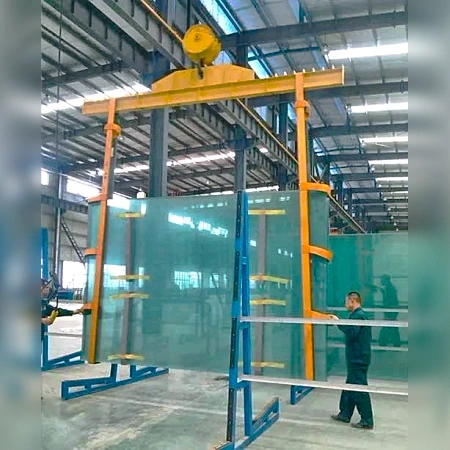
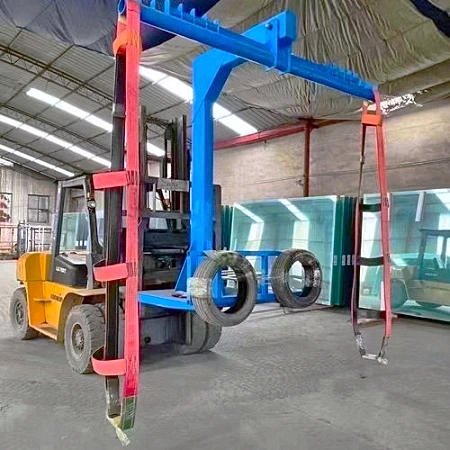
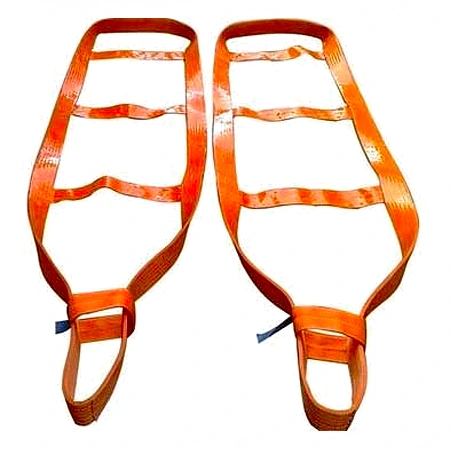
Lift sling rigging company manuafcture Glass Lifting Sling,Glass Webbing Sling,Glass Handling Slings,Lifting Belt Glass Sling,Flat Webbing Glass Lifting Sling,Glass Lifting Strap,Five-Layer Heavy Duty Glass Lifting Sling with Steel Protection for Glass Handling,Webbing sling for glass packages
Glass Lifting Sling.
Last updated 29 October 2026 · reviewed against EN 1492-1
Glass is not a heavy load with a fragile surface — it is a flexible load with sharp edges. Lift it the way you would lift a steel plate and it cracks; the sling has to bear on the faces, keep its legs vertical, and survive being cut by the very edge it is holding. A glass lifting sling is the version of a webbing sling built for that.
In one line: a glass lifting sling is a flat polyester sling built from five layers of webbing with a steel protection plate at the bearing point, rated 1 t 10 t per sling at 7:1 to EN 1492-1. Size the pack at 2.5 kg per m² per mm of thickness, use two slings, and keep the legs vertical with a spreader.
What glass does to a sling that steel does not
Three things, and each one shapes the product. Bending: glass carries compression well and bending badly, so the load has to be spread over the face and supported at two points, never at one. Cutting: the lower edge of a pack is a blade, and it sits exactly where a sling passes under it. Scratching: a single grain of grit trapped between web and glass polishes a mark into the sheet that no one can remove.
So the build differs from a general sling in two places only — more material at the bearing line, and steel where the web would otherwise be cut.
How heavy is the pack? 2.5 kg per square metre per millimetre
Soda-lime float glass is 2,500 kg/m³, which reduces to a rule you can use on the phone: 2.5 kg for every square metre for every millimetre of thickness. Area × thickness × 2.5, then multiply by the number of sheets.
| Sheet size | Area | 6 mm | 10 mm | 12 mm | 15 mm |
|---|---|---|---|---|---|
| 2440 × 3300 mm | 8.05 m² | 121 kg | 201 kg | 242 kg | 302 kg |
| 3210 × 2250 mm | 7.22 m² | 108 kg | 181 kg | 217 kg | 271 kg |
| 2440 × 1830 mm | 4.47 m² | 67 kg | 112 kg | 134 kg | 167 kg |
| 2000 × 1500 mm | 3.00 m² | 45 kg | 75 kg | 90 kg | 113 kg |
At 2,500 kg/m³. A 20-sheet pack of 2440 × 3300 × 10 mm is 4.0 t — which is the figure that decides the sling, not the sheet.
Leg angle is side load, and side load cracks glass
A sling leg that is not vertical pushes inward as well as up. The inward component is the load × tan of the angle from vertical, and on a glass pack it does not press on a strong point — it presses on the faces, across the sheets, where the glass is weakest.
| Leg angle from vertical | Force along one leg | Squeeze into the pack |
|---|---|---|
| 0° | 0.50 t | 0 |
| 5° | 0.50 t | 87 kg |
| 10° | 0.51 t | 176 kg |
| 15° | 0.52 t | 268 kg |
| 30° | 0.58 t | 577 kg |
Two-leg lift, load shared equally: squeeze = W × tanθ. At 15° the pack is being pinched by more than a quarter of its own weight — on a 4 t pack that is 1.07 t of side load.
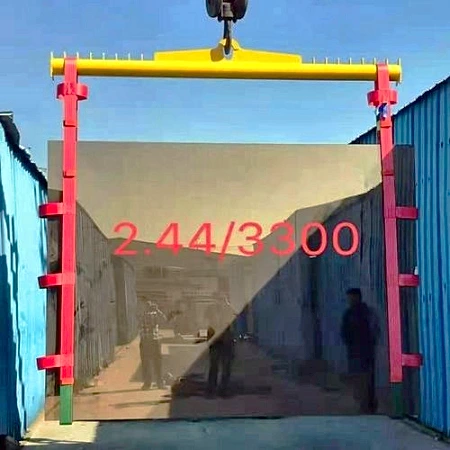
The fix is not a stronger sling, it is a shorter one — or a nostava levityspalkki, which takes the horizontal component into the beam and lets both legs hang vertical. On glass that is the difference between a lift and a break.
The build: five layers, a steel plate, and a ladder of cross bars
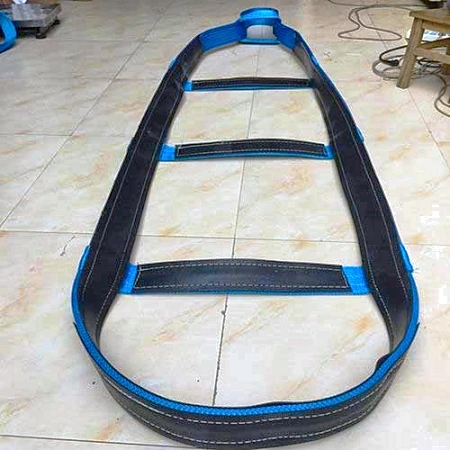
Five layers of polyester web are stacked and sewn into one band. The outer layers take the abrasion and the cut; the inner layers carry the load. At the point where the band passes under the glass, a steel protection plate is inserted and stitched into a pocket, so the blade edge meets steel before it meets yarn — the plate is a wear part and it is meant to be the thing that suffers.
The cross bars are the other half of the idea. On a pack, the slings run up the two faces and are joined across the top by webbing loops at intervals, forming a ladder. The pack cannot bow outward between the slings, and the load stays on the faces instead of transferring to the edges.
How much sling for how much pack
Work from the pack, not from the sheet. Two slings take the pack between them, set at roughly a quarter and three quarters of its length, and each therefore carries half the mass.
| Pack mass | Load per sling | Minimum WLL each | Arrangement |
|---|---|---|---|
| to 1 t | 0.5 t | 1 t | Two slings, legs vertical |
| 1 – 2 t | 1 t | 1 t | Two slings, legs vertical |
| 2 – 4 t | 2 t | 2 t | Two slings + spreader |
| 4 – 6 t | 3 t | 3 t | Two slings + spreader, 5-layer |
| 6 – 10 t | 5 t | 5 t | Two slings + spreader, 5-layer |
| 10 – 20 t | 10 t | 10 t | Four slings or a purpose frame, on request |
Minimum vertical WLL. Used in basket the sling gives twice that, which is the normal margin on glass work. This table sizes the article; it is not a lift plan.
Four ways glass gets damaged, and what stops it
| Damage | Cause | Prevention |
|---|---|---|
| Scratch on the face | Grit trapped between web and glass | Wipe the web and the sheet; store slings off the floor |
| Chipped edge | Sling bearing on the edge, or a shock as it takes up | Bear on the faces; steel plate at the bearing line; take up slowly |
| Crack from the middle | One sling, or two too far apart, so the pack bends | Two slings at quarter points; cross bars to stop bowing |
| Crushed stack | Legs angled in, side load on the faces | Spreader beam; keep the legs vertical |
Inspection: a splinter is a retirement, not a nuisance
Glass slings fail differently from general slings. The obvious defect is a cut through the outer layer, and the one that gets missed is a glass splinter embedded in the webbing — it will not pull out cleanly, and it will cut the hand of the next person who runs the sling through it, then cut the sheet on the next lift.
- Run the band through gloved hands before every lift. A splinter feels like a hard pinprick in an otherwise soft band.
- Look at the steel plate: shifted, bent, or with a corner working through the pocket means the sling comes out of service.
- Check the stitching at the plate pocket and the eyes — broken or drawn thread is the first sign of an overload.
- Retire on: a cut through to the load-bearing layer, an embedded splinter, a loose plate, rikki ompeleet, or an unreadable label.
Do not wash and reuse. A glass sling that has picked up splinters cannot be cleaned back into service — the fragments work deeper into the weave. Retire it and record why; the cost of the sling is not the argument.
Specifying one in four answers
- Pack mass, and the sheet size and thickness it is built from — the mass decides the sling, the size decides the length.
- Pack dimensions, so the cross bars land where they support rather than where they pinch.
- What holds the top: crane hook, spreader beam, or forklift-mounted frame.
- Single sheet or pack, and whether the sheet is coated — a coated face scratches more easily and wants a softer bearing.
Questions about glass lifting slings
What is a glass lifting sling?
A flat webbing sling built for glass, also sold as a glass webbing sling: five layers of polyester web with a steel protection plate where the sling meets the sheet, and usually a ladder of cross bars so the load bears on the faces rather than on an edge.
How do I calculate the weight of a pack?
Area × thickness × 2.5 kg, times the number of sheets. A 2440 × 3300 mm sheet is 8.05 m², so 201 kg at 10 mm and 302 kg at 15 mm; twenty of the 10 mm sheets is 4.0 t.
Why does glass lifting need a spreader beam?
Because sling angle becomes side load: two legs at 15° from vertical push into the pack with a force of W × tan 15°, about 27 % of the weight. On a 4 t pack that is over a tonne of squeeze across the faces. A spreader keeps the legs vertical.
Can I use an ordinary webbing sling on glass?
Only with edge protection and only if it is clean. A standard sling will lift a pack, but the lower edge cuts the web and a grain of grit scratches the sheet. The glass build adds layers and a steel plate for exactly those two reasons.
How many slings does a pack need?
Two, each taking half the weight, set at about a quarter and three quarters of the pack length. One sling in the middle lets the ends sag and puts the glass into bending, which is the failure mode it cannot take.
What retires a glass sling?
A glass splinter embedded in the webbing, a cut through the outer layer, a steel plate that has shifted or is working through its pocket, rikki ompeleet, or an unreadable label. A splinter is not something to pick out and carry on with.
Is it safe to lift glass by the edges?
No. Glass is strong in compression and weak in bending and at the edge, so the sling has to bear on the faces with the edge protected. Edge-only lifting is how sheets chip, and a chipped edge fails later under load.
Related: all webbing slings · polyester webbing slings · nylon synthetic web slings · lifting spreader beams · lifting devices · eye & eye flat web slings · endless web slings · steel pipe lifting straps · cargo lashing · vaijeriliinat
Send the pack size and the sheet thickness
Tell us the pack mass, the sheet size and thickness, and what holds the top, and we will come back with the number of slings, the WLL for each, the cross bar spacing and the length — on a drawing, before anything is woven.
Lift Sling Rigging Co., Ltd · Lifting & rigging division of China Lifute Sling Group
Puh / WeChat +86 180 6600 2268 · 702461526@qq.com
Lifuten teollisuuspuisto, Taizhoun kaupunki, Jiangsun maakunta, China · HS code 630790
Figures are for the standard build to EN 1492-1 at 7:1; ASME B30.9 builds at 5:1 are available. The labelled working load limit governs the lift, and the tables above size the article — they do not replace a lift plan.