

Lift sling rigging company produce Aramid net with knots
Aramid Net with Knots
A knotted aramid net built from 12-strand braid: 7 t break on a single rope at 8 mm, mesh from 40 to 120 mm, panels to 10 × 20 m. It is specified where the net has to take an impact — not just hold a static load.
The knots are not a cheaper way to build this net. On aramid they are the only way it survives being hit. That is the whole design argument, and it is worth understanding before you compare this net with a knotless one.
Why an Aramid Net Has Knots
Aramid (Kevlar, Technora) elongates about 3.5% before it breaks and it is stiff while it does it. Every other netting fibre — nylon, polyester, UHMWPE — gives you 10 to 30% and absorbs impact by stretching. Aramid does not. It transfers the load almost as it receives it, which puts the entire question of survival at the joints between ropes.
In a knotless net the yarns are interwoven. Every crossover is fibre lying on fibre, held only by the weave. Under impact the two yarns move against each other at each crossover; because aramid has almost no elongation to redistribute that movement, the contact becomes a shear point. Strands cut into strands, and the net fails at the crossovers rather than at the panel that was hit.
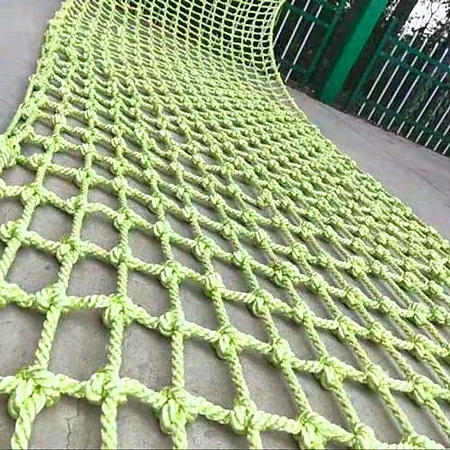
A knot changes the load path. Each mesh leg terminates in a knot that wraps around its own turns, so the load passes through the curvature of the knot instead of through sliding rope-on-rope contact. The knot also locks the mesh geometry: when one mesh is hit, its neighbours are pulled by a defined knot rather than by friction, so the load spreads instead of concentrating.
| Knotted (this net) | Knotless | |
|---|---|---|
| Load path at a crossover | Through the knot’s own turns | Fibre sliding on fibre |
| Failure mode | Rope break at a known load | Progressive cutting, unpredictable |
| Field repair | Re-knot one mesh | Cut out and re-weave a section |
| Inspection | Knots visible, one by one | Damage hidden inside the weave |
What the knot costs you is rope strength: a knot gives up roughly 25–35% of the rope’s break load, which is why the rope is sized from the knot backwards, not from the panel. What it buys is a net whose strength you can calculate, inspect and repair.
7 Tonnes on One Rope, and What That Adds Up To
The standard build is a 12-strand aramid braid. At 8 mm it breaks at about 7 t; larger braids go further. Break load is quoted per rope, but a net is loaded per metre of width, so that is the number worth carrying into a design:
| Braid | Break, single rope | Legs per metre at 100 mm mesh | Break per metre of width |
|---|---|---|---|
| 4 mm | ≈ 2.0 t | 10 | ≈ 20 t |
| 6 mm | ≈ 4.5 t | 10 | ≈ 45 t |
| 8 mm | ≈ 7.0 t | 10 | ≈ 70 t |
| 10 mm | ≈ 12.0 t | 10 | ≈ 120 t |
Halve the mesh and you double the legs per metre: a 50 mm net in 8 mm braid puts about 140 t of break load into the same metre of width. That is the number that makes an aramid net a barrier rather than a fence — and the reason mesh size, not rope size, is usually the first decision.
What the Mesh Has to Catch
A barrier works when the aperture is smaller than the smallest feature you need to stop. For UAV work that feature is usually the propeller arc or the wing leading edge:
- 40–60 mm — small multirotors; the mesh catches a prop tip before the airframe reaches the net plane.
- 80–100 mm — larger multirotors and fixed-wing airframes; props and arms are caught, the body is stopped by the panel behind.
- 120 mm — the open option, for loads where weight and wind area matter more than aperture.
A hit is local. The struck mesh pulls its neighbours through the knots, so the load spreads over an area several meshes wide — which is exactly what the knots are for, and why a knotted net degrades gracefully where a knotless one unzips.
Technical Specifications
| Item | Specification |
|---|---|
| Fibre | Para-aramid (Kevlar / Technora class), UV-stabilised |
| Rope construction | 12-strand braid, no core |
| Rope diameters | 4 / 6 / 8 / 10 mm |
| Break load, single rope | ≈ 2.0 / 4.5 / 7.0 / 12.0 t — batch certificate governs |
| Mesh (knot pitch) | 40 / 50 / 60 / 80 / 100 / 120 mm |
| Knot | Double knot, set by hand and locked; square or diamond orientation |
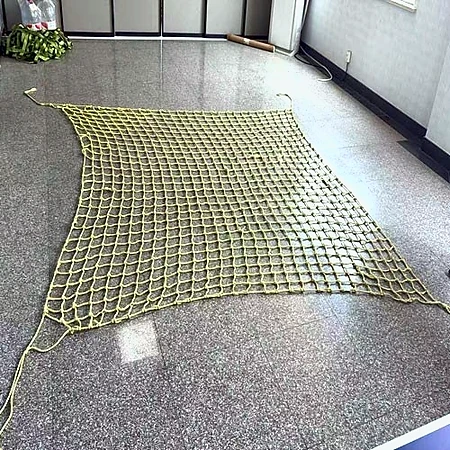
| Panel size | 5 × 10 m, 10 × 10 m, 10 × 20 m; custom to drawing |
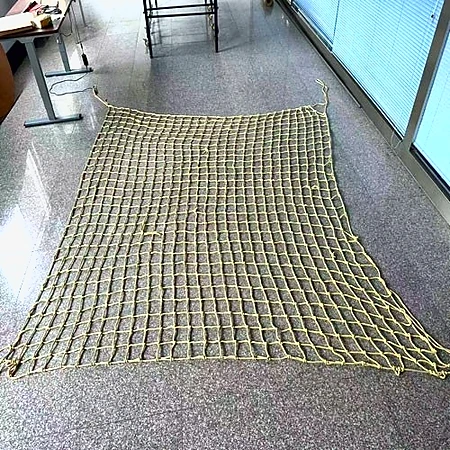
| Border | Same braid or one size up, double-laid, eyes at each corner |
| Weight | ≈ 0.9–1.6 kg/m² depending on braid and mesh (8 mm / 100 mm ≈ 1.15 kg/m²) |
| Elongation | ≈ 3.5% at break; under 1.5% at working load |
| Temperature | Continuous to about 200 °C; does not melt |
| Colour | Natural aramid gold |
| Packing | Rolled or folded on pallet, with panel and batch number |
Values above are for the standard braid at 12-strand efficiency of roughly 50–55%; every consignment is tested and the certificate, not this table, is the number to design from.
Build Options
- Border and corners — doubled border rope with stainless thimbles, or soft eyes for lacing.
- Mixed aperture — fine mesh in the lower 2 m where a drone arrives, coarser above.
- Coating — PU or neoprene dip on the knots for abrasion and UV; adds weight, extends life outdoors.
- Panel joinery — laced seams on site with the same braid, or factory-sewn edge ropes for a single 10 × 20 m panel.
Anchoring Is Half the Design
- Anchor spacing — keep anchor points at 2 m or closer along the border; the border rope carries the load between them.
- Pre-tension — take the slack out and stop. Do not tension a knotted aramid net to working load; the knots set under the first load and the panel will creep if over-tensioned.
- Stand-off — leave at least 1 m between the net plane and anything behind it, so a caught drone has somewhere to deform into.
- Wind — a 100 mm net is roughly 30% solid; calculate the panel as a porous surface at the local basic wind pressure.
- Roof return — a vertical wall alone can be overflown; specify a return or a top curtain for anything above 6 m.
Inspection and Life
Aramid is sensitive to UV and to abrasion at the knots, so the net is a inspected item, not a fit-and-forget one. Check knot tightness, look for glazing or fuzzing on sun-facing ropes, and replace any panel where a knot has slipped or a rope shows more than a few broken filaments. In strong sun, a coated net or a shade structure above it roughly doubles service life.
Frequently Asked Questions
Why can’t an aramid net be knotless?
Because a knotless net holds its geometry by weaving the yarns across each other. Aramid has almost no elongation, so under impact the yarns cannot move to share load — they cut into each other at the crossovers. The net loses strength exactly where the load is highest. A knot removes that sliding contact and gives each mesh a defined load path.
How strong is one rope?
An 8 mm 12-strand aramid braid breaks at about 7 t; 10 mm at about 12 t. The knot retains roughly 65–75% of that, which is why we quote the rope and the knot separately.
What mesh do I need for a drone barrier?
Small multirotors: 40–60 mm. Larger multirotors and fixed-wing: 80–100 mm. The rule is that the aperture must be smaller than the feature you need to catch, not smaller than the aircraft.
Will it stop a munition-carrying drone?
That is what the net is specified for: a 100 mm panel in 8 mm braid carries about 70 t of break load per metre of width, and the knots spread a local hit across several meshes. Whether a given threat is stopped is a function of panel geometry, stand-off and anchors, so we test and quote per project rather than publish a blanket claim.
Can panels be joined on site?
Yes, by lacing with the same braid at 100 mm centres. A laced seam is the weak line in any net, so plan the panel size to keep seams out of the impact zone.
Send the threat, the panel size and the anchors
Tell us what has to be stopped, over what height and width, and what the net will be fixed to. We will come back with braid, mesh, panel layout and border specification — with the break load at the knot, not just on the reel.
Email: lift98@jslift.com · WhatsApp: +86 180 6600 2268