

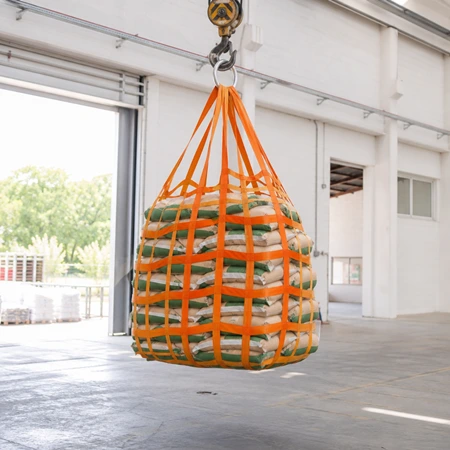
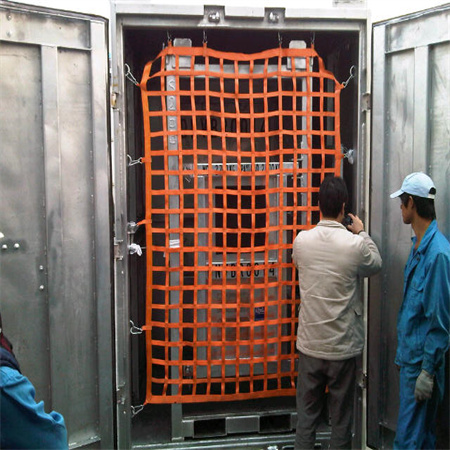
Nostohihnan takilayritys tuottaa polyesterinauhaverkkoa nostoa varten,Web Sling Lifting Cargo Net,Polyesterinauha Cargo Net,Paloa hidastava nauhaverkko,Lastiverkot polyesterinauhasta,Lastinnostoverkko Web Sling,Polyesteri nailonnauha nostolastiverkko,Raskas polyesterilastiverkko litteällä hihnalla,Suuren kapasiteetin lastinnostoverkot raskaisiin nostoihin.
Polyesterinauhaverkko nostoa varten
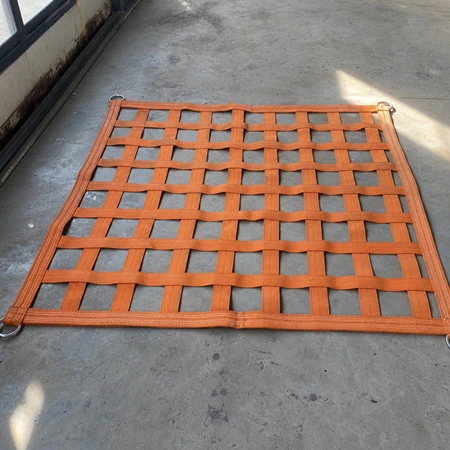
A polyester webbing net for lifting is a lattice of flat high-tenacity polyester (LEMMIKKI) bändit, stitched into a square mesh with a doubled border and reinforced corner loops. The cargo goes in, the four loops are gathered onto the hook or a master ring, and the whole consignment travels as one unit – ei lavaa, no strapping, nothing to re-handle at the far end.
It is supplied in two forms. The flat net holds loads that keep their own shape – kuormalavoja, nippuja, pysäytyskuvat, koneen osat. The closed-bottom bag contains loads that would otherwise escape the mesh – säkit, tiilet, leikkauksia, sekoitettu rahti. Both are cut to the drawing rather than to a catalogue: nauhan leveys, kerrosten lukumäärä, verkko, koko, lifting points and colour are all set before the first metre of webbing is woven, and the finished net is proof-load tested with a material test report.
- Flat PET band, 25-200 mm – sinkku, duplex tai triplex, with a woven selvedge that does not fray.
- 2 t 30 t verkkona – the rating follows the band, the number of load-bearing bands under the cargo and the way the net is rigged.
- Matala venytys, noin 3-7 % osoitteessa WLL – the net stays tight against the load instead of creeping open over a shift.
- Wet duty without loss of rating – polyester takes up almost no water and does not rot, niin sadetta, wash-down and deck work are normal service.
- CE- ja GS-sertifioitu – kudottu, ommeltu, marked and proof-load tested in one plant, ISO:n kanssa 9001, CNAS ja DNV sen takana.
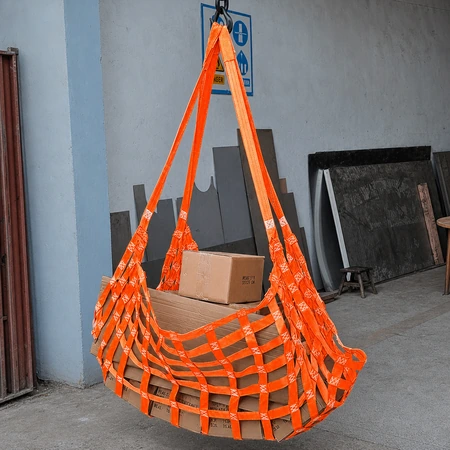
The load path: koukku, silmukka, rajaa, bändi, verkko
A polyester webbing net for lifting is not one component but five, and the load passes through them in a fixed order. Almost every net failure we are asked to investigate comes down to one link in that chain being built to a lower standard than the band itself – usually the stitching at the corner, which is the cheapest place to save money and the first place to fail.
Taulukko 1 – The five links in the load path, and what each one has to do.
| Link | Mikä kantaa kuorman | What fails there first | How we build it |
|---|---|---|---|
| Hook or master ring | All four loops gathered to one point | Loops binding on a sharp hook or a worn shackle | Master ring or grade 80 shackle offered with the net; loops sized to the fitting |
| Corner loop | The full rated capacity of one corner | Stitching pulling out of the border | Loop stitched through a doubled border with multi-row lock stitch, reinforced above 5 t |
| Raja | The sum of the mesh, redistributed to the corners | Border folding or tearing at the corner radius | Kaksinkertainen nauha, folded and stitched the full perimeter, wider at the corners |
| Load-bearing band | The cargo’s weight, band by band | Abrasion and cuts from pallet edges and nails | Kudottu helma, duplex or triplex where the net is dragged; sleeves at contact points |
| Mesh | Suojaus – keeping the cargo in | Items squeezing through an over-wide opening | Opening chosen from the smallest item in the load, 50-300 mm |
The practical consequence is that a net is not rated by its band alone. A 50 mm duplex band can carry 4 t as a single vertical leg, but the net it is woven into may be rated at 2 t because the corner stitching, ei bändi, asettaa rajan. That is why we test the finished net and print the net rating, never the band rating.
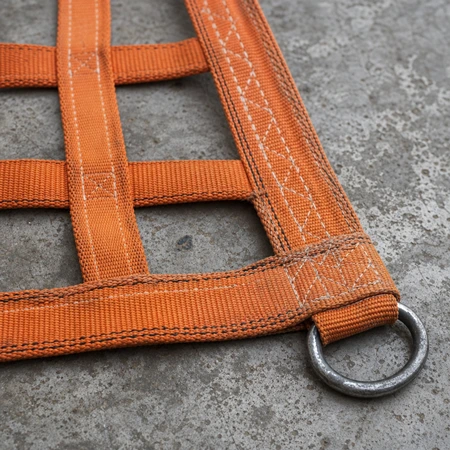
Polyester against nylon, polypropylene and wire rope
The fibre choice is usually made on price and then lived with for years. The four materials behave differently in ways that matter on a handling net, and none of them wins on every line.
Taulukko 2 – The four net materials compared on the properties that decide service life.
| Omaisuus | Polyesteri (LEMMIKKI) | Nylon (PA) | Polypropeeni (PP) | Wire rope |
|---|---|---|---|---|
| Pidentymä WLL:ssä | Noin 3-7 % – alin pehmeistä kuiduista | Roughly twice polyester | Higher again, and it creeps | Under 1 %, but the net is stiff and heavy |
| Vesi | Takes up almost no water; strength unchanged wet | Absorbs several per cent and loses some strength wet | Does not absorb water | Corrodes unless galvanised or stainless |
| Rot and mildew | Immuuni | Can mildew if stored wet | Immuuni | Not applicable |
| UV outdoors | Hyvä, and stabilised in the weave | Kohtalainen | Poor unless heavily stabilised | Unaffected |
| Dry abrasion | Hyvä – best of the soft fibres | Hyvä, slightly behind polyester | Kohtalainen | Erinomainen, but it abrades the cargo |
| Hapot | Good against most dilute acids | Voimakkaiden happojen vaikutus | Hyvä | Depends on coating |
| alkalit | Vahvojen emästen hyökkäämä | Hyvä | Hyvä | Generally good |
| Kosketa kuormaa | Pehmeä, tasainen, ei merkitse | Pehmeä, ei merkitse | Soft but slippery | Marks and crushes; needs sleeves |
| Rigging by hand | Kevyt, folds into a bag | Kevyt, folds into a bag | Kevyin | Needs two people and a trolley |
Two conclusions follow. Where the net works in cycles against pallets, concrete and truck beds, polyester is the default because low stretch keeps the mesh tight and dry abrasion is where it is strongest. Where the cargo shock-loads – romu, demolition, rough castings – nylon’s give is an advantage and the raskas nylon lastiverkkohihna is the better answer. And where the load is hot, or the net has to be rigid, neither soft fibre belongs on the job.
Band specification
The band is where a quotation is won or lost. Viisi numeroa kuvaa sitä, all five are printed on the label, and all five are fixed on the drawing before weaving.
Taulukko 3 – The five numbers that describe a polyester lifting band.
| Määrä | Mikä se on | Kudotumme valikoima |
|---|---|---|
| Leveys | Flat width of the webbing | 25 / 50 / 75 / 100 / 150 / 200 mm; 50 mm vakiona |
| Kerrosten määrä | Kuinka monta verkkoa on ommeltu yhdeksi nauhaksi | Single, kaksipuolinen (kaksi) tai tripleksi (kolme) |
| Paksuus | Aseta leveyden ja kerrosten määrän mukaan | 1.8 mm – 6.0 mm |
| Kudontatiheys | Yarn count in warp and weft, joka asettaa sitkeyden | Aseta EN 1492-1 nimelliskapasiteetin perusteella |
| Reuna | How the selvedge is finished | Kudottu helma vakiona; folded and stitched where the band is handled daily |
Taulukko 4 – Working load limit per band, pystysuora yksijalka, IN 1492-1 perusteella.
| Nauhan leveys | Yksi kerros | Duplex | Triplex |
|---|---|---|---|
| 25 mm | 1 t | 2 t | 3 t |
| 50 mm | 2 t | 4 t | 6 t |
| 75 mm | 3 t | 6 t | 9 t |
| 100 mm | 4 t | 8 t | 12 t |
| 150 mm | 6 t | 12 t | 18 t |
| 200 mm | 8 t | 16 t | 24 t |
This is a band figure, not a net rating. The net’s capacity follows from how many load-bearing bands sit under the cargo and how the net is rigged – which is why we quote the net, ei bändi.
Mesh, border and edge: the three decisions left
Once the band is fixed, three choices remain. They are decided on the drawing, and changing one later means a new net rather than a modification.
Taulukko 5 – Mesh, border and edge options.
| Päätös | Vaihtoehdot | Rule we apply |
|---|---|---|
| Mesh-aukko | 50 / 75 / 100 / 150 / 200 / 300 mm | Chosen from the smallest item in the load, ei koskaan kokonaispainosta |
| Raja | Single fold or doubled and multi-row stitched | Doubled as standard; a single-fold border is only offered on nets under 1 t |
| Edge treatment | Kudottu helma, folded edge, PU-pinnoite | Folded where the net is handled daily; PU coating where it is dragged or stored outdoors |
| Corner reinforcement | Standard loop or reinforced corner | Reinforced above 5 t, and on any net used with a spreader beam |
| Suojaus | Hiha, pad or double band at the contact point | Specified for pallets with nails, machined parts and any sharp edge |
Tekniset parametrit
The figures below cover the standard polyester webbing net for lifting range. Every line is made to order, so treat the table as the starting point for a quotation rather than a fixed catalogue.
Taulukko 6 – Polyester webbing net for lifting: tekniset parametrit.
| Parametri | Erittely |
|---|---|
| Tuotetyyppi | Polyesterinauhallinen nostoverkko – flat net or closed-bottom bag |
| Bändin materiaali | 100 % lujaa polyesteriä (LEMMIKKI) nauha |
| Nauhan leveys | 25 / 50 / 75 / 100 / 150 / 200 mm (50 mm vakiona) |
| Bändin rakentaminen | Yksi kerros, duplex tai triplex; kudottu helmi, ei leikattu reuna |
| Nauhan paksuus | 1.8 mm – 6.0 mm leveydestä ja kerrosten lukumäärästä riippuen |
| Mesh-aukko | 100 × 100 mm neliö standardi; 50 mm – 300 mm tilauksesta |
| Nettokoko | Length × width for a flat net; opening × depth for a bag; piirrettynä |
| Raja | Kaksinkertainen nauha, taitettu ja monirivinen ommeltu, reinforced at every corner |
| Nostopisteet | Neljä vahvistettua kulmasilmukkaa vakiona; kahdeksan levityspalkkia varten |
| Nimelliskapasiteetti | 2 t – 30 t verkkona, bändin asettamat, kerrosten lukumäärä, load-bearing bands and rigging |
| Turvallisuustekijä | 5:1 / 6:1 / 7:1 |
| Pidentymä WLL:ssä | Noin 3-7 % |
| Väri | Värikoodi käyttökuormitusrajan mukaan, tai mukautettu talon väri |
| Vettä ja mätää | Takes up almost no water; does not rot or mildew |
| Työlämpötila | -40 °C:sta +100 °C |
| Hoito | UV-stabiloitu, anti-ageing, hankausta ja repeytymistä kestävä |
| Vakioperuste | Nauha on luokiteltu EN 1492-1 perusteella |
| Sertifiointi | CE, GS, JIS pyynnöstä; ISO 9001; CNAS-laboratorio; DNV |
| Räätälöinti | OEM / ODM koko, väri, painettu nauha, etiketti, logo ja pakkaus |
| HS koodi | 6307.90 – tekstiilimateriaaleista valmistetut nostoverkot |
Standard sizes and rated capacities
Net size is measured along the border for a flat net, and as opening × depth for a bag. The load has to sit well inside the net: a net the same size as the cargo sheds it as soon as the crane takes up the slack.
Taulukko 7 – Standard net sizes; mukautetut koot, verkko ja nostopisteet tehdään piirtämällä.
| Nettokoko | Mesh | Bändi | Tyypillinen kapasiteetti | Tyypillinen käyttö |
|---|---|---|---|---|
| 1.0 × 1.0 m | 100 mm | 50 mm duplex | 2 – 3 t | Rummut, koneen osat, yksittäisiä lavoja |
| 1.2 × 1.2 m (4 × 4 ft) | 100 mm | 50 mm duplex | 2 – 4 t | Tavallinen kuormalavan jalanjälki, laatikollinen lasti |
| 2.1 × 2.1 m (82 × 82 sisään) | 100 mm | 50 mm duplex | 3 – 5 t | Imperial lavan jalanjälki |
| 2.5 × 2.5 m | 100 – 150 mm | 75 mm duplex | 4 – 8 t | Pussitettu rahti, kontin lastaus |
| 2.5 × 6.0 m | 150 mm | 100 mm duplex | 6 – 12 t | Putkiniput, long cargo, trailer loading |
| 4.0 × 4.0 m | 150 – 200 mm | 150 mm duplex | 10 – 20 t | Irtotavara säkitettynä, suuret lavat |
| 6.0 × 6.0 m | 200 mm | 150 mm tripleksi | 20 – 30 t | Portti, barge and heavy bulk handling |
| Piirustuksen mukaan tehty | 50 – 300 mm | 25 – 200 mm | 2 – 30 t+ | Kuorma-auton sänky, kontti, hold and hopper sizes |
Pallet-sized versions are quoted from the pallet footprint and are covered by the nosturi kuormalavojen lastiverkko; long bulk consignments by the polyesteri nostoverkko; and the tensioned version for holding loads down in transit is the lastin kiinnitysverkko.
Rigging arrangements and fittings
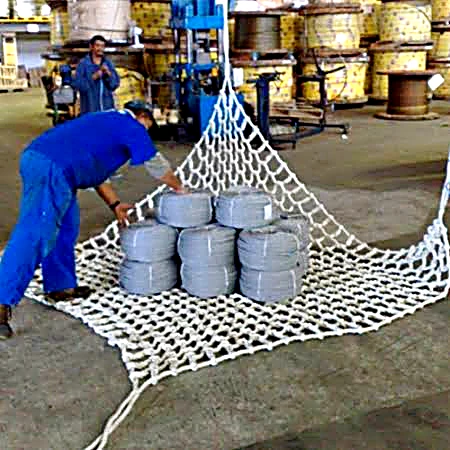
Se, miten verkko ripustetaan, ratkaisee, kuinka paljon kuormaa se todella kantaa. Two arrangements cover most work, and both are rated for the net rather than assumed from the band.
- Koukussa neljä silmukkaa – standardi. The loops gather on the hook or a master ring and the net closes on the cargo as the crane takes up the slack.
- Kahdeksan silmukkaa levityspalkissa – verkko pysyy suorassa, kuorma pysyy tasaisena ja jokaisella kulmalla on ennakoitava osuus; the right answer for long or wide consignments, using a nostava levityspalkki.
- Laukun muoto, suljettu pohja – contains loose cargo that would otherwise fall through the mesh; the form used for loading and unloading.
- Flat net over a load – for pallets, bundles and stillages that keep their own shape and only need holding together.
Liittimet toimitetaan tai asennetaan pyynnöstä: ommeltuja nauhalenkkejä, mestarirenkaat ja päälinkit, luokka 80 kahleet palkkinostimiin, PU-coated band for high-abrasion and outdoor duty, protection sleeves and pads for sharp edges, ja korjaussarjat, joissa on yhteensopivat nauhat ja kierteet omaa kalustoa ylläpitäville kalustoille.
Värikoodaus, merkintä ja tunnistus
Flat webbing has one advantage a rope net does not: the band itself can carry the identification. We print the working load limit along the web and weave the standard colour into it, so a net can be read from across a yard before anyone picks up the label.
Taulukko 8 – Vakiovärikoodi käyttökuormitusrajan mukaan.
| Työkuormitusraja | Bändin väri | Työkuormitusraja | Bändin väri |
|---|---|---|---|
| 1 t | Violetti | 5 t | Punainen |
| 2 t | Vihreä | 6 t | Ruskea |
| 3 t | Keltainen | 7 t | Sininen |
| 4 t | Harmaa | 8 t | Oranssi |
Two rules stand behind the colour. It is a convenience, not the identification – etiketti on, and it is read before every lift. And where a fleet uses a house colour, we weave that instead and print the capacity on the band, so no net is ever identified by colour alone. Nets ship folded in a bag or a crate; six nets take the space of one pallet.
Märkä, hot and chemical: what polyester tolerates
Most net failures blamed on the material are really service conditions the buyer was never asked about. These are the limits we work to, and the questions we ask before quoting a net for a wash-down bay or a chemical plant.
Taulukko 9 – Service conditions and how polyester behaves in them.
| Condition | Performance | What to do about it |
|---|---|---|
| Sade, pesu, deck work | No water uptake, ei mätää, rating unchanged wet | Ei mitään – store wet if space is short, but dry before inspection |
| Sun and UV | Hyvä vastustuskyky, stabilised in the weave | Store out of direct sun where possible; retire on colour or gloss change |
| Abrasion on concrete and pallets | Good dry abrasion, best of the soft fibres | Duplex or triplex band, and a sleeve where the net is dragged |
| Heat up to +100 °C | Within range; no loss of rating | Keep clear of hot cargo, weld spatter and exhausts |
| Edellä +100 °C, hot material | Outside the range – polyester softens and loses strength | Use a heat-rated construction or a different product entirely |
| Dilute acids | Hyvä vastustuskyky | Rinse after exposure and inspect the stitching |
| Strong alkalis | Attacked – strength loss is not visible | Specify nylon instead, and tell us the chemical |
| Oils and grease | Not absorbed, but they hide damage | Clean before inspection so cuts and abrasion can be seen |
| Terävät reunat | A textile cuts – this is the one limit that cannot be engineered out | Protection sleeve or pad at every contact point |
Testaus, sertifiointi ja jäljitettävyys
- Neljäkymmentä vuotta nostolaitteiden valmistusta – perustettu vuonna 1985 Taizhoussa, Jiangsu, enemmän kuin 200 työntekijöitä.
- Band woven in our own mill, niin leveys, kerrosten lukumäärä, värit ja painatukset pysyvät hallinnassamme sen sijaan, että niitä ostettaisiin.
- Jokainen nettovarmistuskuorma on testattu itse 1000 t vaakasuuntainen kone – testattu, ei otettu näytteitä – tilauksen mukana kulkeva materiaalitestiraportti.
- CE-vaatimustenmukaisuusvakuutus ja GS-sertifikaatti, JIS-sertifikaatilla vientitilauksissa.
- ISO 9001 laadunhallintajärjestelmä, CNAS-akkreditoitu laboratorio ja DNV-sertifiointi tehtaan takana.
- Jokaiseen verkkoon on merkitty sen käyttökuormitusraja, koko ja verkko ennen pakkaamista, joten verkko ja sen paperityöt ovat aina samaa mieltä.
Sertifikaatit ja testiraportit ovat saatavilla PDF-muodossa tarjoustiedostoa tai tullitarkastusta varten – katso koko sertifiointi sarja.
Hoito, tarkastus ja eläkkeelle jääminen
- Lue painettu merkintä ja kantavuuskilpi ennen jokaista nostoa, and check the load is inside the rating for the way the net is rigged.
- Tarkista ensin kulmasilmukat ja niiden ompeleet, sitten raja, sitten kantavat nauhat – that is the order in which a webbing net wears.
- Etsi leikkauksia, hankausta, rikki ompeleet, kemiallinen värjäys, lämpölasitus ja värin tai kiillon muutos, joka ilmoittaa UV-säteilyn heikkenemisestä.
- Keep the cargo inside the mesh and off the border, and protect the bands from sharp edges with a sleeve or pad.
- Älä koskaan ylitä nimelliskapasiteettia, älä koskaan nosta alle koko sarjan silmukoita, and never drag a loaded net sideways with the crane.
- Säilytä puhtaana ja kuivana, irti maasta ja poissa suorasta auringonpaisteesta; älä koskaan korjaa nauhaa solmimalla, hitsaamalla tai lämmittämällä sitä.
- Withdraw the net if a load-bearing band, rajaa, a loop or its stitching is damaged, ja anna pätevän henkilön tarkastaa verkot sivustosi edellyttämällä aikavälillä.
Usein kysytyt kysymykset
What is a polyester webbing net for lifting used for?
Moving bagged, laatikollinen, palletised and mixed cargo as one unit on a crane hook. The flat form holds loads that keep their own shape; the closed-bottom bag contains loose cargo that would otherwise fall through the mesh. It replaces pallets, strapping and repacking at both ends of the trip.
Why polyester rather than nylon?
Koska käsittelyverkko toimii sykleissä. Polyester stretches far less at its working load, so the mesh does not creep open as the crane takes up the slack; it takes up almost no water, so the rating holds in wet duty; and it is stronger in dry abrasion against pallets and concrete. Choose nylon where the load shock-loads and a little give is safer.
Is the net rated by the band or as a finished net?
As a finished net. A 50 mm duplex band carries 4 t as a single vertical leg, but the corner stitching and the number of load-bearing bands may rate the net lower. We proof-load and mark the net, and quote the net capacity – the band table is only the starting point.
Mikä verkkoaukko minun pitäisi valita?
From the smallest item in the load, ei koskaan kokonaispainosta. 100 × 100 mm is standard and holds bags, lohko- ja laatikkotavarat; small or loose items need 50-75 mm, and large indivisible loads can take 150-300 mm.
Can it be used in the rain or on deck?
Kyllä. Polyester takes up almost no water, does not rot, and does not lose strength wet, niin sadetta, wash-down and deck work are normal service. Dry the net before inspection so damage is visible.
Can I lift hot material with it?
Jopa +100 °C. Above that polyester softens and loses strength, and hot cargo – valukappaleet, kuona, asphalt – needs a different construction. Tell us the temperature and we will say plainly whether a webbing net belongs on the job.
Miten kapasiteetti todistetaan?
Nauhan luokitus on EN 1492-1 perusteella ja verkot toimitetaan osoitteessa 5:1, 6:1 tai 7:1 kuten on määritelty. Jokainen verkko on kestävyystestattu itse 1000 t kone ja materiaalitestiraportti kulkee tilauksen mukana; the products are CE and GS certified.
Mitä muuta teet samassa nauhassa?
The same band goes into our nauhahihnat ja loputtomat pyöreät silmukat, and the net range continues with the nauhalastin nostoverkko, the nylon litteä nauhaverkko ja nylon lastin nostoverkko. Koko luokka on lueteltu alla lastin nostoverkot.
Pyydä tarjous
To quote a polyester webbing net for lifting, send the load weight and shape, verkon tai pussin koko, verkon aukko, nauhan leveys ja kerros, the lifting points you need and how many cycles the net will run – tai piirustus kuorma-auton alustasta, kontti, hyppää tai suppiloon sen täytyy mahtua. Insinöörimme vahvistavat bändin, kerrosten lukumäärä, nimelliskapasiteetti ja pakkaus, ja lainaa sitä yhdessä vastauksessa. Puhutaan ensin läpi, ota yhteyttä insinööreihimme.
Lift Sling Rigging Company – Lifuten teollisuuspuisto, Taizhoun kaupunki, Jiangsun maakunta, Kiina
Puh: +86 523 8693 5818 | WhatsApp: +86 180 6600 2268 | Sähköposti: lift98@jslift.com