

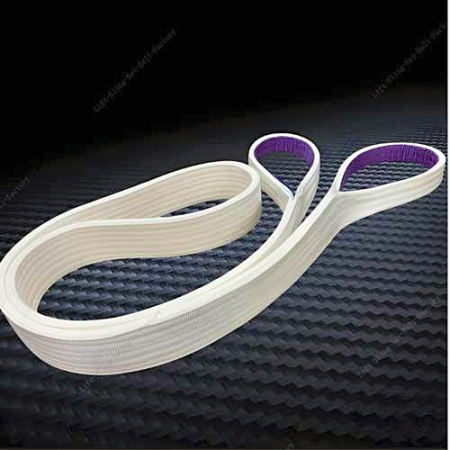
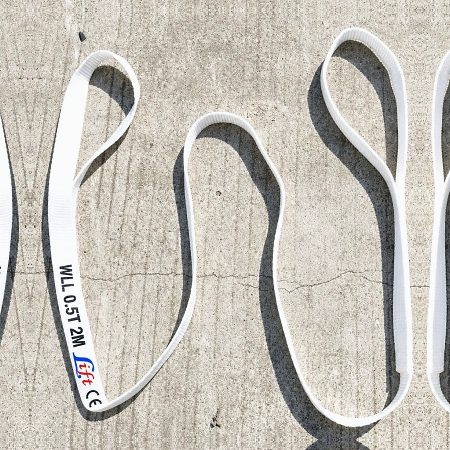
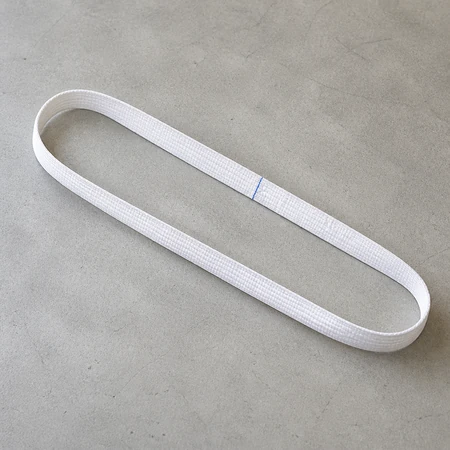
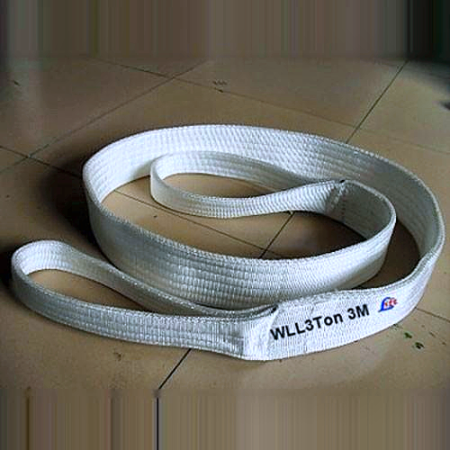
Lift sling rigging company produce White Flat Webbing Sling,White lifting sling ,White webbing sling,White Polyester webbing sling,White Lifting Sling Belt Crane Flat Polyester Webbing Sling.
White Flat Webbing Sling
A white flat webbing sling is a flat woven polyester band with a formed eye at each end, left undyed. The colour is not the absence of a specification; it is one. A white band is bought because the load is white or light and cannot take a transfer, because the band has to show what has happened to it, or because the print on the band is the only marking it is allowed to carry. Everything else about the article – the weave, the width, the factor, the eyes – is specified exactly as it is on a dyed band of the same figure.
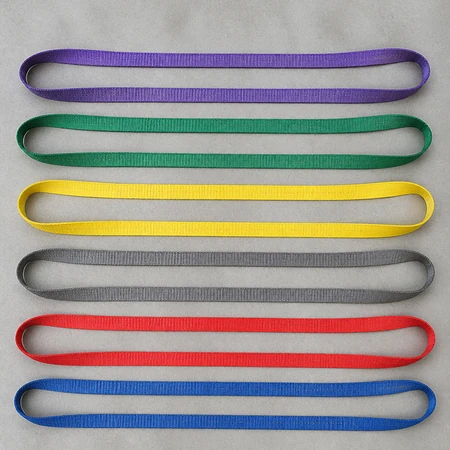
That last point is worth stating before anything else, because white is often read as the cheap option. In this works the white band is the same article as the violet, green or yellow one: same yarn, same weave, same stitching, same marking discipline. What changes is the dye bath and what the colour is asked to do at the load. The same article is sold as a white webbing sling, a white lifting sling or a white flat web sling; the words describe the colour and the form, not three different products.
Where the colour is the specification
Four properties come with an undyed band, and each one is a reason to specify it rather than a happy accident.
- Nothing to transfer. Undyed yarn carries no dyestuff, so there is no colour to come off onto a white reel of paper, a roll of white fabric, a painted panel or a polished aluminium face when the band is new or wet. A dyed band is normally harmless; on a white load, “normally” is the wrong word to rely on.
- Contrast. White shows oil from a hook, rust bleed from a wet stillage, grit from a truck bed and the first nick from a sheet edge. A dark band hides all four until the damage is structural.
- Print that can be read. Black or blue figures on white are legible at arm’s length in poor light, which is where the working load limit actually gets read.
- A blank page for your own coding. Where a warehouse or a customer codes slings by its own system, a white band does not argue with the scheme the way a capacity-coded colour does.
Where a white band earns its place
White webbing slings are bought for a narrower set of loads than coloured ones, and the loads have one thing in common: the surface is worth more than the sling.
| The load | Why white rather than a coded colour | What decides the sling |
|---|---|---|
| White paper and tissue reels | A dyed band wet with condensation is the one thing that can tint a white reel; an undyed band removes the question | Reel mass, the two pick positions, and the width that keeps the band off the cut edge |
| White or light textile rolls, nonwoven | Contact transfer shows on the outer wrap and cannot be cleaned back | Roll diameter, whether the band bears on the wrap or the core, and the finish of the ends |
| Painted white panels, coachwork, white goods | A mark on a finished white face is a rejection, not a cosmetic complaint | Panel mass, edge condition, and whether an edge protector travels with the band |
| Aluminium, stainless and polished sheet | Soft load, soft band; white also shows any pickup from the previous lift | Laius, sleeve, and whether the band may touch the face at all |
| Marble, quartz, terrazzo and white stone | Slurry and stone dust are visible on white, so a dirty band is caught before it prints a grey line | Slab mass, arris condition, and a sleeve at every bearing point |
| Food-adjacent packing and clean assembly | Soiling is visible early, and an undyed band carries no colour to migrate | Washability, how the band is stored between lifts, and the width at the contact |
What white does not fix
The colour changes nothing mechanical, and buyers occasionally ask it to. A white band does not soften an edge, widen itself, carry more, or make a synthetic fibre suitable for a hot surface. Four specifications still have to be written on the order exactly as they would be on a dyed band.
- Servad. A white band cut by a sheet edge is a cut band, and the cut is easier to see but no less fatal. Sharp corners take a sleeve or a protector, whatever the colour.
- Laius. Bearing pressure is set by width and by nothing else. If the surface cannot take a line, the answer is a wider band, not a paler one.
- Heat. These fibres have a working limit around 100 °C and they fail by melting rather than by deforming politely. White does not change that, and a band that has been near hot work should be inspected for glazing before it goes back in the store.
- Chemistry. A white polyester band takes water, oils and most common chemicals well; strong alkalis and some solvents are hostile to it. Send us what the band will touch and the fibre is confirmed rather than assumed.
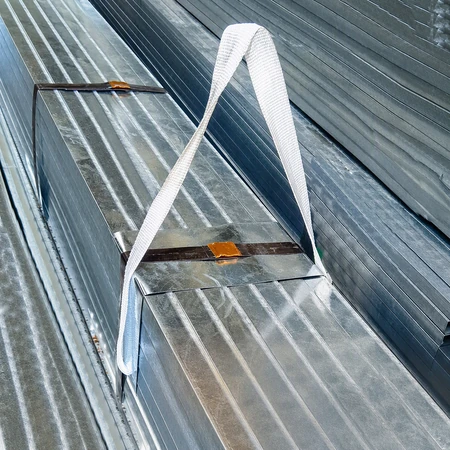
White is not a hygiene certificate. An undyed band is easier to see soil on, and that is all it is: the band still has to be washed, dried and stored clean, and a white band that is grey with handling is telling you it has not been.
The construction under the colour
The band is woven from high-tenacity polyester – a white polyester webbing sling is the undyed version of the same article, not a different weave: the load path is the warp yarns running the length of the sling, held by the weft, with both selvedges woven closed. That is why the face of a flat sling shows fine longitudinal lines – those lines are the load. Two thicknesses are woven, 4 mm and 7.5 mm, ja 7.5 mm band carries roughly double the figure at the same width.
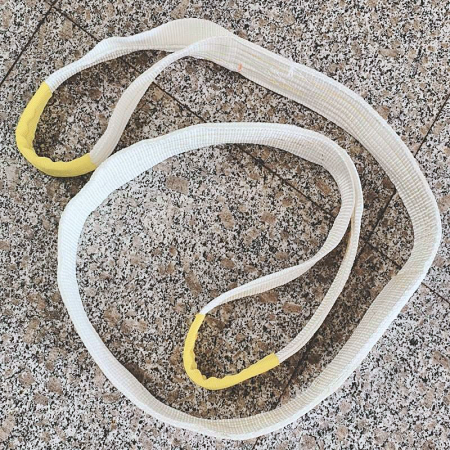
The eye is the part that wears out first and the part that decides whether the band can be used at all, so it is worth choosing deliberately rather than accepting the default.
- Formed flat eye – the band folded back on itself and closed with rows of stitching. The general-purpose end: soft, tasane, and it sits on a hook without a thimble.
- Folded (tapered) eye – the eye narrows towards the body of the band, which suits a shackle or a pin and keeps the hardware from walking along the eye.
- Reinforced eye – extra webbing laid into the eye before stitching, for a fitting that is rough, small or heavily loaded.
- Sleeved eye – a separate sleeve over the eye where it meets steel hardware or a sharp load. On a white band the sleeve is usually the only colour on the article, which is a useful thing in itself.
Capacity is per hitch, not per tonnage
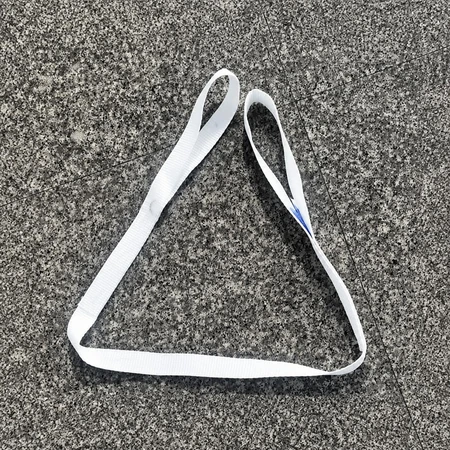
A flat webbing sling does not have one capacity. It has a figure for each way it is hitched, and the label states them. The figures below are the mode factors the market uses: each multiplies the sling’s own marked working load limit, and the label on the article always overrides the table.
| Korraldus | Factor | What it means at the load |
|---|---|---|
| Vertikaalne | 1.0 | One leg, straight up; the band hangs and carries |
| Lämbunud | 0.8 | Round the load and back through its own eye; the wrap grips and the band is loaded against itself |
| Korv, jalad 0-45 kraadid | 2.0 | Band under the load, both ends on the hook, legs near vertical |
| Two legs, 45-60 kraadid | 1.0 | A pair with the legs spread; the spread costs capacity |
The full table of eight arrangements, with the angle bands, is on the webbing sling category page; the four above are the ones that decide most white-band orders.
Two consequences are worth stating plainly. A choked white sling is weaker than the same sling used vertically, so a load that must be choked needs a bigger band rather than a longer one. And as the legs spread the capacity falls – a geometric fact, answered by a wider angle-free arrangement, a spreader, or a bigger sling, and by nothing else.
The ladder: width for a given figure
Width is not chosen freely; it follows from the figure and the factor. The table below is the 7:1 column of the works’ published ladder for flat woven bands, which is the factor European practice uses for general-purpose webbing slings. The 5:1 ja 6:1 columns are narrower for the same tonnage and are published on the single use lifting slings page, where the same ladder is reproduced in full.
| Töökoormuse piirang | Band width at 7:1 | Thickness | Weight per metre | Tüüpiline kohustus |
|---|---|---|---|---|
| 1 t | 30 mm | 4 mm | 0.20 kg | Light panels, single sheets, small fabric rolls |
| 2 t | 60 mm | 4 mm | 0.60 kg | Reels, bundles of tube, painted parts |
| 3 t | 90 mm | 4 mm | 0.78 kg | Textile rolls, white goods, marble slabs |
| 4 t | 120 mm | 4 mm | 0.90 kg | Sheet stacks, larger reels, stone |
| 5 t | 150 mm | 4 mm | 1.14 kg | Heavy panel packs, aluminium bundles |
| 6 t | 180 mm | 4 mm | 1.33 kg | Structural steel with sleeving, dense packs |
| 8 t | 240 mm | 4 mm | 1.85 kg | Heavy stone, large fabric rolls |
| 10 t | 300 mm | 4 mm | 2.05 kg | Top of the 4 mm ladder; 7.5 mm band from here upward |
Width and weight are the works’ published figures for this ladder. Nothing in it is a stock size: the tonnage, the factor, the width and the length together describe a band made to your line, and the wide-band minimums (1.5 m at 100-150 mm, 2.0 m at 200 mm and above) are confirmed with the order.
One reading note that catches buyers out: the width that protects a surface and the width that carries a figure are not always the same number. Where the load is soft or finished, the band is often one step wider than the figure requires, because bearing pressure – force divided by area – is what marks a panel, not the tonnage.
Märgistus: print, silt, and the colour-code question
Flat webbing slings are colour-coded by capacity under the convention most of the market uses, and white is not one of the eight colours. That is not a defect in the band; it is a reason the marking has to be read rather than glanced at.
Everything on a white band is therefore decided at the printing stage: the working load limit, the length, the factor, and whatever reference your own system needs – a part number, an asset number, a customer code. Print contrast is the advantage the colour brings, so it is worth using: black or blue figures, on the face, at a point that does not enter the choke.
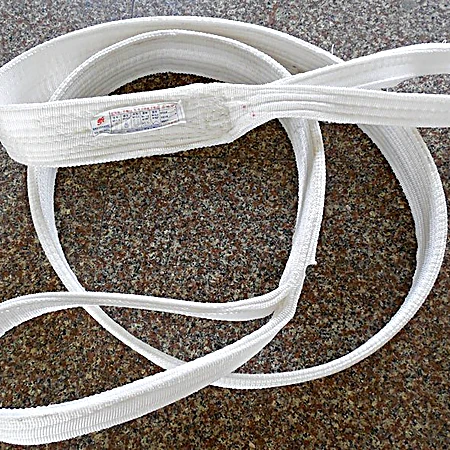
- Print or label, but agree them. A printed figure on the band and a sewn label with different numbers is a contradiction, not a detail. Where both exist they are printed from the same order line.
- Your own reference is a production instruction. Send the exact string, in the exact case, and it is printed as given rather than tidied up.
- A marking is not a certificate. Where a project or a market requires a documented figure, a declaration or a specific standard marking, say so on the enquiry and it is confirmed before the bands are woven.
Pikkus, and the convention it is measured in
A flat band is quoted either as the working length between the bearing points of the two eyes, or as the overall length including the eyes. The difference is two eye lengths, which on a short band is the difference between a load that hangs level and one that does not – and it is the commonest disagreement on this article.
- Say which convention you are quoting. Working length is what the lift geometry needs; overall length is what the stores measure. Both are legitimate; mixing them is not.
- Eye length is part of the figure. A 3 m band with 300 mm eyes is not the same article as a 3 m band with 150 mm eyes, even where the figures on both read 3 t.
- Range. 0.5 m kuni 100 m in this family, with the minimum set by the width rather than by the tonnage – 30 mm takes 0.5 m, 60 juurde 90 mm takes 1.0 m, 100 juurde 150 mm takes 1.5 m, ja 200 mm and above takes 2.0 m.
Hoolitsemine, cleaning and storage
White raises the standard of care, and the care is not complicated. What it asks for is that the band is treated as a textile rather than as a tool.
- Wash in clean water with a mild detergent, rinse, and dry before it goes back in the store. A band stored damp is a band that will smell, stiffen and eventually fail at the stitching.
- No solvents, no bleach, no machine drying on heat. These attack the fibre or the stitching, and on a white band the damage is invisible until it is structural.
- Hoida puhtana, kuiv ja päikesevalguse eest kaitstud. Ultraviolet light degrades synthetic webbing; a band left on a stillage in a yard for a season is not the band that was delivered.
- Keep it off the floor and out of grit. The grit that travels into the contact does more damage than the load does, and on a white band it is visible before it is expensive.
- Temperature. Around 100 °C is the working limit for these fibres, and heat damage shows as a glazed or brittle patch rather than as a stain.
Ülevaatus, and what ends a white band’s life
Inspect before every use, and formally at the interval the site rules set. The conditions that remove a band from service are specific rather than a matter of judgement.
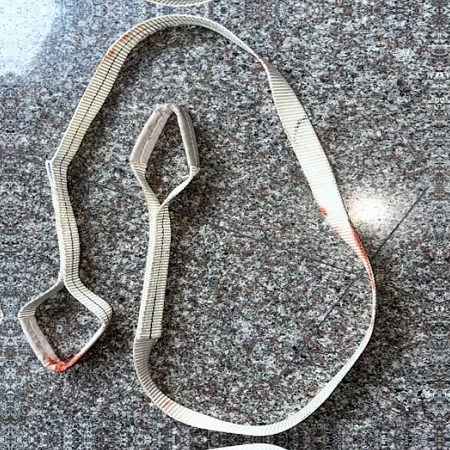
- Cuts, nicks, snags and punctures anywhere in the load path, and particularly at the eye where the hardware bears.
- Abrasion and glazing – a shiny, flattened or stiffened patch is fibre that has been working against something.
- Stitching – broken, worn or pulled rows at the eye or at the join. This is the failure that gives no warning.
- Chemical attack – stiffness, discolouration or a patch that smells wrong after contact with an acid, a caustic or a solvent.
- Heat damage – glasuuritud, brittle or melted fibres, however small the area.
- An unreadable label or print. If the figure cannot be read, the band cannot be matched to a lift.
A band with any of those is out of service. On a white band there is one addition to the list, and it is a practical one: contamination that will not wash out – oil that has gone through the weave, rust that has stained the yarn – is a reason to look harder at the fibres underneath, not a reason to keep using it because it is only a stain.
Six lines on the enquiry
The figure alone does not describe a white flat webbing sling. Six lines do, and they are the six that decide the article.
| # | The line | What it fixes | What goes wrong without it |
|---|---|---|---|
| 1 | The load, and its mass as it is lifted | The figure the band has to carry | A band sized on a drawing instead of on the real load |
| 2 | The hitch: vertikaalne, basket or choked | Which capacity applies | A choked lift run at the vertical figure |
| 3 | Laius, or the surface and edge condition | Bearing pressure and whether a sleeve is needed | A band that prints a line on a finished face |
| 4 | Pikkus, and the convention it is measured in | Whether the load hangs level | A band two eye lengths out, and a lift that tilts |
| 5 | The ends, and the fittings they will meet | Eye type and eye size | An eye that will not take the hook or the pin |
| 6 | The print: figures, reference, and the colour of the print | What the band says about itself | A band that cannot be matched to your own system |
Korduma kippuvad küsimused
What is a white flat webbing sling?
A flat woven polyester band with a formed eye at each end, left undyed rather than dyed to a capacity colour. It is the same article as a coloured band of the same figure: same yarn, weave, stitching and marking. The colour is chosen for what it does at the load – no dye to transfer, visible soiling, legible print.
Why buy white instead of a colour-coded band?
Because the load or the marking calls for it. A white or light load cannot take a transfer from a dyed band; a band that has to be inspected closely is easier to judge in white; and where your own system codes slings, a white band does not argue with it. If none of those apply, a coded colour is the more convenient article.
Is a white sling a lower grade than a coloured one?
Ei. The fibre, the weave, the width, the factor and the marking are specified the same way, and the figures printed on the band are the figures that apply. White is not a cheaper article: it is the same band without the dye, and it is bought for what the colour does at the load.
Will a white band mark my load?
The band is softer than steel hardware and it will not bruise a painted or polished face the way a chain does. It will, however, transfer whatever is on it: a band that has been lying in grit or oil marks a white surface. Clean storage is part of the specification, not an afterthought.
Can the band be printed with our own reference?
Jah – the working load limit, the length, the factor and your own part or asset number, in black or blue on the white face. Send the exact string to be printed and it is reproduced as given.
What widths and lengths can be supplied?
30 mm kuni 300 mm on a 4 mm band in the published ladder, 7.5 mm bands to 24 t to order, and lengths from 0.5 m kuni 100 m. The minimum length follows the width rather than the tonnage, so a wide band means a longer minimum.
How should a white sling be cleaned?
Clean water and a mild detergent, rinsed and dried before storage. No solvents, no bleach and no heat drying. Inspect the stitching after washing as well as before use, because washing is when a loose row becomes visible.
White is not in the colour code – is that a problem?
It is only a problem if the colour was doing the work of the label. The eight capacity colours identify a sling at a glance; white identifies nothing, so the printed figure and the label have to be read. That is a discipline, not a defect.
Where each question goes on this site
This page owns the white band. The figure, the hitch and the tonnage each have a page of their own, and they are the better place to settle those questions.
- Rihmaga tropp – the category, and the full mode-factor table
- 1 tonne webbing sling – 1000 kg, the smallest of the ladder
- 2 tonnes flat polyester webbing sling – the middle of the ladder
- 3 tonne white lifting sling – the most-bought size in this colour
- 4 tonne webbing sling – 2 m kuni 10 m working lengths
- 8 tonne webbing sling – wide band, heavy packs
- Single use lifting slings – the same band, bought for one journey
- Tõsteseadmed – hooks, shackles and the hardware at the eye
- Lifting spreader beam – when the picks hang from a beam
Võtke ühendust
Lift Sling Rigging Co., Ltd weaves the article on this page: flat woven polyester bands, white or dyed, alates 1 t kuni 24 t, with the eyes, the sleeving, the length and the print the job needs.
Send the load, the hitch, the surface it must not mark and the length convention you are working in, and we will confirm the width, the ends and the marking before the band is woven.
- Telephone and WeChat: 18066002268
- E-post: 702461526@qq.com
- Aadress: Lifute tööstuspark, Taizhou linn, Jiangsu provints, Hiina
- HS kood: 630790