

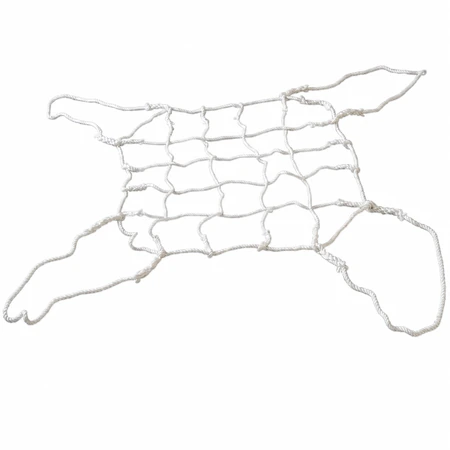
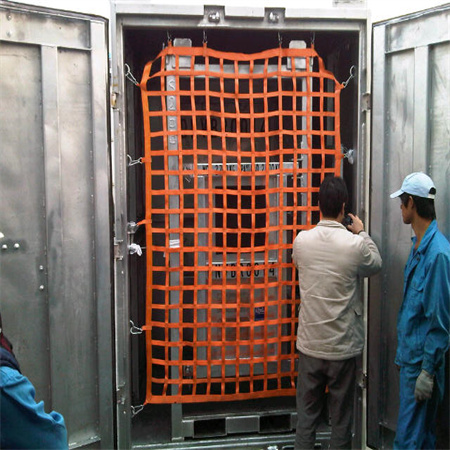
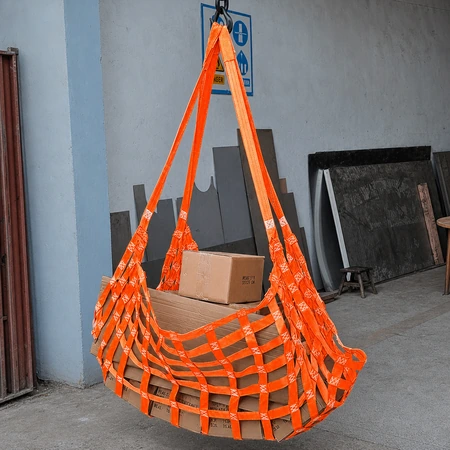
Lift troppide taglase ettevõte toodab nailontrossi lastivõrku, terastrossist lastivõrk ja ülitugevast lindist lastivõrk.
Lasti tõstevõrk
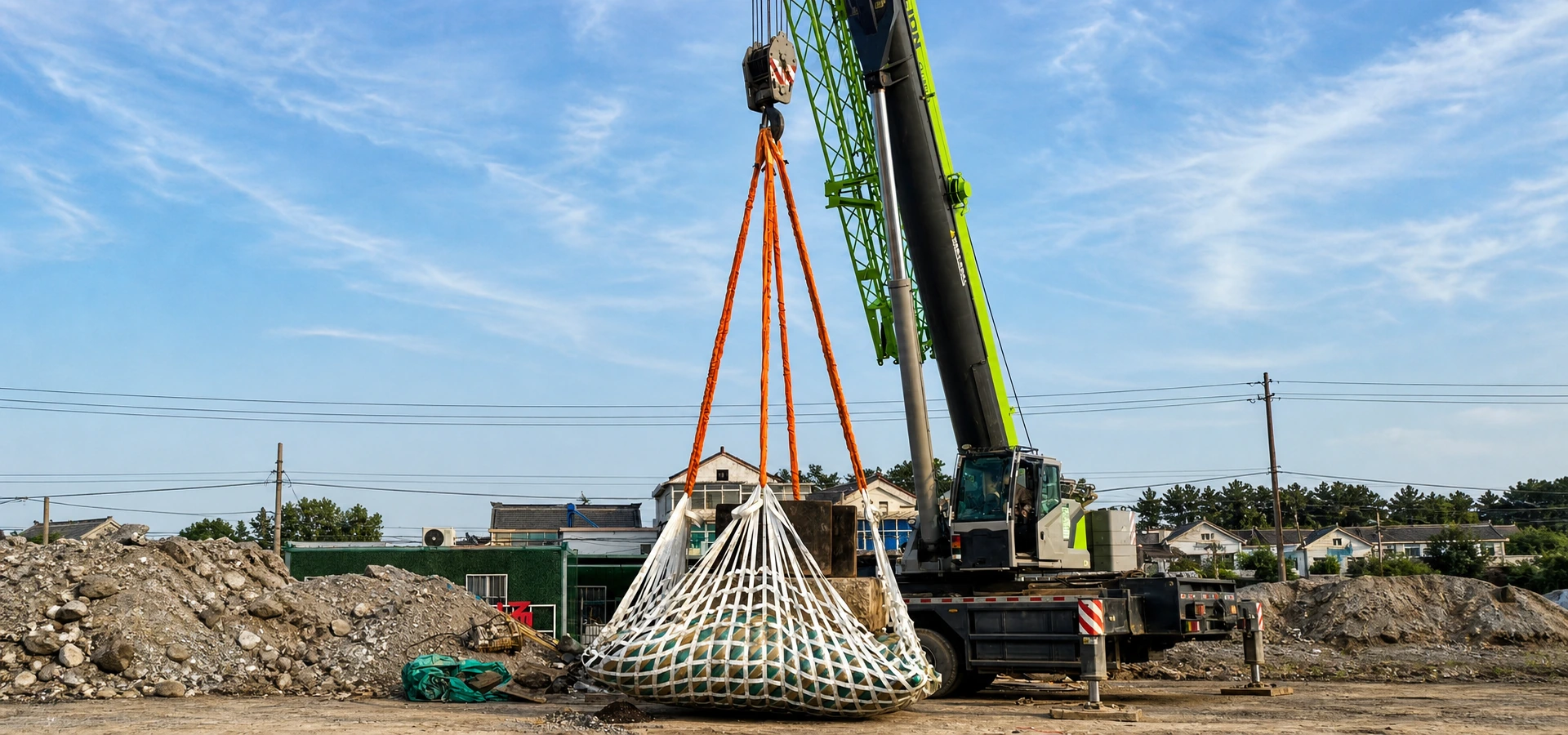
A cargo lifting net turns a loose, stacked or bagged consignment into a single crane lift. The net closes around the whole load instead of choking individual pieces, and it carries that load from its corners rather than from one contact point, so cargo that cannot be repacked, banded or palletised can still be moved in one movement.
We manufacture cargo lifting nets in three woven constructions – high-tenacity nylon rope, galvanised steel wire rope and high-strength polyester webbing – across a rated capacity of 1 t kuni 100 t. Võrgusilma avamine, neto suurus, piir, lifting points and colour are made to your drawing, and every net is proof-load tested in our own plant before it is packed.
- Nimivõimsus: 1 t – 100 t, stated for the way the net is rigged
- Võrgusilma avamine: 50 mm – 400 mm, chosen from the smallest dimension of the cargo
- Tõstepunktid: 4 reinforced corners as standard, 8 points for a spreader beam
- Ohutusfaktor: 5:1 / 6:1 / 7:1 depending on construction
- Dokumentatsioon: capacity label, material test report and CE marking
- Standardid: built to your nominated standard; ISO 9001 quality system
Which cargo lifting net suits your load?
Kolm konstruktsiooni võimsuselt kattuvad, so the choice is normally decided by the cargo and the working environment rather than by tonnage alone. Use the table below as a starting point, then confirm the mesh, the net size and the lifting points with our engineers.
| Cargo | Recommended construction | Usual mesh | Tüüpiline võimsus |
|---|---|---|---|
| Bagged goods – fertiliser, teravilja, seed, sööda | Polyester webbing or nylon rope | 100 mm | 2 t – 10 t |
| Palletised cartons, boxed goods | High-strength lint lasti tõstevõrk | 100 x 100 mm | 2 t – 10 t |
| Tellised, plokid, lõhestatud kivi | Nylon rope net in bag form | 100 mm – 150 mm | 2 t – 25 t |
| Quarry run, agregaadid, lammutuspraht | Steel wire rope net | 150 mm – 300 mm | 10 t – 100 t |
| Palgid, saematerjal, poolused | Nylon rope net, sõlmitud | 200 mm – 300 mm | 2 t – 50 t |
| Steel plate packs, torukimbud, lõigud | Webbing net with edge protection, or wire rope net | 100 mm – 200 mm | 5 t – 50 t |
| Trummid, rehvid, rullid | Nylon rope net or webbing net | 100 mm – 200 mm | 1 t – 10 t |
| Machined, painted or plated parts | Webbing net only – tasane, non-marking bands | 50 mm – 100 mm | 1 t – 20 t |
| Scrap metal, mixed abrasive bulk | Steel wire rope net | 200 mm – 400 mm | 10 t – 100 t |
| FIBC big bags, 1 t ja 2 t | Rihmavõrk, or a purpose-made kraana kaubaaluste lastivõrk | 50 mm – 100 mm | 1 t – 5 t |
What a cargo lifting net is – ja mis see ei ole
Lasti tõstevõrk on kootud võre, mitte kotti ega troppi. Ribad või kiud ristuvad täisnurga all, moodustades avatud võrgu; the border and the corners carry the load; and the cargo sits inside the lattice rather than on top of it. That geometry is what makes a net useful: the load is distributed over a wide bearing face instead of being concentrated at a hook, a choke point or a fork pocket, so contact pressure drops and the surface of the cargo is left intact.
It differs from a sling in three practical ways. A net holds the cargo in three dimensions, so nothing can slide out sideways during the lift. A net can be loaded on the ground, spread flat, and only then closed around the goods, which means the goods never have to be lifted to be netted. And a net is rated as an assembly of corners, border and mesh, so its capacity is quoted for a stated rigging arrangement rather than as a single line pull.
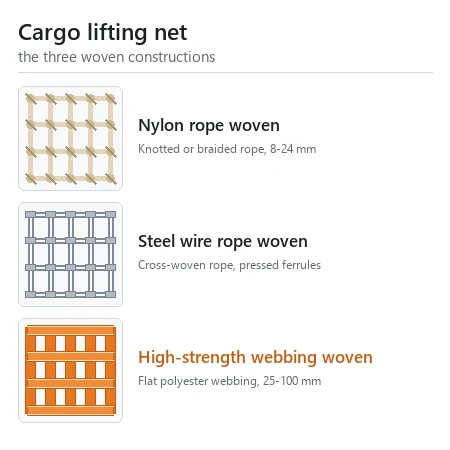
The four elements that set the rating
The strand or the band. Nailonist köis, steel wire rope or flat webbing. This single choice sets the strength, the net weight, the surface contact and the resistance to abrasion, cut and heat.
The mesh opening. The size of the square or diamond aperture. See otsustab, mis jääb võrgu sisse ja kui palju võrk kaalub. It is chosen from the smallest dimension of the cargo, mitte kunagi võrgu välismõõdust – a 6 m net with a 300 mm mesh will lose bricks through the mesh no matter how strong the rope is.
Piir. A doubled or reinforced edge running the full perimeter, nii et servaribad ei saaks lahti rullida, spread apart or pull out under load. On a webbing net the border is double-layer stitched; on a rope net it is a doubled border rope spliced into the corners.
The lifting points. Four reinforced corner loops as standard, või kaheksa punkti, kus võrk puistetalalt tõstetakse. Load must enter the corners and the border, never the middle of a panel. Loading the middle of a net is the most common way a sound net is destroyed in service.
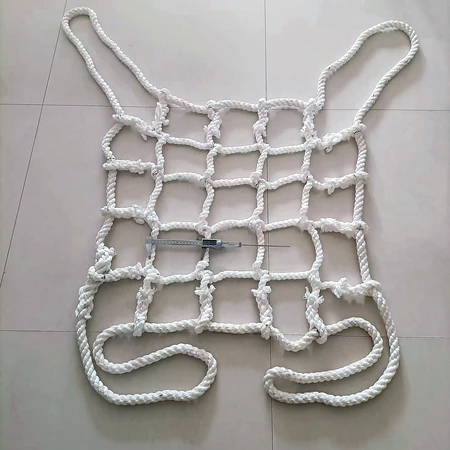
Cargo lifting net technical parameters
The table below puts the three constructions side by side. Values are our standard production range; anything outside it is built to drawing, and the rating that applies is the rating of the net as it is rigged, not the capacity of the crane above it.
| Parameeter | Nylon rope net | Steel wire rope net | Rihmavõrk |
|---|---|---|---|
| Materjal | 100% ülitugev nailon (polüamiid) multifilament | Tsingitud terastross; roostevaba 304 / 316 nõudmisel | 100% ülitugev polüesterrihm; nylon or PP on request |
| Strand / bänd | 8 – 24 mm köis, 3-kiud laotud või 8 / 12-kiud punutud (kuni 32 mm nõudmisel) | 6 x 19 for abrasion, 6 x 37 / 6 x 36WS for flexibility; 6 – 20 mm; FC or IWRC | 50 mm webbing standard; 25 / 75 / 100 mm nõudmisel |
| Võrgusilma avamine | 100 – 300 mm, ruut või teemant | 150 – 400 mm, ruut | 100 x 100 mm ruudu standard; 50 – 300 mm nõudmisel |
| Ühine / lock | Netmaker’s knot, or knotless braided splice | Pressed aluminium ferrule at every intersection | Woven band crossings, stitched at the border |
| Piir | Kahekordne piirdeköis, spliced into the corners | Pidev piirnöör, rõngastihendiga lukustatud | Double-layer stitched border round the full perimeter |
| Tõstepunktid | 4 nurga silmad; 8-punkt nõudmisel | Pressitud nurgasilmad sõrmkübaratega, or rings / põhilingid | 4 reinforced corner loops; 8-punkt- ja rõngasliitmikud nõudmisel |
| Nimivõimsus | 1 t – 50 t | 2 t – 100 t | 2 t – 10 t standard; heavier to order |
| Ohutusfaktor | 5:1 / 6:1 / 7:1 | 4:1 / 5:1 / 6:1 | 7:1 |
| Pikendamine | u. 18 – 22% vaheajal – absorbs shock load | Väga madal – the mesh keeps its shape under steady load | Madal, u. 7% töökoormuse piiril |
| Hõõrdumine ja lõikamine | Hea; a single damaged strand can be replaced locally | Kõrgeim kolmest | Hea, kuid tuleb hoida eemal teravatest servadest |
| Korrosioon | Mädanemiskindel; suited to wet and salt-water duty | Galvanised as standard; stainless for marine and chemical service | Roostevaba polüester, UV-stabiliseeritud |
| Töötemperatuur | -40 C kuni +80 C | Hot and dirty service – kinnitage meiega kohustus | -40 C kuni +100 C |
| Värv | Valge, or dyed to order | Tsingitud / stainless finish | Orange high-visibility, sinine, must, green or custom |
| Sertifitseerimine | CE, GS, ISO 9001; test report per net | CE, ISO 9001; CNAS and DNV certified facility | CE, GS, ISO 9001; test report per net |
Net size and rated capacity
Standard sizes are listed below. Veoauto voodi, konteiner, hold and spreader dimensions are made to drawing, and the capacity quoted is the capacity of the finished net, tested before dispatch.
| Neto suurus (L x W) | Tüüpiline võimsus | Tüüpiline kasutus |
|---|---|---|
| 2.0 x 2.0 m | 1 t – 3 t | Trummid, masinaosad, väikesed komponendid |
| 2.5 x 2.5 m | 2 t – 5 t | Kaubaalustele ja kottidesse pakitud kaubad, konteinerite laadimine |
| 2.5 x 6.0 m | 4 t – 10 t | Pikad kaubad, torukimbud, veoautode ja haagiste laadimine |
| 4 x 4 jalga (1.2 x 1.2 m) | 2 t – 3 t | Väikesed koormused, trummid, masinaosad (imperial markets) |
| 82 x 82 sisse | 2 t – 5 t | Standardne kaubaaluste jalajälg keiserlikel turgudel |
| 6.0 x 6.0 m | 10 t – 25 t | Bulk bagged cargo, puit, jäägid |
| 8.0 x 8.0 m | 25 t – 50 t | Heavy bulk, kivi, quarry and demolition work |
| Ehitatud joonistamiseks | 1 t – 100 t | Veoauto voodi, konteiner, hold and spreader beam dimensions |
Võrgusilma avamine: choose it from the smallest dimension of the cargo
Mesh is the parameter buyers most often get wrong, because it is chosen from the net size instead of from the load. The rule we apply is simple: the aperture must be smaller than the smallest dimension of the smallest piece that must not escape. The table below is the guide we use on quotation.
| Smallest cargo dimension | Cargo example | Mesh to specify |
|---|---|---|
| Under 50 mm | Bottles, small castings, nuts and bolts, components in bulk | 50 mm – closed or near-closed bag form |
| 50 – 100 mm | Tellised, bagged fertiliser, boxed goods, FIBC big bags | 100 mm |
| 100 – 200 mm | Trummid, kastid, lõhestatud kivi, saematerjal | 150 – 200 mm |
| Läbi 200 mm | Blocks, palgid, jäägid, lammutuspraht | 250 – 300 mm, või 400 mm in wire rope |
Lifting configuration and how the rating is stated
A cargo lifting net is rated as an assembly. The same net gives a different rating for a four-point vertical lift, a two-point lift and an eight-point lift from a spreader beam, because the number of load-bearing corners changes. Every net we supply is therefore labelled with its working load limit and, where a net is used in more than one arrangement, each arrangement is listed separately on the label. Quote the configuration you will actually use when you enquire – a rating copied from a catalogue without the configuration is not a rating.
Nylon rope cargo lifting net
A nailonist lasti tõstevõrk is knotted or braided from high-tenacity nylon rope. Each strand can move slightly inside its knot, so the net settles around an irregular stack instead of sitting on top of it, ja nailoni suur pikenemine neelab lööke, kui kraana võtab lõtvu. It is the usual choice for timber and logs, kivi, trummid, rehvid, scrap and any load whose shape shifts as it is lifted.
Rope is also the most repairable construction: a damaged strand can be re-knotted or re-spliced locally and the net re-inspected, which matters on a site where a net is working daily. For polypropylene rope in the same construction, vaata polypropylene rope cargo net sling.
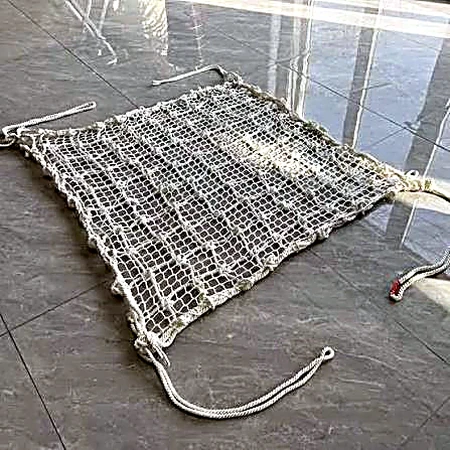
Steel wire rope cargo lifting net
A steel wire rope cargo lifting net is cross-woven from galvanised wire rope and locked at every intersection with a pressed aluminium ferrule, so the mesh cannot open up or distort when the net is dragged across a quay or a truck bed. Wire rope is the construction for abrasion, teravad servad, hot surfaces and long service with little maintenance – quarry run, agregaadid, lammutuspraht, scrap and heavy bulk.
It is the heaviest of the three and the least forgiving to finished surfaces, so it is normally specified where the cargo is rough. Where a wire rope net has to handle dressed material, we supply the same construction with sheathed contact sections, using the rope from our trosstropid ulatus.
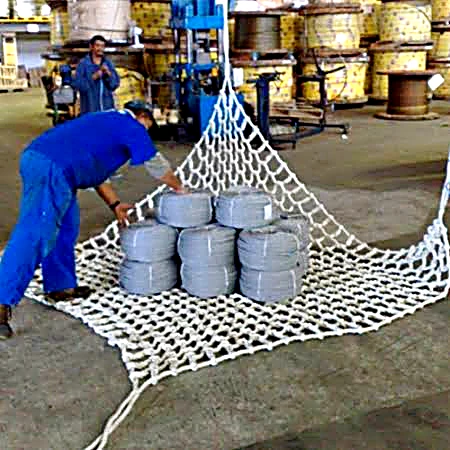
High-strength webbing cargo lifting net
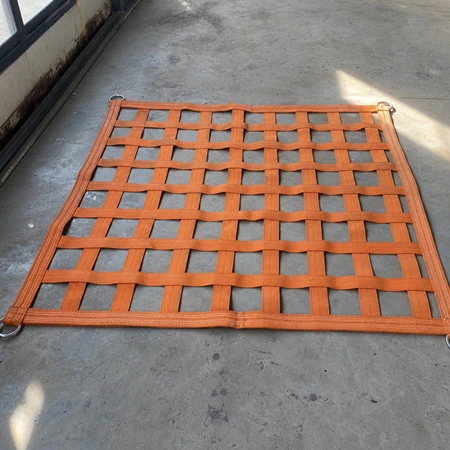
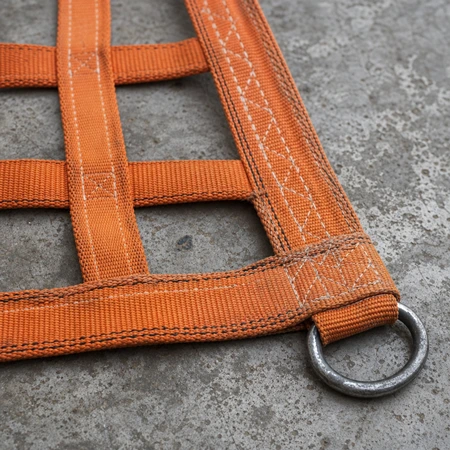
A high-strength webbing cargo lifting net is woven from flat polyester webbing. Ribad ristuvad täisnurga all, moodustades avatud ruudukujulise võrgu, the border and corners take the load, ja kogu võrk on piisavalt pehme, et kotiga vastu istuda, kastitud, värvitud või töödeldud lasti ilma seda märgistamata. Sellel on kolmest konstruktsioonist kõige laiem kandepind kõige väiksema netomassiga, which is why it is the default for palletised, bagged and unitised cargo in ports, on trucks and on site cranes.
Polüester on väikese pikenemisega, so the mesh keeps its shape while the crane takes up the slack and the load stays square. Lint on kootud meie oma veskis, which is why band width, värvi, mesh and capacity can be tuned to the load instead of bought in from a catalogue. It is the same webbing used in our rihmaga tropid ja lõputud ümmargused tropid, so a net and a sling on the same lift are matched in elongation and colour coding.
Kuidas veose tõstevõrku paigaldatakse
- Four-point lift from a single hook. Neli nurgaaasa on koondatud konksu või pearõnga külge, so the net closes around the cargo as the crane takes up. This is the standard arrangement for bagged, palletised and unitised loads.
- Eight-point lift from a spreader beam. Võrk jääb kandiline ja koorem püsib tasane, mida pikk või lai saadetis vajab. Meie tõstetav puistetala takes the eight points and keeps the legs vertical.
- Koti vorm. A closed three-dimensional net for loose goods that must not escape – tellised, lõhestatud kivi, bottles, small castings.
- Flat net, cargo inside the mesh. For palletised, bundled or unitised loads that only have to be held together during the transfer.
Ükskõik milline korraldus, load must go into the corners and the border. Three habits destroy nets faster than any cargo: loading the middle of a panel, dragging the net sideways with the crane, and lifting on fewer than the full set of lifting points.
Mida me vajame, et tsiteerida lasti tõstevõrku
| Teave | Miks see on oluline |
|---|---|
| Koorma kaal ja koorma kuju | Määrab nimivõimsuse ja lasti all olevate kanderibade või ribade arvu |
| Võrgu pikkus x laius | Võrk peab olema suurem kui koorma jalajälg, et veos paikneks võrgusilma sees, mitte selle peal |
| Võrgusilma avamine | 100 x 100 mm is our webbing standard; smaller or loose items need a smaller aperture |
| Strand diameter or band width | Sets strength and net weight; band width also sets the bearing face on the cargo |
| Tõstepunktid | Four corners as standard, or eight points and rings for a spreader beam |
| Kraana, konks või puistur | Determines whether the corners carry eyes, rõngad, shackles or thimbles |
| Keskkond | UV, soolane vesi, avamerel või kõrgel temperatuuril töötamine määrab materjali ja töötlemise |
| Dokumentatsioon | CE-märgis, katsearuanne, declaration of conformity or own-brand labels |
Ülevaatus: what to check and when to retire a net
Inspect before every lift and record a formal inspection at the interval your site requires. Check the corner loops and the corner stitching first – that is where wear starts – then work round the border and the mesh.
| Check | Retire the net if |
|---|---|
| Corner loops and corner stitching | Stitching is broken, the loop is deformed, or the ring / thimble is cracked or worn |
| Piir | The border rope or border band is cut, unravelled or pulled out of the mesh |
| Strands or bands | Any load-bearing strand or band is cut, deeply abraded, heat-glazed or chemically stained |
| Knots and ferrules | A knot has slipped, or a ferrule is cracked, displaced or corroded through |
| Vöö | Bands are cut, powdered by UV, or contaminated with oil, paint or chemicals that cannot be removed |
| Labels | The capacity label is missing or illegible – an unlabelled net cannot be rated |
Ärge kunagi parandage võrku katkenud kiudu sõlmides, terastrossi keevitamine või riba kuumutamine. Repairs belong to the maker or to a competent person using the original materials, followed by a re-test where the standard requires it. Store nets clean, dry and off the ground, otsese päikese eest.
Where cargo lifting nets are used
| Sektor | Mida võrk teeb |
|---|---|
| Sadamad ja terminalid | Konteinerite täitmine ja täidise eemaldamine, kaubaalustel ja kottides lasti, quay and hold work with a net that is soft, roostevaba ja kergesti kokkupandav |
| Teras ja valmistamine | Plate packs, kimbud, töödeldud osad ja paisukoormused, kus pinda ei tohi märgistada |
| Kivi, karjäär ja täitematerjalid | Lõhestatud kivi, plokid, munakivid ja abrasiivpuiste; wire rope where cut resistance decides the service life |
| Puit ja metsasaadused | Palgid, sawn packs and poles – a rope net settles around an irregular stack as it is lifted |
| Avamere ja merega | Deck and over-the-side transfer; nylon and polyester drain freely and do not rust |
| Põllumajandus ja puistekotid | Väetis, teravilja, seeme ja sööt kottides ja suurkottides, lifted whole without repacking |
| Taaskasutus ja jäägid | Sega- ja abrasiivsed jäägid, kus trossvõrk kestab kauem kui tekstiilvõrk |
| Vehicle and plant loading | RoRo and breakbulk loading, where a wide net spreads the load across the body and chassis; vaata meie sõiduki tõstevõrk ulatus |
Two neighbouring ranges are often quoted with a lifting net: heavy duty truck cargo nets ja container cargo nets for securing rather than lifting, ja turvaköisvõrgud where the net protects people instead of holding cargo. Tell us which duty applies and we will confirm the construction – a securing net is not rated for lifting, and a lifting net is not a fall-arrest product.
Korduma kippuvad küsimused
What is the difference between a cargo lifting net and a cargo net?
A cargo net is a general term that covers lashing, securing and climbing nets as well as lifting nets. A cargo lifting net is a rated assembly: it is designed for a stated working load limit, tested, labelled and supplied with documentation. If a net has no capacity label, treat it as a securing net and never lift with it.
How do I choose between nylon rope, wire rope and webbing?
Karm, kuumad või abrasiivsed puistepunktid terastrossile. Cargo that must not be marked points to webbing. Irregular loads that have to settle into the net, ja märg tekitööd, osuta nailonnöörile. Where two of those apply at once, tell us and we will recommend the construction with the trade-off made explicit.
What safety factor should I specify?
Our standard ranges are 5:1, 6:1 ja 7:1 for rope and webbing nets and 4:1 juurde 6:1 for wire rope nets. The factor must satisfy the standard your site works to, so confirm it at enquiry rather than assuming the lowest option is acceptable.
Can a cargo lifting net be made to my size and mesh?
Jah. Suurus, võrk, strand diameter or band width, tõstepunktide arv, värv ja maht on kõik valmistatud eritellimusel, sealhulgas veoauto voodi, konteiner, hoide ja laoturi mõõtmed. Send a drawing or the internal dimensions of the space the net has to work in.
Will the net hold loose material such as bricks or split stone?
Jah, in bag form with the correct mesh. The aperture must be smaller than the smallest piece, and the net must be closed on all sides. Where material is very fine or very sharp, we will normally propose a smaller mesh in a heavier construction.
Can the net be used in a marine or offshore environment?
Jah. Polyester and nylon nets are UV stabilised and rust-free, trossvõrke saab tarnida tsingitud või roostevabast terasest, ja kõik kolm voolavad tekile vabalt. For offshore duty, tell us the salt-spray exposure and the inspection regime so the material and coating are matched to it.
Is a test certificate supplied with each net?
Jah. Each net leaves the plant with a capacity label and a material test report, ja meie rajatises on CNAS, CE ja ISO 9001 sertifitseerimine. Oma kaubamärgi sildid, printed markings and declarations of conformity are available on OEM orders.
Mis on minimaalne tellimuse kogus?
There is no fixed minimum for standard constructions – a single net for a trial is possible, and batch quantities can combine mixed sizes and mixed constructions in one order. Mixed pallets are also acceptable where the export packing allows it.
How is a cargo lifting net packed for export?
Folded and strapped with the label and test report attached, seejärel pakitud kott või kast vastavalt kokkuleppele. Export packing is built to survive sea freight, and nets can be supplied with a repair kit and a spare corner loop where the customer maintains its own fleet.
Can you print our logo or brand on the net?
Jah. We weave and print webbing in house, so brand names, capacity text, fleet numbers and colour coding can be incorporated in the net rather than added as a tag. Send the artwork with the enquiry.
Why buy cargo lifting nets from Lift Sling Rigging Company
- 40 aastate tõsteseadmete tootmist – founded in 1985 Taizhous, Jiangsu, rohkem kui 200 employees and one of China’s largest sling and net production bases.
- We weave our own webbing and make our own rope nets – riba laius, värvi, võrk ja võimsus on meie kontrolli all, so a net is tuned to the load instead of being bought in from a catalogue.
- Oma katselabor ja a 1000 t horisontaalne katsemasin – breaking load is tested per net and documented; the facility holds CNAS, CE and DNV certification and 15 volitatud patendid.
- Üks tarnija kogu kaubavaliku jaoks – lasti tõstevõrgud, rihmaga tropid, ümmargused tropid, trosstropid, spreader beams, nailonist köied, kaablit tõmbavad sokid and safety nets.
- OEM ja ODM – own-brand labels, trükitud lint, kohandatud värvid ja ekspordipakend edasimüüjatele ja lõppkasutajatele.
Küsi kauba tõstmise võrgu pakkumist
Send the load weight and shape, neto suurus, võrgu ava, the lifting points and the environment – or a drawing of the truck bed, mahuti või hoidke võrk peab sobima. Meie insenerid kinnitavad ehituse, nimivõimsus, the strand or band size and the packing, and quote in one reply. Et see kõigepealt läbi rääkida, võtke ühendust meie inseneridega; meie certification and test records on saadaval nõudmisel.
Lift Sling Taglase ettevõte
Lifute tööstuspark, Taizhou linn, Jiangsu provints, Hiina
Tel: +86 523 8693 5818 | WhatsApp: +86 180 6600 2268 | E-post: lift98@jslift.com
HS kood: 630790