

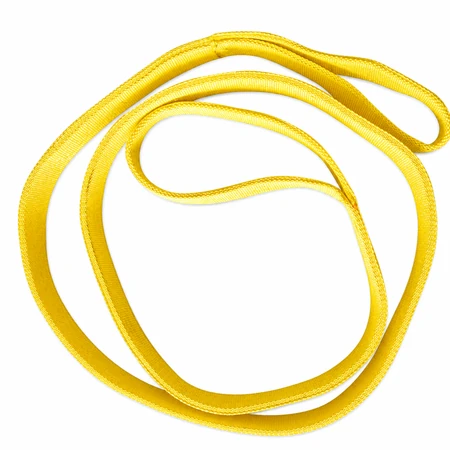
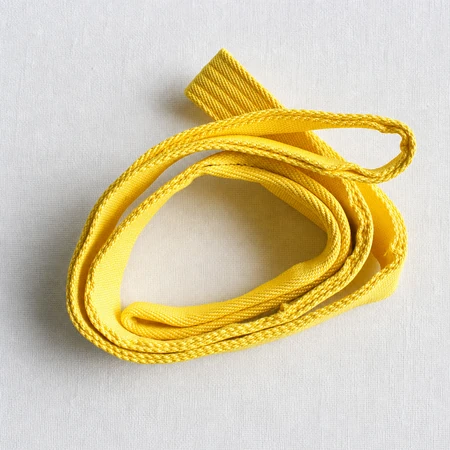
Lift sling rigging company produce High Temperature Webbing Sling,Eslinga de elevación de alta temperatura,Eslinga resistente al calor,High Temperature Resistant Lifting Sling.
Eslinga de correas de alta temperatura
Aramid Flat Webbing Slings & Heat Resistant Protective Sleeves — For Loads Hotter Than Standard Webbing Can Take
A eslinga de correas de alta temperatura exists because ordinary webbing does not tolerate heat. Poliéster, nylon and polypropylene webbing slings are ruled out above roughly 90 °C — the fibre softens, glazes and loses strength, and the damage may not be visible from the outside. Our high-temperature range is built on aramida (Clase Kevlar) fibra, which has no melting point at all: it chars and decomposes around 500 °C instead of turning to liquid, so it survives a hot environment that would destroy a polyester sling outright. Where the contact is even hotter, a woven heat resistant protective sleeve takes the radiant and contact heat and the webbing stays cooler behind it.
- Aramid webbing - sin punto de fusión, caracteres cerca 500 °C en lugar de derretirse
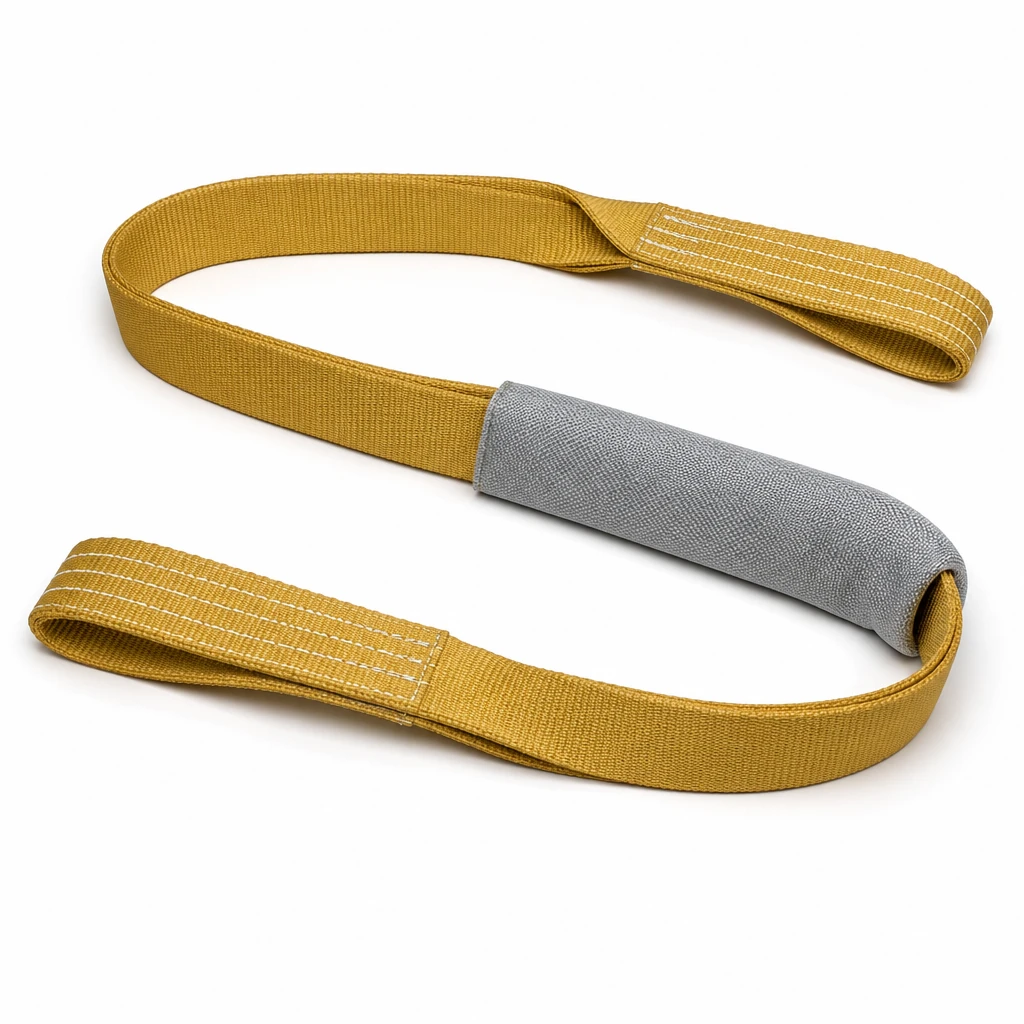
- Heat resistant sleeves — a sacrificial layer where the sling nears the hot surface
- Trusted in hot work — steel mills, fundiciones, fundición a presión, glass and welding shops
- Still soft on the load — a flat band that will not mark a machined or polished surface
Características clave
aramida, Not Polyester
Aramid fibre has no melting point. Heated far enough it chars and breaks down — but it does not liquefy the way polyester or nylon does, which is what makes it usable in hot work.
Sleeves Take the Heat
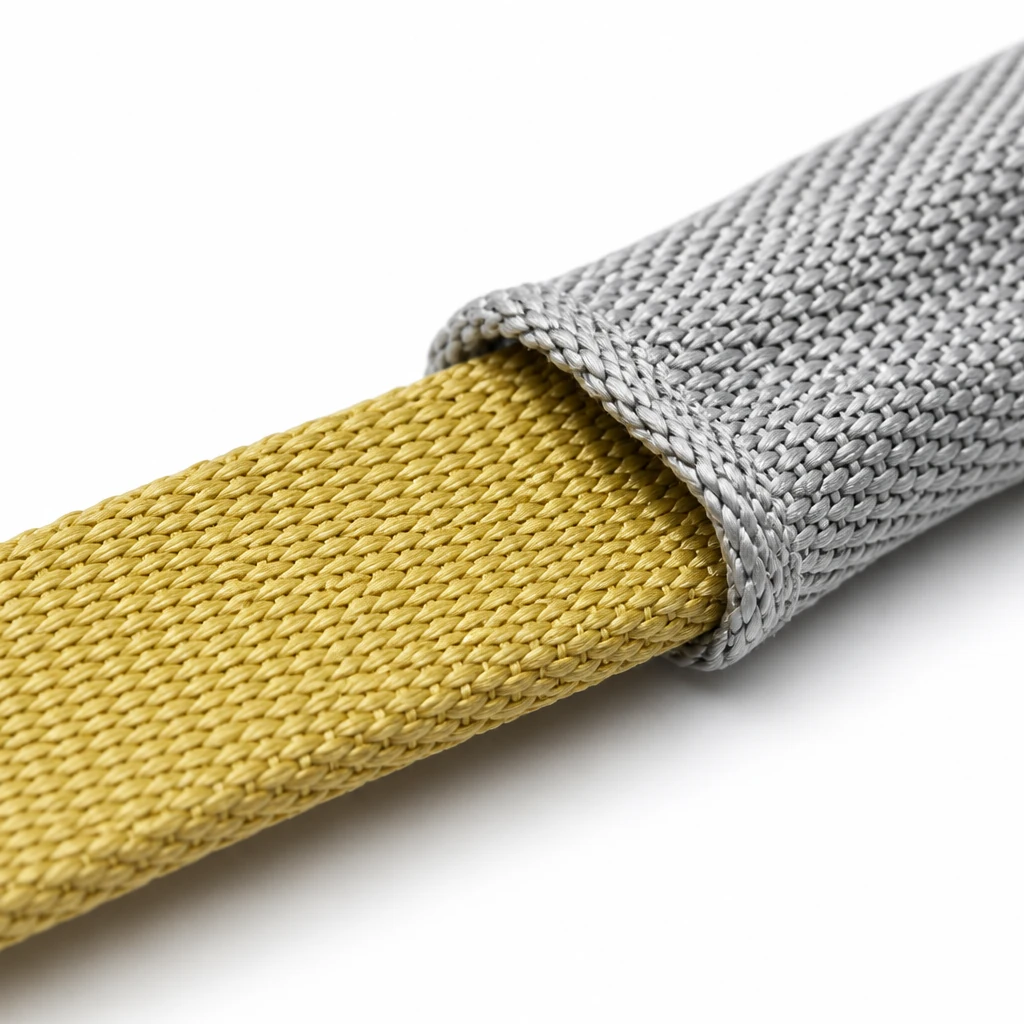
A woven heat resistant sleeve is a sacrificial layer over the load-bearing band. It is cheaper and quicker to replace than a sling, and it is where the heat should arrive.
Inherently Non-Melting
Because the fibre chars rather than melts, the failure mode in an overheat is a scorched patch you can see and feel — not a hidden softening of yarn throughout the band.
Flat Band, Soft on the Load
A flat webbing band spreads the bearing pressure and conforms to the surface, so hot workpieces are lifted without the bruising and marking that chain or wire rope causes.
Rotate to Spread the Burn
The same section of sling tends to meet the same hot corner. Rotating the sling or sliding the sleeve moves the wear and keeps one spot from taking all of it.
Free of Hard Metal
No hooks, thimbles or shackles in the sling itself. A conductive path or a spark struck off metal rigging is one less hazard beside a hot workpiece.
Why Standard Webbing Stops at 90 °C
Polyester and nylon are thermoplastics: heat them and they progressively soften, then melt. The melting point — around 255 °C for polyester and roughly 215–265 °C for nylon — is not the number that matters. What matters is what happens well below it. By about 90 °C the yarn has already begun to lose the molecular structure that gives it strength, and because the sling is still intact to look at, the loss is easy to miss.
That is why the industry rule is a working limit of roughly 90 °C for polyester and nylon webbing slings, rather than the fibres’ melting points. A hot workpiece sitting next to a webbing sling is not a small margin — it is the sling’s whole service envelope.
Aramid behaves differently. No tiene punto de fusión, so there is no softening phase and no liquid failure. It keeps its structure until it begins to char and decompose at around 500 °C. That single difference is what qualifies it for hot work — and it is also why an aramid sling damaged by heat shows as a scorched, brittle or discoloured patch rather than a melted one.
Temperature Ladder: Fibre by Fibre
Choosing a sling for a hot job starts with knowing what the fibre can take. The table below sets out the common options, in the order you should consider them.
| Fibra | Punto de fusión | Typical working band | Behaviour when overheated |
|---|---|---|---|
| polipropileno | Aprox.. 165 °C | Up to ~90 °C | Melts — no useful residual structure |
| Poliamida (nylon) | Aprox.. 215–265°C | Up to ~90 °C | Suaviza, glazes, then melts |
| Poliéster | Aprox.. 255 °C | Up to ~90–100 °C | Suaviza, glazes, then melts |
| aramida (Clase Kevlar) | Ninguno: caracteres en su lugar | ~200 °C continuous | Chars and decomposes near 500 °C; no liquid phase |
| Glass fibre | Softens approx. 840 °C | Up to ~600 °C | Softens and loses strength |
| Basalt fibre | Softens above 1 000 °C | ~600–700 °C | Suaviza; very high temperature work |
Which construction for which temperature band
| Load or ambient temperature | Construcción a especificar | Por qué |
|---|---|---|
| Arriba a 90 °C | Standard polyester or nylon webbing sling | The ordinary sling. No derating and no need to pay for aramid. |
| 90–150°C | Standard webbing sling with a heat resistant sleeve | The sleeve takes the contact heat; the webbing behind it stays within its band. |
| 150–200°C | Eslinga de cinta de aramida | Aramid’s own working band. Size the band so the sling is not also the weak point. |
| 200–400 °C | Aramid webbing sling with an aramid sleeve, short exposure | Workable, but exposure time and geometry decide the outcome. Describe the job to us. |
| Arriba 400 °C | Glass fibre or a specialist high-temperature construction | A different product from this one. Ask us — we make heat resistant rope down to this band too. |
Especificaciones técnicas
| Nombre del producto | Eslinga de cincha para alta temperatura / heat resistant webbing sling / eslinga de correas de aramida / Eslinga de cinta de Kevlar |
|---|---|
| Material de carga | aramida (Clase Kevlar / aramida 1414) fibra de alto módulo, tejido en correas planas; polyester version with sleeve available where the heat is modest |
| Construcción | Cinta tejida plana en forma de ojo y ojo o sin fin.; una sola capa o varias capas |
| Funda protectora | Woven heat resistant sleeve, aramida, glass or coated sleeve depending on the band; sliding or fully sewn, fitted where the sling meets the load |
| Ancho de banda | 25 mm a 300 mm como estándar, adaptado al límite de carga de trabajo y a la construcción de la capa |
| Límite de carga de trabajo | 1 t a 100 t, en los pasos estándar 1 · 2 · 3 · 4 · 5 · 6 · 8 · 10 · 12 · 15 · 20 · 25 · 30 · 40 · 50 · 100 t — the aramid band carries the same ratings as polyester at the same width, at a lower weight |
| Factor de seguridad | EN 1492-1 la practica es 7:1 para eslingas de cinta tejida plana de uso general; otros factores producidos por encargo |
| Longitud de trabajo efectiva | 0.5 metro a 20 m como estándar; más tiempo para ordenar |
| Temperature capability | Aramid band with no melting point, charring near 500 °C; the usable working band depends on exposure time and on the sleeve — tell us the job and we will state the figure for your construction |
| Alargamiento | Low stretch — aramid elongates far less than nylon under the same load |
| Calificación | Etiqueta cosida con límite de carga de trabajo., longitud y lote; sleeve identification marking available |
| Embalaje | Enrolle en una bolsa de polietileno o bolsa de transporte., cartón etiquetado, embalaje de exportación personalizado |
| Cantidad mínima de pedido & OEM | MOQ bajo para pedidos de prueba; OEM completo: capacidad, ancho, capa, sleeve length and position, color, marcado y embalaje |
Manejo, Inspección y limitaciones
An aramid sling is more tolerant of heat than a polyester one, but it is not immune, and the way it fails is deceptive. A scorched patch may look superficial while the yarn beneath has already lost its strength.
- Inspect after every hot lift, not just at the start of the shift — look for discolouration, scorching, a brittle or stiff feel, a hard or glazed patch, and any change in colour at the sleeve or the band.
- Feel it as well as look at it — a band that has stiffened, or that crackles when flexed, has been overheated even if the colour looks acceptable.
- Retire on any sign of charring — a charred or brittle section is a permanent loss of strength and cannot be assessed by eye. Take it out of service.
- Inspect the sleeve separately — the sleeve is designed to be damaged and it is expected to be replaced. When it is burnt through, worn through or stiffened, change it before the next lift.
- Do not use aramid where it will be cut or abraded on edges — aramid resists heat, but it is more sensitive to cutting and to flex-fatigue than polyester. Protéjalo de los bordes afilados.
- Keep it away from other chemicals and UV — aramid is affected by strong acids and degrades under prolonged sunlight. Almacenar limpio, dry and out of the sun.
- Grabarlo — log the number of hot lifts and the highest temperature seen. It is the most reliable retirement guide for this class of sling.
Aplicaciones
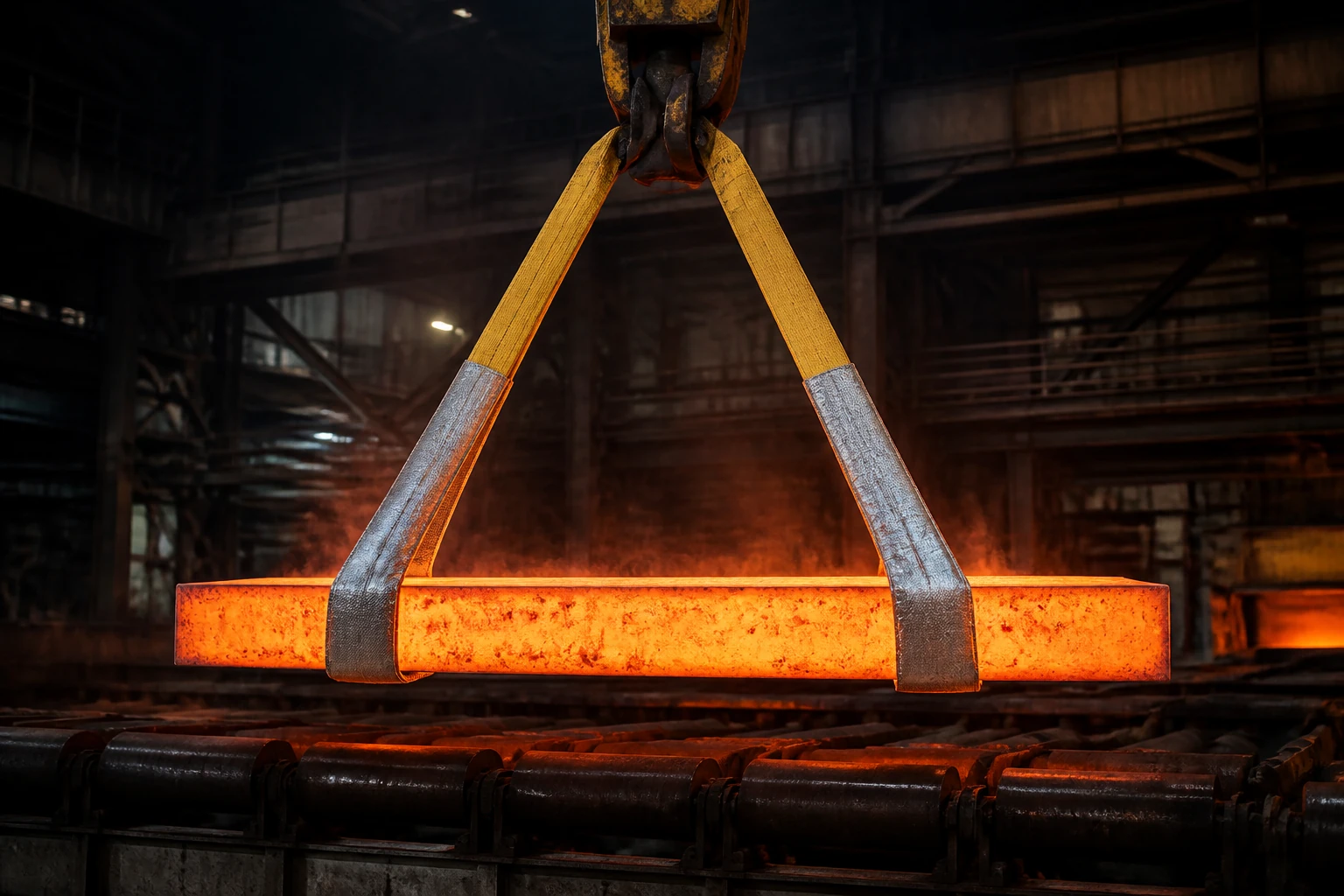
- Hot steel slabs, billets and blooms still radiating heat from the furnace
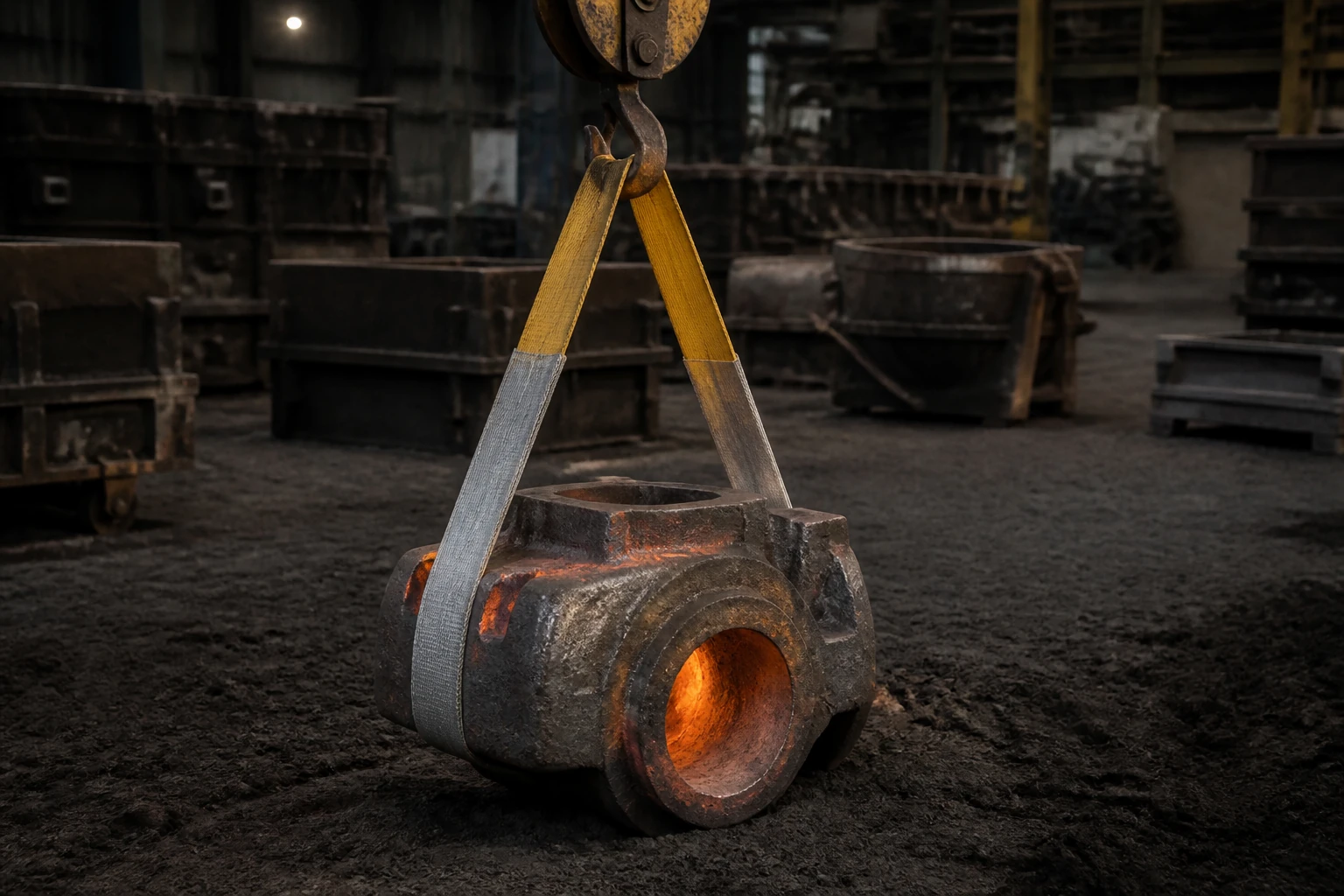
- Foundry and die casting work — castings, dies and moulds handled while still hot
- Rolling mills and forge shops where the ambient temperature alone rules out standard webbing
- Glass industry handling and any operation near a furnace or a kiln
- Soldadura, cutting and fabrication bays where spatter and hot offcuts are routine
- Stage and entertainment rigging above hot luminaires and pyrotechnic equipment
- Any lift where a polyester sling has been refused because of the environment, no la carga
Personalización y servicio OEM
A high-temperature sling is specified around the job rather than picked from a shelf, because the temperature, the exposure time and the shape of the hot surface are all part of the answer. Tell us what the sling will touch and for how long, y dimensionaremos la banda, the plies and the sleeve to suit.
- Capacidad — 1 t a 100 t, incluyendo pasos intermedios entre los tamaños estándar
- Fibra — aramid webbing as standard; polyester with a sleeve where the heat is modest and the budget matters
- Termina - ojo y ojo o sin fin, ojos lisos o reforzados
- Mangas — sliding or fully sewn, aramida, glass or coated, positioned to cover exactly the section that meets the hot load
- Longitud y marcado — longitud de trabajo efectiva bajo pedido; el diseño de tu etiqueta, convención de lenguaje y marcado
- Artículos relacionados — matching heat resistant round slings, stage slings and aramid rope for the same hot job
Control de calidad
Se comprueba el ancho de cada banda., espesor, densidad y color del tejido antes de cerrar los ojos, the sleeve fit is checked against the section it has to protect, y cada eslinga terminada se revisa en sus costuras., su marca límite de carga de trabajo, su longitud total y su etiqueta antes del embalaje. Hemos fabricado eslingas, Productos de correas y cuerdas para uso industrial., clientes de seguridad y exportación durante casi tres décadas, y mantenemos el proceso visible: A petición suministramos el certificado de fibra., las cifras de prueba del lote y una eslinga de muestra para que usted pueda manipularla y probarla antes de que comience la producción en volumen.
Preguntas frecuentes
Why can’t I just use a polyester webbing sling on a hot load?
Because polyester begins to lose strength long before it melts. Polyester and nylon webbing slings are restricted to roughly 90 °C — well under the fibre’s melting point of around 255 °C. By the time a polyester sling looks damaged it has usually already lost a substantial part of its strength, which makes the failure hard to catch by inspection.
What makes aramid suitable for high temperature lifting?
Aramid has no melting point. Instead of softening and liquefying, it keeps its structure until it begins to char and decompose at around 500 °C. There is no liquid failure phase and no hidden softening of the yarn across the whole band — heat damage shows as a scorched, brittle or discoloured patch where the heat actually arrived.
Do I need a heat resistant sleeve as well?
Usually, Sí, wherever the sling comes near the hot surface. The sleeve is a sacrificial layer: it takes the contact and radiant heat, it is far cheaper and quicker to replace than a sling, and it protects the band from abrasion on the hot workpiece at the same time. Where the whole environment is hot rather than one contact point, the aramid band does the work and the sleeve may not be needed at all.
Will an aramid sling hold a higher working load than a polyester sling?
Not at the same band width — the standard capacities are published on the same width ladder, and what you gain with aramid is heat tolerance and a lighter band, not a larger number. Sizing still follows the working load limit and the safety factor, exactly as for any other webbing sling.
¿Es un cabestrillo para altas temperaturas certificado según un estándar??
The general-purpose flat webbing sling standards cover polyester, polyamide and polypropylene slings, with a scope that sits roughly in the −40 °C to +90 °C band. A high-temperature aramid sling falls outside that scope, so its temperature rating is a manufacturer’s specification rather than a figure quoted from the standard. Ask us to state the rating for the exact construction you are buying.
How do I know when to retire a high temperature sling?
Retire it on any sign of charring, on a brittle or stiffened section, on a glazed or hardened patch, or where the sleeve has burnt through to the band. Heat damage in aramid is not always obvious from the colour alone, so feel the band as well as looking at it. Keep a log of the hot lifts and the temperatures seen — for this class of sling, that log is the most reliable retirement guide there is.
Request a Quote for High Temperature Webbing Slings
Envíanos el límite de carga de trabajo., the temperature the sling will actually see, whether it is radiant or contact heat, how long each exposure lasts, and the shape of the hot surface. Volveremos con la fibra., banda, sleeve and rating for your job, más una muestra para probar.