 702461526@qq.com
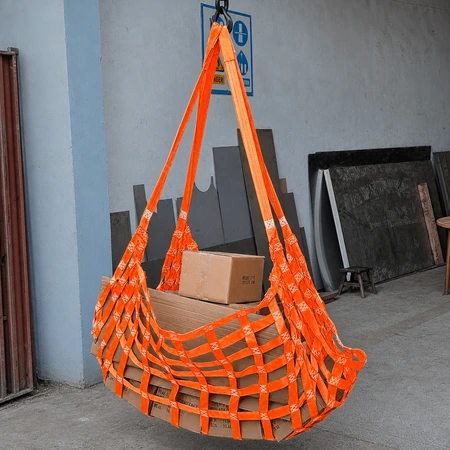
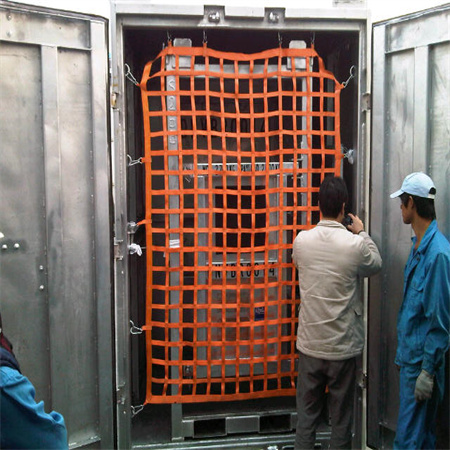
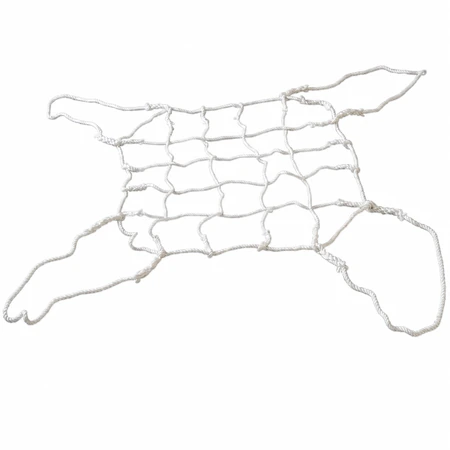
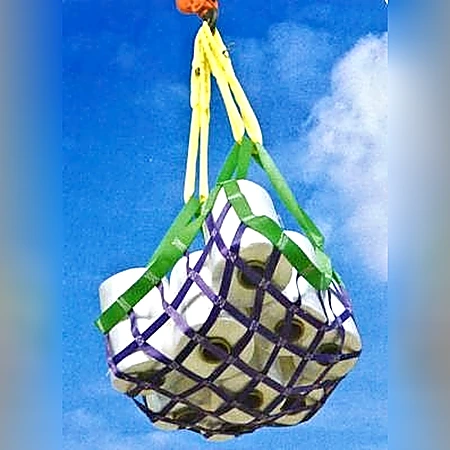
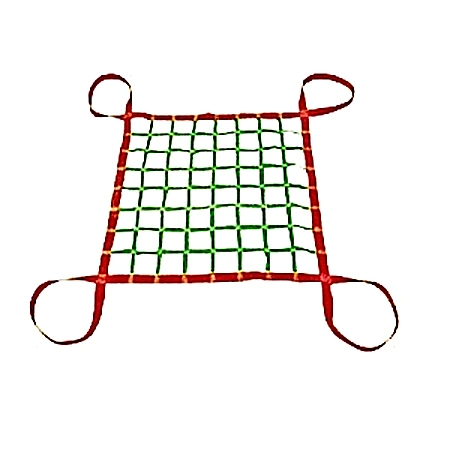
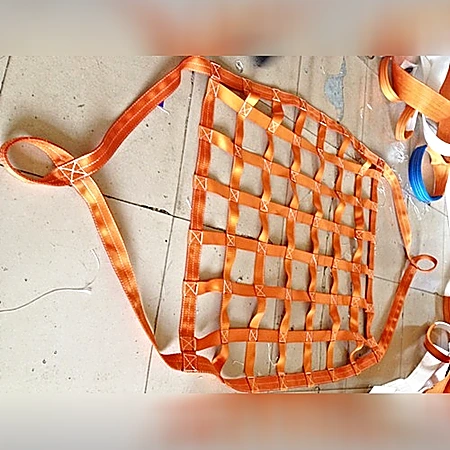
Lift sling rigging company produce Nylon Cargo Lifting Net,Polypropylene Cargo Net Sling,Polyester Nylon Webbing Lifting Cargo Net,Nylon Rope Cargo Lifting Net,Nylon Webbing Cargo Lifting Net,Nylon Strap Cargo Lifting Net,Nylon Belt Cargo Lifting Net,Polypropylene rope Cargo Net,Lifting Rope Cargo Net.
Nylon Cargo Lifting Net
Nylon rope, high-strength webbing and polypropylene rope lifting nets — woven to order in Taizhou, China
Short description
A nylon cargo lifting net lifts a whole consignment in one soft sling. The net cradles the load instead of gripping it, so bagged, boxed, painted and machined cargo can be moved in a single pick — without strapping it piece by piece and without the scuffing a wire rope or chain leaves behind.
Nylon is the material that made the rope lifting net work. It is strong for its weight, it stretches under shock instead of snatching at the crane, and it cannot rust. Polypropylene is the low-cost alternative where the net has to work wet and does not need nylon’s strength; high-strength webbing is the flat-band version for palletised cargo that must stay unmarked.
Lift Sling Rigging Company weaves this page’s net in three constructions: a nylon rope woven lifting net for irregular and heavy shapes, a high-strength webbing woven lifting net for flat and finished cargo, and a polypropylene rope cargo net for wet, chemical and floating duty. Rated capacity runs from 0.5 t to 50 t, mesh and net size are built to your drawing, and every net is load tested before it leaves the works.

Figure 1 — A rope cargo lifting net in service. The four corner loops are gathered onto the crane hook and the load is carried inside the mesh, not on top of it.
1. What a nylon cargo lifting net is
A cargo lifting net is a lattice of rope or webbing bands hung from its corners, used to lift a whole stack, bundle or pile in one movement. On this page the lattice is made from nylon rope, from high-strength webbing or from polypropylene rope. The parent range also covers the steel wire rope version, which is described on the cargo lifting nets page.
Four things decide how any of these nets performs, and all four are under our control because we braid the rope and weave the webbing ourselves:
- The rope or band — nylon, polypropylene or polyester, and its diameter or width. This sets the net’s strength and how soft it feels against the cargo.
- The mesh opening — the distance between strands. It has to be small enough to keep the items inside and open enough to keep the net light.
- The border — a doubled rope or a double-layer stitched band around the whole perimeter, so the edge cannot unroll or pull out under load.
- The lifting points — four corner eyes as standard, eight for a spreader beam. The load must always go into the corners, never into the middle of a panel.
If the net will lift steel, hot material or demolition debris rather than nylon-friendly cargo, the cargo lifting net page covers the woven steel wire rope construction, and the cargo lifting nets hub lists every net we make.
2. Why nylon rope for a cargo lifting net
Nylon (polyamide PA6 or PA66) is the default rope for lifting nets because of one property the other materials do not have: high elongation with high strength. A nylon net stretches roughly 18–22 % before it breaks, so when the crane takes up the slack the net absorbs the snatch instead of passing it straight into the cargo and the hook. That is what makes it the right choice for timber, logs, stone, scrap, drums and any load whose shape shifts as it is lifted.
The trade-off is water. Nylon takes up around 4 % moisture and loses roughly 10–15 % of its dry strength when saturated, so a permanently wet or salt-water net is usually specified in polypropylene or polyester instead. Nylon also needs UV stabilisation to survive year-round outdoor work, which we add as standard.
| Property | Nylon rope | High-strength polyester webbing | Polypropylene rope |
|---|---|---|---|
| Strength for weight | High; the best of the three | Very high along the band; low across it | Moderate; lowest cost per tonne |
| Elongation at break | 18 % – 22 % (absorbs shock) | 7 % or less at WLL (stays put) | 15 % – 20 % |
| Water absorption | About 4 %; strength drops when wet | Low; will not rot | Below 0.1 %; floats on water |
| Salt water / rot | Rot-proof but weakened when saturated | Unaffected | Unaffected; the marine choice |
| UV resistance | Good when UV-stabilised | Good, UV treated | Only when UV-stabilised — mandatory outdoors |
| Abrasion and cut | Good; strands can be re-spliced locally | Good, but keep off sharp edges | Moderate; the softest rope of the three |
| Chemical resistance | Fair; attacked by strong acids | Good against most acids and alkalis | Excellent against acids, alkalis and solvents |
| Working temperature | -40 °C to +80 °C | -40 °C to +100 °C | -20 °C to +80 °C |
| Best for | Timber, logs, stone, scrap, drums, tyres, shock loads | Bagged, boxed, palletised and finished cargo | Wet quays, floating duty, chemical and wash-down areas |
Table 1 — Material comparison: the three constructions on this page.
3. The three woven constructions
The three nets on this page look similar in a photograph and behave very differently in service. The drawing below shows the difference at a glance: a knotted round-rope lattice, a flat-band lattice, and a fine stranded rope lattice in a diamond mesh.

Figure 2 — The three nylon cargo lifting net constructions: nylon rope woven, high-strength webbing woven and polypropylene rope.
3.1 Nylon rope woven lifting net
This is the classic knotted rope net. Round nylon rope is knotted at every intersection, or braided into a knotless lattice, and the whole net is bordered with a doubled rope that carries the corner eyes. Because each strand can move a little inside its knot, the net settles around an irregular load instead of sitting on top of it — which is why rope nets handle logs, stone, scrap, drums and demolition debris far better than a flat band net does.
Round strands also mean the mesh is fully open. Water drains straight through, grit falls out, and a saturated net is no heavier than a dry one to handle. Rope nets are therefore the usual choice on deck, at the quayside and in any wash-down area.
Construction
- Rope — 100 % high-tenacity nylon multifilament, 3-strand laid or 8/12-strand braided, UV stabilised.
- Mesh — knotted at every intersection, or knotless braided for a smoother surface on the cargo.
- Border — doubled border rope running the full perimeter, spliced into each corner eye.
- Lifting points — four spliced corner eyes, or eight for a spreader beam. Thimbles or master links fitted on request.
| Parameter | Specification |
|---|---|
| Material | 100 % high-tenacity nylon (polyamide PA6 / PA66) multifilament |
| Rope construction | 3-strand laid, or 8-strand / 12-strand braided |
| Rope diameter | 8 mm – 24 mm; up to 32 mm on request |
| Mesh opening | 100 – 300 mm, square or diamond |
| Knot type | Knotted, or knotless braided intersections |
| Border | Doubled border rope, spliced at each corner |
| Lifting points | Four corner eyes standard; eight eyes for spreader beam work |
| Rated capacity | 1 t – 50 t; heavier nets built to order |
| Safety factor | 5:1 / 6:1 / 7:1 |
| Elongation at break | About 18 % – 22 % (shock absorbing) |
| Treatment | UV stabilised, anti-ageing; optional PU or PVC coating |
| Colour | Natural white, orange, green, black or custom |
| Working temperature | -40 °C to +80 °C |
| Proceso de dar un título | CE / ISO 9001; material test report with each order |
| Customisation | OEM / ODM net size, label and logo |
Table 2 — Nylon rope woven lifting net: technical parameters.
| Net size (L × W) | Rope Ø | Typical capacity | Typical use |
|---|---|---|---|
| 2 × 2 m | 12 mm | 1 t – 3 t | Drums, machine parts, small pallets |
| 2.5 × 2.5 m | 12 – 16 mm | 2 t – 5 t | Bagged cargo, container loading |
| 2.5 × 6 m | 16 mm | 4 t – 10 t | Timber, pipe bundles, truck loading |
| 4 × 4 m | 20 mm | 8 t – 20 t | Logs, scrap, stone |
| 6 × 6 m | 24 mm | 15 t – 30 t | Bulk cargo, quarry and port work |
| Made to drawing | 8 – 24 mm | 1 t – 50 t | Truck bed, container and hold dimensions |
Table 3 — Nylon rope net: typical sizes and capacities. Every size is made to drawing.
 A knotted nylon rope lifting net laid flat — 100 mm mesh, doubled rope border A knotted nylon rope lifting net laid flat — 100 mm mesh, doubled rope border |
 A rope cargo net bag under load; the mesh closes around the load as the crane takes up A rope cargo net bag under load; the mesh closes around the load as the crane takes up |
 Large nylon rope net suspended from its four corner eyes, diamond mesh Large nylon rope net suspended from its four corner eyes, diamond mesh |
 Diamond mesh rope net with reinforced border rope and spliced corner eyes Diamond mesh rope net with reinforced border rope and spliced corner eyes |
3.2 High-strength webbing woven lifting net
Where the cargo must not be marked, the round rope is replaced by flat high-strength webbing. The bands cross at right angles into an open square mesh, so the load is carried across the whole underside of the consignment instead of on a few contact points. Polyester webbing has low elongation — it does not stretch away from the load while the crane takes up the slack — and its surface is flat and soft, which is why it is used for bagged, boxed, palletised, painted and machined cargo. The full construction detail is on the webbing cargo lifting net page; the flat pallet-sized versions are the nylon flat webbing net and the crane pallet cargo net.
Construction
- Webbing — 100 % high-tenacity polyester, 50 mm wide as standard, woven in our own mill; nylon webbing on request.
- Mesh — 100 × 100 mm square opening as standard, woven or cross-stitched into the lattice.
- Border — double-layer stitched border around the whole net so the edge bands cannot unroll.
- Lifting points — four reinforced corner loops stitched through the border, or eight for spreader beam work.
| Parameter | Specification |
|---|---|
| Material | 100 % high-tenacity polyester webbing; nylon webbing on request |
| Webbing width | 25 mm / 50 mm / 75 mm / 100 mm; 50 mm standard |
| Webbing thickness | 1.8 mm – 3.2 mm depending on width |
| Mesh opening | 100 × 100 mm standard; 50 – 300 mm to order |
| Border | Double-layer reinforced stitched border |
| Lifting points | Four reinforced corner loops; eight for a spreader beam |
| Rated capacity | 2 t – 10 t standard; heavier nets built to order |
| Safety factor | 7:1 |
| Elongation | 7 % or less at working load |
| Treatment | UV-resistant, anti-ageing, abrasion resistant |
| Colour | Orange (high visibility), blue, black, green or custom |
| Working temperature | -40 °C to +100 °C |
| Proceso de dar un título | CE / ISO 9001; material test report with each order |
| Customisation | OEM / ODM, printed webbing and stitched brand label |
Table 4 — High-strength webbing woven lifting net: technical parameters.
 High-strength webbing lifting net in orange polyester, 100 × 100 mm square mesh High-strength webbing lifting net in orange polyester, 100 × 100 mm square mesh |
 Corner detail: 50 mm webbing bands, two-layer stitched border and reinforced corner loop Corner detail: 50 mm webbing bands, two-layer stitched border and reinforced corner loop |
 Webbing lifting net carrying bagged goods, lifted from its four corner loops Webbing lifting net carrying bagged goods, lifted from its four corner loops |
 Webbing cargo net bag lifting a boxed load — the softest contact of the three constructions Webbing cargo net bag lifting a boxed load — the softest contact of the three constructions |
3.3 Polypropylene rope cargo net
Polypropylene is the working net. It is the lightest of the three materials for a given strength, it absorbs almost no water, and at a density of 0.91 g/cm³ it floats — so a PP net that goes over the side can be recovered. It resists acids, alkalis and most solvents far better than nylon, and it is the cheapest way to cover a large area of quay, deck or truck bed.
The compromise is that PP has the lowest abrasion resistance of the three and it degrades in sunlight unless it is UV-stabilised. We UV-stabilise every polypropylene net as standard, because an unstabilised PP net left outdoors loses strength quickly. PP also has a lower melting point, so it is not the net for hot slag or freshly cut material.
Construction
- Rope — 100 % polypropylene monofilament or multifilament, 3-strand laid or 8-strand braided.
- Mesh — usually a diamond mesh, knotted or knotless; square mesh on request.
- Border — doubled border rope spliced at each corner, with corner eyes for the hook or master ring.
- Treatment — UV stabilised and anti-ageing as standard, for year-round outdoor use.
| Parameter | Specification |
|---|---|
| Material | 100 % polypropylene (PP), monofilament or multifilament |
| Rope construction | 3-strand laid, or 8-strand braided |
| Rope diameter | 6 mm – 20 mm |
| Mesh opening | 100 – 400 mm, diamond or square |
| Knot type | Knotted, or knotless braided intersections |
| Border | Doubled border rope, spliced at each corner |
| Lifting points | Four corner eyes standard; eight on request |
| Rated capacity | 0.5 t – 30 t |
| Safety factor | 5:1 / 6:1 |
| Density | 0.91 g/cm³ — the net floats |
| Water absorption | Below 0.1 % |
| Elongation at break | About 15 % – 20 % |
| Treatment | UV stabilised (essential outdoors), anti-ageing |
| Colour | Black, white, green, orange or custom |
| Working temperature | -20 °C to +80 °C |
| Proceso de dar un título | CE / ISO 9001; material test report with each order |
Table 5 — Polypropylene rope cargo net: technical parameters.
 A rope cargo net bag lifting concrete blocks — the same construction is supplied in nylon or polypropylene rope A rope cargo net bag lifting concrete blocks — the same construction is supplied in nylon or polypropylene rope |
 Polypropylene rope net in a diamond mesh with a doubled border rope and corner eyes Polypropylene rope net in a diamond mesh with a doubled border rope and corner eyes |
4. Knot, mesh and edge options
Two nets of the same size and capacity can behave quite differently depending on three choices: how the strands are joined, how the mesh is oriented, and how the edge is finished. These are the options we quote most often.
| Option | What it does | Choose it when |
|---|---|---|
| Knotted mesh | Strands are tied at every intersection, letting each one move | The load is irregular, or the net has to be repaired strand by strand on site |
| Knotless braided mesh | Intersections are braided or spliced, so no knot sits against the cargo | The cargo surface must not be marked, or the net is pulled over a load |
| Square mesh | Rows and columns run parallel to the net edges | Stacked, palletised or rectangular loads and container work |
| Diamond mesh | The lattice is rotated 45°, so the strands close around the load | Bag-shaped, loose or rounded loads that need to be contained |
| Doubled border rope | A second rope runs the full perimeter alongside the edge strand | Every lifting net — this is what stops the edge pulling out under load |
| Thimble-lined corner eyes | A steel or plastic thimble protects the eye from the shackle | Frequent lifts, or where the hook or shackle is rough |
| PU / PVC coating | Coating the rope improves abrasion resistance and stiffens the mesh | High-abrasion duty, or where the net must hold its shape when empty |
Table 6 — Knot, mesh and edge options.
5. Standard net sizes and rated capacities
Net size is always quoted as length × width, measured along the border rope, not as the mesh area. The load must sit well inside the border — a net the same size as the load will shed it. The table below covers the sizes we make most often; every one of them is also made to drawing.
| Net size (L × W) | Mesh opening | Typical capacity | Typical use |
|---|---|---|---|
| 2.5 × 2.5 m | 100 – 150 mm | 1 t – 5 t | Palletised and bagged cargo, container loading |
| 2.5 × 6 m | 150 mm | 4 t – 10 t | Long cargo, pipe bundles, truck and trailer loading |
| 4 × 4 ft (1.2 × 1.2 m) | 100 mm | 1 t – 3 t | Small loads, drums, machine parts |
| 82 × 82 in | 100 mm | 2 t – 5 t | Standard pallet footprint in imperial markets |
| 4 × 4 m | 150 – 200 mm | 8 t – 20 t | Logs, scrap, stone, large bulk cargo |
| 6 × 6 m | 200 mm | 15 t – 30 t | Bulk bagged cargo, timber, quarry work |
| Made to drawing | 100 – 400 mm | 0.5 t – 50 t | Truck bed, container, hold and spreader dimensions |
Table 7 — Standard net sizes. Custom sizes, mesh and lifting points are made to drawing.
6. How to specify a nylon cargo lifting net
A lifting net is a made-to-order item, and eight pieces of information are enough for us to quote it correctly the first time. If you have a drawing of the truck bed, container or hold the net has to fit, send that instead — we work from drawings regularly.
| Information we need | Why it matters |
|---|---|
| Load weight and load shape | Sets the rated capacity and how many load-bearing strands sit under the load |
| Net length × width | The net must be larger than the load footprint so the load sits inside the mesh |
| Mesh opening | Holds the items in; a smaller mesh is needed for small or loose pieces |
| Rope diameter or band width | Sets the strength per strand and the weight of the net in handling |
| Construction | Nylon rope, high-strength webbing or polypropylene rope — see Section 2 |
| Lifting points | Four corner eyes as standard, or eight for a spreader beam |
| Crane, hook or spreader | Determines the thimble, master link or shackle fitted to the corners |
| Environment and documentation | UV, salt water, chemicals, temperature; CE marking, test report or own-brand label |
Table 8 — What we need to quote a nylon cargo lifting net.
7. Lifting configurations and corner fittings
How the net is hung decides how much of the load it actually carries. These are the four arrangements we fit most often.
- Four-corner lift — the standard. The four corner eyes are gathered onto a single hook or master ring. The load hangs in the middle of the net and the border carries it.
- Eight-point spreader lift — the net is lifted from eight eyes on a beam or frame. The net stays square, the load stays level and each corner carries a predictable share.
- Basket or bag form — the net is closed around the load and lifted from a single point, used for loose or awkward cargo. See the polyester lifting hoisting net for this style.
- Lorry-bed or lashing net — the net is tensioned over or across the load as a securing net rather than lifted from four corners.
Where the consignment is long or wide, the net is lifted from a beam rather than a single hook — the lifting spreader beam takes the eight points, keeps the net square and keeps the cargo level while it is transferred. A loose or bag-formed version is available as the polyester lifting hoisting net, and the tensioned version as a cargo securing net.
| Corner fitting | Used with | Note |
|---|---|---|
| Spliced rope eye | Rope nets, single hook | Lightest option; the eye is formed in the border rope itself |
| Thimble-lined eye | Rope and webbing nets | Protects the eye from the shackle; recommended where lifts are frequent |
| Sewn webbing loop | Webbing nets | Double-layer stitched loop through the border |
| Master link / master ring | Four-corner lift | Gathers all four eyes onto one point under the hook |
| Shackle or hook | Eight-point spreader lift | Grade 80 fittings supplied with the beam on request |
Table 9 — Corner fittings we supply.
8. Colour, marking and identification
- Orange is the high-visibility standard for lifting nets and is the easiest colour to see on a quay, in a container or on a truck bed.
- Black is the usual colour for polypropylene quay and deck nets, where soiling is expected.
- Blue, green and custom colours are available for fleet identification or to match existing equipment.
- Every net carries a capacity label with its rated capacity, net size and mesh; the label is the first thing to read before a lift.
- OEM orders can be stitched with your own brand label, and webbing nets can be woven with printed identification.
- Nets ship folded in a bag or a crate, and a spare corner eye and repair kit can be supplied for fleets that maintain their own equipment.
9. Quality control and certification
- 40 years of lifting equipment manufacturing — founded in 1985 in Taizhou, Jiangsu, with more than 200 employees, one of China’s largest lifting sling and net production bases.
- We braid our own rope and weave our own webbing — rope diameter, band width, mesh, colour and capacity are under our control, so a net is tuned to the load instead of bought in from a catalogue.
- Own testing laboratory — our facilities hold CNAS laboratory accreditation, European CE certification and DNV certification, and there are 15 authorised patents on our lifting products.
- 1000 t horizontal test machine — the breaking load of every net is tested and documented rather than sampled, and a material test report travels with the order.
- Every net is marked with its rated capacity and net size before packing, so the label on the net and the paperwork match.
10. Care, inspection and retirement
- Read the capacity label before every lift and check that the load, and the way it is slung, are inside the rated capacity.
- Inspect the corner eyes and their splices or stitching most carefully — that is where a lifting net wears first — then check the border and the load-bearing strands for cuts, abrasion, chemical staining and heat damage.
- On nylon nets, watch for the gloss and stiffness that mean UV or chemical degradation; on polypropylene nets, look for a chalky surface, which is the first sign of UV attack.
- Keep the load inside the mesh and away from the border, and protect the strands from sharp edges and hot surfaces with an edge sleeve or pad.
- Never exceed the rated capacity, never lift on fewer than the full set of corner eyes, and never use a lifting net to drag a load sideways.
- Store the net clean and dry, off the ground and out of direct sun, and never repair a lifting net by knotting, welding or heating it.
- Withdraw the net from service if any load-bearing strand, the border, a corner eye or its splice is damaged, and have nets inspected by a competent person at the interval your site requires.
11. Where nylon cargo lifting nets are used
| Industry | What the net lifts | Construction usually specified |
|---|---|---|
| Ports and terminals | Bagged and palletised cargo, container stuffing and de-stuffing | High-strength webbing, or nylon rope for irregular loads |
| Timber and forest products | Logs, sawn packs, poles | Nylon rope, knotted, diamond mesh |
| Stone and quarry | Blocks, kerbs, aggregates | Nylon rope, heavy diameters, small mesh |
| Scrap and recycling | Loose metal, demolition debris | Nylon rope, doubled border |
| Construction | Bricks, blocks, bagged materials | Webbing nets for pallets, rope nets for loose loads |
| Agriculture | Bulk bags, feed, produce, tyres | Polypropylene or nylon rope |
| Marine and offshore | Deck cargo, catch, transfer loads | Polypropylene rope (floats, resists salt water) |
| Vehicle and machinery loading | RoRo and breakbulk vehicle lifts | Heavy-duty nylon rope or webbing |
| Military and disaster relief | Pallets and loose relief cargo by crane or helicopter | Nylon rope, or webbing where packaging must be protected |
Table 10 — Where nylon cargo lifting nets are used.

Figure 3 — Lifting nets and slings in service at a port: base slings under a wheeled loader during loading, with a cargo net stowed on the deck.
 A cargo net in the doorway of a container — the net is pulled around the cargo where a wire rope would damage it A cargo net in the doorway of a container — the net is pulled around the cargo where a wire rope would damage it |
 A lifting net laid out for inspection before dispatch A lifting net laid out for inspection before dispatch |
12. Frequently asked questions
Which construction should I choose?
Nylon rope for irregular, heavy or shock-loading cargo — timber, stone, scrap, drums — and for anything lifted wet. High-strength webbing where the packaging or surface must not be marked, and for flat palletised loads. Polypropylene rope where the net works in water, floats, or meets chemicals, and where cost matters more than strength.
What is the difference between nylon and polypropylene rope?
Nylon is stronger and stretches more, so it absorbs shock and suits heavy, irregular loads. Polypropylene is lighter, absorbs almost no water, floats and resists chemicals better, but it is softer in abrasion and must be UV-stabilised for outdoor use. See the comparison in Section 2.
What capacity can you supply?
From 0.5 t to 50 t depending on the construction: 1 t – 50 t in nylon rope, 2 t – 10 t in the standard webbing range, and 0.5 t – 30 t in polypropylene. Heavier nets are built to order and every net is load tested.
Can you make the net to my size?
Yes — most of our nets are made to drawing. Send the length and width, the mesh, the rope diameter or band width, and the lifting points you need, or send a drawing of the truck bed, container or hold the net has to fit.
Will the net hold loose or bagged cargo?
That is what the mesh is for. A 100 mm opening holds bags, bricks, boxes and small components; for very fine or loose material a smaller mesh or a bag-formed net is used. Tell us the smallest item in the load and we will size the mesh to it.
Is the net suitable for marine and offshore work?
Yes. Nothing in these nets can rust. Polypropylene is the usual marine choice because it floats and resists salt water and chemicals; nylon is used where the loads are heavier. Both are supplied UV-stabilised.
Do you supply a test certificate?
Yes. Every net is supplied with a capacity label and a material test report, the breaking load is tested on our own 1000 t machine, and our facilities hold CNAS, CE and DNV certification. Own-brand labels and printed webbing are available on OEM orders.
What is the typical lead time and minimum order?
Made-to-order nets are quoted with their own lead time once the specification is fixed, and trial and sample orders are accepted so you can check the construction on your own cargo before committing to a fleet.
Do you make the steel wire rope version too?
Yes. The woven steel wire rope cargo net is described in Section 1 above, and the heavy rubber and scrap version as the heavy duty nylon cargo net sling.
13. Why buy nylon cargo lifting nets from Lift
- 40 years of lifting equipment manufacturing — founded in 1985 in Taizhou, Jiangsu, more than 200 employees, and one of China’s largest lifting sling and net production bases.
- Own rope braiding and webbing weaving — rope diameter, band width, mesh, colour and capacity are under our control, so a net is tuned to the load rather than bought in from a catalogue.
- Own testing laboratory and 1000 t test machine — breaking load is tested per net and documented, and our facilities hold CNAS, CE and DNV certification.
- One supplier for the whole cargo range — the full net range plus nylon ropes, webbing slings, endless round slings, wire rope slings, cable pulling socks, safety rope nets and vehicle lifting nets.
- OEM and ODM — own-brand labels, printed webbing, custom colours and export packing for distributors and end users.
More from the same works: webbing slings · endless round slings · wire rope slings · nylon ropes · safety rope nets · vehicle lifting net
14. Request a quotation
Send us the load weight and shape, the net size, the mesh opening, the construction you have in mind and the environment the net will work in — or a drawing of the truck bed, container or hold it has to fit. Our engineers will confirm the rope diameter or band width, the rated capacity and the packing, and quote the net in one reply. To talk it through first, contact our engineers.
Lift Sling Rigging Company — Lifute Industrial Park, TaiZhou City, JiangSu Province, China
Tel: +86 523 8693 5818 | WhatsApp: +86 180 6600 2268 | E-mail: 702461526@qq.com
HS code 630790 — lifting nets of textile materials.
Appendix A — SEO data for this page
The values below are ready to paste into the page’s SEO fields. Title and description are written to the length Google actually displays, and the keyword set is drawn from the terms this page can win without competing against the parent cargo lifting net page.
| Field | Value |
|---|---|
| Target URL | /cargo-lifting-net/nylon-cargo-lifting-net/ |
| Primary keyword | Nylon Cargo Lifting Net |
| Secondary keywords | nylon rope lifting net; nylon rope woven lifting net; high-strength webbing lifting net; polypropylene rope cargo net; PP cargo net; nylon cargo net sling; nylon lifting net; rope cargo net; nylon webbing cargo lifting net; nylon strap cargo lifting net; polypropylene cargo net sling |
| Long-tail / scenario | nylon cargo net 5 ton; nylon lifting net for logs; polypropylene cargo net for quay; webbing lifting net 2 ton; cargo net for container stuffing; floating cargo net for marine use |
| Search intent | Commercial / transactional — the searcher is specifying a net to buy, not researching the category |
| SEO title (54 characters) | Nylon Cargo Lifting Net | Rope, Webbing & PP Net Sling |
| Meta description (146 characters) | Nylon cargo lifting net in nylon rope, high-strength webbing and polypropylene rope. 0.5-50 t, custom mesh and size, CE and ISO 9001. Get a quote. |
| H1 | Nylon Cargo Lifting Net |
| Heading chain | H1 Nylon Cargo Lifting Net → H2 per section → H3 Construction / subsection |
| Canonical | https://www.xulft.com/cargo-lifting-net/nylon-cargo-lifting-net/ |
| Sitemap priority | 0.8 (product detail page, one level below the cargo lifting net hub) |
| Word count | About 5,500 words in total — roughly 3,300 words of body copy plus 2,200 words of specification tables |
| Images on page | 15 images, every one with descriptive alt text |
| Internal links | 16 unique contextual internal links (see Appendix B) |
| Tables | 18 tables — 14 specification and data tables plus 4 image grids |
| Anchor text style | Descriptive and varied; no anchor repeats another anchor’s wording on the same page |
Table 11 — On-page SEO reference.
Appendix B — Internal link and page-weight plan
Internal links are how a new page inherits authority. Two directions matter. Outbound links tell Google which pages are related to this one; inbound links are what actually push weight and ranking power into this page. A page that only links out and is never linked to stays weak, so both tables below matter.
B1 — Outbound contextual links from this page
| Target URL | Anchor text | Where it sits |
|---|---|---|
| /cargo-lifting-net/cargo-lifting-net/ | cargo lifting net | Section 1 and FAQ — the steel wire rope sibling page |
| /products/cargo-lifting-net/ | cargo lifting nets | Section 1 — the category hub |
| /cargo-lifting-net/webbing-cargo-lifting-net/ | webbing cargo lifting net | Section 3.2 — the dedicated webbing net page |
| /cargo-lifting-net/nylon-flat-webbing-net/ | nylon flat webbing net | Section 3.2 |
| /cargo-lifting-net/crane-pallet-cargo-net/ | crane pallet cargo net | Section 3.2 — pallet-sized version |
| /cargo-lifting-net/heavy-duty-nylon-cargo-net-sling/ | heavy duty nylon cargo net sling | FAQ — the heavy scrap and rubber version |
| /cargo-lifting-net/polyester-lifting-hoisting-net/ | polyester lifting hoisting net | Section 7 — the bag-formed version |
| /cargo-lifting-net/cargo-securing-net/ | cargo securing net | Section 7 — the tensioned lashing version |
| /products/lifting-spreader-beam/ | lifting spreader beam | Section 7 — eight-point lifts |
| /products/nylon-rope/ | nylon ropes | Section 13 — the raw material page |
| /webbing-sling/ | webbing slings | Section 13 |
| /round-sling/endless-round-sling/ | endless round slings | Section 13 |
| /products/wire-rope-sling/ | wire rope slings | Section 13 |
| /safety-rope-net/aramid-fall-protection-safety-net/ | safety rope nets | Section 13 — the personnel-protection range |
| /vehicle-lifting-net/ | vehicle lifting net | Section 13 — RoRo and breakbulk |
| /contact-us/ | contact our engineers | Section 14 |
Table 12 — Outbound anchors on this page (16 unique internal links).
B2 — Inbound links to add, so this page gains weight
These are the links that build this page’s ranking power. Each one should be added to an existing, already-indexed page and should point at the nylon cargo lifting net URL with the anchor shown. Do not use the same anchor on every source page — vary it as listed.
| Source page | Anchor text to use | Why this link builds weight |
|---|---|---|
| /products/cargo-lifting-net/ (hub) | nylon cargo lifting net | A link from the category hub is the single strongest internal signal for a child product page |
| /cargo-lifting-net/ (section page) | nylon rope lifting net | Passes section-level relevance together with the parent hub link |
| /cargo-lifting-net/cargo-lifting-net/ | nylon rope cargo net | The most closely related page, so the link is worth the most in context |
| /cargo-lifting-net/webbing-cargo-lifting-net/ | nylon webbing cargo lifting net | Cross-links the two net constructions and keeps the cluster tight |
| /products/nylon-rope/ | nylon cargo lifting net | Material page to finished-product page: a natural relevance match |
| /cargo-lifting-net/heavy-duty-nylon-cargo-net-sling/ | nylon cargo net sling | Heavy-duty variant feeding the broader nylon page |
| Homepage (products list or footer) | cargo lifting net | One homepage link to the section is enough; do not point the homepage at this page directly |
Table 13 — Inbound internal link plan.
Two rules to keep the cluster healthy. First, keep the anchors above distinct from each other and from the anchors on the parent page — repeating one phrase across many internal links is the fastest way to create keyword cannibalisation inside your own site. Second, this page should sit one click from the hub and no deeper: breadcrumb Home > Productos > Red de elevación de carga > Nylon Cargo Lifting Net, with the breadcrumb links in the HTML rather than only in a script.
Appendix C — Google indexing and ranking checklist
| Item | What to do for this page |
|---|---|
| Indexability | Return HTTP 200, keep the page out of noindex, and make sure it is not blocked in robots.txt |
| Canonical | Self-referencing canonical to https://www.xulft.com/cargo-lifting-net/nylon-cargo-lifting-net/ |
| XML sitemap | Include the URL in the product sitemap, then resubmit the sitemap in Google Search Console |
| Internal links | Apply both tables in Appendix B. The page must have at least one inbound link from an indexed page before it will be crawled quickly |
| Title and description | Use the two values in Appendix A; keep them unique against the parent page |
| Heading structure | One H1, then H2 per section, then H3 for the Construction blocks — never skip a level |
| Image SEO | Descriptive alt text on all 15 images, file names in lower case with hyphens, WebP format, and lazy loading below the fold |
| Structured data | Add Product JSON-LD with name, image, description, brand and manufacturer, plus BreadcrumbList for the breadcrumb path and Organization on the site level |
| Core Web Vitals | Compress images to WebP, set width and height on every image to avoid layout shift, and defer non-critical scripts |
| Duplicate content | Do not reuse the parent page’s paragraphs. This page must stay on nylon, polypropylene and webbing; the parent owns the steel wire rope text |
| URL and breadcrumb | Keep the URL lower case with hyphens; no trailing slash variation and no query strings on internal links |
| Search Console | Submit the URL for indexing, then check the Page Indexing and Core Web Vitals reports a week later |
| Rank tracking | Track the primary keyword plus the three main secondary keywords weekly against the parent page and the top three competitors |
Table 14 — Google indexing and ranking checklist.