

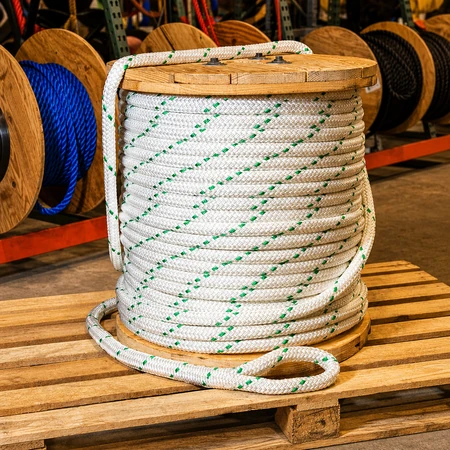
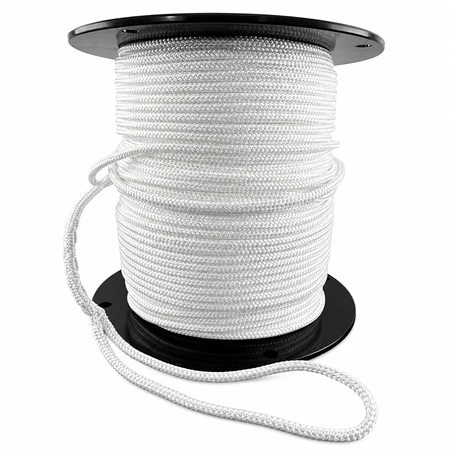
Lift sling rigging company produce pulling rope,Cable Pulling Rope,Double Braid Pulling Rope,Double Braided Cable Pulling Rope.
Seil ziehen
High-Strength Cable Pulling & Traction Rope — UHMWPE and Polyester, 6 mm bis 32 mm
Unser Seil ziehen is built for the hard, repetitive work of drawing cable and conductor: 12-strand braided UHMWPE, polyester double braid and twisted constructions in diameters from 6 mm bis 32 mm. A UHMWPE pulling rope weighs roughly a seventh of a steel wire rope of the same breaking strength, so a crew can hand-haul a line all day without fighting the weight — while the low-stretch, torque-free braid keeps the load steady and stops the rope from spinning a cable sock off the duct. Every rope is supplied with hand-spliced eyes, stainless steel thimbles or swivel connectors to match your winch, pulling grip and stringing blocks.
- Very high strength-to-weight ratio — UHMWPE delivers up to 15× the strength of steel by weight
- Geringe Dehnung — around 3–4 % in der Pause, so pulling force reaches the cable instead of the rope
- Torque-free 12-strand braid — resists kinking and hockling under repeated winching
- Excellent abrasion and UV resistance — long service life on outdoor stringing work
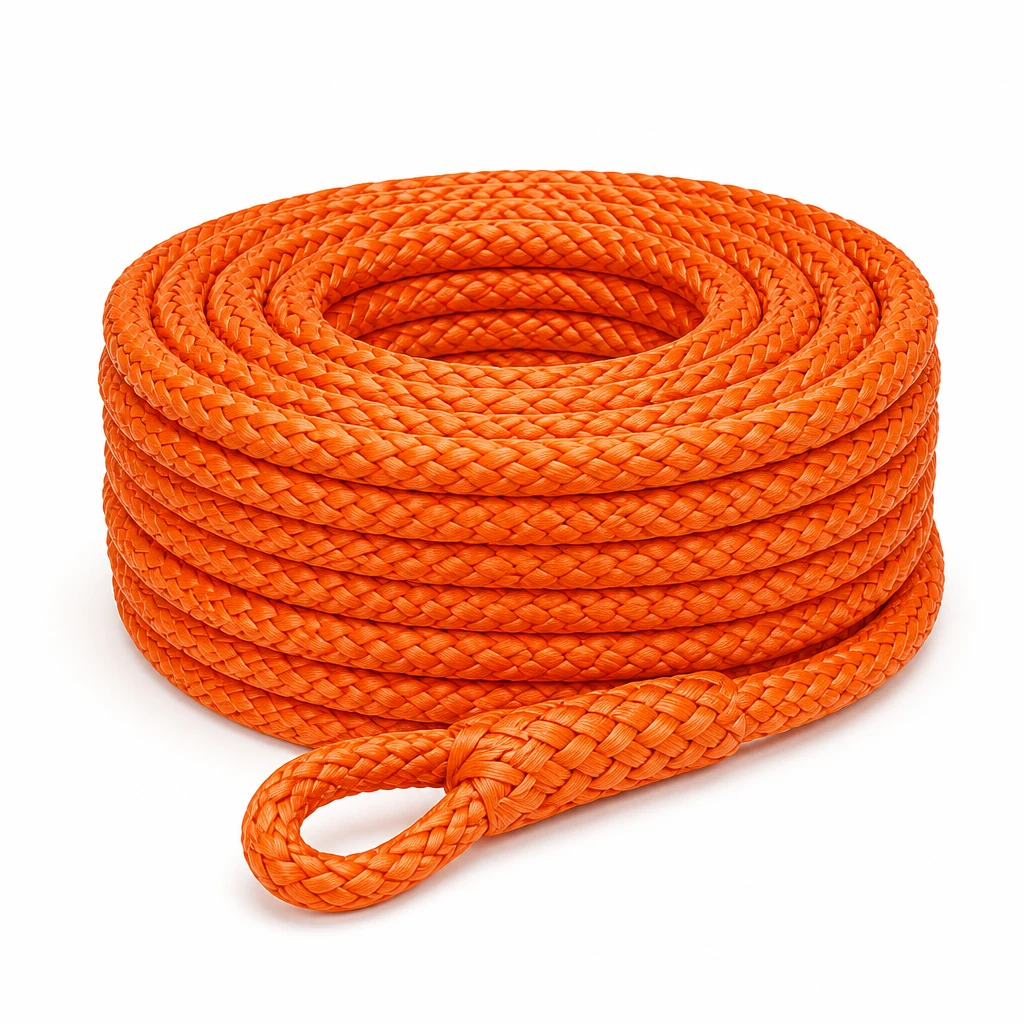
Key Features of Our Pulling Rope
Hohe Festigkeit, Geringes Gewicht
UHMWPE constructions reach roughly 15× the strength-to-weight ratio of steel wire rope — a 16 mm UHMWPE line replaces a far heavier steel pull line with the same breaking strength.
Geringe Dehnung
UHMWPE elongates only about 3–4 % in der Pause, so winch force transfers to the cable almost immediately and the line does not surge or spring back.
Torque-Free Braid
The balanced 12-strand braid does not twist under tension, which keeps pulling grips, swivels and cable socks tracking straight through ducts and pulleys.
Abrieb & UV Resistant
High abrasion resistance against concrete duct mouths, manhole edges and stringing blocks, plus good UV stability for long outdoor exposure.
Floats or Sinks — Your Choice
UHMWPE and polypropylene ropes float (specific gravity below 1.0); polyester and nylon sink. Specify by the working environment and recovery method.
Custom End Fittings
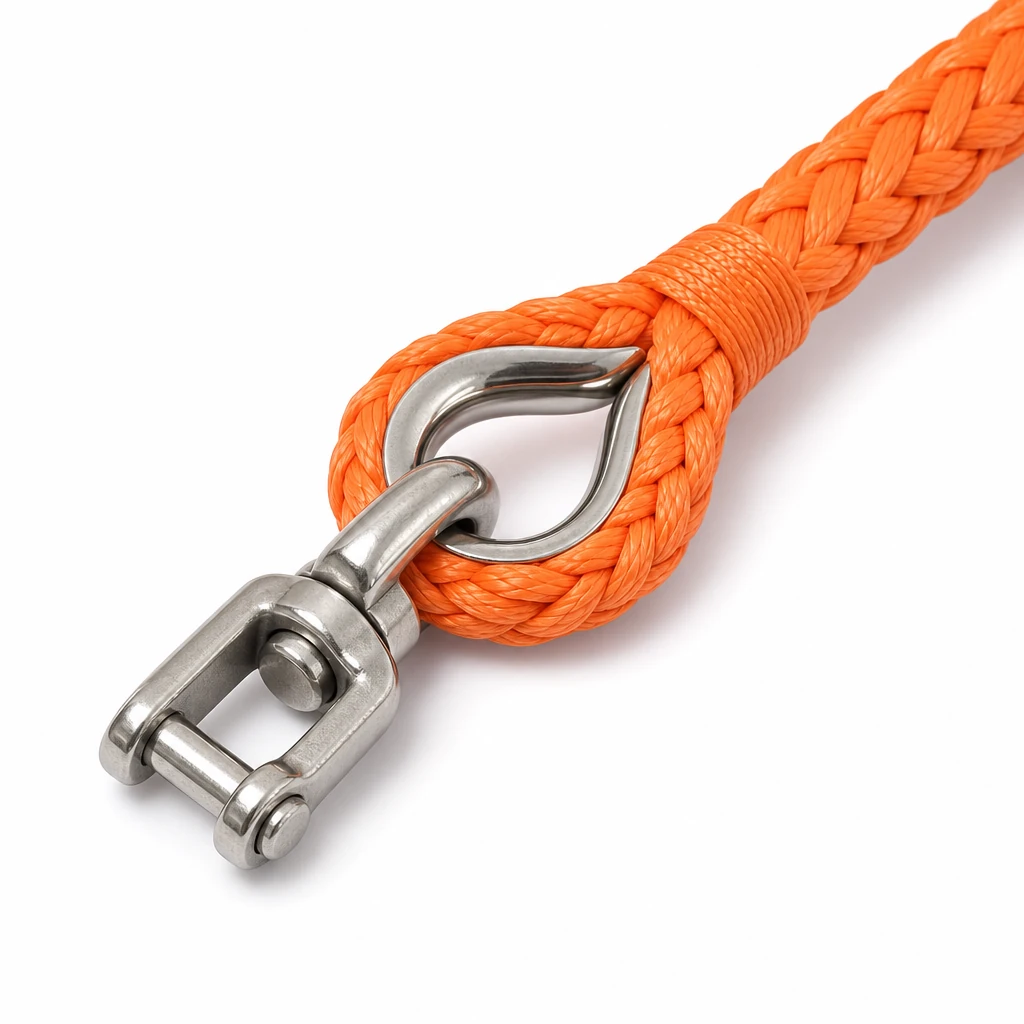
Hand-spliced soft eyes, stainless steel thimbles, swivel clevis connectors, choker loops and covered eyes — matched to your winch drum and pulling hardware.
Technische Spezifikationen
| Produktname | Seil ziehen / cable pulling rope / traction rope / winch rope / towing rope / guide rope |
|---|---|
| Constructions | 12-strand braided · 8-strand braided · double braid (braid-on-braid) · 3-strand twisted |
| Glasfaseroptionen | UHMWPE (HMPE, Dyneema-type) · high-tenacity polyester · nylon · polypropylene · aramid · blended constructions |
| Standarddurchmesser | 6 mm · 8 mm · 10 mm · 12 mm · 14 mm · 16 mm · 18 mm · 20 mm · 24 mm · 28 mm · 32 mm (Brauch bis zu 60 mm) |
| Durchmessertoleranz | ± 3 % |
| Längenoptionen | 50 M · 100 M · 200 M · 500 M · 1000 m — cut to any length, with or without metre markings |
| Bruchdehnung | UHMWPE ca. 3–4 % · polyester double braid approx. 15–20 % (ca. 3 % bei 20 % of breaking strength) |
| Spezifisches Gewicht | UHMWPE 0.97 · polypropylene 0.91 (both float) · polyester 1.38 · nylon 1.14 (both sink) |
| Schmelzpunkt | UHMWPE ca. 145 °C · polypropylene approx. 165 °C · nylon approx. 215 °C · polyester approx. 255 °C |
| Arbeitstemperatur | UHMWPE −40 °C to +70 °C · polyester −40 °C to +80 °C |
| Wasseraufnahme | UHMWPE ≈ 0 % · polyester < 1 % — no loss of strength when wet |
| UV-Beständigkeit | Good to excellent; polyester is naturally the most UV-stable, UHMWPE benefits from a protective coating |
| Chemische Beständigkeit | Good resistance to acids, alkalis, Salzwasser, oils and most organic solvents |
| Abriebfestigkeit | UHMWPE excellent · polyester very good — both far better than natural fibre rope |
| Farbe | Safety orange · yellow · blue · black · white · custom colours and traceable marker strands |
| Endbeschläge | Hand-spliced soft eye · eye with stainless steel thimble · swivel clevis connector · choker loop · covered eye · plain end |
| Recommended safety factor | 4:1 Zu 5:1 for typical pulling and winching duty — confirm against your project or national specification |
| Testberichte | Batch breaking-strength and elongation reports issued against the test method specified in your project, auf Anfrage |
| Verpackung | Spule, wooden reel, plastic spool or rope bag; custom label, tag and barcode available |
| Mindestbestellmenge & OEM | Niedrige Mindestbestellmenge für Probebestellungen; full OEM — custom diameter, Konstruktion, Farbe, printed markings and packaging |
Durchmesser und Bruchfestigkeit
Use the table below to size the rope against your required pulling force. Breaking strength rises with the square of the diameter, so moving up one size gives a disproportionately large gain — which is why the jump from 16 mm bis 20 mm nearly doubles the capacity of a polyester line.
| Durchmesser | Polyester double braid min. Bruchfestigkeit |
UHMWPE 12-strand min. Bruchfestigkeit |
Gewicht (kg / 100 M) Polyester / UHMWPE |
|---|---|---|---|
| 6 mm | 11 kN (1.1 T) | 31 kN (3.2 T) | 3 / 2 |
| 8 mm | 19 kN (1.9 T) | 54 kN (5.5 T) | 5 / 3 |
| 10 mm | 30 kN (3.1 T) | 85 kN (8.7 T) | 8 / 5 |
| 12 mm | 43 kN (4.4 T) | 122 kN (12.4 T) | 11 / 7 |
| 14 mm | 59 kN (6.0 T) | 167 kN (17.0 T) | 15 / 10 |
| 16 mm | 76 kN (7.7 T) | 218 kN (22.2 T) | 20 / 13 |
| 18 mm | 97 kN (9.9 T) | 275 kN (28.0 T) | 25 / 17 |
| 20 mm | 120 kN (12.2 T) | 340 kN (34.7 T) | 31 / 20 |
| 24 mm | 173 kN (17.6 T) | 490 kN (50.0 T) | 45 / 29 |
| 28 mm | 235 kN (24.0 T) | 666 kN (67.9 T) | 61 / 40 |
| 32 mm | 307 kN (31.3 T) | 870 kN (88.7 T) | 80 / 52 |
Seilbau
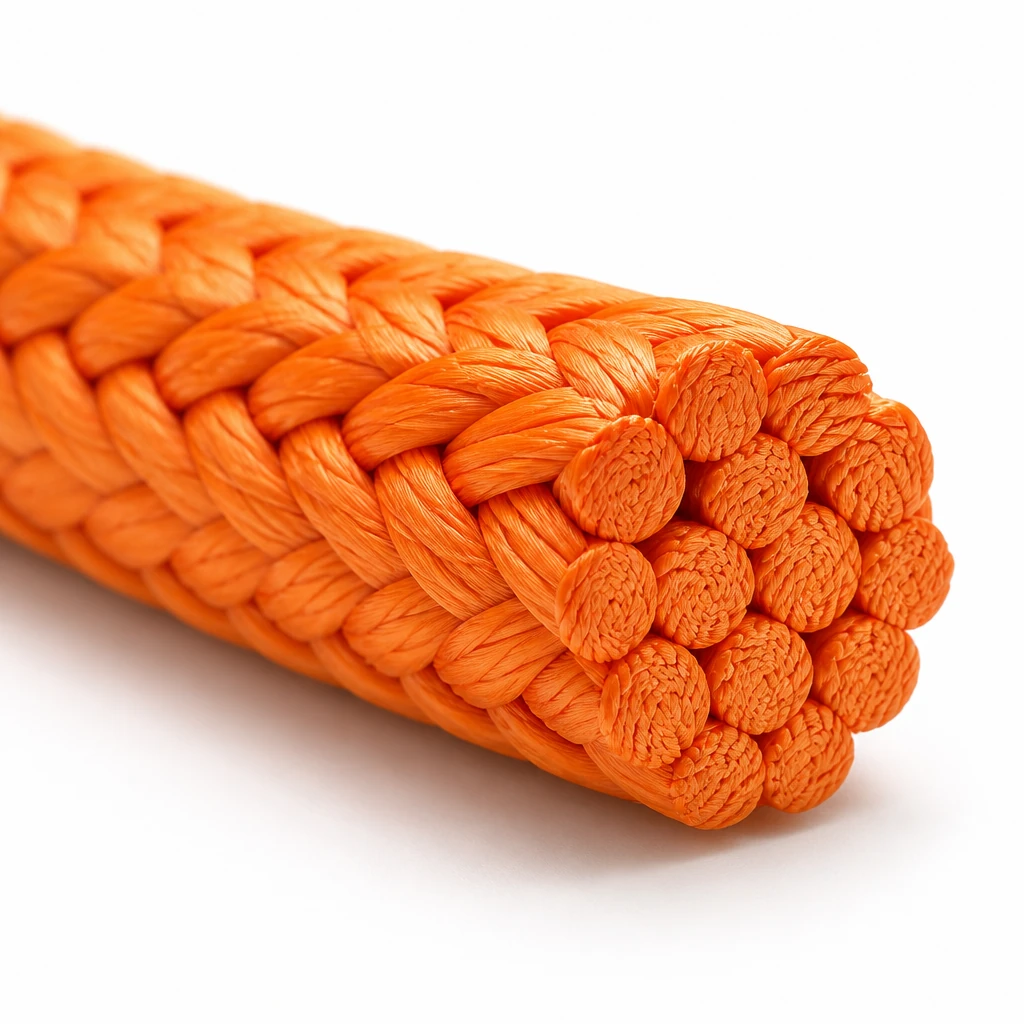
A pulling rope fails for two reasons: the filaments fatigue from repeated bending over sheaves, or the surface wears through against concrete and steel. Both are construction problems, not just material ones. Our 12-strand braid distributes load across every strand along the full length of the rope, so no single strand carries a disproportionate share, and there is no outer jacket to wear through and expose a separate core — the whole rope Ist the load-bearing structure.
Choosing the right material
- UHMWPE (HMPE) — the highest strength-to-weight ratio and the lowest stretch. First choice for long pulls, tower stringing and hand-hauled lines where weight matters. Schwimmt.
- Hochfestes Polyester — the best all-round balance of cost, UV stability and abrasion resistance, with moderate stretch that cushions shock loads. Sinks.
- Nylon — higher energy absorption for towing and shock applications where some give is desirable. Sinks.
- Polypropylen — lightest and cheapest, und es schwimmt, making it useful for water crossings and floating guide lines. Lowest strength of the four.
- Aramid — for high-temperature environments and where cut resistance is required.
Anwendungen
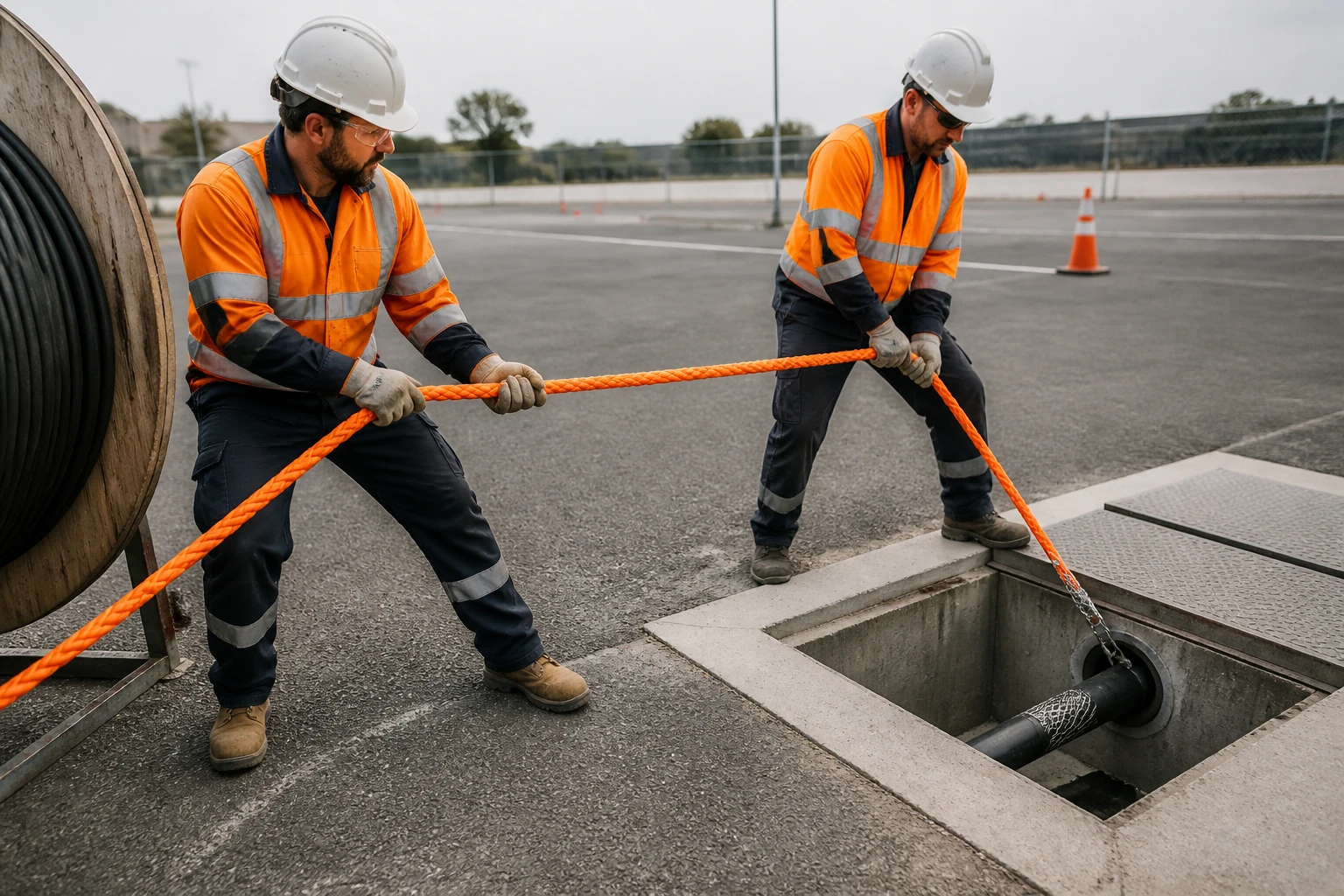
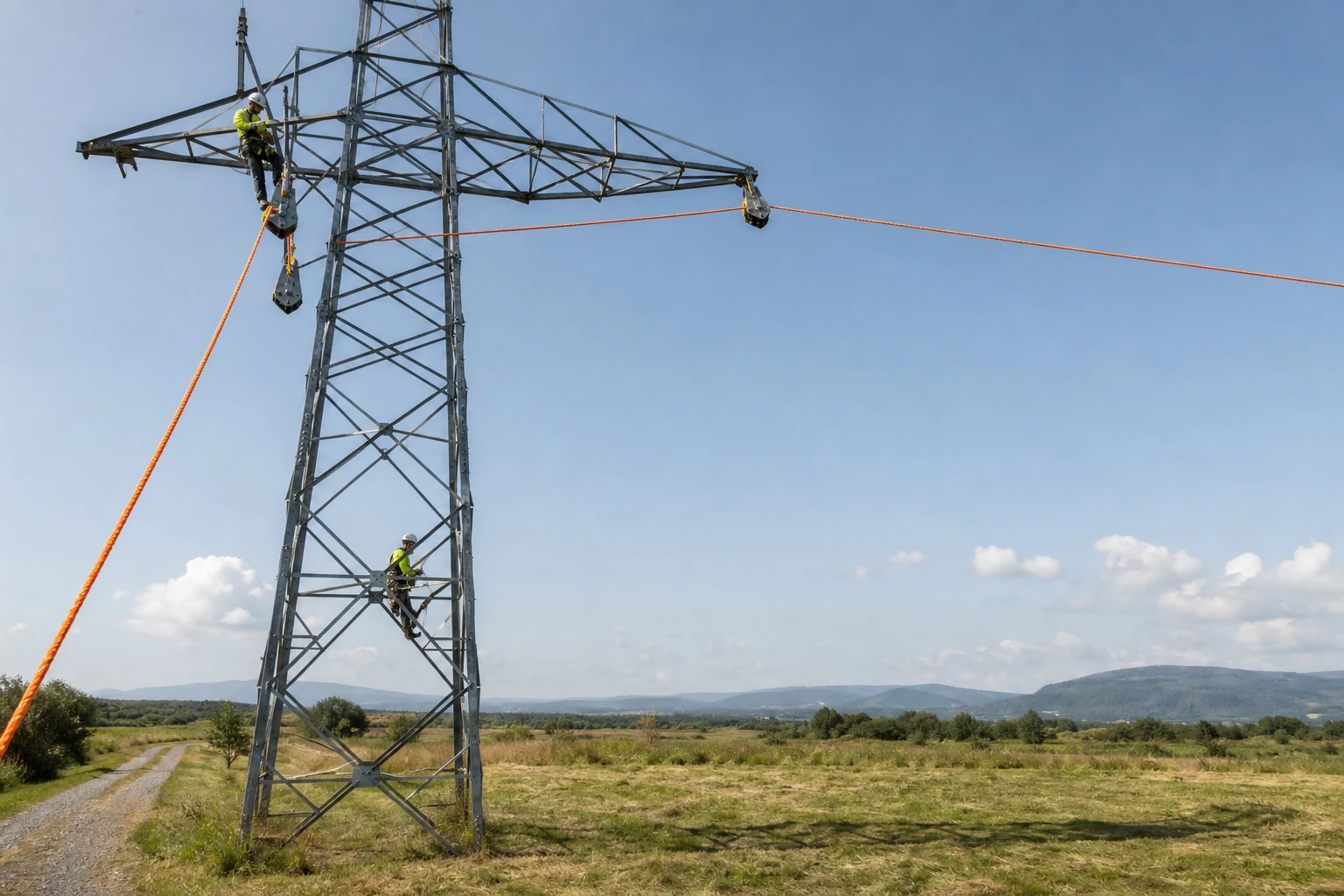
Pulling ropes are supplied to power and telecom contractors, utility companies, marine operators and rigging distributors. Zu den typischen Anwendungen gehören::
- Overhead power line stringing — pilot line, pulling line and conductor hauling through stringing blocks
- Cable pulling through ducts, conduits, manholes and cable trays
- Fibre optic and telecom cable installation
- Winch lines, recovery and vehicle towing
- Meeresliegeplatz, tow hawsers and anchor handling
- Tunnel, metro and underground utility construction
- Wind turbine and substation cable installation
- General rigging, hoisting assistance and industrial hauling
Anpassung und OEM-Service
We manufacture to specification rather than to a fixed catalogue. Tell us the pulling force, the route (Leitung, tower, Winde), the sheave or pulley diameter and the fittings you already use, und wir empfehlen Ihnen den passenden Durchmesser, construction and fibre. Zu den gängigen Anpassungen gehören::
- Diameter and construction — 6–60 mm, 12-Strand, 8-Strand, double braid or 3-strand twisted
- Fibre and blend — UHMWPE, Polyester, Nylon, Polypropylen, Aramid, or a blended jacket for extra grip
- Länge und Markierung — any cut length, with metre markings, red-hot cut ends or taped terminations
- Endbeschläge — soft eye, Fingerhutauge, swivel clevis, Halsband, covered eye or plain end, spliced by hand
- Farbe und Branding — standard colours or custom Pantone, plus woven or printed part numbers
- Verpackung — coil, wooden reel, plastic spool or rope bag with your own label and barcode
Qualitätskontrolle
Jede Charge wird auf Durchmesser überprüft, lineare Dichte, braid tightness, splice integrity and surface finish, and sampled for breaking strength and elongation. We have manufactured lifting and pulling rope products for industrial, utility and public-safety customers for close to three decades, und wir halten den Prozess sichtbar: Auf Wunsch liefern wir das Faserzertifikat, the batch test report against your specified test method, and a production sample before volume runs begin.
Häufig gestellte Fragen
What is a pulling rope used for?
A pulling rope draws cable, conductor or optical fibre through ducts, conduits and overhead lines. It is also used as a winch line, tow line and general hauling rope where a light, hochfest, low-stretch line is needed.
Should I choose UHMWPE or polyester for a pulling rope?
Choose UHMWPE when weight and stretch matter most — long pulls, tower stringing, or lines a crew hauls by hand. It is roughly two to three times stronger than polyester at the same diameter and elongates only 3–4 % in der Pause. Choose polyester where cost, UV stability and moderate shock absorption matter more, such as shorter duct pulls and general winching.
What diameter pulling rope do I need?
Size from the maximum pulling force, then apply a safety factor of 4:1 Zu 5:1. Als Leitfaden, A 12 mm UHMWPE 12-strand rope breaks at roughly 122 kN (12.4 T) und a 12 mm polyester double braid at roughly 43 kN (4.4 T). Confirm the final figure against your project specification.
Will the rope twist and spin my cable grip off?
NEIN. The balanced 12-strand braid is torque-free, so it does not rotate under tension. For added security — and especially on long pulls — we fit a swivel clevis connector at the pulling end so any residual rotation is absorbed before it reaches the cable sock.
Does the rope float?
UHMWPE and polypropylene versions float, with specific gravities of about 0.97 Und 0.91. Polyester and nylon versions sink and are suited to submerged duct work. Tell us the environment and we will specify the right fibre.
Do you supply test reports, custom lengths and OEM branding?
Ja. Batch breaking-strength and elongation reports are issued against the test method specified in your project, und wir bieten vollständigen OEM-Service – kundenspezifische Durchmesser, Konstruktion, Farbe, metre markings, printed part numbers and retail packaging.
Request a Quote for Pulling Rope
Send us the maximum pulling force, the route, the rope length, the fibre you prefer and the fittings you need. Unser Team wird mit einer Spezifikation zurückkommen, ein Beispielplan und ein Fabrikpreis.