

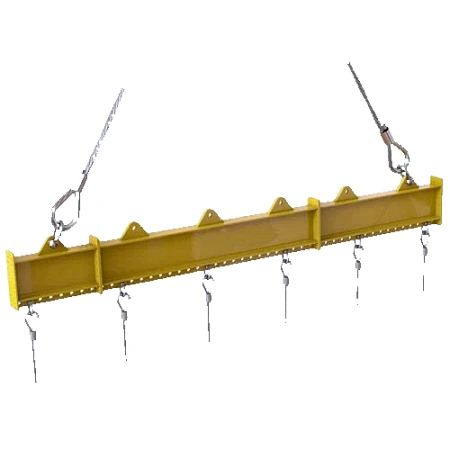
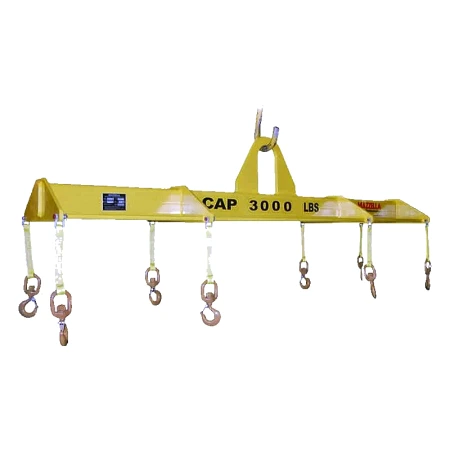
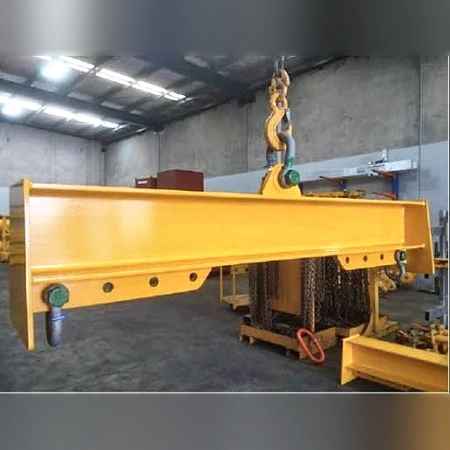
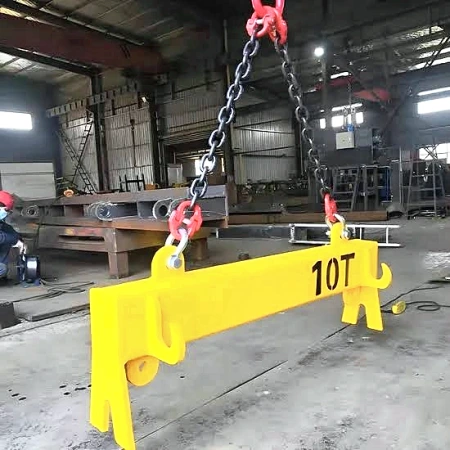
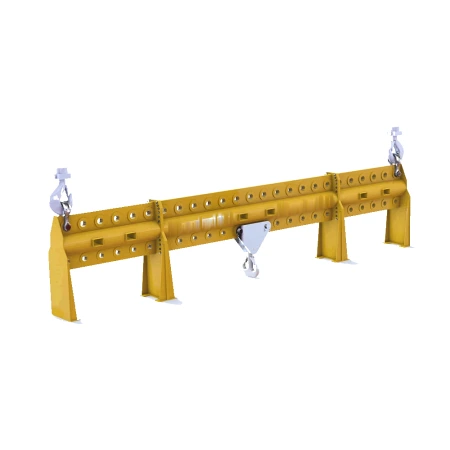
Lift sling rigging company produce Adjustable Lifting Beam,Adjustable Spreader Beam,Adjustable H lifting beam,Adjustable Bail Lifting Beam,Adjustable Spreader Bars for Cranes,Adjustable modular lifting beams.
Adjustable Lifting Beam
An adjustable lifting beam is a beam whose geometry can be changed to suit more than one load: the span slides out and locks, the pick points move along a row of holes, the bail slides to sit over the centre of gravity, or the whole beam bolts together from sections at whatever length the lift needs. Built from 100 kg zu 180 t rated capacity, spans from 0.5 m zu 25 M, in box, H-section or truss construction, proof load tested to 125 % before dispatch. The important part is not that it adjusts – it is knowing which figure applies once you have adjusted it, and that is what most of this page is about.
Why Buy an Adjustable Beam at All
A fixed beam is the lightest and cheapest answer to one load. Three situations make it the wrong answer, and they are the reason most of the beams we build are adjustable in some way.
- The yard handles more than one load length. A beam sized for the longest pack is overweight for everything else; one adjustable beam covers the range instead of three fixed ones.
- The centre of gravity is not where the drawing said. A row of pick points, or a bail that slides, lets the rigger trim the pick until the load hangs level, instead of adding a second sling to level it.
- Transport decides the design. A 20 m beam that cannot be moved is not a solution; a telescopic or bolt-together beam travels in pieces and is assembled at the span needed.
What Actually Adjusts – Four Mechanisms
“Einstellbar” covers four different things and they are not interchangeable. Each carries its own way of locking and its own inspection point.
| Mechanism | Was ändert sich | How it locks | Am besten für | What to watch |
|---|---|---|---|---|
| Multi-position pick points | The position of the lower attachment points along a fixed beam | Pins through a row of holes, or a sliding bracket clamped in position | Mixed load lengths; trimming an off-centre load until it hangs level | Span is unchanged, so the beam is not derated; the pin and hole must be a matched pair, not a bolt dropped in |
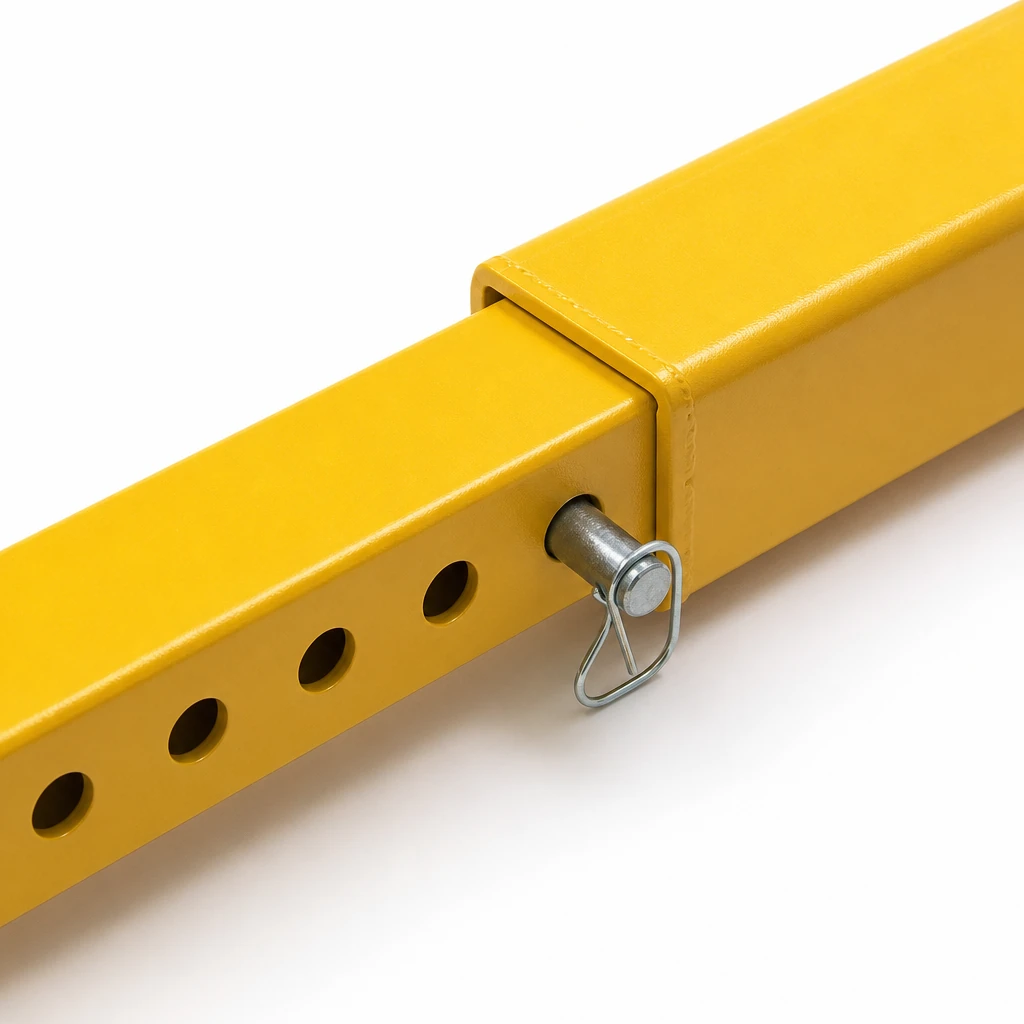
| Telescopic span | The span itself – an inner section slides inside the outer | Pins through aligned hole rows in both sections, usually two pins per joint | A yard that handles a range of load lengths with one beam | Capacity applies at the worst position, normally maximum extension; the joint needs its own inspection |
| Sliding or pivoting bail | The top pick point, so the crane hook sits over the centre of gravity | Pin or clamp on a track; a pivoting bail is retained by its own pin | Loads whose centre of gravity moves between jobs | Moving the bail changes the share on the upper rigging, not the beam’s rating – re-check the sling angles |
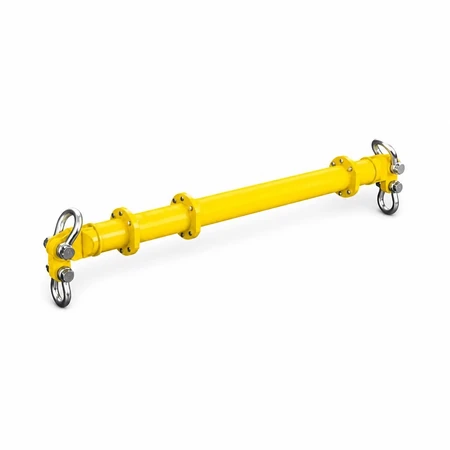
| Modular bolt-together | The length, by adding or removing sections | Bolted flanges or splice plates, torque-controlled | Große Spannweiten, or where transport and storage space is limited | A re-configured beam is a new geometry: the rating, the marking and the test record have to follow it |
The Adjustable Bail, and What It Is For
The bail – the top fitting the hook engages – is the part buyers forget can be adjustable, and it is the one that changes how the beam behaves rather than how big it is. A bail that slides along a track, or pivots on a pin, lets the pick point be placed over the centre of gravity instead of over the middle of the beam. On a load whose weight is not where the drawing says, that is the difference between a level pick and a fight.
Zwei Warnungen. Moving the bail redistributes tension between the upper slings, so the sling angles have to be re-checked at the new position – the beam’s rating has not changed, the rigging around it has. And an adjustable bail is a bail with a pin, a track or a clamp: a wear point a fixed lug does not have.
The Thing That Bites: Extending the Span Changes the Sling Angle
The upper slings run in a V from the hook to the beam, and their inclination is what puts the beam into compression. Extend the span with the same slings and the V flattens, the horizontal component rises fast, and the beam is asked to carry far more compression than it was rated for – from slings that are working harder too.
The numbers below are the reason a telescopic beam must be re-rigged rather than simply extended. They are pure trigonometry from the top sling angle, and they apply to any beam hung in a V.
| Oberer Schlingenwinkel (aus der Horizontalen) | Kompression im Balken | Spannung pro Oberschlinge | What it means on site |
|---|---|---|---|
| 90° (Vertikale) | 0 | 0.50 × laden | No longer a spreader arrangement – a lifting beam in bending |
| 60° | 0.58 × laden | 0.58 × laden | A tall rig, but the beam is lightly loaded |
| 45° (usual working angle) | 1.00 × laden | 0.71 × laden | The normal setting; compression equals the load |
| 30° | 1.73 × laden | 1.00 × laden | What happens when a span is extended without longer slings |
| 20° | 2.75 × laden | 1.46 × laden | Nearly three times the compression, on the same beam |
The practical rule: when you extend an adjustable beam, lengthen the upper slings at the same time so the angle stays between about 45° and 60°. If the headroom will not allow it, the beam is not the constraint – the rig is.
Where the Rating Applies
An adjustable beam has one rated capacity and several positions, and the capacity is quoted at the position the beam was designed for – normally the worst one. Read the marking, not the sales sheet.
| Position | Normally rated at | What to do |
|---|---|---|
| Pick points moved along a fixed beam | Full rated capacity anywhere along the row | Confirm the end positions are within the rated length, then use any hole |
| Telescopic span at minimum extension | Often the highest figure | Use it – but confirm the marking covers that position |
| Telescopic span at maximum extension | The governing figure for the whole beam | This is the number to price and plan against |
| Beam re-configured from modules | The geometry it is assembled to | Re-mark, and re-test if the configuration is outside the original record |
Specifications
| Parameter | Optionen |
|---|---|
| Produkt | Adjustable lifting beam / verstellbarer Spreizbalken / adjustable H lifting beam / adjustable bail lifting beam / adjustable spreader bars for cranes / adjustable modular lifting beam |
| Nennkapazität (WLL) | 100 kg zu 180 t Standardbereich; Größere Sonderanfertigungen auf Anfrage |
| Spanne / Gesamtlänge | 0.5 m zu 25 m je nach Kapazität und Abschnitt; telescopic travel and number of stops to suit your load range |
| What adjusts | Lower pick points (rows of holes or a sliding bracket) · telescopic span · sliding or pivoting bail · bolt-together modules |
| Balkenabschnitt | Geschweißtes Kastenprofil · geschweißtes H-Profil · Gitterfachwerk für große Spannweiten und hohe Tragfähigkeiten |
| Material | Q235B / Q345B (S235JR / S355JR); hochfester Stahl für Konstruktionen mit großer Tonnage |
| Upper suspension | Two welded lugs · sliding bail on a track · pivoting bail · stainless or plated pins |
| Lower attachment | Stiftlöcher · Schäkelösen · Wirbelhaken · Gleithalterungen · 2, 4 oder mehr Punkte |
| Oberer Schlingenwinkel | Normally set between 45° and 60° from the horizontal – confirmed against your headroom and load |
| Designfaktor | Applied against the rated capacity per the applicable standard and service class – typically 3:1 Zu 5:1, pro Projekt bestätigt |
| Probelasttest | 125 % der Nennkapazität vor dem Versand, mit Belastungsprüfzeugnis |
| Surface finish | Schussexplosion auf Sa 2.5 + Epoxidgrundierung + Polyurethan-Decklack (Sicherheitsgelb); optional hot-dip galvanising |
| Markierung | Nennkapazität (WLL), Taragewicht, serial number and year of manufacture on the beam |
| Dokumentation | Übersichtszeichnung, Materialzertifikat, weld record, proof load test certificate |
| Referenzstandards | ASME B30.20 / ASME BTH-1 und EN 13155 üben – confirm the standard and factor required in your market |
| HS-Code | 842890 |
Capacity and Span Bands
If your load lengths straddle two bands, one telescopic beam at the higher capacity usually costs less than two fixed beams.
| Nennkapazität (WLL) | Typical span | Pick points | Typical section | Adjustment normally offered |
|---|---|---|---|---|
| 0.5 T | 1.0 – 2.5 M | 2 | Kasten | Multi-position holes |
| 1 T | 1.0 – 3.0 M | 2 | Kasten | Multi-position holes |
| 2 T | 1.5 – 4.0 M | 2 | Kasten | Multi-position holes / bail |
| 3 T | 2.0 – 5.0 M | 2 | Kasten | Multi-position holes / telescopic |
| 5 T | 2.5 – 6.0 M | 2 | Kasten | Telescopic |
| 10 T | 3.0 – 8.0 M | 2 oder 4 | Kasten / geschweißt H | Telescopic / modular |
| 16 T | 4.0 – 10.0 M | 2 oder 4 | Geschweißtes H | Telescopic / modular |
| 20 T | 5.0 – 12.0 M | 2 oder 4 | Geschweißtes H | Telescopic / modular |
| 32 T | 6.0 – 14.0 M | 4 | Geschweißtes H / Fachwerk | Modular |
| 50 T | 8.0 – 16.0 M | 4 | Geschweißtes H / Fachwerk | Modular |
| 80 T | 10.0 – 18.0 M | 4 | Fachwerk | Modular |
| 100 T | 10.0 – 20.0 M | 4 | Fachwerk | Modular |
| 180 T | 12.0 – 25 M (Brauch) | 4 oder mehr | Maßgeschneidertes Fachwerk | Modular, auf Bestellung gefertigt |
Oben ungefähr 32 t the telescopic joint stops being the economical answer: the inner section has to carry the full compression and the outer section has to be deep enough to house it, so a bolt-together modular beam is usually lighter and cheaper to move. The final span, section and tare weight are confirmed against your load case.
H-Section and Bar Types
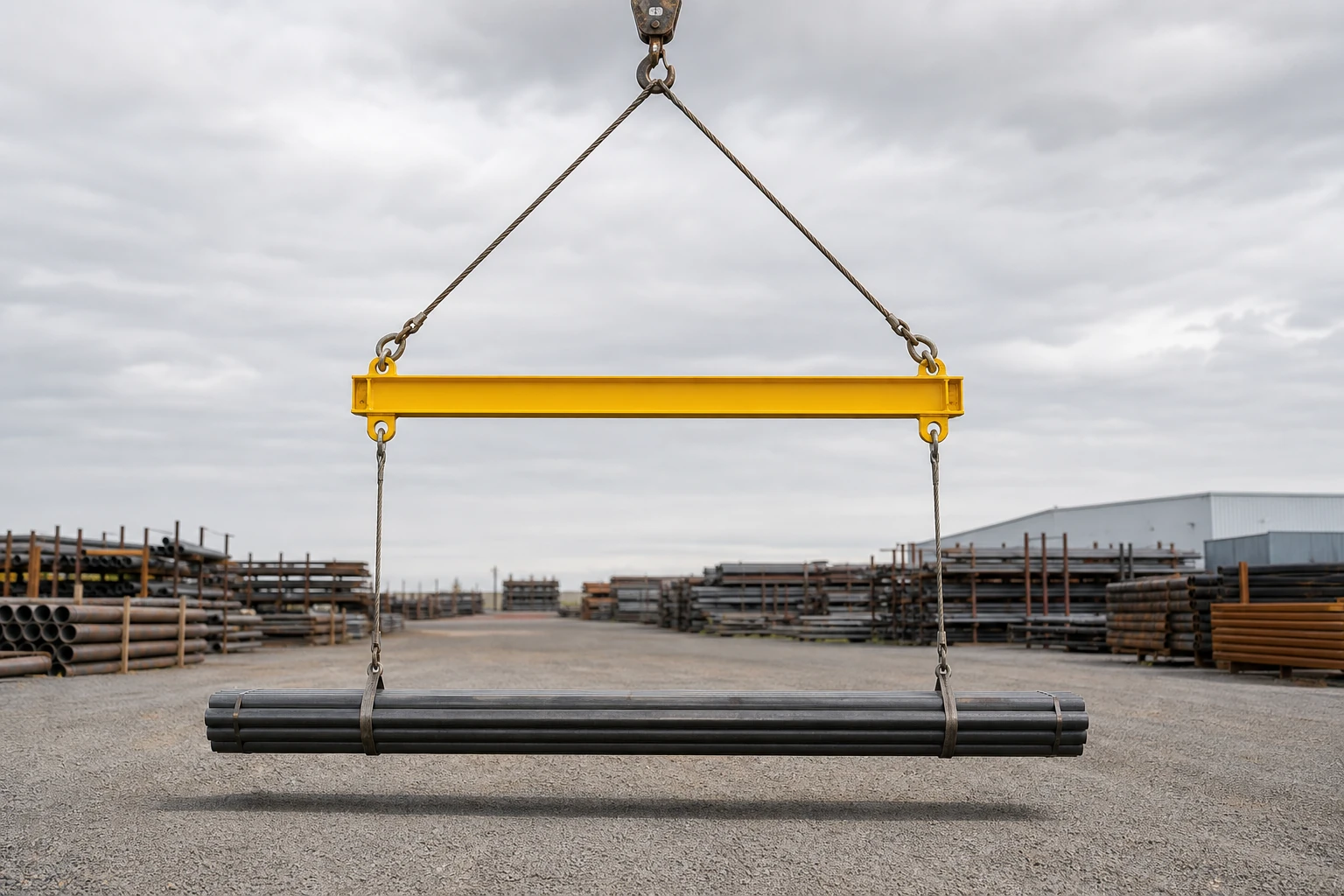
Two of the names this beam is sold under describe the section, not the function. Ein adjustable H lifting beam uses a welded H-section: the flanges stiffen it in the plane the load hangs in, and the web carries the pick-point holes at very little cost to the section. Ein adjustable spreader bar is the same idea at small capacity and short span.
Locking, Pins and the Pre-Use Check
Every adjustable beam has at least one joint that a person sets by hand, and that joint is where adjustable beams fail. The checks are short.
- Pins are the right pins. A matched pin with its own retention, not a bolt from the toolbox. Check the pin, the hole and the retention every time the beam is re-set.
- Both pins in a telescopic joint. One pin holds the span; the second stops the joint racking. Two holes aligned, two pins home.
- The joint is not deformed. An overloaded telescopic joint shows at the pin holes first – elongation, cracking at the hole edge, or a section that no longer slides.
- The bail moves only when it should. A loose sliding bail is a pick point that shifts under load.
- The marking matches the configuration. If the beam has been re-configured from modules or is being used at a position outside its rated range, the marking on the beam is no longer the answer – stop and confirm.
What to Send for a Quotation
| Figur | Why the beam needs it |
|---|---|
| The range of load lengths you handle | Sets the adjustment travel and the number of stops – not just one span |
| Load mass, plus beam and rigging mass | Sets the rated capacity; the beam’s own weight comes off the crane’s |
| Capacity of the crane at the working radius | The binding limit, before any derating for the rig |
| Headroom above the load | Decides the top sling angle, and whether a telescopic beam can keep 45-60° |
| Number and type of pick points | Pin holes, shackle lugs, hooks or brackets; 2, 4 oder mehr |
| Whether the bail has to move | Off-centre loads need a sliding or pivoting bail, not just more holes |
| Transport and storage limits | Decides whether the answer is telescopic, modular, or both |
Testen, Marking and Records
Jeder Balken wird einer Probebelastungsprüfung unterzogen 125 % of rated capacity and issued with a test certificate; rated capacity, Taragewicht, serial number and year are marked on it. On a modular beam the test record should state the configuration tested, and any configuration outside that record needs confirmation before the beam goes back into service. Where a particular standard or market certification is required, say so before the order.
Häufig gestellte Fragen
What is an adjustable lifting beam?
A beam whose geometry can be changed for different loads: the span slides and locks, the pick points move along a row of holes, the bail slides to sit over the centre of gravity, or the beam bolts together from sections. It is built for a yard that handles more than one load size rather than for one fixed lift.
What is the difference between adjustable, telescopic and modular?
Adjustable is the general word. Telescopic means the span itself changes, with an inner section sliding inside the outer and locking on pins. Modular means the beam is assembled from bolt-together sections, so the length is set when it is built. Multi-position pick points are a fourth, separate thing: the span stays fixed and only the attachment points move.
Does the capacity change when I extend the beam?
The rated capacity is the figure at the position the beam was designed for, normally the maximum extension, and that figure governs the whole beam. Extending also changes the top sling angle unless the slings are lengthened with it – and a shallower angle can multiply the compression in the beam by two or three times. Extend the span and lengthen the slings together.
What is an adjustable bail for?
To put the crane hook over the centre of gravity instead of over the middle of the beam, so an off-centre load hangs level without a second sling. Moving the bail changes the tension share between the upper slings, so the sling angles have to be re-checked at the new position.
Can one beam really cover several load sizes?
Within its rated range, Ja – that is the point of it. Tell us the shortest and longest load, the heaviest load, and the number of pick points each needs, and the beam is sized on the worst combination rather than on the average.
How much heavier is an adjustable beam than a fixed one?
It depends on the mechanism: a telescopic joint needs an inner section and a deeper outer section, so it is the heaviest per metre of span; multi-position holes add almost nothing. Oben ungefähr 32 T, modular is usually lighter. The tare weight is stated on the drawing for the configuration quoted.
Is the beam tested, and what comes with it?
Prüflastgeprüft nach 125 % of rated capacity with a test certificate, and supplied with the general arrangement drawing, material certificate and weld record on request. Nennkapazität, Taragewicht, serial number and year are marked on the beam, and where the beam is modular the test record states the configuration tested.
Request a Quotation
Send the range of load lengths, the heaviest load, the headroom and the number of pick points, and we will come back with the section, the adjustment travel, the tare weight and a factory-direct price.
Send your adjustable beam details for a proposal
Telephone / WeChat: +86 180 6600 2268 | E-Mail: 702461526@qq.com
Industriepark Lifete, Stadt Taizhou, Provinz Jiangsu, China | HS-Code: 842890