

Lift sling rigging company produce Single Use White Lifting Slings,One Way White Webbing Sling,One Way White Lifting Sling.
Single Use White Lifting Slings
Dye-free polyester bands from 0.5 t til 5 t — the label, ikke farven, carries the rating
A single use white lifting sling is bought with the load and leaves with it. The white band is the plainest article in the envejs slynge rækkevidde: undyed high-tenacity polyester, a formed eye at each end or woven closed into a loop, printed with a working load limit, a length and a batch, checked once at issue and then written off against the job.
White earns its place for reasons that are mostly about the load rather than the sling. An undyed band cannot transfer dye to a white marble slab, a paper reel, a painted panel or a carton of finished goods. It shows contamination — oil, rust bleed, cement dust — exactly where a coloured band would hide it. And there is no dye lot to match, so the second bale matches the first, which matters when the same specification has to be repeated shipment after shipment.
What white cannot do is tell a rigger the capacity from across the yard. There is no white step in the colour sequence, which is why the marking on this page is specified as carefully as the webbing: on a single-trip article the printed figures are the whole record of what the band is.
White is an absence of dye, not a capacity code
Colour coding is a convention for identifying the working load limit at a glance: 1 t violet, 2 t grøn, 3 t gul, 4 t grå, 5 t rød, 6 t brun, 8 t blå, 10 t orange. White sits outside that convention, and buyers sometimes read that as a lower grade. Det er det ikke. It is the colour of undyed polyester, chosen because the band will touch something that must not be marked, or because the consignment has to be built to a repeatable specification with no shade to match.
The trade-off is stated plainly in the table below. On a white band the label is the only statement of capacity, so the label has to be legible in the condition the sling arrives in — after a container, after weather, after being dragged across a deck. That is a specification line on the enquiry, not an afterthought at despatch.
| White single use band | Colour-coded band | |
|---|---|---|
| Identification at a distance | None — the label states the WLL | Colour states the WLL |
| Dye transfer to the load | None — no dye present | Possible on light or absorbent loads |
| Forurening | Olie, rust bleed and dust show immediately | Hidden by the colour |
| Repeat orders | No dye lot, so bales match | Shade can drift between lots |
| Bedst til | White goods, paper, sten, painted and coated surfaces, export packing | Yards issuing from a rack, multi-trip stores |
| Discipline required | Label checked at every issue | Fast visual check plus label |
What the absence of colour changes
Bandet, the eyes and the mark
The band is woven from 100% højstyrke polyester, ufarvet, in a plain flat weave. Polyester is the default because it stretches little under load, keeps its strength when wet and does not absorb water into the weight of the sling; white polypropylene and white nylon are available where a chemical or a weight requirement points that way. Width and ply follow the figure: 25–50 mm single ply covers 0.5–1 t, 50–100 mm two ply covers 2–5 t.
- Ends — flat eye as standard, folded eye or reinforced eye where the hook is large or the eye will be dragged. De Engangs løftesejl endeløs løkke version has no eye at all: bandet er sluttet til sig selv, so there is nothing to place on a hook.
- Stitch — the eye is closed with a multi-row lock stitch in high-tenacity thread, with the stitch pattern and the number of rows part of the specification rather than a workshop habit.
- Mark — a sewn white label carrying the WLL for each mode, længden, fiberen, the batch and the date, plus the same figures printed directly on the band in black. Black on white is the highest-contrast mark available, which is the practical argument for a white band on a job where the label has to be read once, correctly, by someone in a hurry.
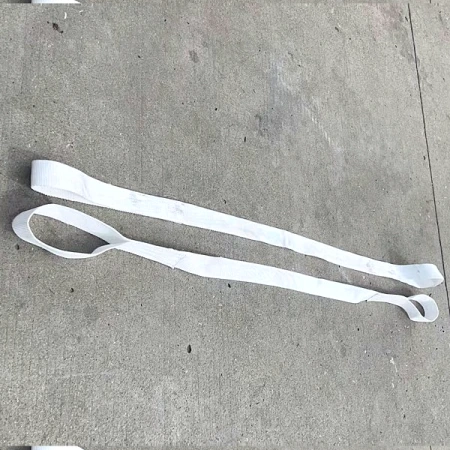
The eye form decides how the band sits on the hook, and the two common one-way forms answer different questions. De One-Way Webbing Sling is the flat band with an eye at each end; de Engangsbånd slynger det ene øje is the version made up for a specific hitch, where one end is finished to suit the fitting that will actually be used.
The range, in figures
These are the standard builds. Length is the effective working length, measured eye to eye or loop to loop, and the working load limit is the vertical figure; the arrangement tables below give the rest.
| Model | WLL, lodret | Bredde | Plies | Standard EWL | Enhedsvægt |
|---|---|---|---|---|---|
| SUW-0500 | 0.5 t | 25 mm | 1 | 0.5–6 m | ≈ 0.10 kg/m |
| SUW-1000 | 1.0 t | 35 mm | 1 | 0.5–6 m | ≈ 0.15 kg/m |
| SUW-2000 | 2.0 t | 50 mm | 2 | 0.5–6 m | ≈ 0.32 kg/m |
| SUW-3000 | 3.0 t | 75 mm | 2 | 0.5–6 m | ≈ 0.48 kg/m |
| SUW-5000 | 5.0 t | 100 mm | 2 | 0.5–6 m | ≈ 0.65 kg/m |
Standard single use white slings — nominal unit weights at mid-length
Unit weights are nominal and move with the weave and the finish; the drawing governs. Wider bands, longer lengths and mixed consignments are quoted against the load rather than picked from a list. For the two sizes bought most often, the figures are set out on the 2000KG single use lifting slings og 1000KG single use slings sider.
The arrangement decides the figure
A webbing sling does not have one capacity. It has a capacity in the vertical, another in basket, a lower one choked, and the label states each of them. The factors below are the standard mode factors for flat webbing slings: multiply the sling’s own marked WLL by the factor. Vinklen er vinklen af benet til lodret, og etiketten på artiklen tilsidesætter altid tabellen.
| Arrangement | Mode faktor | Hvad det betyder på gulvet |
|---|---|---|
| Lodret | 1.0 | Et ben, lige op. Bandet hænger og bærer. |
| Kvalt | 0.8 | The band goes round the load and back through its own eye. |
| Kurv, 0–45° | 2.0 | Bånd under belastningen, begge ender på krogen. |
| Kurv, 45–60° | 1.4 | Kurv med spredte ben; spredningsomkostningerne kapacitet. |
| To ben, 0–45° | 1.4 | To bånd til en krog, belastning delt. |
| To ben, 45–60° | 1.0 | The same pair with the legs spread. |
| Three and four legs, 0–45° | 2.1 | Not three or four times the figure — the load rarely shares evenly. |
| Three and four legs, 45–60° | 1.5 | The same arrangement spread. Re-check, do not assume. |
Mode faktor efter aftale
Two consequences matter when a white band is specified by the bale. A choked sling is weaker than the same sling used vertically, so a load that has to be choked needs a wider band rather than a longer one. Og efterhånden som benene spredes, falder kapaciteten, which is geometry rather than material: it is answered by a spreader, by a narrower angle, or by a bigger sling, og intet andet.
Where a white one-way sling is the right article
The pattern across these jobs is a load that is finished before it is lifted, and a sling that will not come back to a store where it could be re-issued.
- White goods and appliances — painted and powder-coated casings, where a dyed band can leave a mark that will not come off at the packing line.
- Papir, board and print — reels and pallets where a wet or dyed band transfers colour into the edge of the stock.
- Sten, terrazzo and white cement products — slabs and precast units judged on the face, not the arris. The technique is the same one used with a glas løftesejl: blød, wide contact and an honest edge check before the lift.
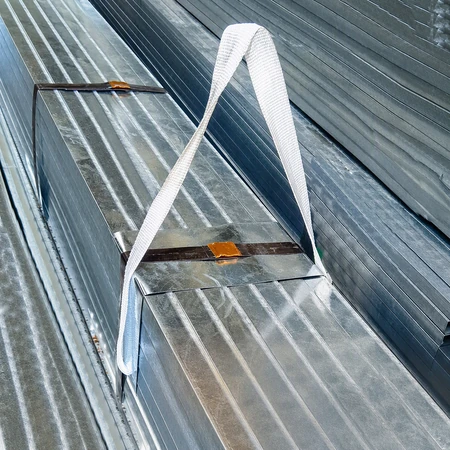
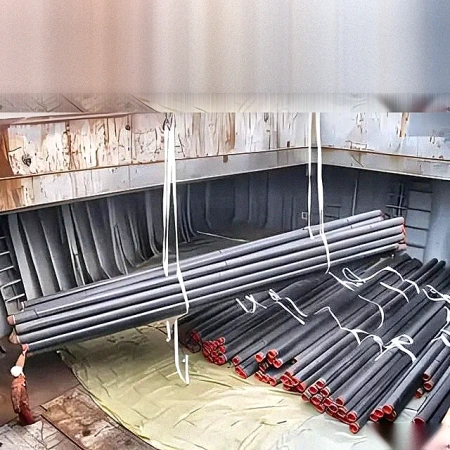
- Export pipe and tube — bands fitted before the consignment is packed, so the receiving end never has to choose one. The pre-slung form in the container photograph above is the usual build.
- Coated coil, aluminium and stainless sheet — where the surface is the product. EN polyester båndslynge in undyed white keeps the contact soft and the evidence of any contamination visible.
For a consignment that is wrapped rather than hitched, the restraint is a different article: -en last løftenet or a lashing, rated for continuous tension rather than for a lift. The two duties do not transfer, and the marking on each says which one it is.
Quantity, længde og markering: the three lines on the enquiry
One-way slings are bought by the bale and issued by the piece, so the enquiry is arithmetic before it is engineering. Give the figure per hitch, den effektive arbejdslængde, the number of lifts in the consignment, and how the bands will be identified at the far end.
- Length is EWL — pin to pin, øje til øje, loop to loop — not the cut length of the webbing. State the convention on the order, because the two differ by the length of the eyes.
- Quantity is normally 50 bands to a bale, with cartons for mixed lengths. The total weight is worth calculating at the wider end of the range: a bale of 100 mm bands is a handling exercise before it is a lifting device.
- Marking is the record. Our reference, the batch, the WLL per mode and the date go on the label and on the band; a printed QR or a serial can be added where the consignment has to be reconciled at the destination. HS kode 630790.
One inspection, and the conditions that end the band
A single-trip sling is inspected once, på tale, and that inspection is the only one that can change anything. Look at the weave where it meets the load, at the stitching or sleeving at the ends, og på etiketten. A band that fails is destroyed rather than returned to the rack, because a band that comes back will be issued again with a marking that is no longer true.
- Nedskæringer, snasker, punctures or tears in the load path — including a notch at an edge that looks superficial.
- Smeltning, forkulning eller glasering, which on polyester means the fibre has been above its working temperature and no longer has the strength the label states.
- Kemisk angreb: acid or alkali burns, or stiffness and discolouration after contact with a solvent.
- Ødelagt, worn or pulled stitching at the eye, or a distorted eye from a hook that was too small.
- A label that cannot be read. On a white band this is the whole record, so an illegible label is the same as no label.
Single use against reusable: the arithmetic
The case for a one-way band is not that it is cheap per band. It is that the costs attached to a returnable band — the return freight, the inspection register, the cleaning, the storage — disappear when the band is left with the load.
| Single use white band | Reusable band | |
|---|---|---|
| Lifts per band | En, then destroyed | Multi-year, subject to inspection |
| Inspektion | Engang, på tale | Documented periodic thorough examination |
| Return logistics | None — it travels with the load | Returfragt, cleaning, storage |
| Forurening | Can be left or cut at destination | Must be cleaned and quarantined |
| Traceability | Batch label and one recorded lift | Serial number and individual register |
| Hvor den vinder | Eksport emballage, one-off shipments, work that ends on site | Yards, hire fleets, repeated lifts |
What the word changes, og hvad det ikke gør
The engineering does not change: fiberen, vævningen, the factor and the length convention are specified exactly as they are on an article that will be used for years. What changes is the journey, and the fact that there is no second inspection to catch a band that should never have been issued.
Ofte spurgt
Is white a capacity code?
Ingen. The colour sequence runs violet 1 t, grøn 2 t, gul 3 t, grå 4 t, rød 5 t, brun 6 t, blå 8 t, orange 10 t, and white is not part of it. On a white band the working load limit is the figure on the label and on the print, og intet andet.
Why specify white rather than a coded colour?
Tre grunde: an undyed band cannot transfer colour into a light or absorbent load; it shows contamination instead of hiding it; and there is no dye lot, so repeat bales match. The cost is that nobody can read the capacity from a distance.
Is a single use white sling weaker than a reusable one?
Ingen. It is made to the same 7:1 faktor, proof tested and marked the same way. Ordet beskriver rejsen, not the grade.
Kan den bruges en anden gang, hvis den ser perfekt ud?
That is the case the discipline exists to prevent. A single lift does not visibly age a webbing band, so a second use is an uninspected article doing a job nobody rated.
What widths and lengths are standard?
25–100 mm width and 0.5–6 m effective working length, in single or two ply. Wider, longer and mixed consignments are quoted against the load and the packing.
Does white not simply look dirty?
It does, and in clean work that is useful: olie, rust bleed and cement dust appear where they would otherwise be invisible. On grit and concrete a white band looks old sooner, but the conditions that actually retire it are the same as on any other colour.
Can the band carry our own reference or logo?
Yes — printed in black on the band, with the batch and the WLL, and a QR or serial where the consignment has to be reconciled at the far end.
Hvid, ensrettet, and endless: which word answers which question?
White is the colour of the fibre, one-way is what happens after the lift, endless is the shape. A white band can be endless or eye-and-eye, and the endless form is on its own page, Engangs løftesejl endeløs løkke.
Hvor skal man hen næste gang
Related categories and pages: Engangssejl, Single-Use Lifting Slings for One-Trip Lifts, Engangsslynge, Endeløs løftesejl, Rund Slynge, Webbing slynge, Last løftenet, Løftende spredebjælke.
Kontakte
Lift Sling Rigging Co., Ltd — telefon og WeChat 18066002268, e-mail: lift98@jslift.com, Lifute Industripark, Taizhou by, Jiangsu-provinsen, Kina. HS kode 630790. Send the figure per hitch, den effektive længde, the packing and the number of lifts, og vi bekræfter bredden, the eye form and the marking before the bands are cut.