

Lift sling rigging company produce Synthetic Fiber Lifting Belt Slings,synthetic lifting belt,Syntetický zvedací popruh,Heavy-Duty Lifting Belt.
Synthetic Fiber Lifting Belt Slings
Polyester, nylon, polypropylen, aramid and UHMWPE: the fibre decides whether the sling survives the job, and the form decides how it meets the load.
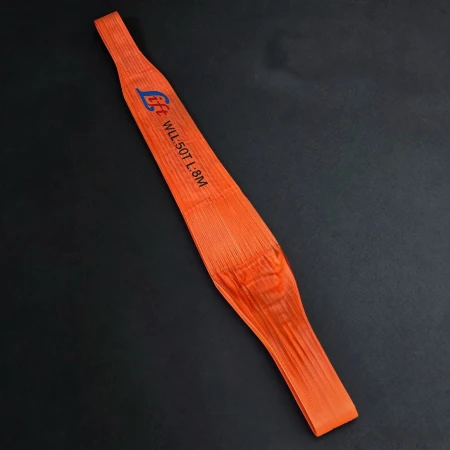
Lift Sling Rigging Company weaves the band, forms the eyes and proof-tests the sling in Taizhou. This page is about the part of the specification that decides whether a sling survives the job at all — the fibre — and about the two forms it is made into.
The two forms, from the same fibre family
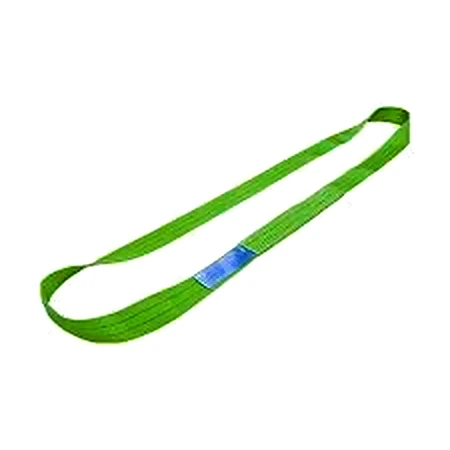
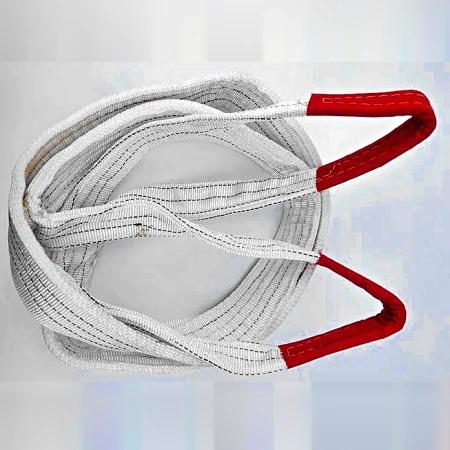
The brief calls for flat belt or round slings, and both are built from the same fibres. The form changes how the load is contacted and how the sling is handled; it does not change what the fibre can survive.
| Flat webbing belt sling | Kulatý závěs (nekonečný) | |
|---|---|---|
| Průřez | Plochý pás, 25- šířka 300 mm | Kolo, sleeved core, 30–100 mm diameter |
| Contact on the load | Widest face; the least pressure per area | Narrower line contact, but soft and compliant |
| Kde se to hodí | Finished flat surfaces, talíř, coated sheet, bagged cargo | Trubka, trubice, kroužky, anything that a flat band would crease on |
| Damage visibility | Cuts and abrasion are visible on the face | Damage hides inside the sleeve until it is severe |
| Označení | Printed along the band, easy to read | Label on the sleeve; colour on the sleeve |
| Typical rating | 0.5 – 24 t a výše, per build | 1 – 50 t a výše, per build |
The five fibres, and what each one buys
Every synthetic sling on the market is one of a handful of fibres. They differ in strength per kilo, in how far they stretch, in the temperature they tolerate and in what chemicals attack them — and the differences are large enough to decide the application.
| Vlákno | Pevnost / hmotnost | Úsek | Teplo | Chemicals and UV | Kde vyhraje |
|---|---|---|---|---|---|
| Polyester (PET) | Vysoký | Nízký | -40 až +100 °C | Good against acids; UV stable | Výchozí: obecné zvedání, coated and painted work, colour-coded bands |
| Nylon (PA) | Vysoký | Vysoký (absorbs shock) | Lower at the top end than polyester | Napaden kyselinami; moderate UV | Shock loads, hrubé zacházení, cargo that must settle into the sling |
| Polypropylen (PP) | Mírný | Mírný | The lowest of the family | Excellent against most chemicals and alkalis; plave | Wet docks, chemický závod, light duty, cost-sensitive work |
| Aramid | Velmi vysoká | Velmi nízké | 200 °C nepřetržitě, 400 vrchol °C | Poor UV; moderate chemicals | Horká práce, foundry and steel plant, anything near heat |
| UHMWPE | The highest per kilo | Velmi nízké | Low — heat is its weakness | Good chemicals; poor at high temperature | Maximum strength for minimum weight, long heavy lifts |
Heat figures are the ones we publish for the aramid webbing; for the other fibres the limit depends on the build, and the label states what the article was rated to.
Two of these rows are worth reading twice. Aramid is the only fibre on the list that will stand in front of hot work — our aramid webbing is rated 200 °C continuous and 400 °C peak with an LOI of 28 or above — but it is also the weakest of the five in sunlight. UHMWPE gives the most strength for the least weight, and then fails earlier than polyester as the temperature climbs. Neither is a general-purpose substitute for the other.
Why the soft face is the whole point
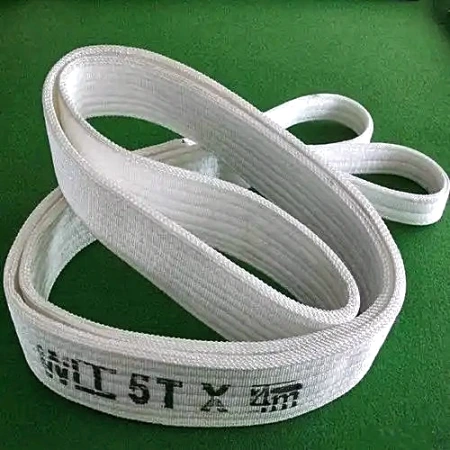
The reason a synthetic sling replaces a wire rope is geometry rather than strength. A 50 mm band and a 10 mm rope carrying the same 5 t present the same force over five times different a contact area — the band presses on the load at roughly a fifth of the pressure, and it does it with a woven surface instead of a steel one.
- Vymalováno, pokovené, coated and polished surfaces arrive at the other end as they left;
- Bagged and boxed cargo is not cut through at the sling line;
- No broken wires to catch a hand, no meat hooks, no kinking — the sling folds away;
- A band of the same rating weighs a fraction of the rope and can be carried by one person.
Matching the fibre to the environment
The tonnage is the easy part. What removes a synthetic sling from service is the environment, and the fibre is the only defence against it.
| životní prostředí | Fibre to specify | Proč |
|---|---|---|
| General workshop, painted or machined work | Polyester | Nízká průtažnost, UV stable, the widest availability |
| Loads that land or swing | Nylon | Stretch absorbs the shock instead of passing it to the hook |
| Quay, wet dock, chemický závod | Polypropylen | Indifferent to water and to most chemicals; it floats |
| Next to heat, slag or hot plate | Aramid | The only fibre rated for continuous heat in this family |
| Maximum load for minimum weight | UHMWPE | Highest strength per kilo; accept the lower heat ceiling |
| Outdoor storage, long term | Polyester | The most UV-stable of the five |
| Mixed or unknown duty | Polyester | The safest default; specify up when the duty is known |
Rating is per hitch, and the label wins
No synthetic sling has a single capacity. The marked working load limit applies to the arrangement it is used in, and the arrangement is what changes on the floor.
| Uspořádání | Faktor | Co to znamená |
|---|---|---|
| Vertikální | 1.0 | Jedna noha, straight up — the marked figure |
| Přidušený | 0.8 | Zaoblete náklad a zpět vlastním okem |
| Košík, 0–45° | 2.0 | Pás pod zátěží, nohy blízko svislé polohy |
| Košík, 45–60° | 1.4 | Same basket, legs spread — the spread costs capacity |
| Dvě nohy, 0–45° | 1.4 | A matched pair to one hook |
| Dvě nohy, 45–60° | 1.0 | The pair with the legs spread |
| Tři nebo čtyři nohy, 0–45° | 2.1 | Not three or four times the figure; the load rarely shares evenly |
| Tři nebo čtyři nohy, 45–60° | 1.5 | The same arrangement, spread |
The angle is measured from the vertical. The label on the sling overrides this table wherever the two disagree.
What a given width carries
Width is the other half of the specification: it sets the pressure on the load and the figure the band can be marked at. The ladder below is the one we publish for the standard build, so a quotation can be read against it.
| Limit pracovní zátěže | Šířka pásu | Usual ply | Typical end |
|---|---|---|---|
| 1 t | 30 mm | Singl | Flat loop or folded eye |
| 2 t | 60 mm | Singl | Flat loop or folded eye |
| 3 t | 90 mm | Singl | Folded eye |
| 4 t | 120 mm | Two-ply | Folded or reinforced eye |
| 5 t | 150 mm | Two-ply | Folded or reinforced eye |
| 6 t | 180 mm | Two-ply | Vyztužené oko |
| 8 t | 240 mm | Two-ply | Vyztužené oko |
| 10 t | 300 mm | Four-ply | Vyztužené oko |
Read it with the mode factors above and a lift resolves quickly. A 6 t band in a vertical hitch is a 180 mm polyester belt with a reinforced eye. To samé 6 t in a choke is not: a 0.8 factor takes the capacity to 4.8 t, so the next size up carries it. Move the same job beside a furnace and the width stays but the fibre changes — aramid — because polyester would be the wrong answer however wide it is.
Where a synthetic sling must not go
Honesty here saves a load. The same softness that protects the cargo is what limits the article, and three conditions end it quickly:
- Ostré hrany a otřepy. A cut band starts as a notch. Either the band is sleeved at the works, or the corner carries a pad — and the sleeve has to be ordered with the sling, because it cannot be retro-fitted to a woven band.
- Heat beyond the fibre. Standard synthetic webbing fails by melting, ne slušnou deformací. Above the working limit the answer is aramid, a heat sleeve, or a chain.
- Chemicals the fibre cannot take. Acids attack nylon; strong alkalis and some solvents attack polyester. Where the load is wet with something aggressive, the fibre is chosen for that chemical, not for the tonnage.
How the sling is built and marked
- The band is woven from high-tenacity fibre to the specified width, then cut and formed into eyes or a loop; multi-ply builds layer two or more bands for heavier working limits.
- Eyes are folded and double-stitched in a pattern that puts the thread in shear; reinforced eyes add a wear layer where the hook sits.
- Each sling is proof loaded before dispatch and fitted with a label carrying the working load limit, délka, the fibre and the batch.
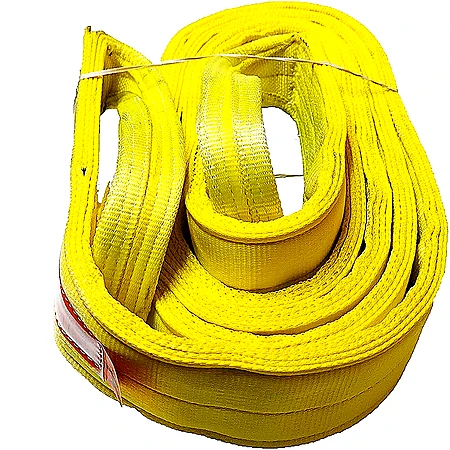
- The band itself can be printed — WLL, délka, fleet number and your own brand — and the colour follows the market convention: 1 t fialová, 2 t zelená, 3 t žlutá, 4 t šedá, 5 t červená, 6 t hnědé, 8 t modrá, 10 t oranžová. The colour is a quick check; the label is the answer.
Kontrola a odchod do důchodu
- Read the label before the lift and confirm the sling is rated for the arrangement in use;
- Check the whole band for cuts, zádrhely, propíchnutí, oděru, heat glazing and chemical staining — an acid or caustic burn is a retirement, not a stain;
- Check the eyes and the stitching most carefully: broken or worn stitching retires the sling;
- Check for distortion of the eyes or fittings after an overload;
- Skladujte čisté a suché, mimo sluneční světlo, a vést záznam s popruhem.
Často kladený dotaz
Which fibre should I take for a general workshop?
Polyester, unless the duty says otherwise: it stretches little, tolerates UV far better than aramid or UHMWPE, and is available in every width and rating. Move to another fibre only when a specific condition — shock, teplo, chemikálie, weight — rules polyester out.
Aramid or UHMWPE for a hot application?
Aramid. It is rated 200 °C continuous and 400 vrchol °C; UHMWPE has the lowest heat ceiling of the family, so it is the wrong answer next to hot work however strong it is.
Can a round sling replace a flat belt sling?
On pipe, trubice, rings and anything that a flat band would crease on, yes — and it is often kinder. On flat finished surfaces the belt gives the wider contact. Both are made from the same fibres, so choose the form by the load’s shape, ne podle tonáže.
Does the colour tell me the fibre?
Žádný. Colour codes the working load limit by convention, not the material — a yellow sling is 3 t whether it is polyester or nylon. The fibre is on the label.
Why does my nylon sling stretch so much?
Because nylon stretches further before it parts, which is exactly why it is chosen for shock loads: the stretch absorbs the jolt instead of passing it into the hook and the crane. Where a level load matters more than shock, polyester is the better fibre.
Can these slings be used outdoors?
Polyester and polypropylene yes, with normal care; aramid and UHMWPE degrade in prolonged sunlight, so they are stored out of it. In every case, inspect for condition rather than against a calendar.
Vyžádejte si cenovou nabídku
Pošlete povinnost, nejen tonáže
The load — what it is, what its surface is worth, and how it will be hitched;
The figure — working load limit needed, and the arrangement it will be used in;
The environment — heat, chemikálie, voda, sluneční světlo, oděru, ostré hrany;
The form — flat belt or round sling, and the end type: flat loop, folded or reinforced eye;
The marking — WLL, délka, fleet number and your own brand if you need them printed.
Kam dál
- The webbing sling range — widths, ends and mode factors in detail;
- Multi-ply webbing slings a single-ply eye-eye slings;
- Aramid flame-retardant webbing for hot work;
- Kulaté popruhy where the load suits a round, soft cross-section;
- Nekonečné zvedací popruhy a the flat webbing sling factory;
- Vaky na drátěná lana where a hard, cut-resistant sling is the right answer, a contact.