

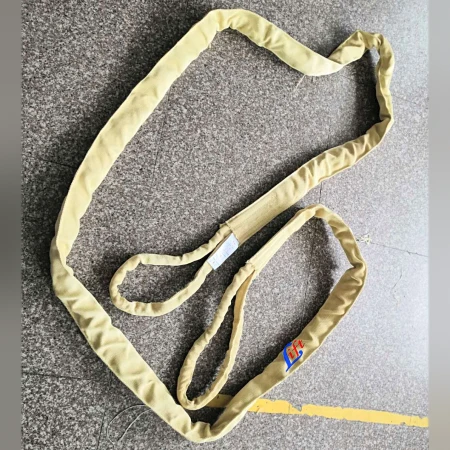
Lift sling rigging company produce Heavy-Duty Para-Aramid Endless Round Sling,Aramid Endless Round Sling,Aramid Fiber Fireproof Endless Type Round Sling for Lifting,Fireproof Round Sling.
Round sling · Heavy lift · Hot work
Heavy-Duty Para-Aramid Endless Round Sling
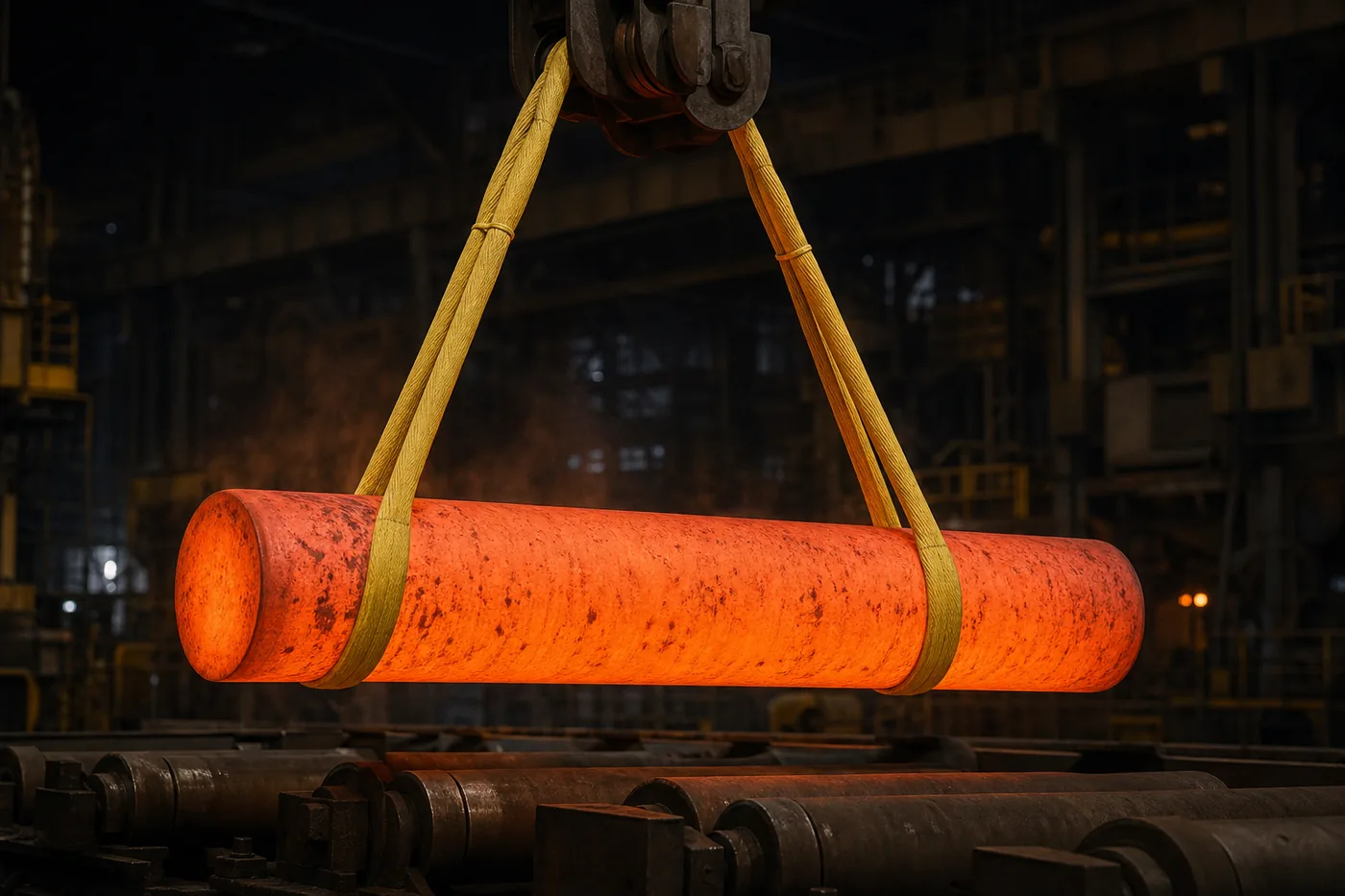
Some lifts are heavy. Some are hot. The ones that are both are the reason this sling exists.
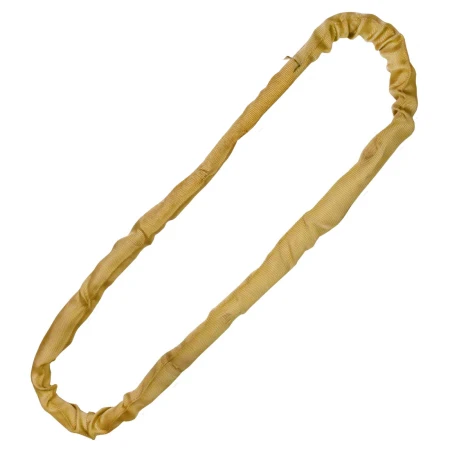
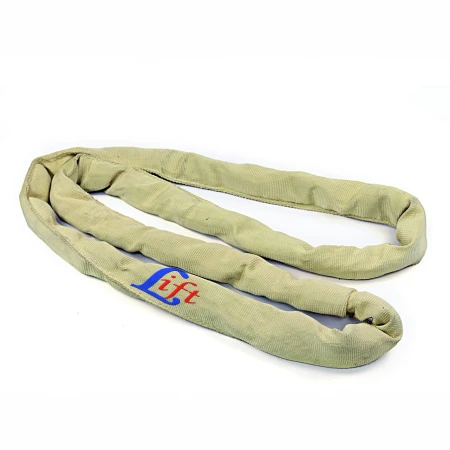
A heavy-duty para-aramid endless round sling carries a parallel core of para-aramid filament — about twice the tensile strength of high-tenacity polyester, weight for weight — inside a woven sleeve, closed into an endless loop with no ends, no stitching and no metal fittings. It has no melting point, it does not drip, and it holds its working length while the load is still at 300 °C.
It is not the right sling for every job, and this page is written to help you decide rather than to sell it to you. Below 10 t and below 80 °C, a polyester round sling does the same work for less money. Above that — hot rolls, die blocks, castings straight from the mould, preheated fabrications — the specification changes, and so does the fibre.
What the Three Figures Actually Mean
Most data sheets list these numbers side by side without saying how they interact. They are not three independent selling points; they are one specification, and each one is limited by the others.
2× — strength, ne kapacita
Weight for weight, the para-aramid core is roughly twice as strong as high-tenacity polyester. In a finished sling that shows up as a smaller core for the same working load limit: a slimmer body in the hook, a lighter sling in the hand, and more capacity inside a sleeve diameter that still fits the lifting point. It does not mean the sling is rated at twice the load of a polyester sling of the same label — the label is set by the construction and the 7:1 factor. It means you get the same rating from less fibre.
300 °C — continuous contact, not shop air
This is the temperature at the interface between the sleeve and the load during a normal lift, held for the duration of that lift. It is not the ambient temperature of the building, and it is not the temperature of the far side of the workpiece. A sling rated at 300 °C can sit against a 300 °C surface; it cannot sit in a 300 °C furnace atmosphere for an hour and be expected to behave the same way.
500 °C — an excursion, and time is the variable
A short exposure up to about 500 °C — a roll that is still cooling, a die just opened, a casting moved before it equalises — is within the construction’s capability. What consumes a sling is not the peak figure but the time spent at it. Two seconds at 500 °C and two minutes at 500 °C are different events. Quote the temperature and the dwell time together, and we will confirm the construction against both.
Where the Strength Sits — and Why the Sleeve Works Harder Here
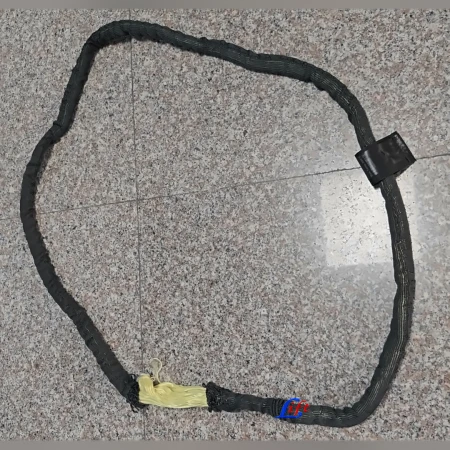
The load path is a dense bundle of parallel para-aramid filament running the full circumference of the loop. The woven sleeve carries no load at all. Its job is to take everything the core cannot: oděru, sunlight, the sharp corner, the hot spot, the drag across a concrete floor.
On a heavy-duty sling that division of labour becomes more pronounced. A 50 t core is a substantial bundle, and the sleeve has to be built to match it — a heavier weave, usually double-layer on the large sizes, with wear pads where the body will bear on the load. The sleeve is also the part you can see, which makes it the part you inspect. A worn sleeve on a polyester sling is an abrasion problem. On an aramid sling it is an abrasion and a UV problem at the same time, because the fibre is weak against both and the sleeve is the only thing standing between the core and either of them.
If your priority is the lightest possible rigging rather than heat, a Dyneema round sling is the better starting point. If the heat is radiant and the load is modest, a high-temperature round sling range covers the sleeve combinations built for that duty.
Specification Range
| Produkt | Heavy-duty para-aramid endless round sling (aramid / Kevlar-class core) |
|---|---|
| Construction | Continuous parallel filament core inside a woven tubular sleeve, closed into an endless loop — no ends, žádné šití v dráze zatížení |
| Core | Para-aramid (Aramid 1414 / Kevlar-class) high-modulus filament, parallel lay |
| Sleeve | Woven aramid sleeve; double-layer and wear-pad options for heavy-duty service |
| Limit pracovní zátěže | 1–100 t. Heavy-duty sizes from 10 t: 10 · 12 · 15 · 20 · 25 · 30 · 40 · 50 · 60 · 80 · 100 t |
| Bezpečnostní faktor | 7:1 jako standard (V 1492-2 practice); other factors to order |
| Prodloužení při přetržení | Přibl. 3–4 % — far lower than polyester under the same load |
| Creep | Very low under a sustained static load; holds its working length |
| Continuous working temperature | Přibl. 300 °C at the sling/load interface |
| Short excursion | Up to approx. 500 °C, brief exposure only |
| Melting point | None — the fibre chars and decomposes instead of melting |
| Cut resistance | High at fibre level; the sleeve still needs edge protection against sheared and machined edges |
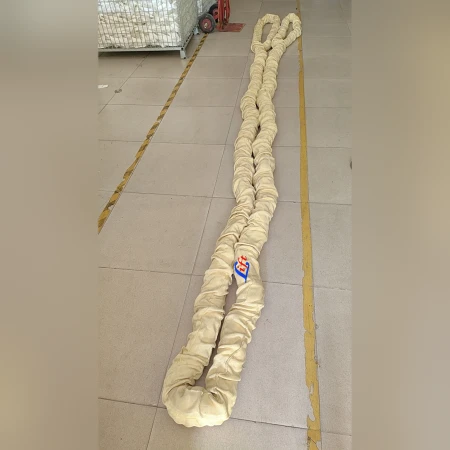
| Effective working length | 0.5–20 m standard; longer to order |
| Barva | Natural golden / khaki; other sleeve colours to order |
| Označení | Sewn label with working load limit, length and batch; printed sleeve marking optional |
| Balení | Coil in a poly bag or carry bag, labelled carton, custom export packing |
| MOQ & OEM | Low MOQ for trial orders; full OEM on capacity, délka, sleeve, rozložení a balení štítků |
Capacity at the Heavy End
The figure on the label is the vertical rating. Every other arrangement is that figure multiplied by a mode factor — and at heavy capacities the difference between arrangements is measured in tens of tonnes, not kilos.
| WLL vertical | Choked ×0.8 | Basket 0–7° ×2.0 | Basket 7–45° ×1.4 | Basket 45–60° ×1.0 |
|---|---|---|---|---|
| 10 t | 8.0 t | 20.0 t | 14.0 t | 10.0 t |
| 12 t | 9.6 t | 24.0 t | 16.8 t | 12.0 t |
| 15 t | 12.0 t | 30.0 t | 21.0 t | 15.0 t |
| 20 t | 16.0 t | 40.0 t | 28.0 t | 20.0 t |
| 25 t | 20.0 t | 50.0 t | 35.0 t | 25.0 t |
| 30 t | 24.0 t | 60.0 t | 42.0 t | 30.0 t |
| 40 t | 32.0 t | 80.0 t | 56.0 t | 40.0 t |
| 50 t | 40.0 t | 100.0 t | 70.0 t | 50.0 t |
| 100 t | 80.0 t | 200.0 t | 140.0 t | 100.0 t |
At 45–60° a basket gives you no more than a vertical lift. On a 40 t sling that is the difference between picking 80 t and picking 40 t from the same sling, and it is the most common rigging error on heavy lifts.
Reading the Temperature Rating on the Job
Five things decide whether a 300 °C sling behaves like a 300 °C sling on your floor:
- Contact or radiant. A sleeve resting on a hot surface is a different problem from a sling hanging beside one. Radiant heat is uneven and the part facing the source takes it all.
- Dwell time. The rating assumes a lift, not a soak. A sling left hooked to a hot load through a shift is accumulating damage even if the load is below the figure.
- Contact pressure. The same temperature under a choked load on a narrow edge is harsher than the same temperature in a wide basket. Pressure and heat together age aramid faster than either alone.
- The sleeve is the gauge. Glazing, stiffness, a brownish cast or a burnt smell means the sleeve has already absorbed heat. It is doing its job — but it is also telling you how much of it has been used.
- Cool-down. Do not quench a hot sling. Let it cool in air, off the load, and inspect it before it goes back into service.
One further point in the sling’s favour: because both the core and the sleeve sit between the hot surface and the workpiece, the sling also insulates the load. A painted, coated or machined surface is less likely to be marked than it would be by chain or bare wire.
Para-Aramid Against High-Tenacity Polyester
The honest comparison, because the price difference is real and only some of these rows will matter to your lift.
| Property | Para-aramid core | High-tenacity polyester core |
|---|---|---|
| Tensile strength, weight for weight | Přibl. 2× polyester | Baseline |
| Continuous working temperature | Přibl. 300 °C | Přibl. 80–100 °C |
| Behaviour at high temperature | No melting point; chars near 500 °C | Softens, then melts around 250–260 °C |
| Cut resistance | High | Moderate |
| Creep under standing load | Very low | Low to moderate |
| Stretch under load | Very low — approx. 3–4 % at break | Higher |
| Abrasion resistance | Poor at fibre level — the sleeve carries it | Good |
| UV resistance | Poor — the sleeve shields the core | Good |
| Relative cost | Higher | Lower |
| Specify it when | Heat, cut risk, standing loads, heavy hot work | General lifting at ambient temperature |
The two are not interchangeable in either direction. A polyester sling is the correct, cheaper answer to a cold lift. An aramid sling is the answer when the polyester sling has been refused — and paying for aramid on a cold job buys nothing but a lighter invoice for the same lift. The wider aramid round sling range covers the standard-duty sizes if heat is the only requirement.
Selecting the Sling: Three Questions, in Order
- What is the load, and how will it be rigged? Start with the weight and the configuration, apply the mode factor, then choose the capacity — not the other way round. If the pick-up points are fixed and the geometry repeats, a round sling with eyes gives you a defined length; if the load is awkward and every lift differs, the endless loop is the more useful form.
- How hot is it, and for how long? Give the surface temperature, the dwell time and whether the heat is contact or radiant. This is the answer that decides aramid, and it is the one most often left out of an enquiry.
- What is the surface like? Sheared plate, burred edges and abrasive castings attack the sleeve. If the load can cut, budget for edge protectors and inspect the sleeve every lift — the fibre will resist the cut, the sleeve will not resist it forever.
If the lift is long as well as heavy, the sling angle and the spreader arrangement usually matter more than the sling itself. Our lifting beams and spreader beams are built for exactly that combination.
What Fails First — and What to Look At
On a heavy aramid sling the failure order is predictable, and it is not the core.
- The sleeve on the bearing line. Where the body wraps a corner or bears in a basket, the weave compacts and wears first. Check the whole bearing length, not just the visible side.
- Heat glazing and stiffness. A sleeve that has gone stiff, shiny or brown has been hotter than it should have been. Retire it before the next hot lift, not at the next service.
- Core discolouration. Where the sleeve allows a view of the core, a dull or brownish cast is damage. Aramid does not fade; it degrades.
- Cuts and holes in the sleeve. On this sling a torn sleeve exposes the core to both abrasion and UV at once — the two things the fibre tolerates least.
- Štítek. If the working load limit and the batch cannot be read, the sling cannot be verified. That alone takes it out of service.
Where This Sling Is Specified
Foundries and steel mills, where the ambient heat alone rules out polyester. Rolling mills and forge shops, lifting hot rolls, blooms and die blocks in a basket. Die-casting and injection moulding, where a mould is moved while it is still at temperature. Glass works and kilns, where a hot product has to be moved without being marked. Preheated fabrications and heat-treatment racks, where the sling stays rigged while the load cools. Heavy plant maintenance, where a hot component has to come out before it has had time to equalise.
Často kladené otázky
Is a para-aramid round sling really twice as strong as high-tenacity polyester?
At fibre level, yes — weight for weight, para-aramid filament is roughly twice as strong as high-tenacity polyester. In a finished sling that becomes a smaller core for the same working load limit, a slimmer body in the hook and more capacity inside the same sleeve diameter. The finished sling is rated at 7:1, so the label figure — not the fibre figure — is what governs the lift.
Can it work continuously at 300 °C, and what does the 500 °C figure mean?
About 300 °C is the continuous working contact temperature at the sling-to-load interface. 500 °C is a short excursion — a brief exposure such as a cooling roll or a freshly opened die — and not a continuous duty point. Dwell time, contact pressure and the condition of the sleeve all reduce the usable figure, so the temperature and the time at temperature should be quoted together.
Will it resist cuts from steel plate and machined edges?
Para-aramid has high cut resistance at fibre level, which is one of the reasons it is specified where polyester has been cut through. The sleeve is still the first line of defence, and a sheared, burred or machined edge will damage it. Use edge protectors on any edge that can cut, and inspect the sleeve after every lift on that kind of load.
Does it stretch or creep under a standing load?
Elongation at break is roughly 3–4 %, far lower than polyester, and creep under a sustained static load is very low. That is what makes it suitable for lifts that stay rigged for hours or days rather than for a single pick. It is not a rigid sling, and it is not a substitute for a certified below-the-hook device where the lift requires one.
Can I get a heavy-duty specification with custom length and marking?
Ano. Capacities run from 1 t to 100 t including intermediate steps, with the heavy-duty range from 10 t. Effective working length, sleeve construction, wear pads, barva, label layout and packing are all made to order. Tell us the load, the configuration, the temperature and the dwell time and we will confirm the construction before the order.
Send the Load, the Temperature and the Dwell Time
That is enough for us to specify the core, the sleeve and the length, and to confirm what can be certified for the construction. Samples and batch test figures available before volume production.
Související produkty